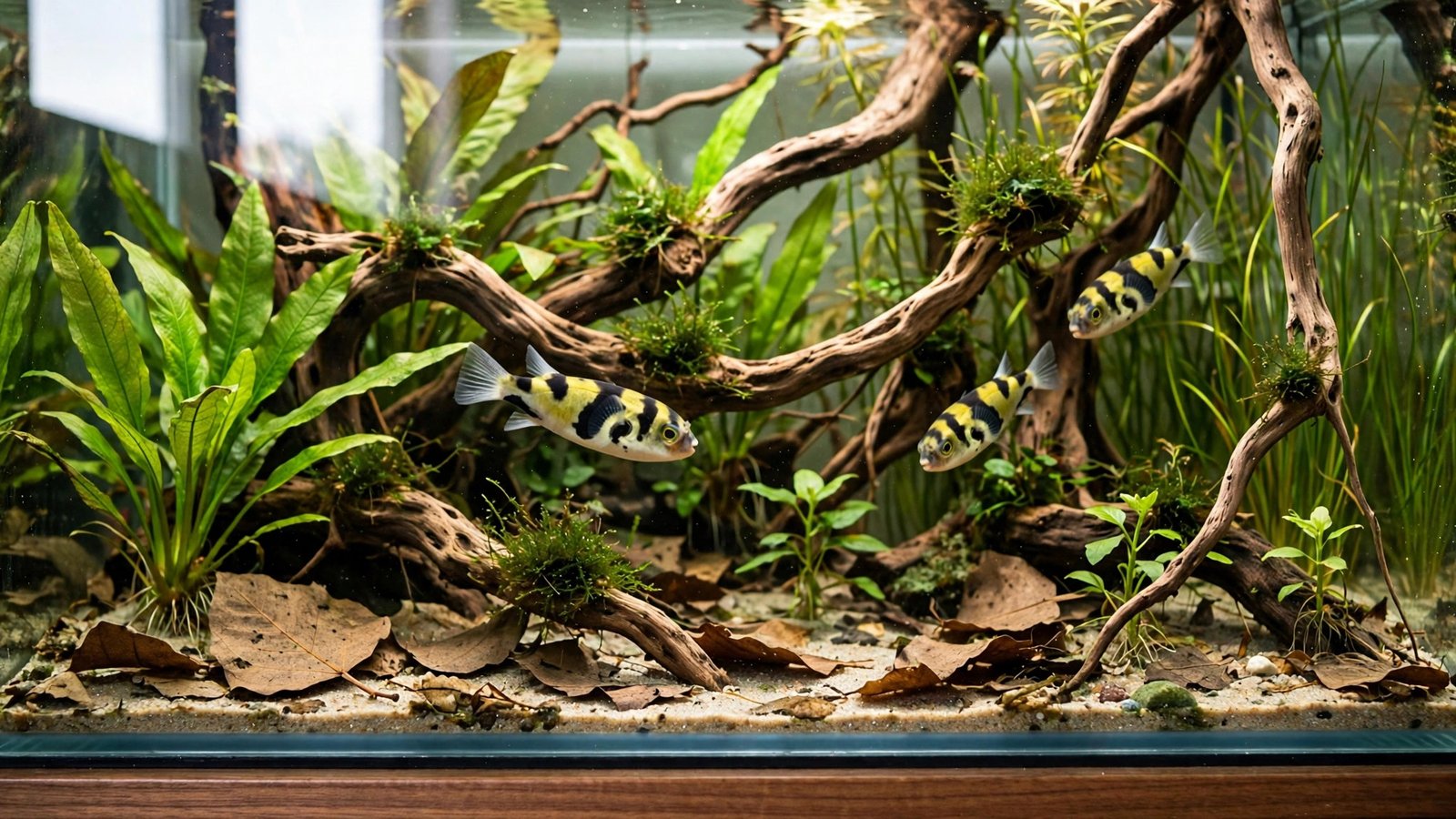
Most puffers are beautiful little thugs you keep alone — which is why the Amazon puffer stops aquarists mid-sentence. Colomesus asellus can live in a group, in a planted tank, without declaring war on everything that moves. An amazon puffer planted tank is one of the hobby's most rewarding setups — if you honor the beak-trimming diet most guides gloss over.
Amazon Puffer Planted Tank: The Complete Setup Guide
Amazon puffers earn their "nice puffer" nickname honestly. Unlike pea puffers — tiny freshwater terrors best kept as a species-only showcase (see how a pea puffer tank differs from this group setup) — Colomesus asellus is a genuine shoaling species from South American river basins. In a group of six or more, nipping pressure spreads across the shoal instead of landing on one victim.
Don't confuse them with the other extreme either. Fahaka and Mbu puffers grow to dinner-plate size and shred plants for sport. The Amazon puffer tops out around 3–5 inches, prefers snails to your stem plants, and is one of the very few puffers that suits a planted community.
Hardware and water
| Item | Spec |
|---|---|
| Tank | 30 gal minimum; a 40 gal breeder gives the best footprint for 6–8 puffers |
| Lid | Tight-fitting — Amazon puffers spook easily and jump harder than they look |
| Filtration | Canister or HOB rated 6–10× turnover |
| Substrate | Fine sand or smooth gravel |
| Water | 74–80°F, pH 6.8–7.8, ammonia and nitrite at zero, nitrate under 20 ppm |
Fishless-cycle fully before the puffers arrive. They are sensitive to ammonia spikes, and one stressed fish getting picked on during a cycle wobble ruins the group dynamic from day one.
Planting for a Nippy Fish: Sight-Line Breaks Matter Most
Amazon puffers are curious, not destructive. They mouth-test every leaf, decide most of it isn't food, and move on — so choose tough plants that shrug off inspection. The dense-cover picks in the aquarium plants for fish tank guide all work in puffer setups.
| Plant | Why it works | Placement |
|---|---|---|
| Java fern | Bitter rhizome leaves puffers investigate once and ignore | Driftwood, midground |
| Anubias (barteri, nana) | Tough leaves that survive taste-testing | Wood and rocks |
| Hornwort / guppy grass | Cheap fast growers; nibbled tips regrow in days | Background thickets |
| Vallisneria | Tall curtains that divide the tank into visual zones | Back glass |
| Amazon sword | Broad leaves for shade and shoal resting spots | Background focal points |
The layout goal is a jungle, not a sculpture. Cluster plants into islands with swimming lanes between them, and make sure no fish can see the full length of the tank from any spot — each broken sight line is one fewer chase. Many keepers follow a jungle-style planted build almost verbatim, with puffer-proof plant choices.
The Beak-Trimming Diet (the Real Commitment)
A puffer's beak grows continuously, like a rodent's teeth. In the wild, crunching snail shells wears it down. In a tank fed only bloodworms and brine shrimp, the beak overgrows within months until the fish can't close its mouth — and then you're hand-trimming under sedation, a procedure most owners should never learn.
The fix is simple: snails, regularly. Pond snails, ramshorns, trumpet snails — the "pest" snails hobbyists give away free. Six puffers usually clear roughly 30–50 ramshorns in a week or two, so keep a separate 5-gallon snail breeding jar (lettuce, algae wafers, airstone). A weekly handful dropped in the tank is the best enrichment you can offer.
Round out the diet with frozen bloodworms, mysis shrimp, and krill two to three times a week. If the upper and lower beak ever stop meeting cleanly, run a snail-heavy week — caught early, diet corrects mild overgrowth alone.
Group Dynamics and Tank Mates
Six is the magic number, and more is mellower. In a group of 3–4, one individual usually becomes the target; at 6+, social pressure diffuses into genuine shoaling — the group patrolling together, sleeping piled in the plants at night.
Amazon puffers are nippy, not predatory. Fast tank mates with short fins get ignored; slow, long-finned fish get their tails sampled:
| Good companions | Bad companions |
|---|---|
| Fast tetras (black skirt, bleeding heart) | Bettas and guppies (long flowing fins) |
| Corydoras (bottom, armored, quick) | Slow angelfish (tempting fins) |
| Otocinclus (small, fast, uninteresting) | Cherry shrimp colonies (expensive puffer snacks) |
Stock the dither fish first and let them settle for two weeks, then add the puffers. Established tank mates get nipped far less than new arrivals dropped in alongside them.
Maintenance Rhythm
Amazon puffers are messy eaters — crushed shells and half-eaten krill collect in the substrate fast. A weekly 30% water change with a gravel vacuum through the swimming lanes keeps nitrates down; rinse the pre-filter sponge every other week. Test weekly for the first two months, then monthly.
Watch the group at feeding time. A puffer that hangs back from the snail drop is your early warning — check its beak, check for bullying, and be ready to separate it for a week. Keep the lid latched: on the lid-versus-open-top decision, a tight lid is non-negotiable for known jumpers.
Frequently Asked Questions
Can Amazon puffers live alone?
They can survive alone but do worse — lone Amazon puffers nip tank mates more and stress-surf the glass. This species evolved to shoal; the group dynamic is what makes them the "nice puffer." With room for only one puffer, a pea puffer species tank is the better choice.
How often do Amazon puffers need their beaks trimmed?
With weekly hard-shelled snails, most never need manual trimming — the shells do the work. Without snails, expect visible overgrowth within 2–4 months, needing a trim every 4–8 weeks under clove-oil sedation. A snail breeding jar is far easier than learning puffer dentistry, so treat snails as a staple.
Will Amazon puffers eat my plants?
Generally no — they mouth-test leaves out of curiosity but rarely cause real damage, especially to tough rhizome plants like Java fern and anubias. Soft, expensive tissue-culture stems may get shredded by an enthusiastic individual. Stick to the hardy plant list here and keep fast growers as sacrificial buffers.
Are Amazon puffers aggressive?
They're nippy rather than aggressive — closer to tiger barbs than cichlids. Groups of 6+ with dense planting and sensible tank mates stay genuinely peaceful; small groups, sparse tanks, and slow long-finned companions cause nearly every "aggressive Amazon puffer" story.
What tank size do Amazon puffers need?
30 gallons is the minimum for a group of six, but a 40-gallon breeder is the sweet spot — its wide footprint gives the shoal room to patrol and lets you build the plant islands that keep the peace. Smaller tanks concentrate nipping and make water quality harder to manage.
Can I keep snails with Amazon puffers as a cleanup crew?
Not as a permanent crew — the puffers will hunt and eat them, which is exactly the point. Treat snails as a food source, not tank mates. For actual algae cleanup, otocinclus and fast-growing plants do the job. A separate snail breeding jar keeps the food supply free.
The Amazon puffer is the rare puffer that rewards you for doing the social thing: a lively shoal weaving through dense plants, hunting snails with obvious glee. Give them the group, the snails, and the jungle, and the "nice puffer" nickname will make sense within a week. For wild habitat data, the Seriously Fish Colomesus asellus profile is worth bookmarking.