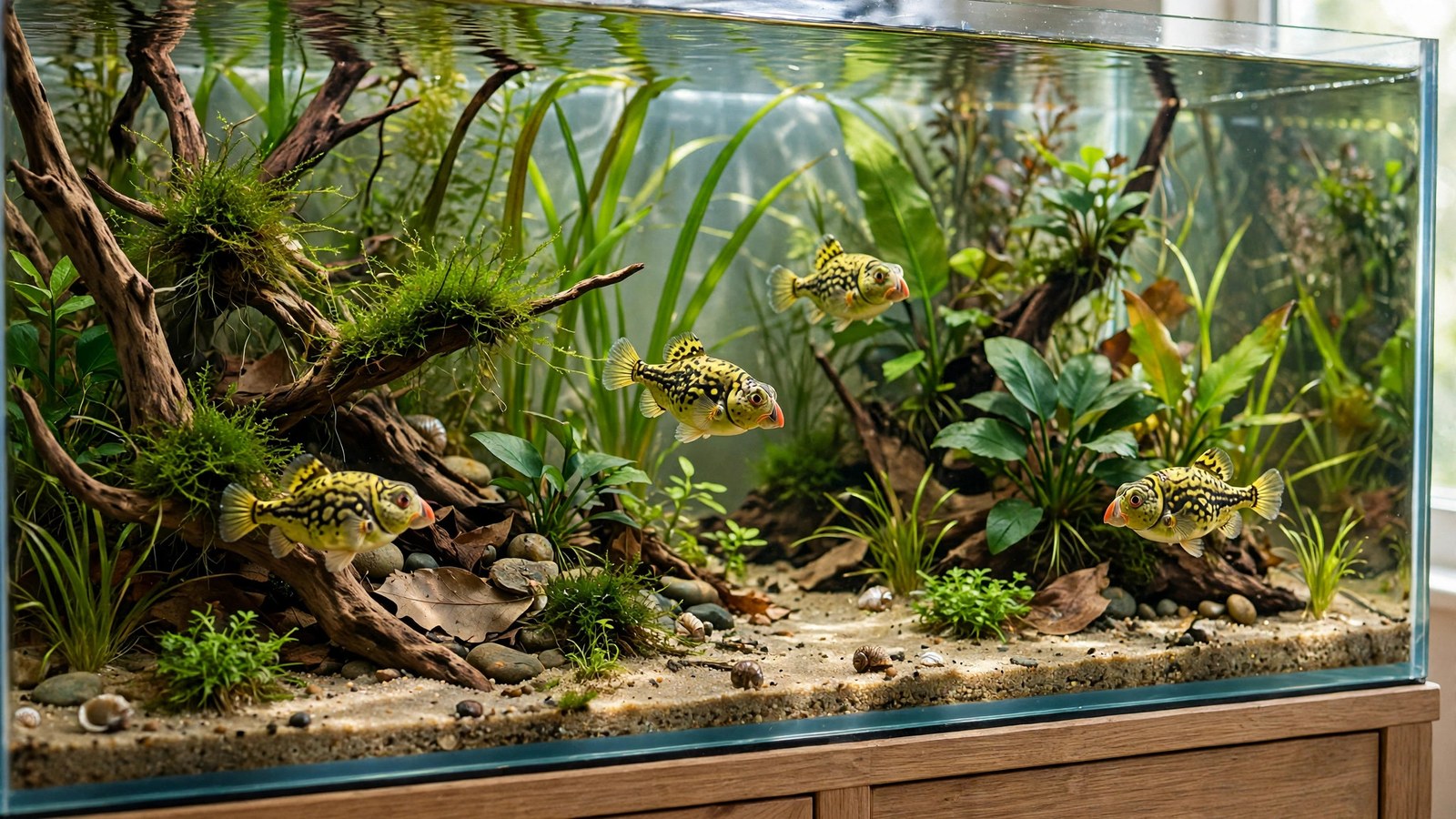
Most figure 8 puffers sold as freshwater fish die young — not from disease, but from living in the wrong water. Tetraodon biocellatus is a low-end brackish fish from Southeast Asian estuaries, and it stays healthy for years only at low salinity. The good news: at a specific gravity of 1.004–1.005, salt-tolerant plants still thrive, so a planted brackish tank – the setup this fish evolved for – is not a compromise.
Short answer: A figure 8 puffer cannot live in freshwater long-term — it is a brackish fish that needs specific gravity 1.002–1.008, ideally 1.004–1.005. Mix marine salt (never aquarium salt) into dechlorinated water, measured with a refractometer – hydrometers fail at low salinity. At SG 1.004–1.005, hardy plants like java fern, anubias, vallisneria, and Cryptocoryne ciliata grow normally. House one puffer in 20–30 gallons at 75–80°F and pH 7.5–8.3.
Why the figure 8 puffer is not a freshwater fish
Fish shops hold figure 8 puffers in freshwater — a retail holding pattern, not a care recommendation. In the wild, Tetraodon biocellatus lives in Southeast Asian estuaries and mangrove creeks. Kept permanently in freshwater, these puffers survive but rarely thrive: weaker immunity, more illness, years shaved off their lifespan.
Low-end brackish water changes everything. At SG 1.004–1.005, figure 8 puffers are active, curious, and long-lived — and this salinity is so low that salt-tolerant plants barely notice it. That is the whole trick: the sweet spot where fish and plants both win. Read a detailed figure 8 puffer caresheet for the full background, then choose plants that suit your setup at this salinity instead of forcing freshwater species into salt.
Mixing brackish water: marine salt, refractometer, bucket
Two rules. First: marine salt mix, not aquarium salt — aquarium salt is just sodium chloride, while marine salt carries the minerals and buffers brackish water needs. Second: a refractometer, not a swing-arm hydrometer, which is too inaccurate at low specific gravity.
Mix in a bucket, never the tank — dechlorinated water, salt added gradually, stirred until dissolved, reading confirmed. Shift salinity by no more than 0.002 SG per water change; bacteria and plants need time to adjust.
| Parameter | Target | Notes |
|---|---|---|
| Specific gravity | 1.004–1.005 | Range 1.002–1.008; hold low for plants |
| Temperature | 75–80°F (24–27°C) | Stability beats the exact value |
| pH | 7.5–8.3 | Marine salt buffers this |
| dGH | 8–12 | Hard, alkaline – the estuary norm |
| Ammonia / nitrite | 0 ppm | Sensitive fish; messy eating spikes waste |
| Nitrate | Under 20 ppm | Kept in check by weekly water changes |
| Water changes | 30–50% weekly | Pre-mixed water at the same SG |
Salt-tolerant plants that actually grow at SG 1.004
Brackish setups earn their bad reputation here: people salt too high, plants melt, and they declare planted brackish impossible. At SG 1.004–1.005 the plants below grow normally — choose plants chosen for the fish first, and take a low-tech planted approach: moderate light, no CO2, slow growers that tolerate salt.
| Plant | Placement | Why it works here |
|---|---|---|
| Java fern | Attached to driftwood | Tough leaves the puffer ignores |
| Anubias | Attached to hardscape | Nearly indestructible; slow grower |
| Vallisneria | Background | Tall leaves break sightlines |
| Water sprite | Floating or planted | Floating form doubles as jump cover |
| Java moss | Wood and rock crevices | Tolerates mild salinity |
| Cryptocoryne ciliata | Midground | The true brackish crypt |
| Hornwort | Floating | Shades the surface; calms jumpers |
Scape for the puffer: driftwood and tall vallisneria break sightlines, floating plants shade the surface. A bare tank stresses these curious patrollers; a structured planted one keeps them busy.
Feeding: snails are not optional
A puffer's beak is four fused teeth that grow constantly. Wild figure 8s crunch snails and crustaceans all day, filing the beak naturally; on soft food alone — bloodworms, brine shrimp — it overgrows within months until the fish cannot eat. After the freshwater mistake, this is captivity's most common killer.
The fix: snails every day. Pond and ramshorn snails are cheap, easy to breed, and hard enough to wear teeth down — crush for juveniles, let adults crunch whole shells. Add vitamin-soaked krill; bloodworms are an occasional treat, not a staple. Puffers are spectacularly messy eaters, so feed small portions and siphon leftovers the same day. If a strictly freshwater puffer appeals more, a planted pea puffer tank is the right project instead of forcing this brackish species into fresh water.
Tankmates, lids, and the species-only rule
One puffer alone in 20–30 gallons, plus 10–15 per extra — with a rehoming plan ready if aggression appears. These intelligent, territorial predators investigate everything with their mouths: fin-nipping, harassing slow tankmates, and eating anything in the snail-shrimp-small-fish category.
Never house them with shrimp or ornamental snails you want to keep — those are food. In larger tanks, cautious keepers sometimes succeed with mollies, knight gobies, or bumblebee gobies — always with a backup plan. A planted setup for knight gobies shows what a compatible companion needs; an Amazon puffer planted tank shows how a more social puffer lives — figure 8s do not work that way.
The lid is mandatory: these are notorious jumpers, and floating plants only reduce the urge. Use a tight-fitting lid with no gaps around cords — every long-term keeper has a puffer-on-the-floor story, and you want yours to be about the lid that prevented it.
Your first 30 days
Fishless-cycle at SG 1.004–1.005 so bacteria establish at the target salinity, and plant heavily from day one — plants eat ammonia and give instant cover. Drip-acclimate for an hour, dim the lights on day one, and offer snails within 24 hours. Test SG before every water change for the first month and keep a log: stable salinity, consistent feeding, weekly changes — once boring, the tank is working.
Frequently Asked Questions
Can a figure 8 puffer live in freshwater permanently?
No — not long-term. They are low-end brackish fish from Southeast Asian estuaries, and permanent freshwater weakens their immunity and shortens their lives. They need SG 1.002–1.008, ideally 1.004–1.005, mixed with marine salt. Shops hold them in freshwater temporarily, which feeds the myth.
What salinity does a figure 8 puffer need?
Target SG 1.004–1.005 (range 1.002–1.008). Hold the low end for a planted tank, since most salt-tolerant plants handle 1.004–1.005 but melt above 1.008. Measure with a refractometer — hydrometers fail at low specific gravity — and shift salinity by no more than 0.002 SG per water change.
What should I feed a figure 8 puffer to keep its teeth trimmed?
Snails daily — pond and ramshorn snails are ideal. The beak grows constantly, and crunching shells files it down; an all-soft-food diet causes overgrowth that can stop the fish eating. Crush snails for juveniles, supplement with vitamin-soaked krill, and keep bloodworms as a treat. Breeding snails in a separate small tank gives you a free, endless supply.
Can figure 8 puffers live with other fish?
Species-only is the safe choice — 20–30 gallons for one puffer. They nip fins, harass slow tankmates, and eat shrimp and snails. Larger tanks sometimes allow mollies, knight gobies, or bumblebee gobies, but treat every addition as an experiment with a backup plan, and add 10–15 gallons per extra puffer.
Why are my plants melting in my brackish tank?
Almost always the salinity is too high, or the species was never salt-tolerant. Hold SG at 1.004–1.005 and stick to proven plants: java fern, anubias, vallisneria, water sprite, java moss, and Cryptocoryne ciliata. Avoid sudden swings — adjust by no more than 0.002 SG per water change, and top off evaporation with freshwater only.
The brackish planted tank that works
A figure 8 puffer in a planted brackish tank is one of the hobby's most rewarding setups — an intelligent fish in water that suits it, surrounded by plants that suit the water. Get three things right — low salinity from marine salt, snails in the diet, a lid on the tank — and the rest is enjoying the fish.