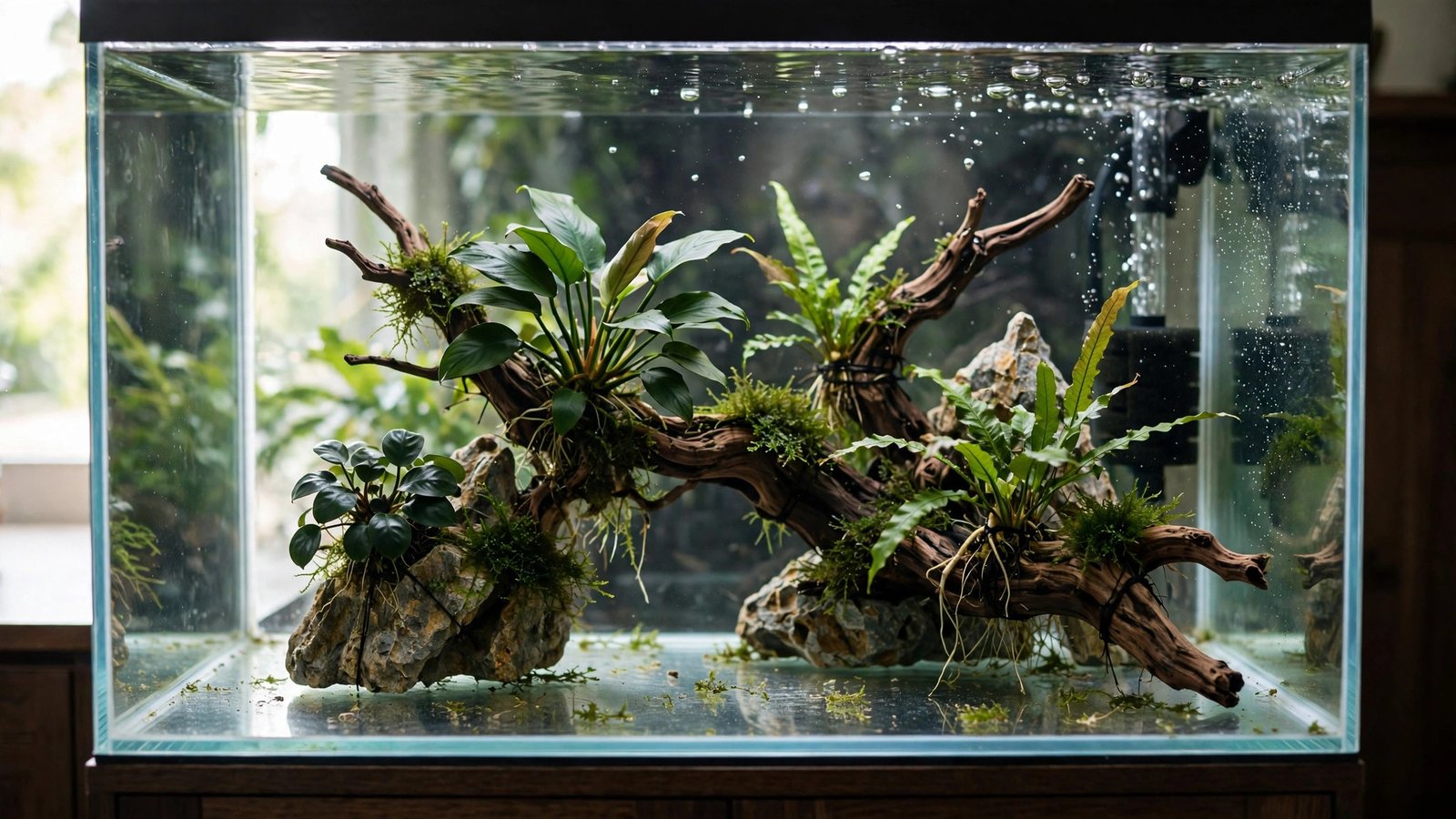
Every year, many discus keepers do something that would make an aquascaper wince: they strip their tanks down to bare glass. Not because they gave up on plants — but because a bare bottom planted tank lets them have both: thriving greenery and the easy, thorough cleaning that messy, expensive fish demand.
The trick is that nothing is planted in the floor itself. Plants grow in terracotta pots, fastened to driftwood and rocks, or floating on the surface. Pair this with the plants that grow without substrate for the full plant list; here is how to build and run the system. And if you do want a classic soil bed, skipping substrate entirely is the deliberate opposite choice.
The bare bottom planted tank idea, in one paragraph
Strip away the gravel and you remove the one place waste can hide. A bare bottom planted tank keeps every uneaten pellet and every bit of detritus sitting visibly on the glass, waiting for the siphon — which is why breeders have run bare bottoms for decades. The planted version adds pots, hardscape epiphytes, and floaters — the most forgiving planted system for fish that need massive, frequent water changes.
How to Build a bare bottom planted tank
Everything here works best as a low-tech planted setup: moderate light, no injected CO2, steady routines.
What you need
- Unglazed terracotta pots, 2–4 in (5–10 cm) — six to ten covers a 55-gallon tank. Soak new pots 24 hours, scrub off dust.
- Aquasoil or clay-based aquascaping soil, 2–3 litres, for pot filling.
- Fine gravel or coarse sand, one small bag, to cap the aquasoil.
- Driftwood and rocks for attaching epiphytes.
- Cotton thread or aquarium-safe super glue (cyanoacrylate gel).
- Comprehensive liquid fertilizer plus root tabs for swords and crypts.
- Narrow-nozzle gravel vacuum and a turkey baster for spot-cleaning.
Building it, step by step
- Place the hardscape first. Cluster driftwood and rocks toward the back two-thirds; leave open swimming room in front.
- Prepare the pots. Fill three-quarters with aquasoil, plant your rooted species, then cap with 1 inch of fine gravel — the cap keeps the water clear even if a fish knocks a pot over.
- Set the pots in place. Nestle them behind rocks and wood to hide the rims, then attach epiphytes (anubias, java fern, bucephalandra) to the wood and rock with cyanoacrylate gel and wedge moss into crevices with cotton thread.
- Add the floaters. Frogbit, red root floaters, or water lettuce go in last; corral them with an airline-tubing ring if you want a clear feeding area. Check local rules before buying — water lettuce is a prohibited exotic species in some states (e.g., Texas); never release it into the wild.
- Fill slowly. Pour over a plate to keep caps undisturbed. Plant heavily from day one: one pot cluster per 8–10 gallons is a good starting density.
The three planting methods: what goes where
Here's what goes where, and what each method demands from you.
| Method | Best plants | Container / anchor | Feeding |
|---|---|---|---|
| Potted | Crypts, Amazon swords, Vallisneria, dwarf sagittaria | 2–4 in pots, aquasoil filled, gravel capped | Root tabs every 2 months + liquid fertilizer |
| Attached | Anubias, java fern, bucephalandra, mosses | Super glue or cotton thread on wood/rock | Liquid fertilizer only (rhizomes rot if buried) |
| Floating | Frogbit, red root floaters, water lettuce* | None — free-floating | Liquid fertilizer; nutrient sponges |
*Water lettuce is a prohibited exotic species in some states (e.g., Texas); never release it into the wild.
Mix all three and the tank reads as designed: height from floaters' roots, structure from hardscape plants, density from pot clusters.
Feeding plants without a substrate
With no substrate to store nutrients, the water column carries everything. Dose a comprehensive liquid fertilizer at half the label strength twice a week — full strength is the most common cause of algae here, because there is no substrate buffer to absorb the excess. Heavy root feeders get one root tab each every two months, pushed deep into the aquasoil through the gravel cap.
Your floaters are the canary. Frogbit and red root floaters pull nitrate straight from the water: if they are multiplying, your dosing is right; if they yellow, bump it slightly.
Cleaning: the real reason this system exists
Vacuum the bare glass two to three times a week (daily for heavy feeders), and lift each pot cluster once a month to siphon underneath.
Water changes: 40–50% every week, minimum. Heavy-feeder tanks do better on two 30% changes per week than one big one. Wipe the glass panels weekly — in a bare bottom tank the glass is the substrate visually, so streaks show. Pair this routine with a planted tank maintenance schedule, skipping the substrate-vacuuming entries.
Which fish suit a bare bottom planted tank
This system was made for messy eaters. Discus need 29–30°C water, near-daily large water changes, and heavy feeding with beef heart and frozen foods that foul gravel within hours — bare glass lets you siphon every crumb in minutes. See a dedicated planted discus tank setup for pairings at those temperatures. Goldfish are the second-best match: relentless diggers and heavy waste producers, but potted plants survive the digging — see the planted goldfish tank setup. Breeding setups fit too: fry show up clearly on bare glass. Loaches, corydoras, and burrowers need real substrate and don't belong here.
Keeping it beautiful: the design discipline
The honest risk is that a bare bottom tank looks like a holding tank. Three rules keep it looking intentional: cluster, don't scatter (groups of three or five pots behind hardscape); hide the evidence (moss creeping over pot rims erases the line between "pot" and "scape" within two months); light with intention (aim the light at the plant clusters, leave the front swimming area slightly dimmer).
Frequently Asked Questions
Can plants really thrive with no substrate at all?
Yes. Rooted plants feed from the aquasoil and root tabs inside their pots, epiphytes absorb nutrients through their leaves, and floaters grow unanchored. The bare glass is purely visual; the chemistry happens in the pots and the water.
Do terracotta pots affect water chemistry?
Plain unglazed terracotta is inert and fish-safe; it won't shift pH or hardness. Use lead-free pots with no paint or glaze, and soak new pots 24 hours and scrub off manufacturing dust.
How do I stop the aquasoil in the pots from clouding the tank?
Cap every pot with a one-inch layer of fine gravel or coarse sand, and fill the tank by pouring water over a plate. The cap holds the aquasoil even if a fish knocks a pot over. Choose a hard-fired aquasoil granule — soft pellets disintegrate and defeat the cap.
Is a bare bottom planted tank good for discus?
It's arguably the best planted setup for discus. They need large, frequent water changes and heavy feeding with messy foods that foul gravel; bare glass lets you siphon everything in minutes.
How often should I clean a bare bottom planted tank?
Siphon the glass two to three times a week — daily for heavy feeders like discus or goldfish. Lift the pots monthly and siphon underneath. Add 40–50% weekly water changes (or two 30% changes for messy fish) and the system stays pristine with less effort than vacuuming gravel.
Worth building
A bare bottom planted tank is the most honest system in the hobby: no hidden rot, no unreachable waste, no mystery under the gravel. What it asks is design discipline — clustered pots, attached epiphytes, drifting floaters. The beginner discus threads on SimplyDiscus are worth reading before you buy pots.