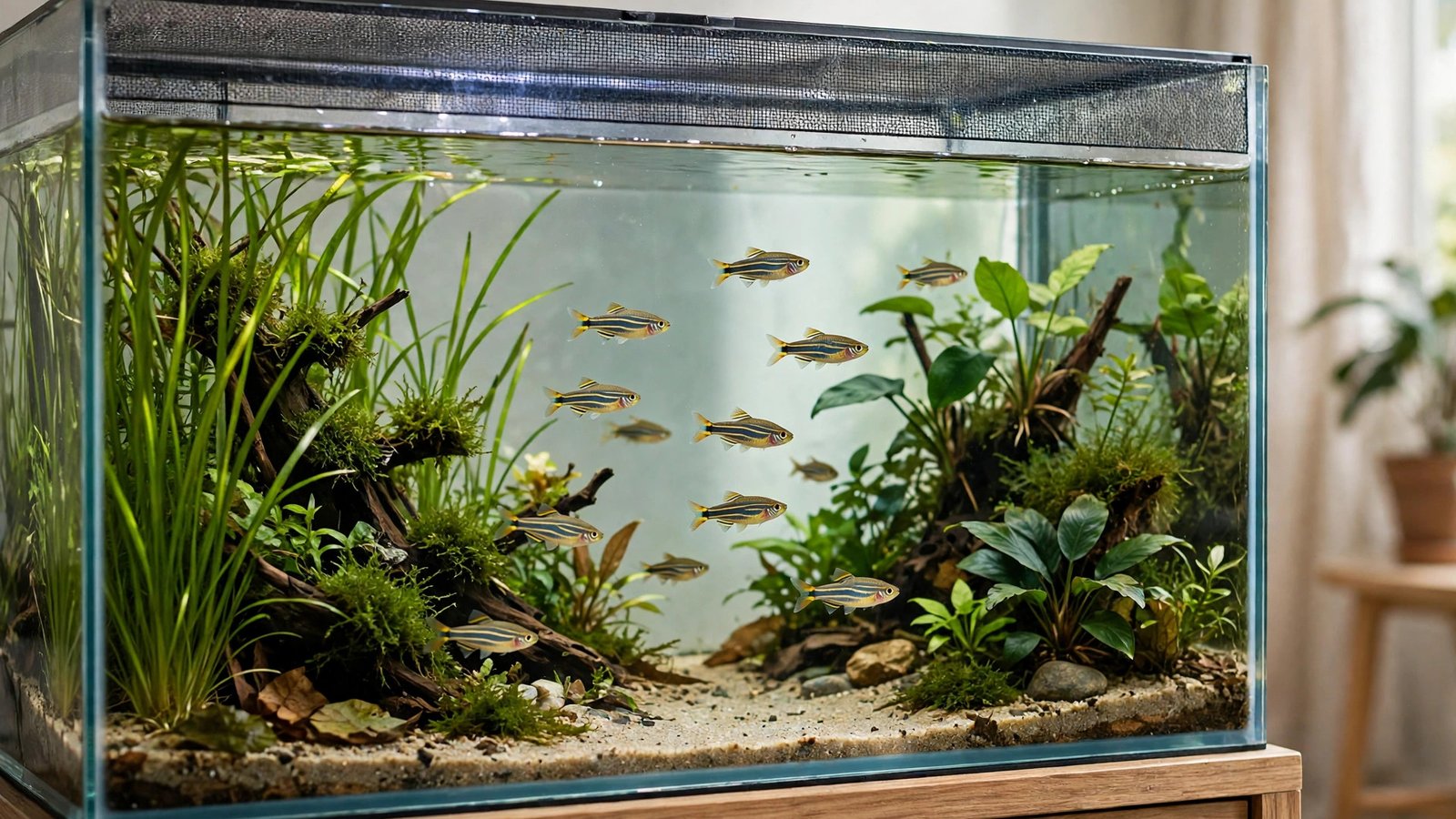
Most zebra danio tanks fail the same way: a 10-gallon rectangle packed edge-to-edge with plants, one tight ball of stressed fish hovering in the corner, and an owner wondering why "the hardy ones" jumped the night the lid sat ajar. A zebra danio planted tank only works when you design for the sprint — open lanes down the middle, dense planting as the lane boundaries, and a lid that never comes off halfway. Get those three right and a school of eight to ten danios in a 20-gallon long becomes the most alive tank you will ever own.
Why danios need a different kind of planted tank
Most planted-tank guides assume your fish will politely weave through stems. Zebra danios don't weave — they commute. Confine that behavior to a heavily planted 10-gallon and you get frantic pacing, torn fins, and fish that launch through a two-centimeter lid gap.
So the layout rule is one short line: planted perimeter, open center lanes, dark substrate, tight lid. If you're new to the basics, read this alongside Low-Tech Planted Tank Setup for Beginners — everything below is the danio-specific layer on top.
The zebra danio planted tank open-lane layout
Divide the tank from above: dense planting along the back glass and both side walls, one or two clear lanes through the center, front to back. The danios school up and down the lanes all day; the plants act as walls, and walls make open water feel safe.
Boundary plants should reach at least two-thirds of the tank height. Anything shorter doesn't register as cover to a fish cruising mid-water, and the school stays skittish instead of relaxed.
| Zone | What goes there | Why it works |
|---|---|---|
| Back corners | Amazon swords, Vallisneria | Tall backdrops; danios spawn among fine leaves |
| Side walls | Java fern, Anubias on wood or rock | Tough resting cover the fish never damage |
| Center lanes | Nothing — open water, dark sand | Sprint room; keeps the school active and tight |
| Surface | Frogbit, ≤30% coverage | Dims the light, calms the fish, never blocks lanes |
Footprint first: why a 20-long beats a taller tank
A sprinting adult danio clears half a meter in a second. An 80 cm 20-gallon long gives the school a lane it can actually use; a 10-gallon gives it a lane it finishes before it starts, so the fish pace the glass. Height is nearly irrelevant — danios live in the middle and upper water, so shallow and long beats tall and narrow at the same volume. Below six fish, danios get nippy and scatter; at eight to ten, they form the tight shimmering formation the species is famous for.
Surround the lanes with hardy plant picks for fast swimmers and the fish provide the decoration themselves.
The lid is not optional
Zebra danios are among the most reliable jumpers in the hobby. A startled fish or a courting male at dawn will find any gap — and a feeding hatch counts as one. Your lid needs to be full, tight, and seated every night, not just "resting fine like this."
The tight lid also cuts evaporation and traps the humid air frogbit prefers. Watch nothing happen for months with the lid cracked open — that is exactly how the habit forms before the morning you count nine fish instead of ten.
Plants that survive a sprinting school
Danios rarely eat plants, but they batter delicate stems with their wakes and nudge loose ones out. Choose plants that hold their ground — epiphytes tied to hardscape, deep-rooted swords, floaters — and give them two to three weeks to root before the school goes in.
| Plant | Placement | Light | Why it fits |
|---|---|---|---|
| Java fern | Tied to side-wall wood | Low–moderate | Indestructible epiphyte; danios can't uproot it |
| Anubias barteri | Foreground rock, sides | Low | Tough leaves; thrives at 18–24 °C |
| Amazon sword | Back corners | Moderate | Tall backdrop; one root tab per plant |
| Vallisneria | Back wall | Moderate | Runners fill the back fast; spawning cover |
| Amazon frogbit | Surface, ≤30% | Moderate | Calms the school; absorbs excess nitrate |
For species profiles and care detail, Tropica's plant database is the most reliable open reference. And if you're weighing species, our guide to the best schooling fish for planted tanks compares danios against tetras and rasboras on exactly this open-water behavior.
Substrate, light, and the cooler-water quirk
Dark sand does two jobs. Visually, the blue-gold striping reads twice as strong over dark substrate as over pale gravel. Practically, fine sand won't trap debris the way coarse gravel does in a high-flow tank. Lay it two to three centimeters deep in the lanes, slightly deeper under the planted edges.
Keep light moderate — 30–50 PAR at the substrate, six to eight hours a day — and skip the CO2 entirely. High light with no CO2 grows algae, not plants, and danios evolved in dappled stream light; the frogbit dims things from above anyway.
Then the quirk that catches people: danios prefer 18–24 °C, cooler than the 24–28 °C band most tropical guides assume. At around 22 °C their metabolism calms, colors deepen, and every plant above thrives. Skip the heater in most rooms — these fish do better slightly cool than slightly warm.
Stocking and the first 30 days
Plant first, cycle the tank, then add the school. Plants consume ammonia while the tank matures, and three to four weeks of root growth keeps everything anchored once the sprinters arrive (a faster planted-tank cycle is realistic — just don't rush the rooting). Add all eight to ten danios at once, feed small amounts twice daily, and change 30% weekly using the planted-tank water-change technique. Prune Vallisneria runners monthly and thin frogbit back to 30% whenever it passes half the surface.
Frequently Asked Questions
Can zebra danios live in a fully planted jungle tank?
They survive it but don't show their best. Without open lanes, danios pace the glass, scatter instead of schooling, and their color fades. Give them the perimeter-plus-lanes layout and the same fish become the tight, active school that made you choose them.
How many zebra danios can go in a 20-gallon long?
Eight to ten is the sweet spot — a real school with room to sprint in an 80 cm lane. You can stretch to twelve with strong filtration and established plants, but keep to ten on a first planted tank. Below six, expect nipping and skittish behavior.
Do zebra danio tanks really need a lid?
Yes — non-negotiable. Danios are powerful jumpers, and a startled fish or a courting male at dawn will find any gap, including feeding hatches. Use a full, tight-fitting lid seated every night; it also slows evaporation in their cooler 18–24 °C water.
Do I need CO2 for a zebra danio planted tank?
No. Java fern, Anubias, swords, Vallisneria, and frogbit all grow well on moderate light and a basic all-in-one liquid fertilizer. Start at half the label dose, watch your livestock, and increase only if plants show deficiency after two to three weeks.
What temperature do zebra danios need?
18–24 °C, cooler than most tropicals — room temperature suits them in most homes, and a heater is usually unnecessary. All the plants in this guide tolerate the low 20s comfortably, so nothing in the setup has to compromise.
The 20-long is your canvas
This build asks for restraint more than effort: fewer plants in the middle, better plants on the edges, a lid you never cheat on. Set the 20-long with dark sand and the perimeter-plus-lanes layout, hold the water near 22 °C, and within a month the school will be running laps under the frogbit canopy while the swords fill the back wall. For a smaller-footprint take on the same logic, our planted neon tetra tank guide applies the open-lane idea to nano schools.