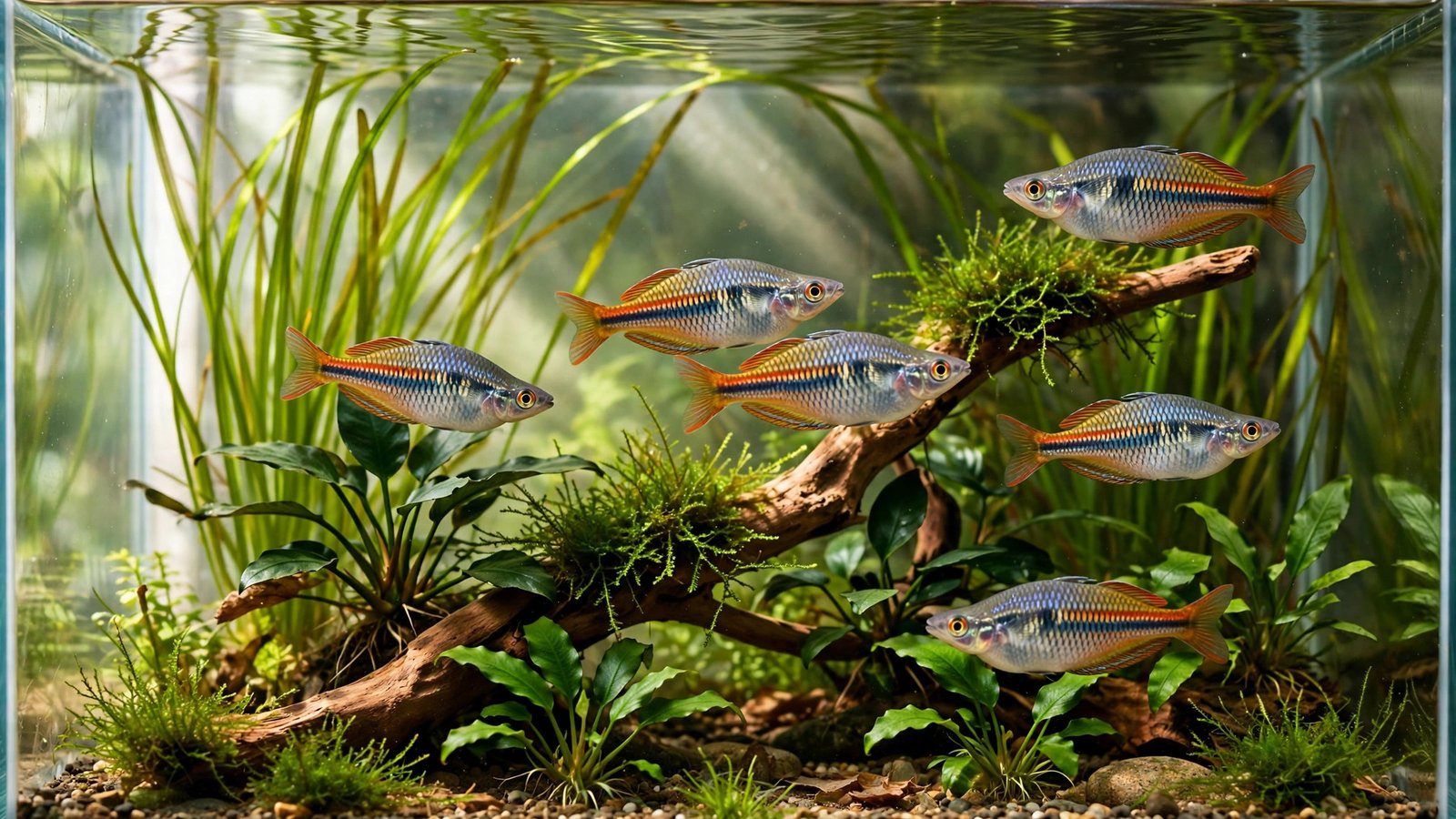
Most fish sold as "banded rainbows" are mislabeled Melanotaenia praecox or juveniles that will never grow the bold mid-body stripe this species is known for. The real Melanotaenia trifasciata — also sold as the Jewel or Regal rainbowfish, the same fish under three names — is a six-inch Australian schooler with some of the most geographically varied coloration in the hobby. A banded rainbowfish planted tank built around their real needs delivers a display rivaling much rarer fish.
A banded rainbowfish planted tank suits 55-gallon-plus setups with neutral-to-hard water, 6–8+ fish at a 1:2 male-to-female ratio, and dense planting under a tight lid. The citable fact most guides miss: named wild populations (Goyder River, Jewel, Batavia Rainforest) show measurably different coloration — buy by collection locality, not by trade name.
What "Banded" Actually Means in a Banded Rainbowfish Planted Tank
The signature mark is a dark horizontal mid-lateral stripe against a silvery-gold base that flashes blue-green under good light. That's how you separate true trifasciata from the mix-ups: the blue rainbowfish (M. lacustris) lacks the bold stripe, and juvenile M. praecox sold as "banded rainbows" never grow it and stay half the size. Adults reach 5–6 inches. Males are deeper-bodied with redder fins and stronger color; females are slimmer and quieter in tone. If you're comparing candidates, our planted rainbowfish tank guide places this species in the wider genus.Regional Populations: The Detail That Changes How You Shop
Wild trifasciata ranges across northern Australia, and isolated river populations have diverged into visibly different color forms. Serious breeders sell by locality — and you should buy by locality, because unlabeled stock is a lottery ticket. Never mix two localities if you intend to breed; hybrids muddy the lines collectors value.| Population | Signature look | Availability |
|---|---|---|
| Goyder River | Deep blue body, red-orange fins, strong stripe | The benchmark "Jewel" form |
| Batavia Rainforest | Greener-gold base, subtler stripe, red fin edges | Specialist breeders |
| Jewel (classic trade form) | Silvery-gold with blue sheen, bold black stripe | Widely available |
| Northern Territory strains | Variable, often paler, adapted to very hard water | Occasional imports |
Building Your Banded Rainbowfish Planted Tank: Layout and Hardscape
These fish need what looks like a contradiction: open swimming lanes for six-inch athletes, plus dense cover so the school feels secure enough to color up. Resolve it with structure — plant the back and sides heavily, keep the front-center third open — about 60% planted volume overall. Tall background plants (Vallisneria, Hygrophila, Amazon swords) give the school structure to weave through, while Anubias on driftwood provides shaded retreats for females. A floating canopy of frogbit or salvinia dims overhead light and improves color. The lid is non-negotiable. Banded rainbows are among the hobby's most committed jumpers: feeding splashes, startled bursts, even a stray bubble can put one on the floor. Use a tight lid with no gaps around hoses or cables, and check it monthly — warped plastic leaves the slot a panicked fish finds.Water Parameters for a Banded Rainbowfish Planted Tank
Unlike soft-water rainbowfish, trifasciata prefers neutral-to-hard water — exactly what most planted tanks already run.| Parameter | Target | Notes |
|---|---|---|
| Temperature | 72–79°F (22–26°C) | Best color mid-70s |
| pH | 7.0–7.8 | Stability beats exact numbers |
| GH | 8–15 dGH | Comfortably hard water |
| Ammonia / nitrite | 0 ppm | Cycle fully before adding fish |
| Nitrate | <20 ppm | Weekly 30% water changes |
| Flow | Moderate | Fine with flow; keep calm pockets |
Schooling, Ratio, and Tank Mates
Six is the functional minimum; eight-plus is where the real display behavior appears — males courting females in open water, fins spread. Pairs or trios go pale and skittish within a month. The 1:2 male-to-female ratio matters because male-heavy groups spar constantly, stressing the school and dulling color. Good tank mates match their energy without competing for space: medium tetras, barbs, peaceful gouramis, and corydoras all work. Avoid slow, long-finned fish — the school will harass bettas and fancy guppies at feeding time. For more ideas, see our best schooling fish for planted tanks. Note the contrast with their New Guinea cousin: our red rainbowfish planted tank guide covers the deep-bodied Glossolepis incisus — a different genus, softer water preferences, and a very different build.Plants That Thrive With Banded Rainbows
Banded rainbows are plant-safe, but six-inch fish shred delicate stems with daily traffic. Choose robust growers and anchor them well.| Zone | Plant | Why it works here |
|---|---|---|
| Background | Vallisneria spiralis | Tall, tough patrol lanes |
| Background | Hygrophila corymbosa | Bounces back from traffic |
| Midground | Anubias barteri on wood | Tough, shaded retreats for females |
| Midground | Java fern | Epiphyte; no substrate needed |
| Foreground | Cryptocoryne wendtii | Low, shade-tolerant foreground |
| Surface | Amazon frogbit | Dims light; spawning cover |
 ★4.6
NICREW ClassicLED Plus planted aquarium light
Check Price on Amazon ★4.6Feeding and Daily Care
Feed twice daily in small portions — rainbows beg for a third meal and then bloat. A quality micro-pellet staple plus frozen daphnia, brine shrimp, or bloodworm two to three times a week brings out the red fin coloration pellets alone won't deliver. Seriously Fish's Melanotaenia trifasciata species profile is the best independent reference on wild-collection localities. Water changes stay at 30% weekly — a school of six-inch fish is a heavy bioload. Trim stems biweekly so the swimming lane stays open, and wipe the lid's underside monthly; condensation crust blocks light and dulls colors.Frequently Asked Questions
Are Jewel, Regal, and Banded rainbowfish the same species?
Yes — all three are Melanotaenia trifasciata. "Banded" describes the stripe; "Jewel" and "Regal" are trade names for colorful strains. The real distinction is locality: named populations like Goyder River differ visibly, so buy by river system instead of hunting for three species.
Can banded rainbowfish live in a 40-gallon tank?
Not comfortably. A school of 6–8 adults at 5–6 inches needs the 48-inch footprint of a 55-gallon tank. In a 40-gallon breeder, males spar more and colors wash out. If 55 gallons isn't possible, pick a smaller rainbowfish like M. praecox instead.
Why did my banded rainbowfish lose their stripe?
A fading stripe signals stress, not disease. Usual causes: a group under 6 fish, too many males, harsh overhead light with no floaters, or unstable water. Healthy fish flash the stripe at feeding and courtship. Correct the ratio, dim the light, stabilize parameters — the stripe usually returns within days.
Do banded rainbowfish eat aquarium plants?
No — they're plant-safe. But six-inch fish batter delicate stems with daily traffic, so stick to robust Vallisneria, Anubias, Java fern, and Cryptocoryne, anchored firmly for the first month. They'll pick soft algae off leaves, which is a bonus.
How do I tell males from females?
Males are deeper-bodied and brighter, with redder fins and a stronger stripe — especially during morning courtship. Females are slimmer and more silvery. Compare body depth across a group rather than judging one fish. Buy juveniles in groups of 8+ and the ratio usually sorts itself out.