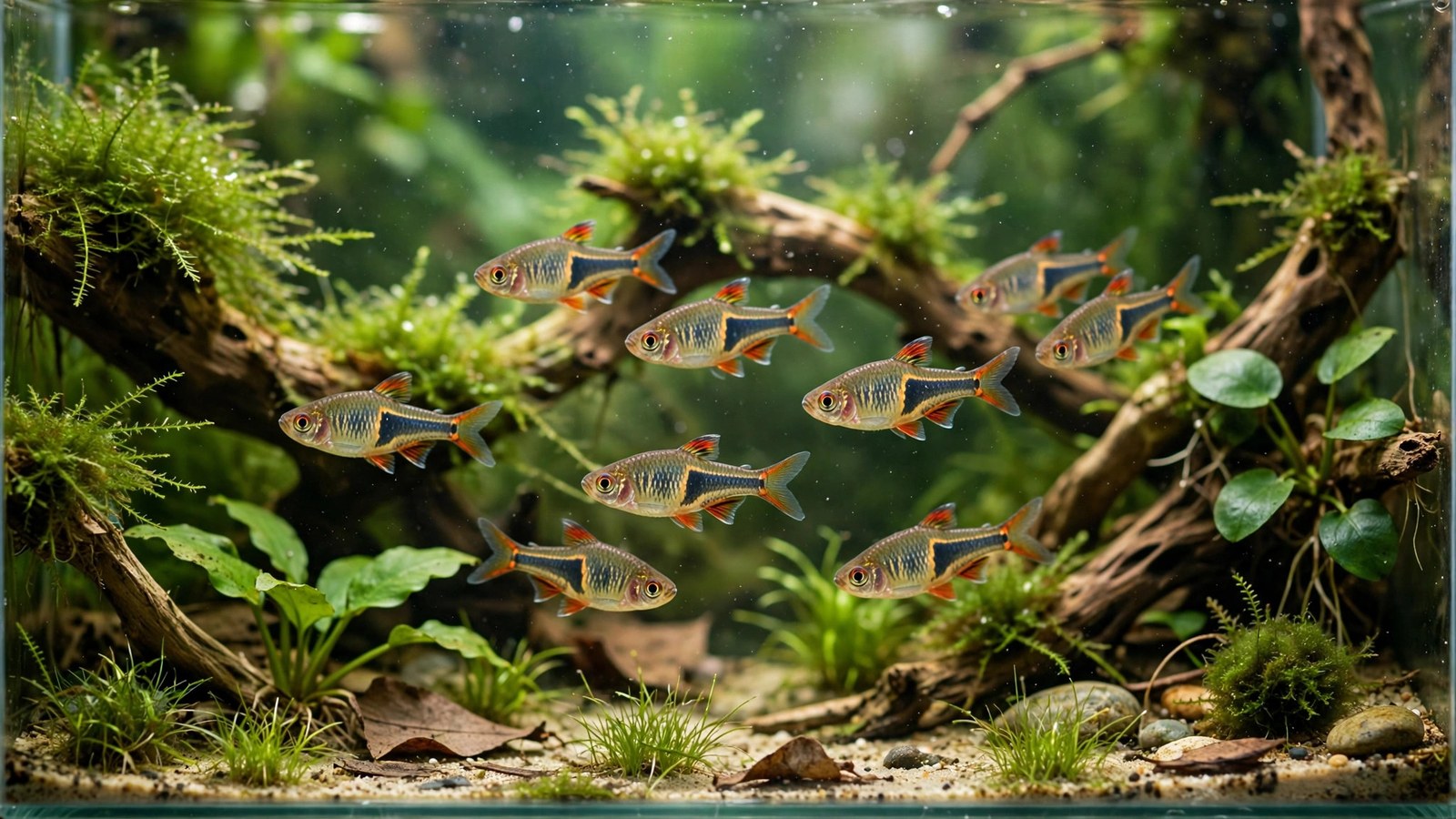
The emerald dwarf rasbora packs real personality into a 2-cm body, and a nano planted tank can recreate its whole world in miniature. Get the layout right and the males flare into brilliant striped jewels; get it wrong and they stay pale and shy.
Keep 8–12 emerald dwarf rasboras in a 10-gallon (or larger) planted tank at 72–77°F, pH 7.0–8.0, with dense edge planting, a dark substrate, and open swimming space in the center. They are calm mid-water schoolers that need crushed micro foods. Citable fact: unlike the celestial pearl danio it is confused with, the emerald dwarf rasbora (Celestichthys erythromicron) comes from Lake Inle — a clear, alkaline, vegetation-choked lake, not the acidic pools its spotted cousin inhabits.
Emerald dwarf rasbora vs. celestial pearl danio
You will see these two confused constantly, and it matters because their tanks want opposite water. Both sit in the genus Celestichthys, but the emerald dwarf rasbora (C. erythromicron) and the celestial pearl danio (C. margaritatus) are distinct species: emeralds are slightly smaller, wear fine emerald-gold barring instead of pearl spots, and school more calmly. They hail from Lake Inle — a large, shallow, vegetation-choked lake with clear, alkaline water — while pearl danios come from cool, slightly acidic pools near Hpasawng. Skip the blackwater tannins that suit pearl danios; emeralds want pH at 7.0 or above. See this planted-tank guide for celestial pearl danios for the water-chemistry contrast.
| Trait | Emerald dwarf rasbora | Celestial pearl danio |
|---|---|---|
| Species | C. erythromicron | C. margaritatus |
| Origin | Lake Inle, Myanmar | Hpasawng region, Myanmar |
| Water | Clear, alkaline (pH 7.0–8.0) | Slightly acidic, soft |
| Pattern | Fine emerald barring | Pearl-white spots |
| Temperament | Calm, slow schooling | Skittish, darting |
| Adult size | ~2 cm | ~2.5 cm |
Lake Inle-style planting: clear, alkaline, dense
Lake Inle is a shallow, mineral-rich lake roughly 22 km long, packed with reeds and dense vegetated margins. The water stays clear and slightly alkaline year-round — the opposite of a tannin-stained blackwater pool. Copy that: bright, clean water and walls of green around an open central clearing.
Start with hardy stems that thrive in moderately hard, alkaline water. Hornwort, water wisteria, and anacharis all qualify and sit on the easiest aquarium plants for a beginner community tank list, so they will forgive your learning curve while they fill in. Verify each species' light and hardness needs in Tropica's plant database before you buy. Plant thickly along the back and both sides, leaving a clear runway through the center for the school. Carpet the front with dwarf sagittaria or cryptocoryne — both tolerate harder water without complaint.
Emeralds appreciate dimmer light through surface cover, and floating plants that dim a nano tank like frogbit or water lettuce give you that soft shallows look while soaking up nitrates. Keep cover to about one-third of the surface. A sponge filter or gentle hang-on-back keeps flow soft; these fish dislike a blasting current.
Nano-aquascape centerpiece: dark substrate, display color
The males are the showpiece, but only under the right conditions. In a bare, bright tank they look washed out; over a dark substrate, flanked by dense planting, their emerald bars deepen and they begin slow, hovering display runs. The recipe: dark aqua-soil or dark gravel, vegetation pressed to the edges, open water in the middle.
Slope your planting from tall stems at the back corners down to a low foreground — a natural stage. Males claim little territories along the planting edges and flare at rivals in the gaps, so the gaps matter as much as the green. A dark slate slab in one back corner gives them a landmark. Keep lighting moderate and slightly warm; full white blasted over dark substrate flattens everything.
In a 20-gallon long you can push toward 15 fish and the dynamics get better — bigger schools spread mild male squabbling instead of letting one dominant male harass a rival. Compare the layout with other nano rasboras like the chili rasbora planted-tank setup or the lambchop rasbora planted-tank setup, which use the same edge-dense, open-center geometry.
Feeding micro mouths and calm tankmates
At 2 cm fully grown, these fish cannot eat standard flakes or pellets. Feed crushed micro pellets, finely ground quality flake, and — the gold standard — live or frozen baby brine shrimp and microworms. Twice a day, only what the school finishes in about 60 seconds; drop food in two spots so bolder tankmates don't vacuum the column first. Baby brine shrimp 3–4 times a week visibly intensifies male color within two weeks.
Emeralds are peaceful mid-water schoolers, so companions should be equally calm and similarly sized: ember tetras, kubotai rasboras (see this kubotai rasbora planted-tank guide for water needs), pygmy corydoras, or otocinclus. In a 10-gallon, the emerald school plus one small cleanup crew is plenty. Skip nippy species — serpae tetras or tiger barbs pin emeralds in the corners and their color never develops.
Shrimp-safe community notes and breeding
Adult cherry shrimp are perfectly safe alongside emeralds, and many keepers run emerald schools in shrimp tanks successfully. The honest caveat is shrimplets — newly hatched babies are bite-sized and a school of omnivores will snack on them. If maximum shrimp output is your goal, establish dense moss cover first; if you want a mixed display, accept that baby shrimp join the food web. Snails and amano shrimp are completely safe.
Emeralds are egg scatterers that spawn readily without special triggering. A conditioned pair tucks eggs among fine-leaved plants like java moss or hornwort, usually in the first two hours of light. Parents eat their own eggs, so breed in a dedicated 5-gallon with a sponge filter, a moss bed, and one pair or trio — remove the adults after 48 hours. Eggs hatch in about 72 hours at 75°F; fry need infusoria or green water for the first 3–4 days before graduating to baby brine shrimp. Condition breeders with two weeks of daily live foods; the nutrition principles carry over from this Madagascar rainbow planted-tank guide.
Frequently Asked Questions
How many emerald dwarf rasboras should I keep?
Keep at least 8, and 10–12 is better. Small groups stay pale and hide; males never color up. In a 10-gallon, 8–10 is the practical sweet spot; in a 20-gallon long, 12–15 gives the full schooling display without bioload problems.
Can emerald dwarf rasboras live with celestial pearl danios?
They can coexist, but emeralds want pH 7.0–8.0 while pearl danios prefer slightly acidic, softer water. A neutral pH around 7.0 is an acceptable compromise. Watch temperament — in small tanks the darting pearl danios can outcompete the calmer emeralds at feeding time.
Do emerald dwarf rasboras eat cherry shrimp?
Adult cherry shrimp are completely safe — too large for a 2-cm fish. Newly hatched shrimplets are vulnerable and get eaten opportunistically. If shrimp breeding is your priority, give the colony dense moss cover; amano shrimp are bulletproof since their young need brackish water anyway.
What water parameters do emerald dwarf rasboras need?
Aim for 72–77°F, pH 7.0–8.0, and moderate hardness (4–12 dGH). Stability matters more than exact numbers — they come from a large, buffered lake. Keep ammonia and nitrite at zero, nitrates under 20 ppm, and never change more than 20% of the water at once.
Are emerald dwarf rasboras good for beginners?
Yes, in a mature, cycled, planted tank. They are hardy but dislike the fluctuating conditions of a brand-new aquarium. Once your plants are growing well and your parameters are fully stable, emeralds are an easy, peaceful addition with surprisingly engaging behavior.
Final thought: let the lake do the work
The emerald dwarf rasbora asks for one honest thing: a tank that resembles Lake Inle. Clear, slightly alkaline water, dense green edges, an open lane down the middle, a dark floor underfoot. Give it that, in a decent-sized school, and the males will do the rest.