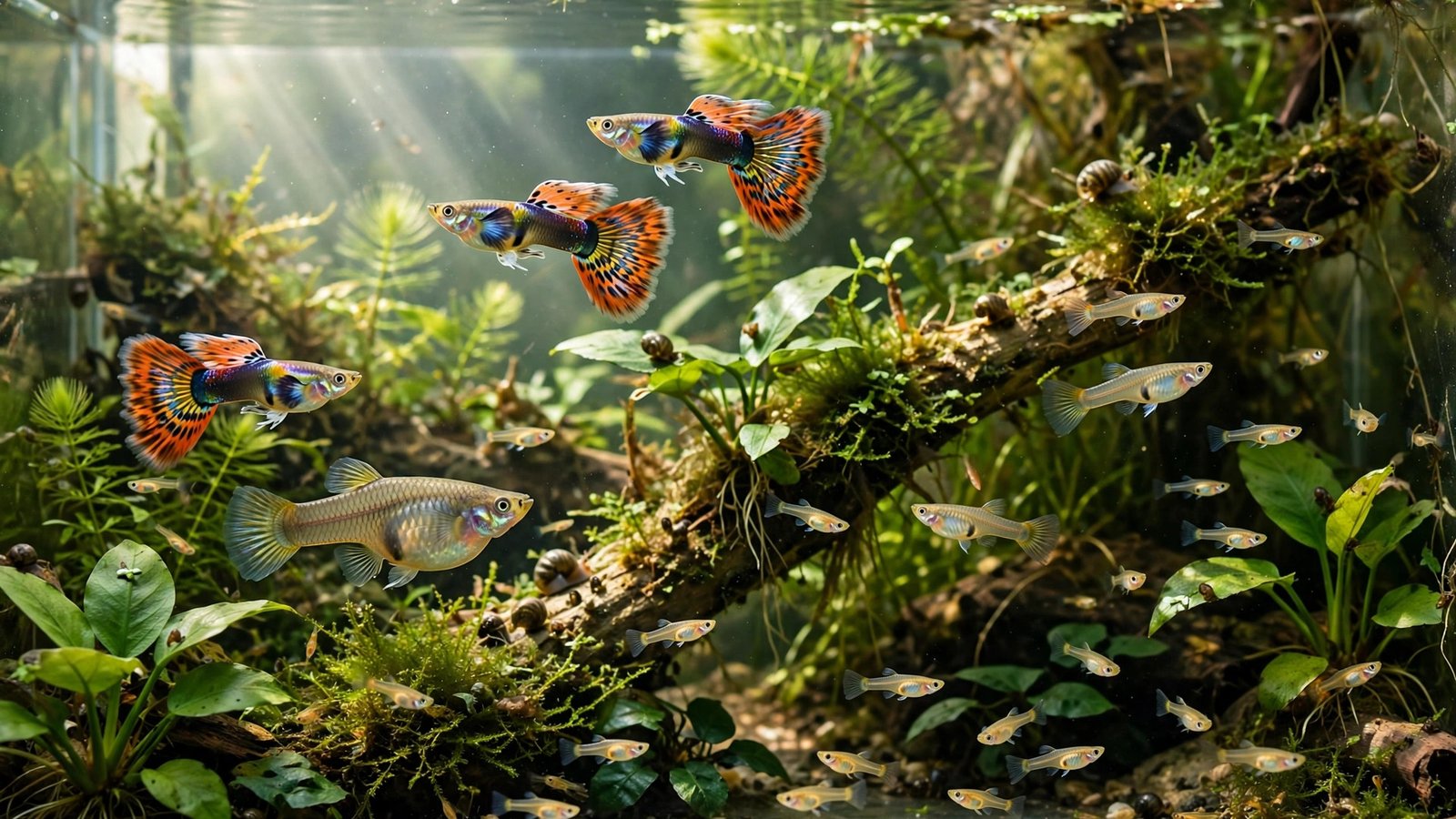
The most expensive mistake in guppy breeding is buying the birthing box first. Trapping a stressed, gravid female in plastic while her fry drop into a bare tank is how half a brood vanishes by morning. A breeding guppies planted tank flips that script: dense plants become the nursery, the female stays calm, and most of every brood survives. This guide runs the full method — conditioning, ratios, fry cover, grow-out, and population control.
It assumes a cycled, growing tank — specifically the planted guppy tank setup this guide builds on. If your tank is still a plan on paper, start there and return once plants are filling in.
A planted tank breeds guppies on its own: one female drops 20–50 live fry roughly every 28–30 days, and fine-leaved plants shelter most newborns. A University of Dhaka lab study measured 25–35 day gestation with 12–60 fry per brood, and females store sperm for months. Run 1 male to 2–3 females at 24–27°C, feed fry newly hatched baby brine shrimp, and males are identifiable by about 8 weeks.
Breeding Guppies Planted Tank: The Method That Actually Works
Guppies are livebearers: sperm transfers internally, the female carries the young, and she drops fully formed fry that swim and eat within hours. You do not trigger spawning — you condition, balance ratios, and plant cover. Stock healthy young adults at one male to two or three females, condition two weeks on varied food (flake plus frozen daphnia or brine shrimp), and watch for the dark gravid spot and squared-off belly that signal birth is near. Run a sponge filter — fry-safe, gentle, no intake to swallow newborns.
Set Sex Ratios That Protect Your Females
More males does not mean more fry — it means harassment, torn fins, and females that hide instead of eat.
| Setup | Ratio | Best for | Watch out for |
|---|---|---|---|
| Starter trio | 1 : 2 | 10-gallon project | Lower-ranking female may need rotating out |
| Colony standard | 1 : 3 | 20+ gallon planted colony | The goldilocks zone — calm and productive |
| Recovery | No males | Ragged-looking females | Stored sperm still yields broods for months |
| Never | 2+ males : 1 female | Nothing | Constant chasing, skipped meals, torn fins |
Stored sperm means removing the male is not an off-switch. For a true breeding pause, separate the sexes before they mature at about 6–8 weeks.
Fry Cover: The Plants That Decide Who Survives
Newborn fry are 6–7 mm long, and every adult in the tank — including their mother — sees snacks. Fine-leaved tangles near the surface give them somewhere adults cannot follow. Guppy grass earns its name: fast, undemanding, and its strands trap fry like a net. Hornwort works the same way, growing inches a week. Java moss on wood or rock shelters bottom-hugging fry, and floaters like frogbit add root curtains where fry instinctively rise — the roots trap infusoria, a free first food. See the best plants for guppy tanks and the plants-for-fry-survival setup for the full picks; general selection principles live in the fish-first aquarium plants guide.
Birthing Boxes vs Plants-Only: An Honest Comparison
Both methods work for different goals — be honest about yours.
| Method | Pros | Cons |
|---|---|---|
| Plants-only | Calm females, zero handling stress, natural first foods | 30–50% survival; weak traits survive too |
| Breeder box / net | Near-total fry survival per brood | Stresses the female — can delay birth; cramped water stunts fry |
| Dedicated breeding tank | Calm female plus protected fry plus strain control | Needs a second tank, heater, and filter |
Casual colour breeding belongs in the plants-only camp. Developing a strain — keeping only the reddest males, say — needs the dedicated tank, because uncontrolled colonies mix genes freely. The lab study of guppy breeding biology behind these numbers confirms the baseline every method shares: ~28-day gestation, 12–60 fry per brood, maturity at 8–10 weeks.
Feeding Fry and the Grow-Out Weeks
Day-one fry eat what fits their mouths: newly hatched baby brine shrimp or powdered fry food. Feed 3–4 tiny meals a day for the first three weeks — amounts finished in two minutes. One big feeding rots; in a fry tank, leftover food kills faster than hunger.
| Age | Food | Milestone |
|---|---|---|
| Days 1–7 | Baby brine shrimp, powdered food, infusoria from plant roots | Free-swimming, hiding in cover |
| Weeks 2–4 | Crushed flake, micro-pellets, frozen daphnia | Colour starting in males |
| Weeks 4–8 | Finely ground adult foods | Sexes separable at ~6–8 weeks |
| 8–10 weeks | Full adult diet | Sexually mature — manage numbers now |
At 6–8 weeks the male gonopodium appears and colour starts — your deadline for decisions. Juveniles must be sexed and sorted here, because an 8-week male breeds with his own sisters. Grow-out tanks stay simple with the beginner community-tank plant picks: hardy, no CO2 fuss, and thick enough to keep juveniles calm.
 ★4.6
Pawfly 4" Aquarium Shrimp Net
Check Price on Amazon ★4.6Population Control: The Part Nobody Plans
Three females at 30 fry each, monthly — 90 juveniles a month from one colony. Without an exit plan you get stunting, inbreeding, and a nitrate nightmare. Realistic options: rehome through local fish clubs; run a separate males-only display tank; or let a compatible community tank be the natural limiter, where only the fastest fry survive.
One identity note: Endlers are not guppies. Endler's livebearers (Poecilia wingei) are a separate species that hybridizes freely with guppies, muddying any breeding project. Keep them in separate tanks; the Endlers planted-tank guide covers how their nano breeding setup differs. Never mix colonies if you care about strain purity.
Frequently Asked Questions
How many fry does a guppy have at once?
Expect 20–50 fry per brood from a healthy adult female. A University of Dhaka lab study measured 12–60 per brood, scaling with the female's body size. First-time mothers usually drop 10–20. Conditioning matters: well-fed females on varied diets consistently produce larger broods than females raised on flake alone.
How often do guppies have babies?
About every 28–30 days, with lab studies recording a 25–35 day gestation range. Critically, females store sperm for months, so monthly broods continue long after the male is removed. "Taking the male out" does not stop breeding — separating juvenile males and females by 6–8 weeks is the only reliable way to pause reproduction in a colony.
Can guppy fry survive in a planted tank without a breeder box?
Yes. With guppy grass, hornwort, java moss, and floaters covering roughly a third of the tank, a meaningful share of each brood reaches adulthood with zero intervention. Survival runs 30–50% versus near-total in boxes, but females stay calm, plant roots supply natural first foods, and you avoid the stunting cramped boxes cause.
What is the best male-to-female ratio for breeding guppies?
One male to two or three females. This spreads the male's relentless courtship so no single female is harassed to exhaustion. Never run 1:1 — the female gets chased constantly, stops eating, and her fins tear. More than three females per male is fine in large colonies, but 1:2 or 1:3 is the minimum that keeps females healthy and broods coming regularly.
When should I separate male and female guppy fry?
By 6–8 weeks, when the male's gonopodium becomes visible and colour starts showing. Lab research puts sexual maturity at 8–10 weeks, so 6–8 weeks is your safe sorting window before accidental inbreeding starts. Use two grow-out tanks or a divider, and inspect closely — late-developing males hide in the female group.
Start With the Plants, Not the Box
Breeding guppies in a planted tank rewards the aquarist who builds the nursery before the parents arrive. Dense cover, calm ratios, a sponge filter, and an exit plan for the fry — get those four right and each monthly brood largely raises itself. Build the thicket first.