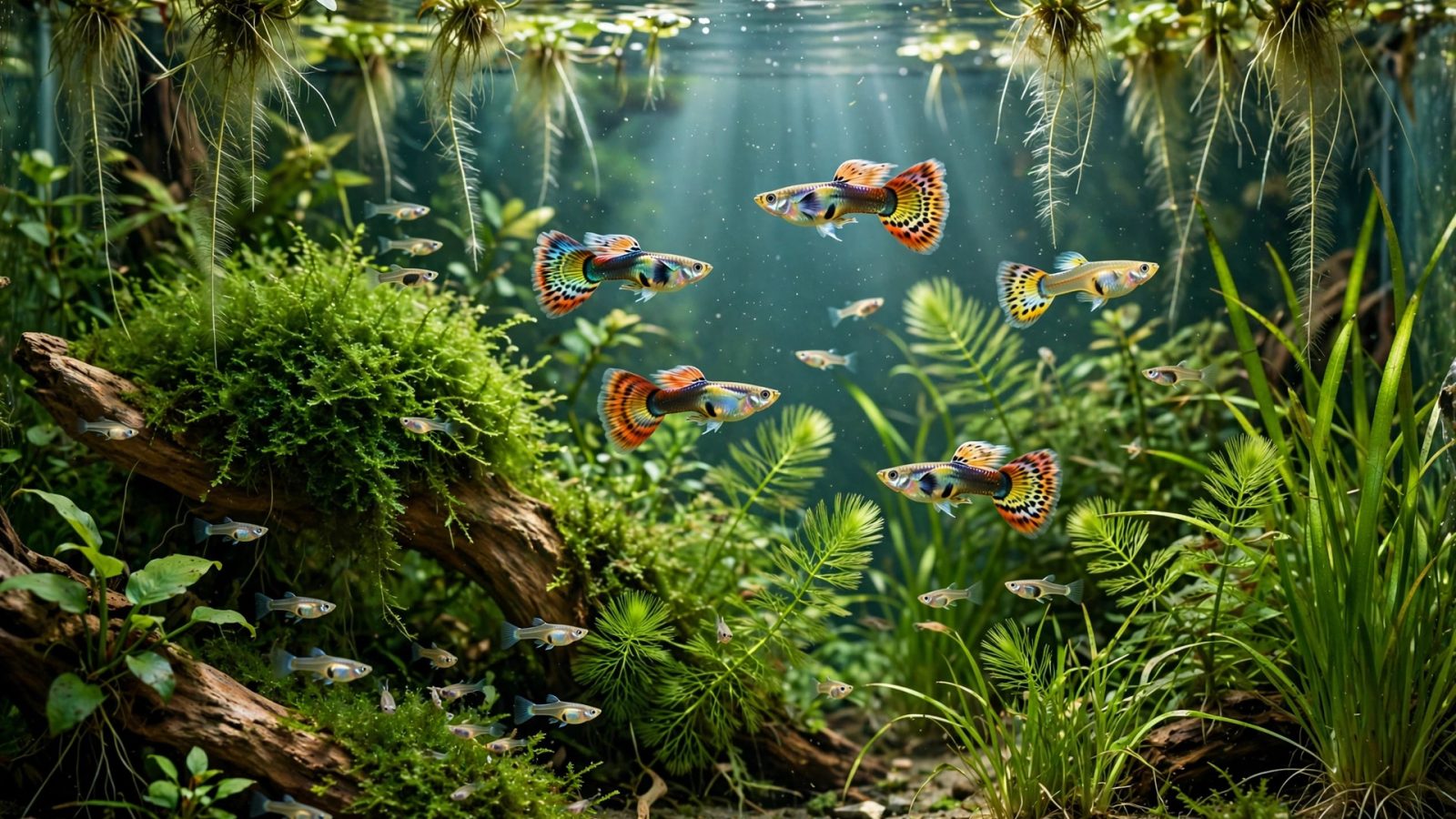
Guppies breed. Relentlessly. A single female can drop 20–50 fry every month, and in a bare tank most of them become snacks — often for their own parents. The difference between a guppy tank that sustains a colony and one that’s a fry graveyard is plants for guppy tanks: dense, fine-leaved cover where newborn fry hide until they’re too big to eat.
This isn’t about decoration — it’s about engineering survival. The best guppy plants share specific traits: fine texture fry can vanish into, fast growth that keeps up with grazing, and tolerance for the hard, alkaline water guppies prefer. Here are nine proven picks, plus the setup strategy that maximizes fry survival.
What Fry Actually Need
Newborn guppy fry are ~6mm, slow, and instinctively head for cover. Effective fry cover means:
- Fine, dense structure — feathery leaves, moss tangles, floating root masses. Broad anubias leaves look nice but a fry can’t hide behind one.
- Multiple zones — surface cover (floaters), mid-water thickets (stems/moss), and bottom shelter. Fry scatter; cover every level.
- Fast growth — guppies nibble soft plants; fast growers outpace the damage.
- Hard-water tolerance — guppies thrive at pH 7.0–8.0, GH 8–12. Soft-water specialists (many delicate stems) struggle here.
1. Hornwort (Ceratophyllum demersum)
The undisputed king of fry cover. Hornwort’s dense, needle-like foliage forms impenetrable thickets that fry pour into at birth. Float it in bunches at the surface — newborn fry instinctively rise, and a floating hornwort island is the first shelter they find. It grows fast in hard water, tolerates anything, and costs almost nothing.
It sheds needles when adjusting to new water — normal, not death. Anchor bunches with a plant weight or let them drift; don’t bury stems (buried portions rot). Thin regularly or it’ll take over.
2. Java Moss (Taxiphyllum barbieri)
Java moss is the classic breeding-tank plant for a reason: its tangled fronds create a three-dimensional maze at exactly fry scale. Tie portions to wood, rock, or mesh to create moss walls and carpets — every crevice is a hiding spot. It also harbors infusoria and microfauna that newborn fry graze on, making it a first food source as well as shelter.
It grows slowly but never stops, tolerates hard water cheerfully, and survives near-darkness. The only maintenance: trim occasionally, because detritus accumulates in old moss. Rinse portions in tank water during water changes.
3. Water Sprite (Ceratopteris thalictroides)
Water sprite works double duty: planted, it forms a lacy background bush; floated, it becomes a surface island with trailing roots. Both forms shelter fry brilliantly. It’s a fast grower and a nutrient sponge, which helps control the waste load of a breeding colony. Fry graze microfauna from its fine roots.
Give it some nutrients — pale, transparent fronds signal deficiency, fixed with a half-dose of liquid fertilizer. Plantlets form on leaf edges; separate them to expand coverage free.
4. Anacharis (Egeria densa)
Anacharis is the beginner’s stem plant: cheap, nearly indestructible, and fast enough to outgrow anything guppies do to it. Planted in bunches at the back, it forms a dense vertical forest; floated, it creates mid-water shelter. It thrives in the hard, alkaline water guppies love — in fact it prefers it.
In very warm tanks (above 80°F) it can struggle; guppy tanks at 74–78°F are its sweet spot. Like hornwort, don’t bury it deeply — anchor lightly or float.
5. Amazon Frogbit (Limnobium laevigatum)
Frogbit’s broad leaves shade the surface while its long, feathery roots hang down like a curtain — and that root curtain is prime fry habitat. Newborns hover among the roots, invisible from above and below. It also absorbs nitrates aggressively, valuable in a breeding tank with a growing bioload.
Keep it corralled (airline tubing ring) so it doesn’t cover the entire surface — aim for a third. Thin weekly; it multiplies fast. Details in our floater guide — the mechanics are identical for guppies.
6. Dwarf Water Lettuce (Pistia stratiotes)
For larger guppy tanks, dwarf water lettuce’s dense root masses are among the best fry shelters available — thick, hairy, and extensive. Rosettes multiply outward, so a small starter group becomes a floating nursery in weeks. It’s also a nutrient hog that keeps breeding-tank water cleaner.
Keep leaves dry (wet tops rot) and thin daughter rosettes regularly. In tanks with strong surface agitation it struggles — baffle filters in breeding setups anyway.
7. Vallisneria (Vallisneria spiralis)
Vallisneria’s tall, grass-like leaves create a background meadow that fry use as a vertical refuge — they slip between blades where adults can’t follow efficiently. It spreads by runners, eventually forming a dense stand from a few starter plants. It loves hard water, making it a natural guppy-tank citizen.
Plant individual rosettes a few inches apart; don’t bury the crown. It melts if exposed to liquid carbon products (glutaraldehyde) — one more reason to skip those in breeding tanks. Once established, thin runners to control spread.
8. Guppy Grass (Najas guadalupensis)
Named for exactly this job. Guppy grass is a fine-leaved, fast-growing stem that forms dense submerged thickets — arguably the best mid-water fry cover on this list. Fry don’t just hide near it; they live inside it. It tolerates hard water, grows floating or planted, and propagates from fragments — every trimming becomes a new plant.
It’s brittle and breaks apart when handled roughly; that’s fine, the fragments grow. Keep it in the brightest part of the tank for densest growth.
9. Christmas Moss (Vesicularia montagnei)
Java moss’s prettier cousin: denser, more structured fronds that form lush mounds and walls. Everything said about java moss applies, with better aesthetics. It’s slightly slower-growing and appreciates a bit more light, but in a guppy tank it becomes a living apartment complex for fry and shrimplets alike.
Tie to mesh for moss walls — a back-wall moss panel in a breeding tank is extraordinarily effective cover that takes zero floor space.
The Fry-Survival Setup Strategy
Plants alone don’t maximize survival — arrangement does:
- Layer the zones: Floaters on top (frogbit/water lettuce), thicket plants mid-tank (hornwort, guppy grass), moss at the bottom and on hardscape. Fry use all levels.
- Density beats variety: A tank stuffed with three species shelters more fry than a tank sparsely planted with nine. Plant heavily from the start — see how many plants for a new aquarium.
- Feed the fry: Cover keeps them alive; food grows them. Crushed flakes, microworms, or powdered fry food 2–3x daily.
- Don’t “rescue” every fry: In a well-planted colony tank, enough survive to sustain the population without breeder boxes. That’s the goal — a self-sustaining colony, not a fry factory.
Plants to Avoid in Guppy Tanks
- Delicate soft-water stems (Rotala wallichii, Ammania) — they melt in hard guppy water.
- Slow growers as primary cover — anubias and java fern are fine additions but useless as fry shelter; they’re too open.
- Anything needing CO2 — unnecessary cost and complexity in a breeding tank.
Frequently Asked Questions
Will adult guppies eat all the fry anyway? In a bare tank, mostly yes. In a densely planted tank, survival rates jump dramatically — expect 30–70% survival per drop versus near-zero. That’s plenty to sustain and grow a colony.
Do I need a separate breeding tank? Not with heavy planting. The planted colony-tank approach is simpler and less stressful than constantly moving pregnant females.
How fast will the colony grow? Fast. A single trio can become 50+ fish in six months with good cover and feeding. Plan for rehoming — local fish stores often take healthy home-bred guppies.
The Bottom Line
Start with hornwort + java moss + frogbit — surface, mid-water, and bottom cover for under $20. Plant densely, feed the fry, and let the colony establish itself. Guppy breeding isn’t about equipment; it’s about giving newborns somewhere to hide, and plants do that better than any gadget.
Setting Up the Breeding Colony Tank
A dedicated guppy breeding tank optimizes for one thing: maximum fry survival with minimum intervention. The blueprint:
- Tank: 10–20 gallons. Larger volumes dilute the waste of a growing colony and give fry room to disperse.
- Filtration: Sponge filter only — no intake to trap fry, gentle flow, massive biological capacity. Two small sponges in a 20-gallon for redundancy.
- Planting: The nine species above, weighted toward hornwort, guppy grass, and java moss — the fry-cover trinity. Aim for 80%+ coverage; breeding tanks should look overgrown. Aesthetics are secondary to survival.
- Ratio: 1 male to 2–3 females spreads male harassment and maximizes pregnancies.
- Temperature: 76–78°F. Warmer speeds gestation but shortens female lifespan; this range balances both.
Feeding for Breeding
Breeding guppies eat more and need richer food than display fish. Base diet of quality flake or micro-pellets, supplemented with frozen daphnia or baby brine shrimp 3–4x weekly — the protein boosts fry counts and female recovery between drops. Fry need food sized to their mouths: powdered fry food, infusoria (cultured or from your moss), or newly hatched baby brine shrimp. Feed fry 3–4 small meals daily; their stomachs are tiny and their metabolism is fast.
Population Management
The planted colony’s blessing is also its challenge: it works too well. Expect exponential growth — 3 fish becomes 30 in four months, 100+ within a year. Plan exits before you need them:
- Local fish stores often take or buy healthy home-bred guppies — call ahead.
- Local fish clubs run auctions where colorful home-bred stock sells well.
- Separate sexes once you have enough — males in one tank, females in another, to pause production.
- Let nature cap it: In a colony tank at capacity, adult predation on fry naturally increases, creating a rough equilibrium. It’s not pretty, but it’s ecological.
Line Breeding Basics
If your guppies have colors you love, selective breeding preserves them: separate the best male and two best females into their own planted tank, raise their fry, and select the best offspring for the next generation. Three generations of selection visibly intensifies color and pattern. Keep records — which pair produced which batch — or you’ll lose track within months. The planted breeding tank described above is the perfect venue; the fry cover that protects random fry protects selected fry equally.
Guppy Tank Water Parameters
Guppies want hard, alkaline water — pH 7.0–8.0, GH 8–12, temperature 74–78°F. This suits most of our plant list (hornwort, anacharis, vallisneria, and guppy grass all prefer harder water). If your tap is soft, crushed coral in the filter raises GH/KH gently and provides the calcium guppies need for healthy development. Our water parameters guide covers testing and adjustment in detail.
Dealing with Deformities and Culls
Honest topic: colony breeding produces some deformed fry (bent spines, poor fins). Ethical options: separate cull tank (they live fine as pets, just don’t breed them), or humane euthanasia with clove oil for severe cases. Don’t release unwanted guppies into waterways — they’re invasive in warm climates. Responsible breeding means managing the whole population, not just the pretty ones.
How do I sex guppies? Males are smaller, colorful, with a rod-shaped gonopodium (modified anal fin). Females are larger, plainer, with a fan-shaped anal fin and a dark gravid spot near the tail when pregnant. They’re distinguishable by 4–6 weeks old.