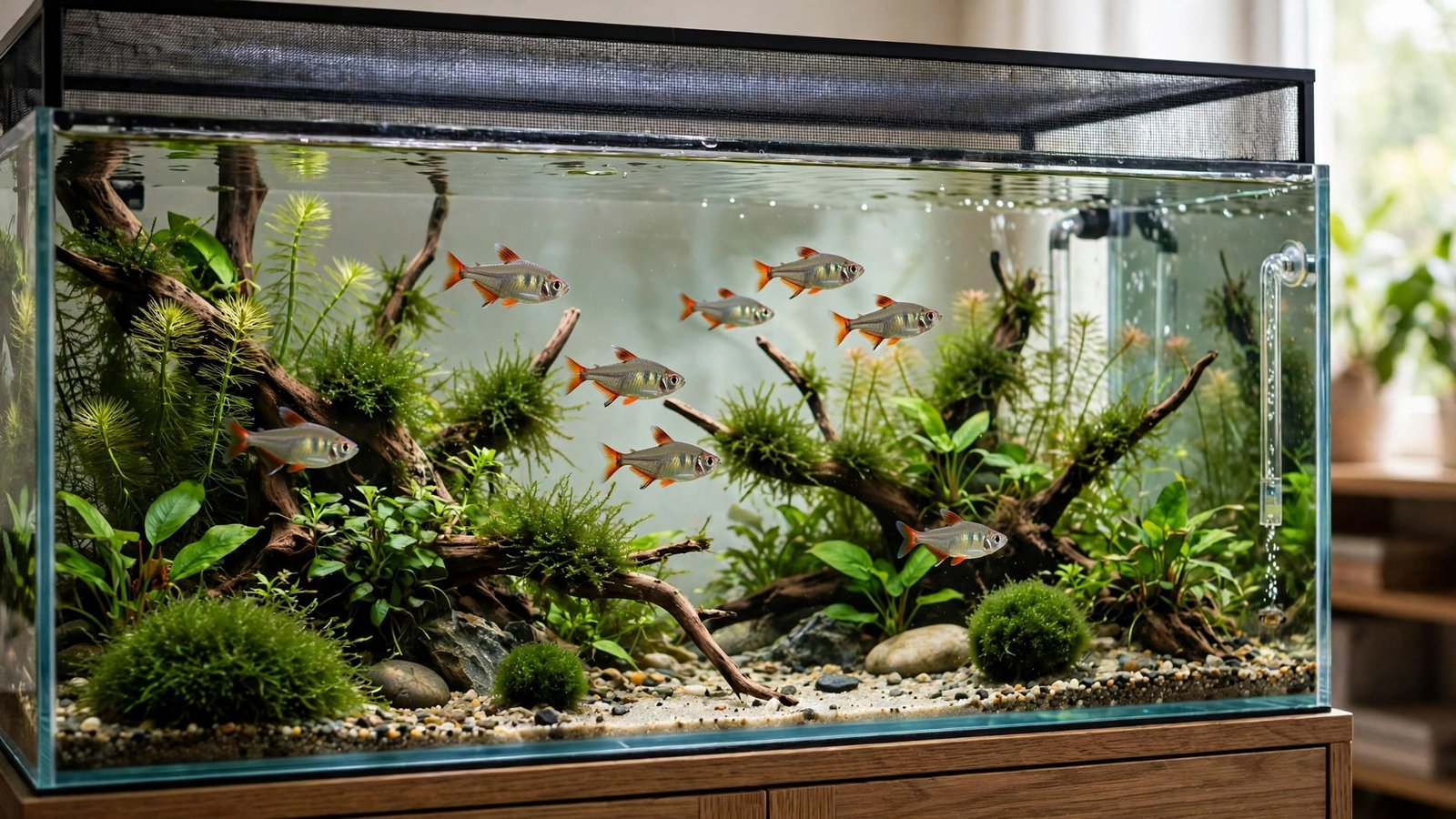
The first bloodfin tetra you lose to the carpet teaches the lesson no care sheet emphasizes: these fish are jumpers. A school of Aphyocharax anisitsi can turn a lidless open aquascape into a one-way trip across the room. This bloodfin tetra planted tank guide shows you how to keep them in the water — tight lid, floating-plant cover, and the fine-leaved planting this Paraná-basin classic needs to breed.
The short answer: a bloodfin tetra planted tank needs a tight lid, floating plants covering roughly a third of the surface, and fine-leaved plants like java moss or hornwort for this egg-scatterer to spawn in. Give a school of 8–10+ a 20-gallon or larger tank at 18–26°C (64–79°F), and you get a hardy classic schooling since the early 1900s. Skip the lid and you will eventually find one of your fish on the floor.
Why bloodfins jump — and why your bloodfin tetra planted tank needs a lid first
Bloodfins live in the upper-middle water column and feed at the surface in the wild streams of the Paraná basin. That surface habit gives them explosive acceleration: a startled fish can clear several inches of air. Common triggers are bright overhead light with no shade, a tankmate darting, or a net passing overhead.
Every floating-plant cover picks for jumpers in that guide applies here, but the lid is the part that actually stops the escape. Choose a glass canopy or tight plastic hood with cable cut-outs sealed — a one-inch gap is plenty for a determined tetra. A rimless open-top look and bloodfins do not mix.
The right school: numbers that make them bold
A bloodfin alone or in a pair is a different animal: pale, skittish, pressed into a corner. At 8–10+ the school clicks into gear — red fins flashing in synchronized turns. This matters practically: bolder fish jump less, because most jumps are panic responses from fish that never settled.
Plan for a 20-gallon long or larger so the school has a genuine runway. A standard 10-gallon can physically hold six, but the cramped footprint keeps them edgy, and edgy fish jump. In 29 gallons and up, 12–15 creates the flowing river-school effect they are known for.
Layout: open lanes with a planted ceiling
Think of the layout in three zones. The bottom and midground get your aquascape — driftwood, a low foreground, and stem plants along the back and sides. The center stays open: a clear corridor end to end where the school performs. The surface gets the "planted ceiling": floating plants that calm jumpy tetras covering 30–40% of the water in the back two-thirds.
This cover dims the light from above and pads the surface, so a spooked fish bumps plant matter instead of launching into air. Frogbit and water lettuce are ideal — their dangling roots give the school shaded cover. Leave the front third open for feeding and viewing.
Plants that work hardest for bloodfins
Bloodfins are gentle with vegetation — they won't shred leaves the way Buenos Aires tetras will — so nearly any planted-tank plant suits them. The species that earn their place here do specific jobs:
| Plant | Job in this tank | Notes |
|---|---|---|
| Frogbit / water lettuce | Overhead security, jump deterrent | 30–40% of surface; thin weekly |
| Java moss | Egg-catching for breeding, fry refuge | Tie to wood; any light |
| Hornwort | Spawning cover, nitrate sponge | Float or weigh down |
| Anubias / java fern | Low-maintenance midground | Never bury the rhizome |
| Vallisneria / tall stems | Background curtains, sightline breaks | Trim to protect open lanes |
Java moss and hornwort matter twice over, because bloodfins are egg scatterers. Easy plants for a bloodfin school rounds out the undemanding background species that thrive in the same cool, moderate-light water.
Water: cool, clean, and forgiving
Bloodfins are famously hardy — they tolerate the learning curve. Their cool-water tolerance is the standout trait: comfortable down to 18°C (64°F), among the few tetras happy in unheated room-temperature tanks. Cap the top end at 26°C (79°F); prolonged heat shortens their lifespan.
Keep pH between 6.0 and 7.5, hardness soft to moderate — they adapt to most tap water. Acclimate them to a fully cycled filter and hold nitrates under 20 ppm with 25–30% weekly water changes. Use gentle filter flow; strong current stresses surface feeders. Feed small floating foods — micro pellets and crushed flake — plus frozen daphnia weekly.
Breeding: egg-scattering in the moss
Given fine-leaved cover and good condition, bloodfins spawn without ceremony — often at first light. Males color up and chase females through the moss, where she scatters the eggs.
For a real yield, set up a dedicated 10-gallon breeding tank with a thick java moss mat, move in a conditioned pair or trio in the evening, and remove the adults the morning after spawning. Eggs hatch in 24–36 hours; feed the fry infusoria first, then newly hatched brine shrimp.
Good tankmates for a planted bloodfin school
Choose peaceful fish that share the 18–24°C sweet spot and won't outcompete the school at the surface. Corydoras patrol the bottom and peaceful rasboras school alongside nicely. For the full community picture, see our guide to the best schooling fish for planted tanks.
Avoid two categories: fin-nippers that will harass the school, and large or boisterous fish whose sudden movements trigger jumping. If you like the red-finned look but want a bolder personality, compare the serpae tetra planted tank setup, or the similarly hardy pristella tetra planted tank for another bulletproof schooling option.
Frequently Asked Questions
Do bloodfin tetras really jump out of the tank?
Yes — they are genuine jumpers. Bloodfins feed at the surface and react to frights with explosive upward bursts that clear a rimless edge. Most losses happen in the first two weeks. A tight lid is mandatory; floating plants across part of the surface further reduce panic jumps.
How many bloodfin tetras should I keep together?
Keep 8–10 as a minimum, with 12–15 ideal in 29 gallons or more. Smaller groups stay pale and skittish, and nervous fish jump more. A confident school shows full red-fin coloration and uses the open lanes a planted layout provides.
Can bloodfin tetras live in cold water without a heater?
They tolerate down to 18°C (64°F), among the few tetras comfortable in unheated tanks. Stability matters more than the exact number: a steady 20–22°C room tank beats one swinging between 16°C and 26°C daily. Run a heater if your room drops below 18°C at night in winter.
Will bloodfin tetras eat my aquarium plants?
No — bloodfins are gentle on vegetation and safe with virtually all aquarium plants, unlike notorious plant-shredders such as Buenos Aires tetras. They may peck at soft algae on leaves, which is harmless to the plant, making them ideal for aquascapes you want pristine.
How do I breed bloodfin tetras in a planted tank?
Provide dense fine-leaved plants like java moss or hornwort and condition the fish on live or frozen foods — they will scatter adhesive eggs in the plants, often at dawn. For fry survival, use a separate breeding tank: parents and tankmates eat eggs and fry. Remove adults after spawning; eggs hatch in 24–36 hours.
What tank size do bloodfin tetras need?
A 20-gallon long is the practical minimum for 8–10, giving the horizontal swimming runway they need. Larger is noticeably better: 29 gallons and up supports 12–15 fish and the flowing school behavior they are known for. Always fit a tight lid.
The calm, jumping-proof bloodfin tank
A bloodfin tetra planted tank succeeds on three quiet decisions: a lid that actually seals, a floating-plant ceiling that tells the school the surface is safe, and fine-leaved plants pulling double duty as spawning cover. Get those right in a 20-gallon or larger tank at 18–26°C, and this century-old Paraná classic rewards you with one of the hardiest schooling displays in the hobby. For a deeper look at the species' wild origins, see the Seriously Fish profile of Aphyocharax anisitsi.