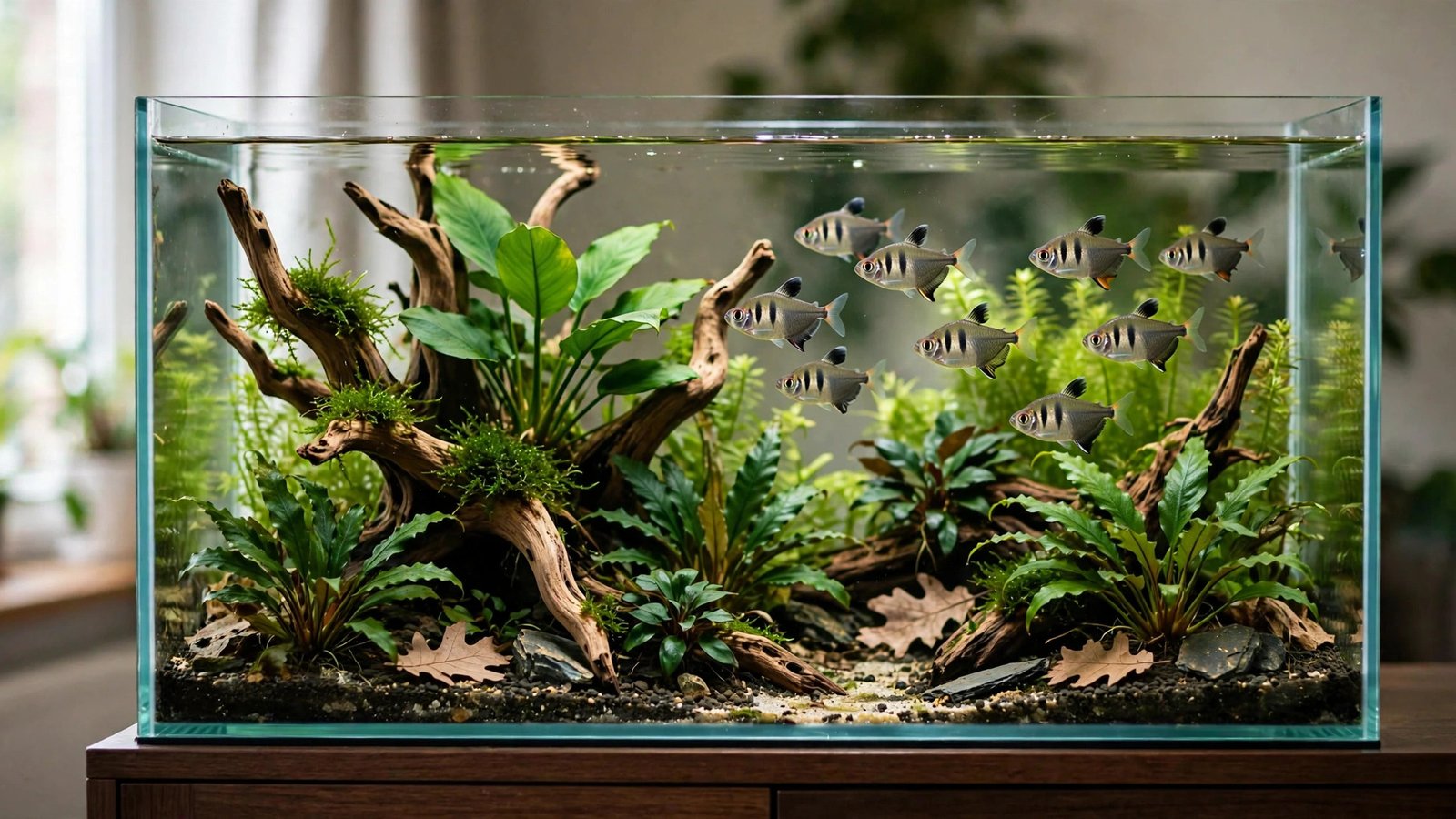
Most black skirt tetras look washed out in shops because bare glass drains their charcoal skirts to grey. A proper black skirt tetra planted tank does the opposite: dense planting, dark substrate, and a correctly sized school turn Gymnocorymbus ternetzi into a striking schooler and calm the fin-nipping reputation that worries beginners. Here is the exact school size, the layout that keeps them peaceful, and how to aquascape around their monochrome look.
Choose plants that suit a monochrome schooling display before you buy the fish, and half of the "difficult tetra" reputation disappears on day one.
Gymnocorymbus ternetzi: Know the Fish You Are Buying
Black skirt tetras come from slow rivers of the Paraguay basin, where they live in large shoals under overhanging vegetation. They are true shoalers tuned to the presence of a crowd — and their natural cover is plant matter, not open water. A planted tank suits their biology, not just their looks. (The Seriously Fish species profile for Gymnocorymbus ternetzi confirms the wild-habitat details and independently recommends a shoal of at least 12.)
They are also routinely misidentified, and the confusion causes real stocking mistakes. The black skirt (Gymnocorymbus ternetzi) is taller and deeper-bodied than the black neon (Hyphessobrycon herbertaxelrodi), a smaller, calmer fish detailed in the black neon tetra planted tank setup, and a different genus from the black phantom (Megalamphodus megalopterus) in the black phantom tetra planted tank guide. Black skirts grow larger than both and nip more readily when their schooling needs are ignored.
Your black skirt tetra planted tank setup plan
Think of this as a species-specific variant of a lightly planted display setup, tuned for a bolder tetra. Just horizontal swimming space, layered retreat cover, and a dark backdrop that keeps their black fins reading as black instead of muddy grey.
| Parameter | Target | Why it matters |
|---|---|---|
| Tank size | 20 gallons long (30" footprint) minimum | Horizontal swimming lanes for a midwater school |
| School size | 10–12 fish | Below 8, hierarchy stress converts into nipping |
| Temperature | 72–79°F (22–26°C) | Mid-range holds color best long-term |
| pH | 6.5–7.2 | Stability matters more than the exact number |
| Lighting | Medium, 7–8 hours daily | Enough for plants, dim enough to calm the school |
| Filtration | Gentle — sponge or baffled HOB | They dislike strong current; plants do too |
Schooling-size math, honestly done
A school of 6 in a 20-gallon is the advertised minimum, not the comfortable one. At 6 fish, every individual is constantly visible to every other, so the dominance pecking order never diffuses — and that is when fins get tasted. At 10–12, aggression dilutes across the group, and the energy goes into synchronized swimming instead of harassment.
The math still works: twelve 3-inch tetras is roughly 36 inches of fish in a 20-gallon, which a planted tank with weekly 30% water changes handles comfortably, since plants absorb a share of the nitrate. If your tank is a 15-gallon, do not solve it with a smaller school — choose a smaller tetra. Understocking causes most "nipping problems" blamed on the fish.
Fin Nipping: Myth vs Reality in Planted Setups
The myth says black skirt tetras are fin nippers, full stop. The reality is conditional: in bare tanks with 5–6 fish, nipping is common — the fish are stressed, exposed, and bored. In a planted tank with 10+ fish and sightline breaks, the same species schools tightly and leaves tankmates alone, since a chased fish can vanish for ten seconds and end the pursuit. Assertive tetras like serpaes work the same way. Two rules keep the peace permanently:
- Never keep long-finned tankmates with them. Flowing betta fins, guppy tails, and angelfish veils are invitations. Pair them with short-finned community fish — corydoras, otocinclus, other robust tetras — and let a cleanup crew for the planted tank handle the algae.
- Feed enough, twice a day. Much "nipping" is exploratory tasting by underfed fish — quality micro-pellets morning and evening, gone in 90 seconds, ends it.
Aquascaping Around a Monochrome Fish
A black skirt is a two-tone animal — charcoal fins, silver-grey body (juveniles show bold vertical bars that fade with age). Your aquascape frames that palette: contrast control, not colorful plants.
- Dark substrate is non-negotiable. Black sand or dark aquasoil makes black fins pop and silver bodies glow; pale gravel washes them out and stresses tetras.
- Build a green wall, not a garden. A dense background of Vallisneria or Ludwigia with midground crypts gives the school a corridor to swim along and thickets to duck into — the corridor principle in this comparison of schooling fish for planted tanks.
- Leave the center open. A clear midwater lane with plants massed left and right turns 12 fish into a single moving ribbon against negative space.
- One warm accent, maximum. A single reddish plant cluster or warm-toned spiderwood stops the tank feeling cold. Restraint is the aesthetic — this fish rewards minimalism.
Stick to undemanding species: java fern, anubias, crypts, vallisneria, floating frogbit. These are easy plants for a beginner tetra tank precisely because they tolerate the moderate light and gentle flow a black skirt setup wants.
What gear actually matters
On gear, two purchases decide how this tank feels: buy a 20-gallon long for the horizontal run (footprint over volume), and buy the full shoal pack of 10–12 together — fish added two at a time re-negotiate rank with every addition and nip through the whole process.
Frequently Asked Questions
Are black skirt tetras fin nippers?
Sometimes, but it is conditional. Nipping concentrates in schools under 8 fish, in bare tanks with no retreats, and around long-finned tankmates. In a planted 20-gallon with 10–12 black skirts, dense cover, and short-finned companions, persistent nipping is uncommon. Fix the stocking and the cover before blaming the species.
How many black skirt tetras should I keep together?
Ten to twelve is the sweet spot for a 20-gallon planted tank. Six is the oft-quoted minimum, but hierarchy stress at that number is exactly what produces nipping — every fish is always visible to every other, so aggression concentrates. Above 8–10, the pecking order diffuses and the fish spend their energy schooling instead.
What tank size does a black skirt tetra need?
A 20-gallon long (30-inch footprint) is the honest minimum for a school of 10–12. Adults reach 2.5–3 inches, so a 10-gallon cannot hold a group large enough to stay peaceful. Prioritize horizontal swimming space over height — midwater swimmers use the full length of the tank.
Are black skirt tetras the same as black neon tetras?
No — different species entirely. The black skirt is Gymnocorymbus ternetzi, taller and deeper-bodied, reaching 2.5–3 inches. The black neon (Hyphessobrycon herbertaxelrodi) stays near 1.5 inches and is calmer; black phantoms (Megalamphodus megalopterus) are a third species again. Identify the fish before planning — each has different needs.
A Calm, Striking School
A black skirt tetra planted tank rewards restraint: right school size, honest tank dimensions, dark substrate, plants massed where the fish use them. Get those four right and the "nippy tetra" reputation never shows up — what you get is a ribbon of silver and black moving as one animal through green water.