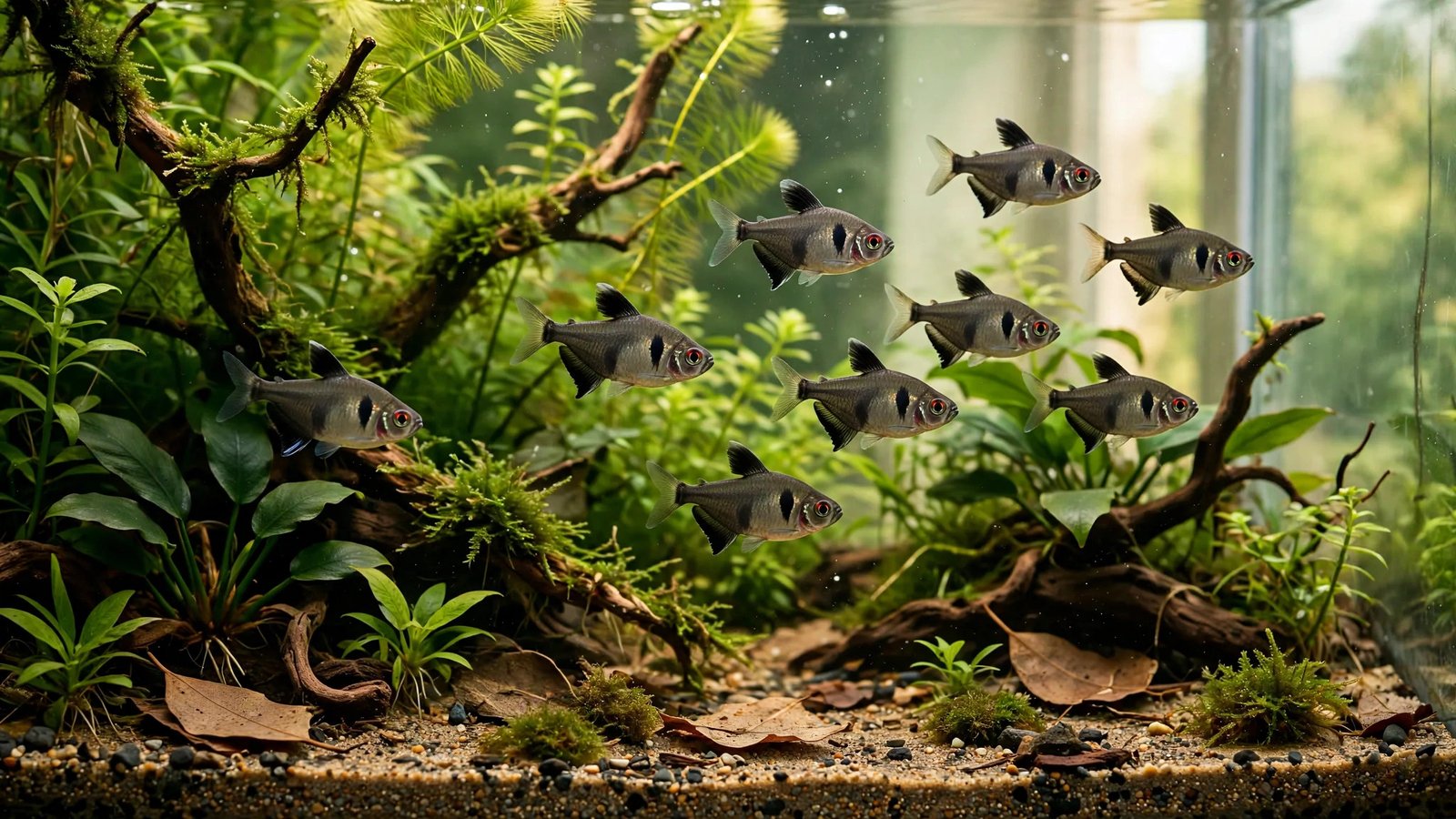
Watch a male black phantom tetra at dusk and you will see freshwater's most theatrical duel: sail-black fins unfurled, circling a rival in slow, silent mock battle. That display only happens in the right light — which is why a black phantom tetra planted tank built around dim lighting, dark substrate, and open swimming lanes reveals behavior a bright tank never will. Note: this is Hyphessobrycon megalopterus, not the black neon tetra — a different species.
A dim, soft-water black phantom tetra planted tank is the single best way to see this species at its peak. Keep 8–10 in a 20-gallon tank with dark substrate, floating-plant shade, tall background cover, and an open swimming lane; hold 22–26°C and pH 6.0–7.0, and you will see the males' famous mock battles — sail fins spread, circling fin-to-fin — a display that appears almost exclusively under low light.
Planning the Black Phantom Tetra Planted Tank
Black phantoms come from the upper Paraguay basin in South America, and they carry one quirk that shapes the whole setup: adult males spar. No nipped fins, no blood — they circle, flare those tall black fins, and stage ritual battles to sort the pecking order. In a group of four, one loser takes all the pressure; in a school of eight to ten, the duels rotate. That number sets the tank size: a 20-gallon long is the realistic floor, a 29-gallon better still.
Layout follows behavior. These are mid-water schoolers that patrol open water and break for cover when startled — think "forest edge." Scape in zones: a dense tall-plant wall across the back third, and the front two-thirds left as an unobstructed swimming lane. The broad principles of matching plants to livestock are covered in this guide to aquarium plants for fish tanks, whose section on mid-water schoolers maps directly onto this build.
Dim Light and Dark Water: The Color Key
The classic mistake with black phantoms is bright light and pale substrate. Under intense light their black fins wash out to grey, females go pallid, and the sparring stops — the display is light-gated. Run dimmable LEDs at roughly 40–60% output and float salvinia, frogbit, or red root floaters to dapple the surface. Floating plants double as overhead cover, which visibly reduces skittishness in the first two weeks.
Dark substrate completes the effect — fine black sand or dark aquasoil. Smoke-grey bodies and black fins stand out like ink on paper, and fish that feel less exposed school tighter and spar more. A lightly planted aquarium setup with subdued lighting is the right template: enough plant mass for water quality and cover, never a wall-to-wall jungle.
 ★4.8
Seachem Catappa Leaves 12-pack
Check Price on Amazon ★4.8 ★4.4
BN-LINK Digital Outlet Timer
Check Price on Amazon ★4.4Plant Picks: Tall Cover, Open Lanes
Choose plants that grow tall in dim light and stay in the background. Fast stems along the back give instant cover while the scape matures; epiphytes on the hardscape add texture without stealing the lane.
| Zone | Plant | Why it fits |
|---|---|---|
| Background | Vallisneria spiralis | Tall ribbon cover in low light |
| Background | Hygrophila corymbosa | Fast, dense — instant security for new schools |
| Midground | Java fern on driftwood | Texture without blocking the lane |
| Midground | Cryptocoryne wendtii | Bronze leaves complement the fins |
| Surface | Salvinia or frogbit | Shade — the biggest single color upgrade |
Water Parameters and Weekly Care
Black phantoms are forgiving, but they color up best in soft, slightly acidic water. Stability matters more than any exact number — this species comes from slow, tannin-stained waters.
| Parameter | Target |
|---|---|
| Temperature | 22–26°C (72–79°F) |
| pH | 6.0–7.0 |
| GH | 4–12 dGH (soft side preferred) |
| Ammonia / nitrite | 0 ppm |
| Nitrate | Under 20 ppm |
| Water changes | 25–30% weekly |
Cycle fully before the school goes in — plant the tank first and give it two to four weeks. Growing stem plants pull ammonia directly, which shortens the cycle. Feed lightly for the first week and test daily; tetras are sensitive to the nitrite spike of a lazy cycle.
Tankmates, Sexing, and Feeding
Black phantoms are peaceful community citizens. Good companions are other calm, dim-light-tolerant schoolers: ember tetras and cardinal tetras fit well, alongside corydoras and a bristlenose pleco. Avoid large or boisterous fish — big cichlids and barbs keep the school pinned in the plants and the fins faded.
Sexing is easy: males carry the tall, jet-black dorsal and anal fins; females are smaller, rounder, and smoky grey with reddish-tinged fins. A male-heavy school — say six males to four females — produces the most sparring, provided the group is big enough to absorb it. If one male is constantly targeted in the first month, add two or three fish rather than removing the aggressor; more targets dilute the pressure.
Feeding is simple: a quality micro-pellet or crushed flake as the daily base, plus frozen daphnia or baby brine shrimp twice a week. The carotenoids in frozen foods deepen the females' warm grey-red tones within two to three weeks. Feed only what disappears in ninety seconds, twice daily. Their congener serpae tetras thrive on the same rhythm.
Breeding in the Planted Tank
Black phantoms are egg scatterers and will occasionally spawn in a well-run planted tank at dawn — a male and female tumbling through fine-leaved plants. The eggs rarely survive in the display tank, so set up a separate 10-gallon breeder: soft acidic water (pH 6.0–6.5), a spawning mop or java moss, dim light. Condition a pair on frozen foods for ten days, introduce them in the evening, and remove both adults the morning after spawning. Fry hatch in 24–36 hours — infusoria for the first week, then baby brine shrimp.
For authoritative species data, see Seriously Fish's black phantom tetra species profile, and filter background plants by light demand in Tropica's plant database.
Frequently Asked Questions
Is the black phantom tetra the same as the black neon tetra?
No. The black phantom is Hyphessobrycon megalopterus; the black neon is Hyphessobrycon herbertaxelrodi. Phantoms grow larger (about 4 cm), carry the males' tall black sail fins, and spar in mock battles. Black neons are smaller, slimmer, marked with a black-and-neon stripe, and never display the fin-flaring duels. Different temperaments, different tank needs.
How many black phantom tetras should I keep together?
Eight to ten is the sweet spot; six is the minimum. Males spar in ritualized mock battles, and in small groups the weakest male absorbs all the attention and stops eating well. Larger schools rotate the sparring, keeping every fish fed and colored. Buy the whole school at once — one introduction settles faster than trickle additions.
Why are my black phantom tetras' black fins fading?
Almost always too much light or too pale a substrate. The black fin pigment fades under bright lighting as a stress response — dim the LEDs, add floating-plant shade, and switch to dark substrate. Allow two to three weeks for recovery. If fins stay pale, check nitrates: levels above 20 ppm will also wash out their color.
Are black phantom tetras good for beginners?
Yes — among the most forgiving tetras. They tolerate a wide temperature and pH range, eat any small food, and resist common beginner diseases better than fussier species. The only traps are keeping too few (under six) and blasting them with bright light. Get the school size and dimming right and they are nearly bulletproof.
Do black phantom tetras nip fins like serpaes?
No — this is the key difference from their serpae cousins. Male black phantoms spar in ritualized mock battles: circling with flared fins, no contact, no torn fins. In a school of eight or more the duels rotate and nobody gets hurt. Serpae tetras, by contrast, are genuine fin-nippers and should never share this tank.
The Ghost-Finned Schooler, at Its Best
Black phantom tetras ask for almost nothing a planted tank does not already provide — soft water, plant cover, calm currents — and repay it with one of freshwater's most theatrical displays. Dim the lights, darken the substrate, give them a lane to duel in, and the ghosts will come out.