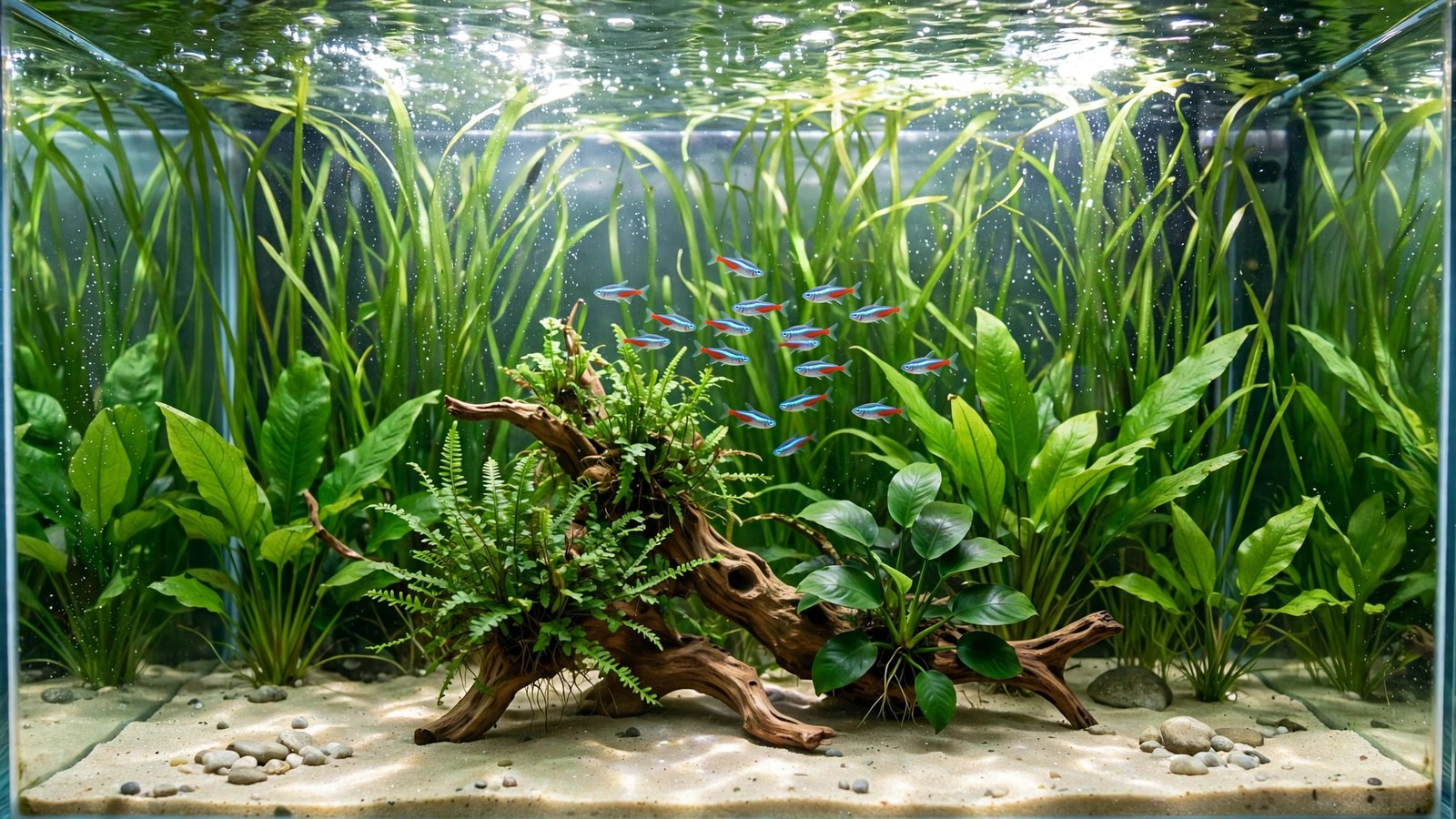
Put one drop of food coloring in a drinking glass of water and it turns dark. Put the same drop in a swimming pool and nothing changes. That single image explains almost everything about aquarium size: every beginner mistake — a little overfeeding, a dead fish left overnight, a heater that sticks on, an ammonia pulse from fresh substrate — hits a 5-gallon tank ten times harder than a 20-gallon one. And yet most beginners buy the smallest tank they can find, because small looks easier. This guide fixes that mistake before you spend a dollar.
Why Bigger Is Easier: The Stability Math
The number-one killer of first planted tanks is not bad plants or bad luck — it is the classic beginner mistakes, and almost all of them scale inversely with water volume. Here is why size is your cheapest insurance policy:
- Dilution. One overfeeding or one hidden dead fish releases the same ammonia whether your tank holds 5 gallons or 20. In the 5-gallon, the resulting ammonia concentration is four times higher — the difference between a stressed fish and a dead one.
- Temperature stability. Water resists temperature change in direct proportion to its volume. A heater malfunction or a hot afternoon nudges a 20-gallon a degree or two; the same event can cook a 3-gallon before you get home from work.
- Dosing forgiveness. A double dose of fertilizer or dechlorinator in a nano is a real overdose. In a 20-gallon, the same slip is a rounding error the plants and water changes absorb.
- Cycling room. During the 2–6 week cycle, ammonia readings in a small tank can rocket from zero to dangerous between your morning and evening tests. Larger volumes move slowly enough that daily testing actually catches problems in time.
None of this means you can neglect a 20-gallon — it means the tank forgives you while you learn. And you cannot eyeball any of this: a liquid test kit like the API Freshwater Master Test Kit ★4.8 is how you turn that forgiveness into visible confidence, checking ammonia, nitrite, nitrate, and pH until the numbers tell you the tank is truly stable.
The 20-Gallon Long: The Sweet Spot
There is a reason the 20-gallon long is the most recommended first planted tank in the hobby, from forums to fish stores: it is the smallest tank that behaves like a big one, and the biggest tank that still behaves like a cheap one.
The footprint does the work. At roughly 30 inches long and 12 deep, a 20-long gives you genuine aquascaping room — a foreground, a midground, and a background, a focal driftwood piece with planting zones on either side. A 20-high has the same water volume in a 24×12 footprint, and scaping it feels like decorating a phone booth. The long layout also means a proper swimming lane: a school of 10–12 neon tetras or chili rasboras actually schools in 30 inches of length.
The equipment economics are unbeatable. The 20-gallon sits squarely in the commoditized middle of the hobby: standard hang-on-back filters fit it perfectly, 24–30 inch LED fixtures are the most common and cheapest per inch, glass 20-longs are among the cheapest dollars-per-gallon tanks sold, and replacement parts are everywhere. Step up to 40 gallons and every component gets a size — and price — bump; step down to 5 and you are paying boutique prices for nano-specific gear.
Maintenance stays a hobby, not a chore. A 20–30% weekly water change on a 20-long is 4–6 gallons — two bucket trips. Parameters move slowly enough that weekly testing (then biweekly once stable) is plenty. The tank is large enough to hold a stable temperature with a basic adjustable heater, and an adjustable-flow hang-on-back filter like the AquaClear 20 ★4.3 gives you the classic 20-gallon filtration: the adjustable flow lets you dial the current down so new stem plantings are not flattened while the tank establishes.
The 10-Gallon: The Honest Alternative
A 10-gallon (20×10×12 in) is a legitimate first planted tank if space or budget genuinely forces the choice — a dorm room, a small apartment, a strict spending cap. Plenty of beautiful planted 10-gallons exist. What you must accept is the trade: you get half the water volume, which means roughly half the buffer against every mistake above.
The 10-gallon rules, stated plainly:
- Stock lighter than you think. Six to eight nano fish (ember tetras, chili rasboras) plus a shrimp colony is a full 10-gallon, not a starter stocking.
- Test more, especially early. During the cycle, test ammonia and nitrite daily — spikes develop faster here.
- Plant heavily from day one. Aim to cover 70–80% of the substrate immediately; dense planting is your substitute for the missing water volume. Fast growers pull ammonia before it spikes.
- Keep the lid on evaporation. Losing half a gallon to evaporation in a 10-gallon concentrates minerals and swings parameters noticeably; top off with fresh water between changes.
If the all-in-one route appeals to you at this size, a complete kit like the Aqueon 10-gallon starter kit with LED lighting ★4.2 bundles the tank, filter, and light so you do not have to match components yourself — a reasonable entry point, with the understanding that you may upgrade the light later if you catch the high-tech bug. Whatever you buy, run through our beginner mistakes checklist before filling it.
Nano Tanks (2.5–5 Gallons): Beautiful Hard Mode
Nano tanks are the great beginner trap of the hobby. They are small, cheap, and the scapes on social media are stunning — so they look like the sensible first purchase. In practice, a 3-gallon is an expert tank wearing a beginner costume.
The physics is unforgiving. In 3 gallons, a single overfeeding can push ammonia to toxic levels in hours. A sunny windowsill can swing the temperature 5 degrees by afternoon. Evaporation of a few cups meaningfully changes hardness and TDS. And stocking options collapse: a 5-gallon holds one betta or one shrimp colony, period — anything more is overcrowding, and a 2.5-gallon holds even less.
That said, nanos have exactly two honest first-tank use cases: a single betta in a well-planted 5-gallon (see our planted betta tank setup), or a cherry shrimp colony in a densely planted 5-gallon where the plants outnumber the bioload. Both work because the livestock is minimal and the planting is maximal — the opposite of the "five fish in a 3-gallon" fantasy the box art suggests.
Disclosure: the product links above are Amazon affiliate links — if you buy through them, I earn a small commission at no extra cost to you, which keeps these guides free.
Going Bigger: 29, 40 Breeder, and 55 Gallons
What about starting bigger than 20? The honest answer: 29 and 40-breeder are excellent first tanks if your space, stand, and budget are ready. The 55-gallon, the classic "big starter," is the one to think twice about.
- 29-gallon (30×12×18 in). The same 30-inch footprint as the 20-long, six inches taller. All the 20-long's virtues, plus room for tall background plants like vallisneria to stretch. The catch: light must penetrate 18 inches of water, so budget for a stronger fixture, and it weighs roughly 330 pounds filled.
- 40-gallon breeder (36×18×16 in). The aquascaper's favorite large tank — a huge 36×18 footprint that makes dramatic layouts easy, at a depth you can still reach the bottom of. Superb stability, genuinely roomy stocking. The commitment: around 460 pounds filled, a properly rated stand is non-negotiable, and substrate, light, and filtration all cost meaningfully more.
- 55-gallon (48×13×21 in). The classic regret. It is 4 feet long but only 13 inches front-to-back and 21 deep — narrow enough that scaping feels cramped, deep enough that planting the back requires tongs and a step stool. Beautiful as a second tank for big schools; awkward as a first.
The real ceiling on "bigger is better" is maintenance morale. Past about 40 gallons, a 30% water change is 12+ gallons — a Python water changer stops being optional and starts being the purchase that decides whether you still enjoy the tank in month six. If a 55 calls to you, read our 55-gallon planted setup guide with eyes open about the weekly bucket math.
The Comparison, Side by Side
Approximate filled weights include tank, substrate, water, and basic equipment:
| Tank size | Footprint (in) | Filled weight (approx) | First-tank verdict |
|---|---|---|---|
| 5.5-gallon | 16×8×10 | ~65 lbs | Hard mode — betta or shrimp only |
| 10-gallon | 20×10×12 | ~115 lbs | Workable if space or budget forces it |
| 20-gallon long | 30×12×12 | ~225 lbs | The sweet spot |
| 20-gallon high | 24×12×16 | ~225 lbs | Fine, but less scaping room than the long |
| 29-gallon | 30×12×18 | ~330 lbs | Great — needs stronger light for the depth |
| 40-gallon breeder | 36×18×16 | ~460 lbs | Superb, but a real commitment |
| 55-gallon | 48×13×21 | ~625 lbs | Awkward first tank — narrow and very deep |
What Changes With Size: Equipment and Stocking
Tank size dictates every equipment choice downstream. The rules of thumb:
- Filtration: aim for a filter rated to turn over 4–6 times the tank volume per hour. A hang-on-back filter covers everything up to about 29 gallons; at 40+ gallons a canister filter earns its price in media capacity and silence.
- Heater: 3–5 watts per gallon of tank volume — so a 100-watt adjustable heater covers a 20-gallon comfortably. Always use adjustable, never preset, so you can actually set 76°F instead of hoping.
- Light: match the fixture length to the tank's footprint — a 24–30 inch light for a 20-long. Deeper tanks (29, 55) need stronger output to reach the substrate; this is where cheap kit lights fail first.
- Substrate: budget 1 pound of substrate per gallon as a starting estimate, a little more for deep aquasoil beds. A 20-long wants roughly 20 pounds; a 40-breeder wants 40+.
Stocking scales with volume too, and planted tanks reward restraint:
- 10-gallon: one school of 6–8 nano fish (ember tetras, chili rasboras) plus cherry shrimp and a snail crew.
- 20-long: a proper school of 10–12 tetras or rasboras, a bottom crew of 6 pygmy corydoras, shrimp, and snails — a complete community with room to spare.
- 40-breeder: two full schools plus a centerpiece fish (a pair of dwarf cichlids or a gourami), with planting zones to match.
Add livestock in waves, never all at once — a week or two between groups, watching test readings. Our silent cycling guide shows how heavy day-one planting lets you stock sooner, safely.
Practical Constraints: Space, Stand, and Water Changes
Before falling in love with a size, run three reality checks:
1. The stand. Water weighs 8.34 pounds per gallon, and the tank, substrate, and equipment add plenty more — a filled 20-long lands around 225 pounds, a 40-breeder near 460. Furniture is not a stand: dressers, desks, and bookshelves are not rated for concentrated, permanent, water-adjacent loads. Buy or build a stand rated for aquariums, set it level (shim it if the floor is not), and never put a tank where a leak would ruin something irreplaceable.
2. The water logistics. You will change 20–30% of the water weekly — that is 4–6 gallons (two buckets) for a 20-long, 12+ gallons for a 40-breeder. Put the tank within hose or bucket distance of a sink or tub, near power outlets for the filter, heater, and light timer, and away from direct sunlight (which grows algae faster than any plant). Hauling buckets across the apartment gets old by week three; plan the route now.
3. The budget, honestly. The tank itself is the cheapest part. Substrate, light, filter, heater, test kit, plants, and hardscape typically cost several times the tank's price — and they scale with size. A 20-long hits the sweet spot where all of this stays reasonable; a 40-breeder roughly doubles the equipment bill. If money is tight, a low-tech setup keeps the 20-long affordable without sacrificing the scape.
The Decision: Three Questions
Forget the forums for a minute and answer these:
- Where will it live? Measure the surface. If you have 30 inches of sturdy, level, water-safe surface near a sink and outlets, get the 20-long. If you genuinely only have 20 inches, get the 10 — and stock it like a 10.
- What is your real budget? Price the whole setup — substrate, light, filter, heater, test kit, plants — not just the glass box. If the 20-long's full setup breaks the budget, a well-built 10-gallon beats a stripped-down 20 every time.
- How much water will you happily carry every week? Be honest. Two buckets is a ritual; six buckets is a chore you will start skipping, and skipped water changes kill more tanks than wrong tank sizes ever will.
If all three answers point to the 20-long, congratulations — you just picked the tank size that gives beginners the highest odds of still loving this hobby a year from now. Plant it heavily on day one, cycle it patiently, and pick an aquascaping style that forgives beginners. For the science behind why some setups thrive with minimal gear, the 2Hr Aquarist guides are the best research-backed reference in the hobby, and Tropica's plant database confirms difficulty ratings for the easy species you will stock it with.
The 5-Gallon Plant List
Epiphytes (the nano backbone)
- Anubias nana petite — tiny leaves, perfect scale, indestructible
- Java fern (narrow/Windeløv) — small varieties on the wood piece
- Bucephalandra (small varieties) — jewel accents; the 5-gallon shows them off
- Java moss / Christmas moss — on wood and stones; shrimp graze it constantly
Small stems and midground
- Cryptocoryne parva / wendtii 'green gecko' — appropriately tiny crypts
- Staurogyne repens — trimmable nano hedge
- Rotala rotundifolia — background stems kept short by trimming
- Pearl weed — versatile nano filler
Foreground
- Monte Carlo — the nano carpet; dry-start it for fastest results
- Dwarf hairgrass — grass texture at the right scale
- Dwarf sagittaria — easy runner carpet, no CO2 needed
Floating
- Salvinia minima or frogbit — a small patch only; full coverage suffocates a 5-gallon. See our floating plant guide.
Stocking: The Short, Strict Menu
Pick one of these concepts — not combinations:
- Single betta: the definitive 5-gallon resident. A planted 5-gallon is a betta palace — our planted betta tank setup is the full guide.
- Shrimp colony: 10–15 cherry shrimp to start; the colony finds its own level. Our planted shrimp tank setup covers parameters.
- Nano fish school: 6–8 chili rasboras or 6 ember tetras — one tiny species, nothing else. See our schooling fish guide.
- Single pea puffer: one puffer, densely planted — our pea puffer setup details the care.
- Shrimp + snails only: the lowest-maintenance living ecosystem; surprisingly captivating.
What never works: guppies (breed beyond capacity in weeks), "a few tetras and a cory" (too much bioload, wrong scale), dwarf gouramis (need more room), any schooling fish in groups under 6.
Example Nano Scape: Step by Step
A concrete build to copy: start with 1 inch of aquasoil sloped slightly higher at the back. Place one small dragon stone off-center at the golden-ratio point, burying it a third deep. Tie anubias nana petite and a bucephalandra to the stone; wedge java moss into its crevices. Plant 2 pots of dwarf sagittaria across the foreground in a loose grid, 3 stems of rotala behind the stone, and a crypt parva cluster at the stone's base. Float a small patch of salvinia. Fill slowly, cycle, then add 10 cherry shrimp — within two months the sagittaria runners knit the foreground, the moss softens the stone, and the shrimp colony grazes the whole composition. Total plant cost: modest. Total time: one focused afternoon. This single-stone formula works because it respects the 5-gallon's one-idea rule — everything serves the stone.
The 10-Gallon Plant List
Choose plants scaled to the tank — giant swords overwhelm 12 inches of height:
Background (tall for 12 inches)
- Rotala rotundifolia — fine, bushy, trims into perfect hedges at this scale
- Bacopa caroliniana — round leaves, structural, easy
- Ludwigia repens — red-green color without demanding CO2
- Water sprite (planted) — feathery, fast, fills the back in weeks
Midground
- Anubias nana / petite on wood — the small-tank workhorse
- Java fern (narrow leaf, Windeløv) — scaled-down varieties suit 10 gallons
- Cryptocoryne wendtii / parva — perfect midground mounds at this scale
- Bucephalandra — jewel-like accents on hardscape
Foreground
- Dwarf sagittaria — the easy 10-gallon carpet; spreads by runners without CO2
- Monte Carlo — carpets faster with CO2, still works low-tech with patience and a dry start
- Staurogyne repens — low bushy foreground that trims into hedges
Floating
- Frogbit or salvinia — a small patch (not full coverage) adds the finished look. See our floating plant guide.
Plant densely from day one — a 10-gallon needs surprisingly few plants to hit 70% coverage, which is why it establishes so fast. Our planting quantity guide helps with numbers.
Stocking: The 10-Gallon Menu
Small tank, small fish, restrained numbers. Proven 10-gallon planted stocking options (pick one concept):
- Single betta + snail: the classic — a betta in a planted 10-gallon is luxury living. Our planted betta tank setup is the detailed guide.
- Shrimp colony: 15–20 cherry shrimp to start; they'll become 100+. Our planted shrimp tank setup covers it fully.
- Nano school: 8–10 chili rasboras, ember tetras, or celestial pearl danios + shrimp. See our schooling fish guide.
- Pea puffer (single): one puffer in a planted 10-gallon is a superb desktop predator — see our planted pea puffer tank setup.
- Guppy trio + fry management: works, but have the population plan ready — our planted guppy tank setup warns about the math.
What doesn't work: angelfish, gouramis (most), goldfish, rainbowfish, or "a little of everything" — the 10-gallon punishes overstocking faster than any other size.
Frequently Asked Questions
Is a 10-gallon tank good for a beginner planted tank?
Yes — a 10-gallon is a workable first planted tank if space or budget rules out a 20-long. The trade is real, though: half the water volume means faster parameter swings, so test more often during the cycle, stock lighter (6–8 nano fish plus shrimp is a full 10-gallon), and plant 70–80% of the substrate on day one so the plants substitute for the missing water volume.
What is the smallest tank size for a planted aquarium?
The practical minimum is about 5 gallons, housing a single betta or a cherry shrimp colony with heavy planting. Below that, even plants struggle: temperature swings, evaporation-driven hardness shifts, and ammonia spikes overwhelm the tiny water volume. Anything under 5 gallons is an expert project, not a starter tank.
Is a 20-gallon long or a 20-gallon high better for plants?
The long, for three reasons: the 30-inch footprint gives you real foreground–midground–background scaping zones, the shallower 12-inch depth lets light reach the substrate with a modest fixture, and the larger surface area improves gas exchange. The 20-high suits tall background plants but feels cramped to scape.
How much does a 20-gallon fish tank weigh when full?
Roughly 225 pounds, fully set up with substrate, water, and equipment. Water alone is about 167 pounds (8.34 lbs per gallon × 20); the glass tank, substrate, and gear add the rest. Always use a stand rated for aquariums — never ordinary furniture.
Should I buy an aquarium kit or buy everything separately for my first tank?
A kit is cheaper and removes guesswork, which has real value for a first tank — just know the included light is usually the weakest part for growing plants. Buying separately costs a little more but lets you pick a proper planted LED and a reliable filter from the start. Either way, budget the full setup (substrate, light, filter, heater, test kit, plants), not just the glass box.
How long before I can add fish to my first planted tank?
Typically 2–6 weeks for the nitrogen cycle to complete — confirmed by zero ammonia and zero nitrite on a liquid test kit, not by the calendar. A heavily planted tank can shorten this with the silent cycling method, but the testing discipline stays the same.