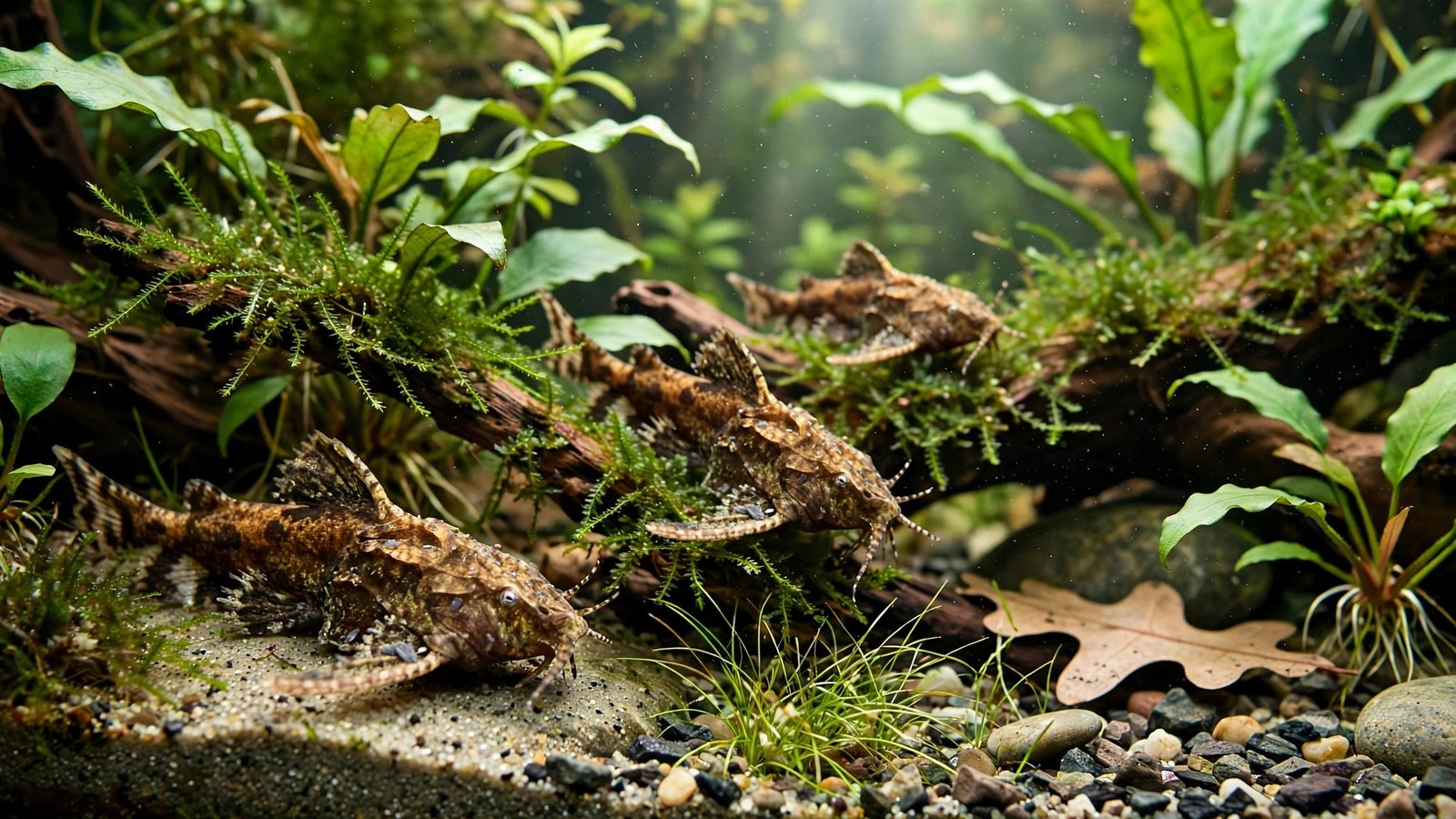
The Asian stone catfish is the size of your thumbnail, ignores algae entirely, and only comes out after dark — yet it's the most planted-tank-friendly nano catfish in the hobby. At just 3–4 cm, Hara jerdoni is the smallest true catfish widely available, and a school of six or more will transform a quiet, dimly planted tank. This guide covers an asian stone catfish planted tank: fine sand, gentle flow, cool water, and the nightly feeding these shy bottom-dwellers need.
Can you keep Asian stone catfish in a planted tank? Yes — Hara jerdoni, at just 3–4 cm, is the smallest true catfish widely sold and one of the most planted-tank-friendly fish available: fully plant-safe, peaceful, and shrimp-safe. Keep a school of 6+ on fine sand in a 10-gallon or larger tank with dense planting, subdued light, 64–75 °F water and pH 6.0–7.5. It eats no algae — feed sinking micro pellets plus frozen bloodworm and daphnia after lights-out.
Meet Hara jerdoni: a miniature catfish built for hiding
The Asian stone catfish (Hara jerdoni, sometimes sold as Erethistes jerdoni, family Erethistidae) comes from slow streams in India and Bangladesh, where it lives among leaf litter, roots, and thick vegetation. Its mottled, stone-like camouflage tells you its habits: by day it sits motionless on the sand or under leaves; after dark it emerges to sift the substrate for food.
The one thing new keepers misjudge is the shyness. A lone fish in a bright, bare tank wedges itself behind the filter and never comes out; a group of six or more in a dim, well-planted tank forages together at night and ventures out by day. For a same-style comparison, see the whiptail catfish in a planted tank — similar habitat needs, very different shape and size.
Setting up an Asian stone catfish planted tank
Every choice here serves one goal: make a shy, nocturnal, sand-sifting fish feel safe enough to come out.
Substrate, light, plants, and hiding spots
Start with smooth, fine sand 2–3 cm deep, rinsed well — the hard rule of this species. Stone catfish forage by mouthing the substrate, and their delicate barbels are easily damaged on coarse gravel.
Bright light drives these fish into hiding. Run low to moderate lighting, break it up with floating plants like frogbit or red root floaters, and plant the lower third densely — low crypts (Cryptocoryne wendtii, C. parva) for foraging cover, anubias and java fern on driftwood for shaded corners, stem plants along the back to cut light and current. Add catappa leaves and alder cones: they tint the water faintly, grow grazing biofilm, and recreate the leaf litter of the fish's home streams. The aquarium plants for fish tank guide covers choosing species that double as shelter.
Filtration and flow
A gentle sponge filter is ideal — no trapping risk and constant grazing biofilm. If you use a hang-on-back or small canister, baffle the outflow and keep circulation gentle but steady.
Water parameters
| Parameter | Target | Notes |
|---|---|---|
| Temperature | 64–75 °F (18–24 °C) | Best at 68–72 °F; avoid sustained heat above 75 °F. |
| pH | 6.0–7.5 | Stability matters more than the exact value. |
| Ammonia / nitrite | 0 ppm | Cycle fully first; catfish are waste-sensitive. |
| Nitrate | <20 ppm | 25–30% water changes weekly. |
| Tank size | 10 gallons minimum | Footprint beats height for bottom-dwellers. |
| Flow | Low to moderate | Sponge-filter flow is ideal. |
Tankmates: a calm nano community
Stone catfish are utterly peaceful — but timid and easily outcompeted at feeding time. Choose small, calm, mid-to-upper-level swimmers: ember tetras, chili rasboras, celestial pearl danios, or pygmy corydoras (day-active, so feeding schedules separate them naturally). Dwarf shrimp are safe tankmates — a planted shrimp tank with a stone catfish school is a classic combination. Avoid large, boisterous, or nippy fish; most barbs and large tetras will stress the catfish or steal their food. Larger catfish cousins like the banjo catfish or featherfin squeaker suit bigger tanks — don't mix them with a stone catfish school.
Feeding a nocturnal micro-omnivore
In the wild these fish sift tiny invertebrates from the sand. In the aquarium they're easy omnivores with one catch: they feed at night, on the bottom, and slowly. Staple: sinking micro pellets or crushed sinking wafers, fed after lights-out. Supplement 2–3 times weekly with frozen daphnia, baby brine shrimp, or finely chopped bloodworm. Offer only what the group finishes overnight; siphon leftovers in the morning.
The critical mistake is assuming they'll "clean up leftovers." They are not a cleanup crew and cannot survive on scraps. Judge by the fish: slightly rounded bellies after a night feed means you're on target; sunken bellies mean they're being outcompeted and need a dedicated feeding spot.
Breeding: rarely reported, be realistic
Breeding Hara jerdoni is poorly documented, with no reliable protocol in the hobby. Scattered reports describe spawning in cool, soft, acidic water after large cool water changes mimicking the rainy season, the male reportedly guarding the eggs. Keep a healthy mixed group in species-correct conditions and treat any fry as a bonus, not a plan.
Common mistakes
- Keeping one or two. A single stone catfish hides forever and wastes from stress. Six minimum; eight is better.
- Gravel substrate. Damaged barbels lead to infection and fish that can't find food. Sand only.
- Too-warm water. A tank at 78–80 °F shortens their lives. Keep at 75 °F or below.
- Bright, bare tanks. High light with no cover means permanent hiding. Dim the light, plant heavily, add leaf litter.
- Daytime feeding only. Faster tankmates eat everything first. Feed after lights-out, every night.
Frequently Asked Questions
How many Asian stone catfish should I keep together?
At least six — a genuinely schooling species. Smaller groups hide constantly and feed poorly. In a 10-gallon tank, 6–8 is the sweet spot; larger tanks can hold 10–12. Bigger groups visibly raise their confidence and daytime activity, and single fish fade fast.
Do Asian stone catfish eat algae?
No. Hara jerdoni is a micro-carnivore eating tiny invertebrates, sinking pellets, and frozen foods like daphnia and bloodworm. It won't clean algae from glass, plants, or substrate. Keep them as a nano schooling fish, fed after lights-out — never as a cleanup crew.
Can Asian stone catfish live with shrimp?
Yes — among the safest fish for a dwarf shrimp colony. At 3–4 cm with tiny mouths they can't eat adult cherry shrimp and are too slow to hunt shrimplets. A planted tank with a stone catfish school and breeding cherry shrimp is a classic, proven combination.
Why is my stone catfish always hiding?
Almost always one of three causes: the group is too small (keep 6+), the tank is too bright or bare (dim the light, add floaters and leaf litter), or the water is too warm (75 °F or below). Fix school size and cover first — most hiding resolves within a week.
How long do Asian stone catfish live?
Expect 3–5 years with cool, clean water and nightly feeding. The main killers are chronic warmth above 75 °F, barbel damage from gravel, and slow starvation where faster tankmates steal food. A quiet tank on fine sand gives them their best shot.
A tiny catfish that earns its place
Most nano fish are chosen for color. The Asian stone catfish is chosen for character: a miniature, stone-camouflaged school that materializes out of the leaf litter after dark. Give it cool water, fine sand, dim light, dense plants, and a proper school, and it rewards you with behavior no tetra can match. For the low-light, low-flow style this species loves, the lightly planted aquarium setup guide is a good starting template — and the Seriously Fish profile for Hara jerdoni is a solid independent reference.