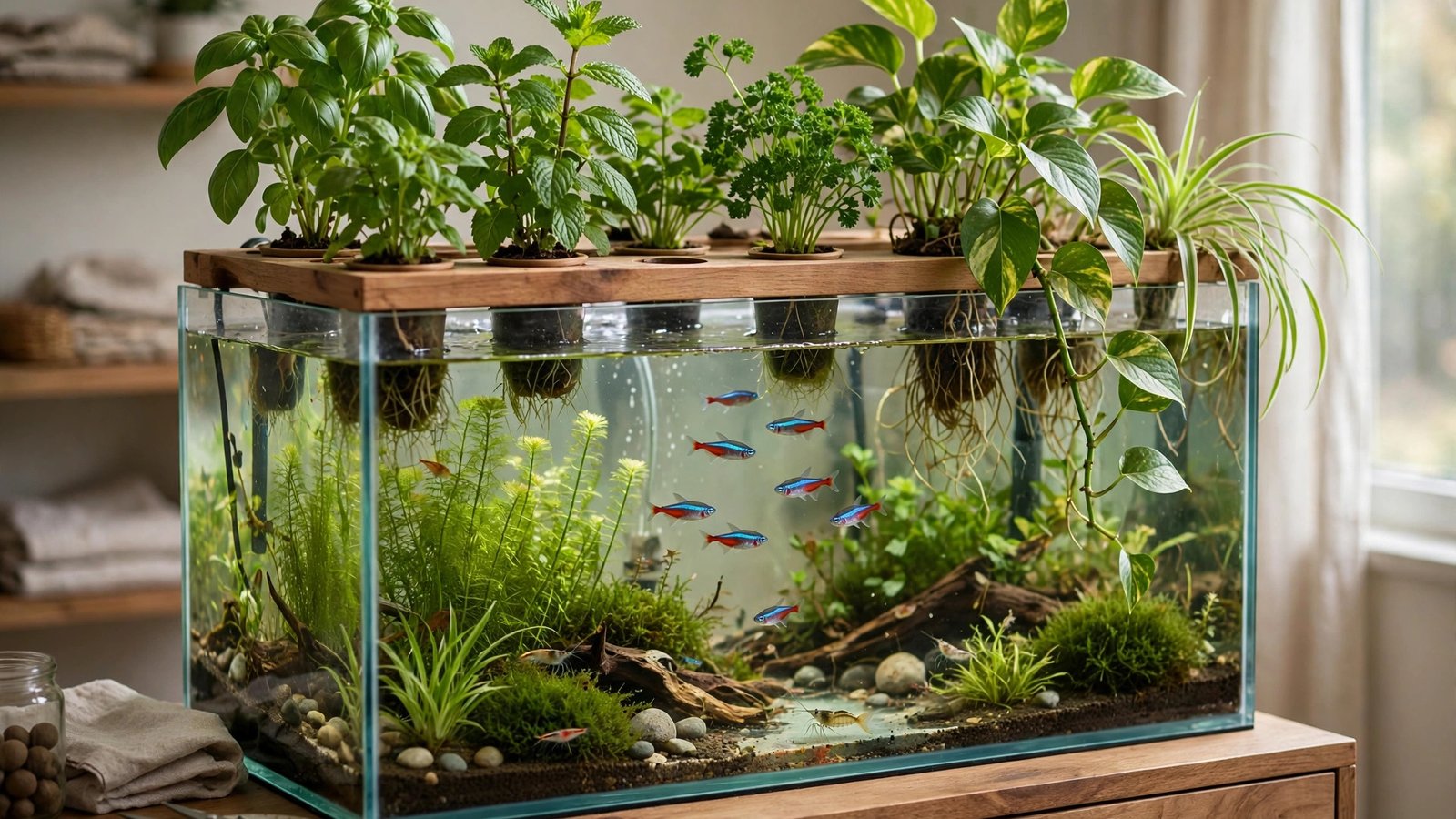
A twenty-gallon community tank can quietly produce enough basil for a summer of pasta, a steady supply of pothos cuttings for every windowsill in the house, and water so clean your nitrates barely register — all powered by nothing but fish food and a light. That loop has a name: aquarium aquaponics. It's the most natural extension of fishkeeping you'll ever try, because the fertilizer factory is already running in your living room. By the end of this guide, you'll know which grow method fits your tank, which plants thrive on fish waste, and how to bring it all online in about six weeks.
How Aquarium Aquaponics Actually Works
Home aquarium aquaponics is a small loop with three players. Fish eat, and their waste releases ammonia. Beneficial bacteria — the same colony you built while cycling the tank — convert that ammonia into nitrite, then nitrate. That nitrate is exactly what most aquarists fight with water changes. In an aquaponics setup, plant roots hanging in the water drink it first.
The result is a self-feeding circle: fish make fertilizer, bacteria refine it, plants eat it, and the fish get cleaner water back. A well-planted 20-gallon can run on half the water changes it needed before. This is the same nitrogen cycle in every planted tank, tilted in the plants' favor by giving them the whole water column at once.
One honest caveat: aquaponics doesn't replace maintenance. Fish waste lacks potassium, iron, and calcium, and plants can't substitute for a filter. Treat them as a nitrate-trimming assistant. Check our guide to planted tank water parameters so you know your starting numbers before the plants start shifting them.
Three Ways to Grow Plants on a Fish Tank
Every home aquaponics rig is a variation on one of three designs. Pick yours based on how much you want to build versus how fast you want to harvest.
| Method | How it works | Best for | Footprint | Cost |
|---|---|---|---|---|
| Floating raft | Net pots sit in a foam raft on the tank surface; roots dangle in the water | Basil, lettuce, mint | None — uses the tank's surface | $10–30 |
| Media bed | A container of clay pebbles above the tank, flooded and drained on a timer; doubles as a biofilter | Everything, incl. fruiting plants | Shelf space beside/above the tank | $40–120 |
| Riparium planters | Rim-hung baskets hold the plant crown above water with roots submerged — zero plumbing | Pothos, peace lilies | Just the tank rim | $15–40 |
Floating raft beds
Cut food-grade foam board (2-inch XPS or a purpose-built pond raft) to float on the surface, leaving a 1–2 inch gap at the edges for gas exchange. Drop seedlings into 2-inch net pots filled with expanded clay pebbles and let the roots drink. The University of Hawaii's aquaponics design notes describe the same floating-raft principle used at commercial scale.
Rafts shine with fast leafy crops — basil, lettuce, and mint establish in days and pull nitrates hard within two weeks. The limitation is real estate: a raft covers the surface, competing with floating plants and blocking light to submerged ones. On a nano planted tank, a 4×6 inch mini-raft with two basil starts is plenty.
Media beds
A media bed is a second container — a tote or spare 10-gallon — filled with expanded clay pebbles, plumbed so tank water periodically floods it and drains back. The pebbles host a huge bacterial colony alongside the roots, so the bed does biofiltration and plant feeding at once. Oklahoma State Extension's media-bed aquaponics fact sheet walks through the nitrification cycle behind these beds, including how long colonization takes (weeks, not days).
Media beds grow anything, including fruiting plants rafts struggle with — cherry tomatoes, peppers, dwarf cucumbers. They export the most nitrate per square foot, but they're a real plumbing project: a small pump, a timer or bell siphon, and a sturdy shelf. If you're already routing water externally, our planted tank with sump guide covers the skills you'll reuse.
Riparium planters
The lazy genius option. Planters hang on the tank rim or suction-cup to the glass, holding the plant's crown above the waterline while roots trail into the tank. No pump, no siphon, no extra container. A pothos cutting roots within a week and starts drinking nitrates immediately — the fastest possible way to get an aquaponics effect. Our riparium build guide shows the arrangement, and the plant holders for emergent growth guide compares basket and cup styles.
Riparium planters are also the prettiest option — a peace lily spilling over the tank's edge reads as decor that happens to filter your water. For a desk setup that has to look professional, see the planted desk tank guide.
The Best Plants for a Small Aquaponics Tank
Fish waste is a warm, nitrogen-heavy, micronutrient-light fertilizer. Plants that love that profile are fast leafy growers with big root systems. Save the tomatoes for a media bed, where you can supplement safely.
Herbs that earn their keep
Basil is the undisputed king — fast, nitrate-hungry, and worth harvesting. Sow in rockwool cubes, transplant into net pots at the two-true-leaf stage, and pinch the tops to keep plants bushy. Lettuce and greens (butterhead, romaine, arugula) are even easier: they mature in 4–6 weeks in a raft and ask for nothing. Mint is nearly indestructible but give it its own net pot — its roots will colonize the whole raft. Watercress is the sleeper pick: it grows half-submerged naturally and tolerates cooler tanks.
Houseplants for the top of the tank
Pothos is the classic: roots in days, survives low light, grows indefinitely. Peace lilies are the heavyweight nitrate exporters, though mildly toxic to pets if chewed. Spider plants handle a planter basket's wet-dry cycle beautifully, and lucky bamboo is bulletproof in low-light offices. Start from established cuttings, not seeds — you want roots in the water within days. If submerged plants stall after you add emergents, light competition is the likely cause.
Fish That Pair Well With Aquaponics
The ideal aquaponics fish is a steady, moderate waste producer that doesn't eat roots. Guppies and platies are the home-scale champions: they breed continuously, producing a gentle nutrient stream that matches plant uptake, and they ignore roots. White cloud minnows do the same in unheated tanks. A single betta in a planted 10-gallon is a proven, low-drama combo. Cherry shrimp and snails fit alongside any of these, grazing biofilm off the roots.
Goldfish are the edge case worth naming: enormous waste (great plant food), but they eat roots — so give them a media bed or a root-guarded raft rather than dangling pothos. A planted goldfish tank with a riparium section is a legitimately great setup. And aquaponics doesn't license overstocking: roughly one inch of adult fish per gallon.
A Week-by-Week Startup Timeline
Don't plant the herbs on day one. The bacterial colony needs to exist before plants can eat its output, and tender seedlings handle an uncycled tank poorly. This plan assumes a fresh or rescaped tank — if yours is already cycled and stocked, skip to week 4.
| Week | Do this | What you'll see |
|---|---|---|
| 1 | Cycle the tank. Install planters or raft; drop in pothos cuttings. | Cuttings develop root hairs within 5–7 days. |
| 2 | Test ammonia and nitrite daily. Top off evaporation — emergents drink a lot. | Ammonia falls, nitrite spikes; pothos leafs out. |
| 3 | Once ammonia and nitrite read zero, add the first fish — half your stocking. | Nitrate starts registering; plants speed up. |
| 4 | Transplant basil or lettuce seedlings into the raft. Start a 12–14 hour photoperiod. | Herb roots reach the water; fish settle in. |
| 5 | Add remaining fish and a second round of plants. Test nitrates twice weekly. | The nitrate curve flattens — plants are keeping up. |
| 6 | First harvest: pinch basil tops, cut outer lettuce leaves. Trim roots at the filter intake. | Nitrates stabilize under 20 ppm on a normal routine. |
New to the process? The planted tank first-month guide maps these milestones with more detail on cycling.
Lighting, Plumbing, and the Small-Tank Rulebook
Emergent plants need 12–14 hours a day of full-spectrum light around 6500K. A clip-on grow light angled at the planters works; so does the tank's own light if the canopy is open. Keep emergent leaves 6–8 inches from the bulb — basil goes leggy under weak light. With a closed lid, planters are awkward; open-top paludarium systems handle emergent growth without a lid.
For a small media bed, tee off your canister or hang-on-back output so a trickle rises through the bed, then drains back by gravity — a 10-gallon bed fed at 100–150 GPH on a 15-minute hourly flood cycle is plenty. The one non-negotiable: a root guard on every filter intake. Dangling roots find unguarded intakes within a month and strangle your flow; a coarse pre-filter sponge solves it.
Evaporation is the hidden tax — a planted top can double daily water loss. Top off with dechlorinated water once or twice a week. Topping off is not a water change — it replaces evaporated water without removing accumulated waste.
 ★4.6
Barrina T8 LED Grow Light
Check Price on Amazon ★4.6Troubleshooting: What Goes Wrong and Why
Algae on raft or roots is the most common complaint — roots leak organic matter, and light plus nutrients equals algae. Keep photoperiods under 14 hours, don't overfeed, and rinse root masses monthly. An algae identification chart helps you name whatever shows up.
Slow growth despite measurable nitrates almost always means a potassium or iron gap — fish waste is nitrogen-rich but thin on everything else. Potassium sulfate plus a half-dose of iron supplement, both invertebrate-safe, usually unlocks growth within two weeks. Test before and after.
A swampy smell from a planter means stagnant water around the roots. Pull the plant, rinse, trim anything black or mushy, and make sure water flows past the roots instead of sitting still. In a raft, this usually means too much surface is covered — leave at least 15% open for gas exchange.
Frequently Asked Questions
Can you do aquaponics on a 10-gallon tank?
Yes, with a light touch. A 10-gallon suits the riparium-planter approach — two or three planters with pothos, a spider plant, and a peace lily will meaningfully reduce nitrates. Skip the media bed; the plumbing eats too much volume. One betta or a small school of guppies plus shrimp is the right stocking. Keep the canopy modest so fish still get light and you can see them.
Do I still need water changes with aquaponics?
Yes, but fewer and smaller. Plants remove nitrate and phosphate, but dissolved organics, hormones, and depleted trace minerals still need exporting. Most aquaponics keepers settle on 15–20% every two weeks instead of weekly, verified by testing. If nitrates stay under 20 ppm and fish are healthy, the schedule is working. Plants assist your routine; they don't replace it.
Is aquaponics safe for shrimp and snails?
Generally yes. Cherry shrimp and nerite or mystery snails thrive in aquaponics tanks because roots grow biofilm they love to graze. The rule: anything you add must be invertebrate-safe. Avoid copper-based products entirely — copper is lethal to shrimp at trace levels. Potassium sulfate and chelated iron dosed conservatively are the standard safe options. Check every label first.
Will plant roots hurt my fish?
Healthy roots are harmless — fish weave through them and rest in their shade. The risk is mechanical: thick root mats can trap small fish, and roots will clog an unguarded filter intake. Trim root masses monthly, keep a coarse pre-filter sponge on every intake, and leave open swimming lanes. Dead or rotting roots are the exception — pull and trim those immediately.
Can I grow herbs indoors through winter?
Absolutely — this is where aquarium aquaponics beats an outdoor garden. The tank water stays warm and a full-spectrum light on a timer replaces the sun. Basil and lettuce actually prefer the stable indoor conditions. Expect slightly slower growth than summer; 12–14 hours of light compensates. Just keep the tank away from cold window drafts, which chill both roots and fish.
What if the plants grow too fast and shade the tank?
That's a good problem. Harvest more aggressively — basil wants pinching anyway, lettuce is cut-and-come-again, and pothos tolerates hard pruning. Move the fastest growers to the back corners and keep the front half of the surface open. A monthly canopy trim takes five minutes. And you can always gift cuttings — a rooted pothos cutting is free decor for friends.
The Tank That Feeds Two Households
Aquarium aquaponics sits at the intersection of two hobbies most of us already have — fish tanks and houseplants — and asks almost nothing new of you. No greenhouse, no grow tent, no fertilizer schedule: just fish you're already feeding and plants doing what plants do. Start with one pothos cutting in a rim planter, watch your nitrate readings drop over the next month, and let the harvest follow. The most common outcome isn't a failed experiment — it's a second raft, because the basil runs out before the tank does.