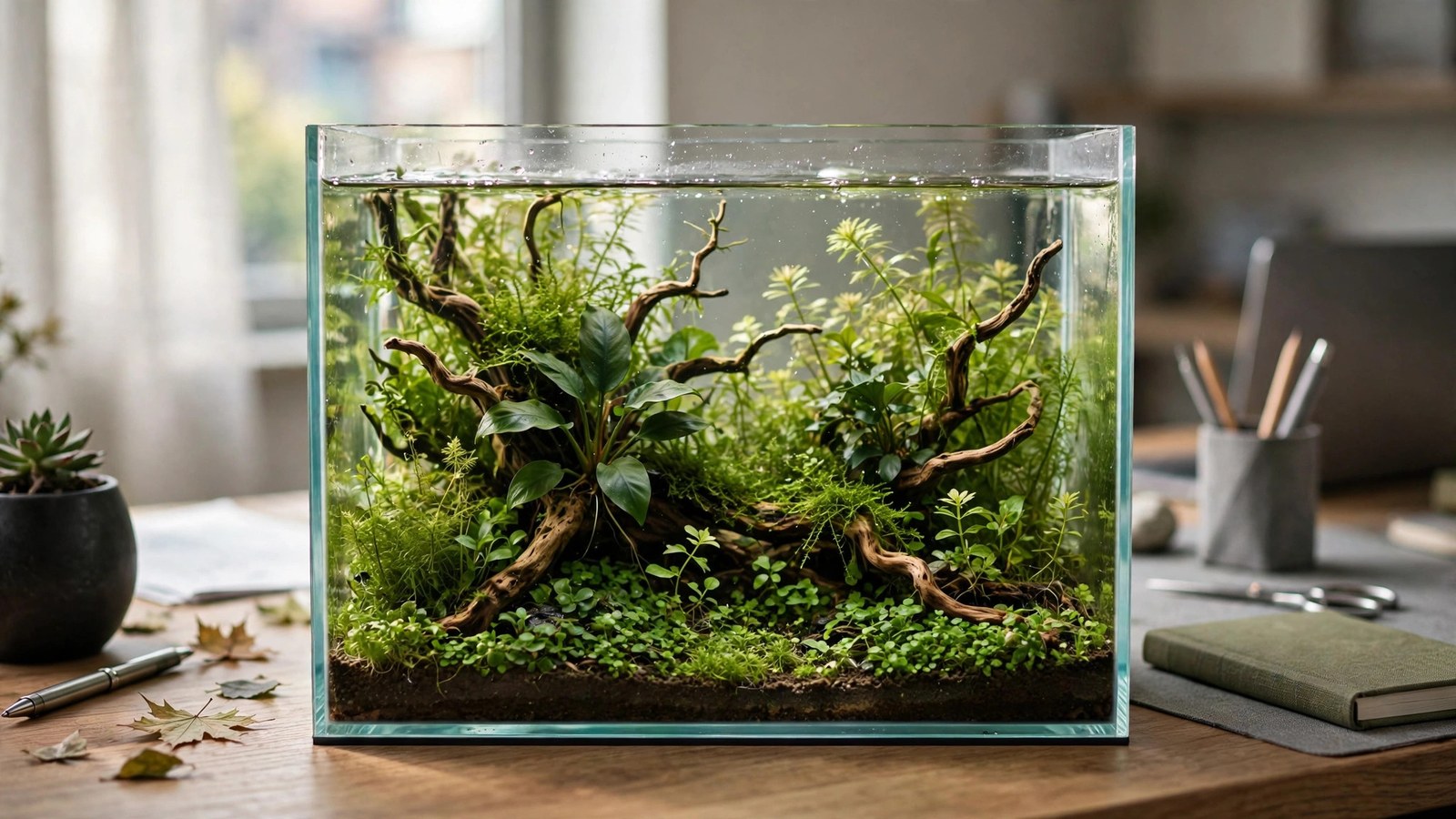
The planted desk tank — a nano aquarium living on your work desk — is the hobby's best productivity paradox: a tiny ecosystem that reduces stress, invites micro-breaks, and looks stunning on video calls, all in five gallons or less. But desks impose unique constraints: limited space, nearby electronics, office lighting, and coworkers. This guide builds the office nano that thrives in the workplace.
Why a Desk Tank Works
Research consistently shows that aquariums reduce stress and improve focus — and a nano tank delivers those benefits at arm's length. The planted desk tank is also the ideal low-commitment aquarium: small water changes, minimal stocking, and a scale where every plant choice shows. For remote workers, it's the background that makes video calls memorable. For office workers (where permitted), it's the desk that everyone visits.
Choosing the Desk Tank: Size and Placement
- Size: 3–5 gallons. A 5-gallon is the practical maximum for most desks (weight ~60 lbs filled — verify your desk handles it); 3-gallon cubes suit small desks. Our 5-gallon planted tank setup is the detailed build guide.
- Placement: away from the desk edge (bumps happen), not in direct sunlight (algae + temperature swings), with the filter and light cables routed safely away from drinks and keyboards.
- Electronics safety: a drip loop on every cable, a waterproof mat under the tank, and the tank positioned so a splash can't reach the laptop. Water and work equipment coexist fine with basic precautions.
- Check the rules: offices vary — confirm aquariums are permitted, and check weight limits for cubicle desks. Home offices have no such constraints.
Equipment: Silent and Compact
Desk tanks must be silent — a buzzing filter on a work desk is a non-starter:
- Filter: small sponge filter driven by a quality nano air pump (the quiet ones cost slightly more and are worth it), or a nano hang-on-back with the quietest rating. Test noise before committing — what sounds fine in a store is maddening at a desk.
- Light: clip-on nano LED on a timer plug. Choose one with adjustable brightness — you'll dim it for video calls.
- Heater: 25W adjustable nano heater — or skip it for a shrimp-only unheated setup if your office stays 68–72°F.
- Lid: mandatory — evaporation, dust, and the occasional flying pen cap.
- Mat: a neoprene or foam mat under the tank protects the desk and dampens vibration.
The Desk Tank Aesthetic
Desk tanks are viewed from 2 feet away, all day, every day — design for the close-up:
- One strong focal point: a single sculptural wood piece or stone; the close viewing distance rewards detail.
- Fine textures: Monte Carlo carpets, anubias petite, bucephalandra, mosses — small leaves read beautifully up close.
- Clean lines: rimless tanks, hidden equipment (sponge filter behind hardscape, heater horizontal low at the back).
- Dark background: film or paint; makes the nano scape pop on camera.
- Minimal livestock: the scape is the star; a few shrimp or a single betta is plenty of motion.
Plants for the Office Nano
Choose slow-growing, low-demand species — you won't be trimming at work weekly:
- Anubias nana petite — the desk tank essential; tiny, indestructible, perfect scale
- Bucephalandra (small varieties) — jewel-like; the close viewing shows them off
- Java moss / Christmas moss — on the focal wood; shrimp graze it
- Cryptocoryne parva — slowest carpet; plant once, ignore for months
- Monte Carlo — dry-start it for a fast carpet, then low-maintenance
- Floating: a few stems of salvinia minima — a full cover suffocates a nano; a small patch adds the finish. See our floating plant guide.
Our nano planted tank ideas explores more aesthetic directions; our low-tech guide covers the no-CO2 approach that suits office life.
Stocking: Minimal and Quiet
The desk tank menu is short — pick one:
- Cherry shrimp colony (10–15 to start): the ideal desk livestock — silent, colorful, constantly active, self-sustaining. Our planted shrimp tank setup covers their care.
- Single betta: interactive, stunning, recognizes you — the best "pet" option. Our planted betta tank setup is the guide.
- Shrimp + snails: the zero-fish option; nerites and shrimp keep the tank spotless.
Avoid fish schools — even nano fish need more swimming room than a desk tank offers, and their activity distracts rather than calms. The desk tank is a shrimp-or-betta proposition.
The Workweek Routine
Desk tanks run on a minimal schedule designed around the workweek:
- Monday: 20% water change (1 gallon — a jug and a siphon, 10 minutes), quick glass wipe.
- Wednesday: top off evaporation, check temperature, feed check.
- Friday: trim anything touching the surface, thin floaters, weekend-ready check.
- Feeding: shrimp need feeding only 2–3 times weekly in a mature planted nano; a betta gets its normal schedule. An automatic feeder is unnecessary at this scale — but a trusted coworker as vacation backup is wise.
- Weekends: the timer handles lights; the tank coasts. For long weekends, do the water change Friday.
Video Call Considerations
The desk tank will appear on camera — plan for it:
- Background positioning: slightly off-center behind you reads as intentional; dead-center can distract.
- Light dimming: bright tank lights blow out on webcams; dim the tank light during calls or angle it away.
- Algae discipline: the camera sees the glass — weekly wiping keeps it presentable.
- The conversation starter: accept that every call will include "nice fish tank" — it's a feature, not a bug.
Example Desk Scape: The One-Stone Nano
A build to copy for a 5-gallon desk cube: 1 inch of aquasoil, one palm-sized seiryu stone placed at the golden-ratio point and buried a third deep, anubias nana petite and a small bucephalandra tied to the stone, java moss tucked into its crevices, and a Monte Carlo dry-start carpet across the foreground (4 weeks covered with cling film, misted daily, then flooded). Add a thumbnail-sized salvinia patch. Cycle two weeks, add 12 cherry shrimp. The result: a miniature mountain in a mossy meadow, shrimp grazing the stone like tiny livestock, growth visible week to week from your chair. Maintenance is the Monday 1-gallon change and Friday floater-thinning — and the whole thing photographs beautifully for the inevitable video-call admirers.
Frequently Asked Questions
Will a fish tank distract me from work?
The opposite, per the research — aquariums reduce stress and provide restorative micro-breaks that improve sustained focus. The key is restrained stocking: a calm shrimp colony soothes; a tank of hyperactive fish distracts. Build for tranquility (plants, shrimp, gentle motion) and the tank becomes a focus tool, not a distraction.
How do I handle vacations with a desk tank?
A mature planted nano with shrimp coasts 1–2 weeks easily: do a water change before leaving, set the timer, top off, and skip feeding (shrimp graze biofilm). For longer absences, the Friday-routine plus a coworker doing one mid-week top-off suffices. Bettas need a feeder for absences over 4–5 days — arrange it before you go.
Is the filter noise really a problem?
Cheap air pumps hum audibly — at a desk, 8 hours a day, it's maddening. Spend the small premium on a quiet nano pump (or a quality nano HOB), mount the pump on foam to kill vibration transfer, and keep airline tubing from rattling against the desk. Test the setup at home for a week before deploying it at work.
Can I keep a desk tank in a windowless office?
Yes — the tank light is the sun. A good nano LED on a timer grows the full plant list regardless of ambient light. Windowless is arguably better: no sunlight means no algae blooms from uncontrolled light and no temperature swings. The tank becomes the brightest, most alive thing in the room.
What if my office bans aquariums?
Check whether the ban targets fish specifically — many offices allow plants but not animals, in which case a fishless planted nano (our fishless planted tank guide) complies beautifully. If all aquariums are banned, a wabi-kusa or sealed terrarium scratches a similar itch with no water-change logistics.
How much does a desk tank cost to run?
Almost nothing ongoing — pennies of electricity for the nano light and filter, a bottle of dechlorinator that lasts a year, occasional fertilizer. The setup cost is the real expense (tank, light, hardscape, plants), and even that is modest at nano scale. It's the cheapest aquarium in the hobby to operate.
The Desk Tank Payoff
A planted desk tank is the smallest aquarium that delivers the full hobby experience — a living ecosystem at arm's length, stress relief on demand, and the best video-call background in the building. Build it silent, plant it fine-textured, stock it minimally, and run the workweek routine. Your desk will never feel the same — and neither will your workdays. The shrimp will learn your schedule before your coworkers do. And on the hard days — the deadlines, the difficult calls — there's nothing quite like watching a cherry shrimp graze a mossy stone two feet away to put it all back in perspective. Small tank, quiet filter, big rewards — the desk tank earns its square foot of workspace many times over.
For the nano plant science behind this setup, see the 2Hr Aquarist aquarium plant care guides.
Tissue-culture plants are the exception — they’re grown in sterile gel and adapt with minimal melting, which is part of what you’re paying for. Plants bought submersed from another hobbyist’s tank also transition with little melt, since they’re already in the right form.
Which Plants Melt Most (and Least)
Heavy melters (expect significant leaf loss)
- Cryptocorynes — infamous for “crypt melt,” sometimes dropping every leaf after any disturbance. They almost always recover from the roots within weeks.
- Stem plants grown emersed — rotala, ludwigia, and hygrophila often shed lower emersed leaves while the growing tips transition.
- Amazon swords — emersed-grown swords typically lose their broad oval aerial leaves and replace them with longer submersed ribbon leaves.
Light melters
- Anubias, java fern, bucephalandra — slow-growing rhizome plants transition gradually; occasional old-leaf melt but rarely dramatic.
- Vallisneria — usually transitions well, though it dislikes the move itself and may sulk for a week.
- Floating plants — minimal melt since their leaves were already at the air-water interface.
The Acclimation Protocol
Step 1: Quarantine or dip first
Before acclimating to your tank’s conditions, make sure you’re not acclimating pests along with the plant. Run new arrivals through our quarantine and dip protocol — it adds days upfront but prevents months of regret.
Step 2: Float to temperature-match (30 minutes)
Float the bag or container in your tank for 20–30 minutes to equalize temperature. Plants are less temperature-sensitive than fish, but a 10°F shock on top of transplant stress is an avoidable insult.
Step 3: Trim before planting
Remove any leaves that are already damaged, yellowing, or heavily algae-covered — they won’t recover and they’ll rot in your tank, feeding algae. For stem plants, trim off the bottom inch and any emersed leaves that look unlikely to adapt; the plant wastes energy maintaining leaves it’s going to shed anyway. Keep the healthy growing tips — that’s where recovery starts.
Step 4: Plant correctly the first time
Follow our planting guide — right depth, crown exposed on rosettes, rhizomes unburied on epiphytes. Every uprooting and replanting restarts the acclimation clock, so get placement right on the first attempt. Decide where each plant goes before it goes in the water.
Step 5: Run a gentle first week
For the first 7 days after planting:
- Moderate light — run your normal photoperiod but consider dropping intensity 20–30% if your light is dimmable. Blast-level light on a melting plant grows algae on the dying leaves, not recovery.
- Stable CO2 — if you inject CO2, keep it consistent. Fluctuating CO2 during acclimation is a melt accelerator. If you’re low-tech, this doesn’t apply — see growing without CO2.
- Half-strength fertilizer — new plants with damaged leaves can’t use full dosing, and the excess feeds algae. Ramp to full strength over 2–3 weeks per our fertilizer schedule.
- No disturbance — don’t move, trim, or “check on” new plants for at least two weeks. Every touch resets root establishment. This is especially critical for crypts.
Step 6: Remove melt, keep the base
As emersed leaves melt, remove the mushy material promptly — decaying leaves release ammonia and grow fungus that can spread to healthy tissue. But never discard the plant while the crown, rhizome, or roots are firm and alive. A crypt that’s lost every leaf but has firm roots is a plant that’s about to recover, not a dead plant. Give it 3–4 weeks before judging.
Telling Normal Melt From Real Problems
Normal transition melt:
- Affects oldest/emersed leaves first, newest growth last
- New submersed leaves emerge even as old ones dissolve
- Roots and crown stay firm and white/green
- Timeline: 1–4 weeks, then obvious new growth
Concerning melt (see our full melting diagnosis guide):
- New growth also melts or emerges deformed
- Rhizome or crown turns mushy and brown — this is rot, not transition
- Entire plant dissolves within days with no new growth after 4+ weeks
- Melting spreads to established plants that weren’t recently moved
Buying Tips to Minimize Melt
- Buy submersed-grown when available — hobbyist-grown cuttings transition with almost no melt.
- Choose tissue culture for sensitive species — crypts and delicate stems establish far more reliably from sterile cups.
- Avoid plants already melting in the store tank — some melt is normal, but a plant that’s mostly mush at purchase has less energy for recovery.
- Transport carefully — keep plants damp and out of direct sun/heat. A plant that dries out or cooks in a hot car melts far worse than one transported properly.
The First-Month Timeline: What to Expect Week by Week
Knowing what’s normal when removes most acclimation anxiety. Here’s the typical timeline for a healthy plant adapting to a new tank:
Week 1: The quiet week
Almost nothing visible happens. The plant is growing roots you can’t see and assessing its new environment. Some species (vallisneria, stem plants) may start shedding their lowest leaves. This is normal. Resist the urge to “help” — no moving, no extra fertilizer, no light changes. The most common beginner mistake is intervening during a week when the correct action is nothing.
Week 2: Melt peaks
This is when emersed leaves give up in earnest. Crypts may drop everything; swords shed their broad aerial leaves; stem plants lose lower foliage. It looks catastrophic and it’s usually fine. Keep removing mushy material, keep conditions stable, and watch the crown and growing tips — if those are firm and green, recovery is already underway.
Week 3: The turn
New submersed-adapted leaves emerge — smaller, thinner, often a slightly different shade of green than the emersed foliage. Stem plant tips start growing visibly; crypts push tiny curled leaves from the crown; swords unfurl narrow ribbon leaves. This is the moment most beginners exhale for the first time.
Week 4+: Established
New growth outpaces melt, and the plant is functionally yours. You can resume full-strength fertilizer, normal trimming, and stop treating it as fragile. Some slow growers (anubias, bucephalandra) take 6–8 weeks to show obvious progress — that’s their normal speed, not a problem.
Acclimating Different Plant Formats
Tissue-culture cups
Sterile, pest-free, and already adapted to high-humidity (not emersed) growth — tissue cultures melt the least of any format. Rinse the agar gel off gently (leftover gel rots and feeds fungus), split the portion into small plantlets, and plant per our planting guide. They establish slowly for the first two weeks, then accelerate. No dip needed, minimal acclimation stress — this is the premium experience you’re paying for.
Potted plants
Remove the pot and strip away the rockwool completely — leftover rockwool traps debris and rots. Tease the root mass apart gently; if it’s a dense mat, splitting it into 2–3 smaller portions actually establishes faster than planting one big clump (more growing points, better water flow around roots). Potted plants are usually emersed-grown, so expect the standard 2–4 week melt cycle.
Bare-root / bunched stems
Typically sold as weighted bunches. Remove any bands, foam, or weights, strip the lower leaves, and plant stems individually or in small groups. Bunched stems from the store are often already transitioning — check for new submersed growth at the tips, which tells you the plant is mid-adaptation and will settle quickly.
Hobbyist cuttings
Already submersed-grown and the fastest to establish — often showing new growth within days. The main acclimation factor is water-parameter difference between the two tanks. Float to temperature-match, plant promptly, and they’ll usually take off with minimal melt. This is why experienced hobbyists prefer trading cuttings over buying potted plants.
Frequently Asked Questions
Should I use a “plant starter” or transplant fertilizer?
Products marketed for transplant shock are mostly B-vitamins and mild hormones. They don’t hurt, but there’s no strong evidence they help aquarium plants specifically. Stable conditions and patience outperform any bottle. Save the money for more plants.
My new plant melted completely — bare crown, no leaves. Is it dead?
Probably not, if the crown or rhizome is firm. Crypts and swords routinely lose 100% of their leaves and regrow from the base within a month. The test is firmness: firm and pale/green means alive; mushy and brown/black means rot. Give firm-but-leafless plants a full 4 weeks before declaring them dead.
Can I speed up acclimation with extra light or CO2?
No — and trying usually backfires. A melting plant can’t use extra light; the excess just grows algae on its dying leaves. Keep light moderate and CO2 stable (not boosted) during acclimation. Growth speed comes from the plant’s own adaptation timeline, which you can’t rush, only avoid delaying.
Should new plants go straight into my main display tank?
After quarantine/dipping, yes — there’s no benefit to a separate “growing-in” tank for most plants. They acclimate to your water fastest in the tank they’ll live in. The exception is very delicate species going into a tank with boisterous fish; give those a few weeks in a calm corner or breeder box first.
The Patience Rule
The single most important acclimation skill is restraint: plant it right, set gentle conditions, remove decay, and then leave it alone for a month. The hobbyists with the best plant growth aren’t doing something clever in week one — they’re simply not interfering in weeks two through four while the plants do what they’ve evolved to do. Melt looks like failure and feels like failure, but in most cases it’s the visible part of a plant successfully becoming yours.