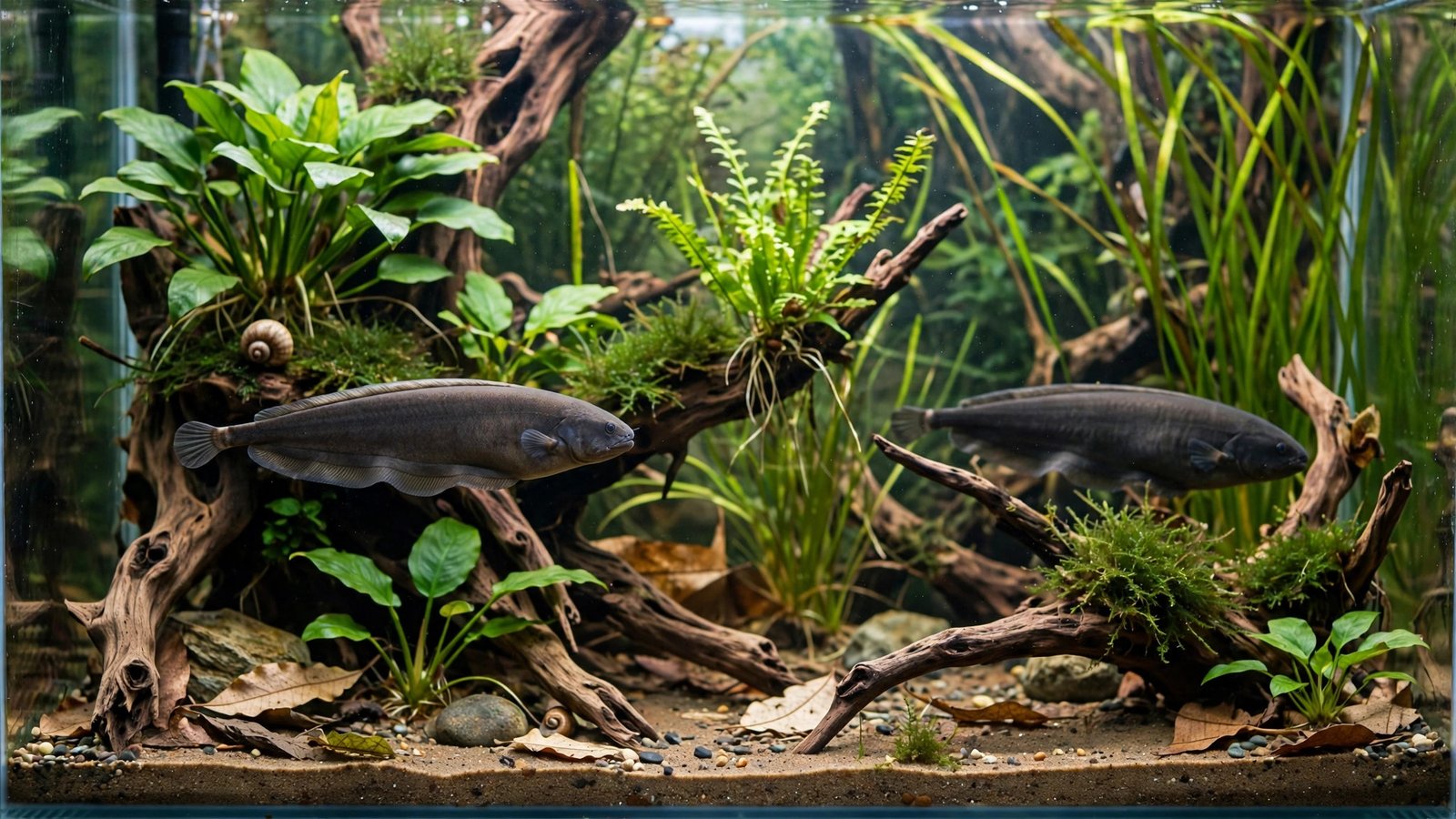
By day the tank looks empty except a dark torpedo inside a driftwood cave. After lights out, the African knifefish planted tank wakes up: a brown-violet oddball glides the glass on rippling anal-fin waves, hunting by electricity. Few true predators can share a planted tank — but this one has three non-negotiables most keepers miss.
Yes, an African knifefish thrives in a planted tank — dense back-and-side planting plus floating cover is what makes this shy nocturnal hunter feel safe enough to feed. Plan a 55-gallon (200-liter) tank with a 120 cm footprint, fine soft sand, dim lighting, and a tight lid with an air gap, since it gulps air with an accessory swim bladder. Warning: it is scaleless, so halve all medication doses and avoid salt, copper, and formalin — standard treatments can kill it outright.
African knifefish planted tank: size, sand, and the escape-proof lid
The costly mistake is treating this like a small community oddball. A juvenile looks slender at 10 cm, but the species reaches roughly 30 cm, and unlike its larger cousin in the black ghost knifefish planted tank guide, a 55-gallon tank genuinely holds an adult. What matters is length, not height: 120 cm of footprint gives a nocturnal patroller the roaming room it uses after dark.
The "knife" shape comes from a single long anal fin that ripples constantly for movement and steering, and the belly is scaleless. Fine soft sand protects both; coarse gravel abrades fin edges and belly, opening the door to infection in a fish that is already medication-sensitive. Aim for a 5–7 cm sand bed — deep enough to plant in, soft enough for the fish.
Third, the lid. The swim bladder doubles as an accessory breathing organ, so the fish rises to gulp air at the surface (it emits a chiming bell-like sound while doing so). Leave an air gap under a tight, weighted, gap-free lid — this fish is a documented escape artist that will find any uncovered opening at night.
| Life stage | Size | Minimum tank | Notes |
|---|---|---|---|
| Juvenile | 7–15 cm | 75–120 L grow-out | Temporary only; plan the upgrade now |
| Subadult | 15–20 cm | 200 L / 55 gal, 120 cm | Minimum long-term home for one |
| Adult | 20–30 cm | 240–300 L | Recommended once grown or with tank mates |
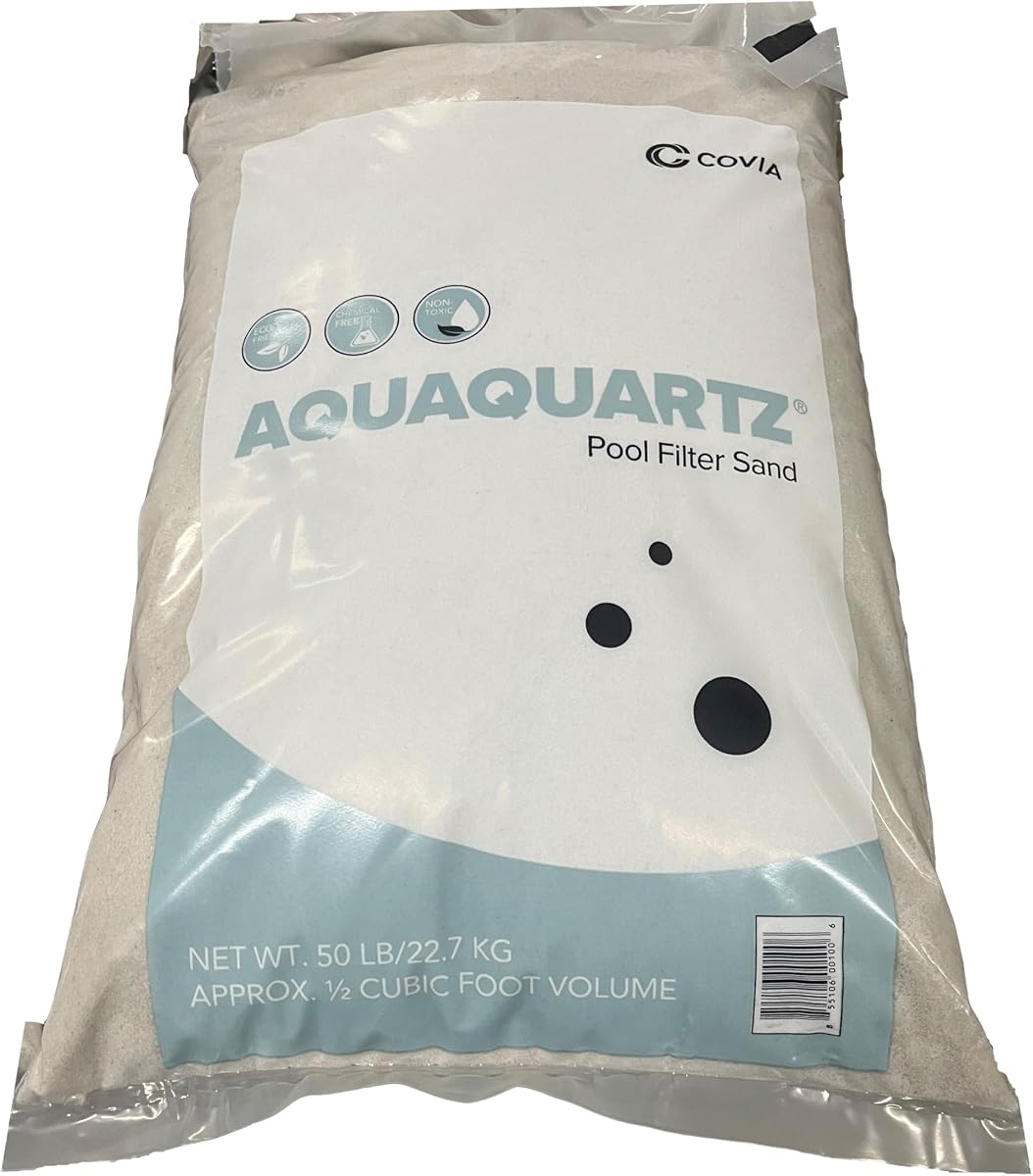
Covia AquaQuartz Pool Filter Sand
Check Price on AmazonFirst, Buy the Right Fish: Xenomystus nigri vs the Asian Knifefish
Readers regularly buy the wrong animal. The African knifefish is Xenomystus nigri, the brown knifefish of the African family Notopteridae. Shops constantly confuse it with the Asian knifefish, Notopterus notopterus — and they are not interchangeable.
Tell them apart at the shop: the Asian knifefish has a true dorsal fin and turns more aggressive with age, while Xenomystus nigri lacks the dorsal fin entirely and is the far less aggressive of the two. Seriously Fish's species profile explicitly warns the two are often confused. If the fish has a visible dorsal fin, it is the Asian species, which needs a bigger tank and stricter tank-mate rules.
Both are weakly electric: the African knifefish generates a faint field to navigate and find prey in the dark, so heavy planting never hinders its hunting.
Lighting, Plants, and Hardscape for a Nocturnal Hunter
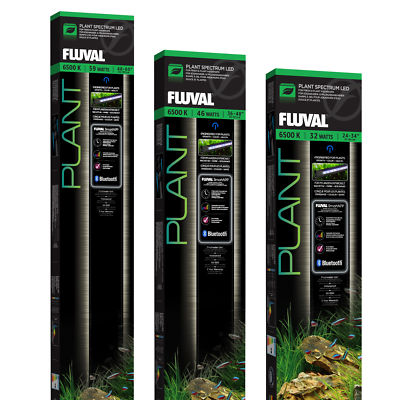
Dim light is a welfare issue. This fish hides all day and feeds at night; a bright open tank produces a fish that refuses to eat. Keep lighting low to moderate, shade the surface with floaters, and follow the fish-first guide to aquarium plants: choose plants that tolerate shade, not ones demanding strong light.
Layout is simple: dense planting along back and sides, open water in front, and a claimed cave. PVC tubes, driftwood, and rocky overhangs all work as daytime retreats. A knifefish that can choose invisibility is a knifefish that eats boldly at night.
| Plant | Role | Why it works |
|---|---|---|
| Anubias (barteri, nana) | Hardscape cover | Thrives in the dim conditions the fish favors |
| Java fern | Midground / driftwood | Low light; dense clumps make cover |
| Vallisneria | Background curtain | Tall leaves give back-wall density for patrolling |
| Frogbit / salvinia | Floating shade | Dims the surface where it gulps air |
 ★4.3
Fluval Plant 3.0 LED Aquarium Light
Check Price on Amazon ★4.3Feeding and Tank Mates
The African knifefish is an obligate carnivore and nocturnal predator: bloodworm, earthworm, prawn, chopped mussel, carnivore pellets — offered after dark. New arrivals that "never eat" are almost always eating when nobody watches; feed at lights-out and check in the morning. Keep one per tank: juveniles tolerate groups, but adults turn territorial toward other knifefish.
Choose tank mates once, carefully — anything that fits in its mouth gets eaten, usually on the second or third night. Safe company: larger characins, medium peaceful cichlids, armored catfish. Layered companions include the surface-dwelling African butterflyfish and bottom-dwelling zebra loaches, which share the same dim, sandy setup. Building this as your first predator tank? The low-tech planted tank setup covers the plant-side fundamentals so the fish stays the focus.
Medication Safety: Scaleless Fish Rules
This species is scaleless, so standard dosing is dangerous: halve all medication doses as the starting rule, and avoid salt, copper, and formalin-based treatments entirely. Quarantine new arrivals and lean on clean water, 23–28 °C, and pH 5.8–7.5 rather than preventive chemicals. When treatment is unavoidable, use the half-dose in quarantine and extend the treatment window instead of raising the dose.
Frequently Asked Questions
Can an African knifefish live in a planted tank?
Yes — and it prefers one. Dense back-and-side planting plus floating cover is what lets this shy nocturnal predator settle, feed, and patrol confidently. Keep lighting low, use fine sand, and provide caves or PVC tubes as daytime retreats. Plants are never harmed; the only risk runs toward small tank mates.
How big a tank does an African knifefish need?
A single adult needs a 55-gallon (200-liter) tank with a 120 cm footprint minimum. Juveniles can grow out in 75–120 liters temporarily, but plan the upgrade at purchase — this fish reaches about 30 cm / 12 inches, though 8 inches is typical in aquaria. Allow 240–300 liters for a fully grown fish or one kept with tank mates.
Why does my African knifefish hide all day and never eat?
Hiding by day is normal — it is nocturnal, not sick. It almost certainly eats after lights out: offer live or frozen meaty foods at night and check the next morning. If it still refuses food after a week, the causes are usually overly bright lighting, no secure retreat, or bullying tank mates. Shade the surface with floating plants first.
Is the African knifefish the same as the Asian knifefish?
No. The African knifefish is Xenomystus nigri (Notopteridae); the Asian knifefish is Notopterus notopterus. The Asian species has a true dorsal fin that X. nigri lacks and is far more aggressive. Mislabelled stock is common — inspect before buying; the Asian species needs a larger tank and stricter tank-mate rules.
What fish can live with an African knifefish?
Larger characins, medium peaceful cichlids, and armored catfish such as Synodontis. Avoid anything small enough to fit in its mouth — it will be eaten at night regardless of how peaceful the tank looks by day. Good layered companions include the surface-dwelling African butterflyfish and bottom-dwelling zebra loaches.
A Night-Tank Done Right
By day a quiet, shadowy aquascape; by night the most interesting tank in the room. Get the three non-negotiables right — 55 gallons of length, soft sand, a tight lid with an air gap — and the rest is maintenance. Before buying, cross-check the Seriously Fish species profile for Xenomystus nigri and the African knifefish care profile on tropicalfreshwaterfish.com.