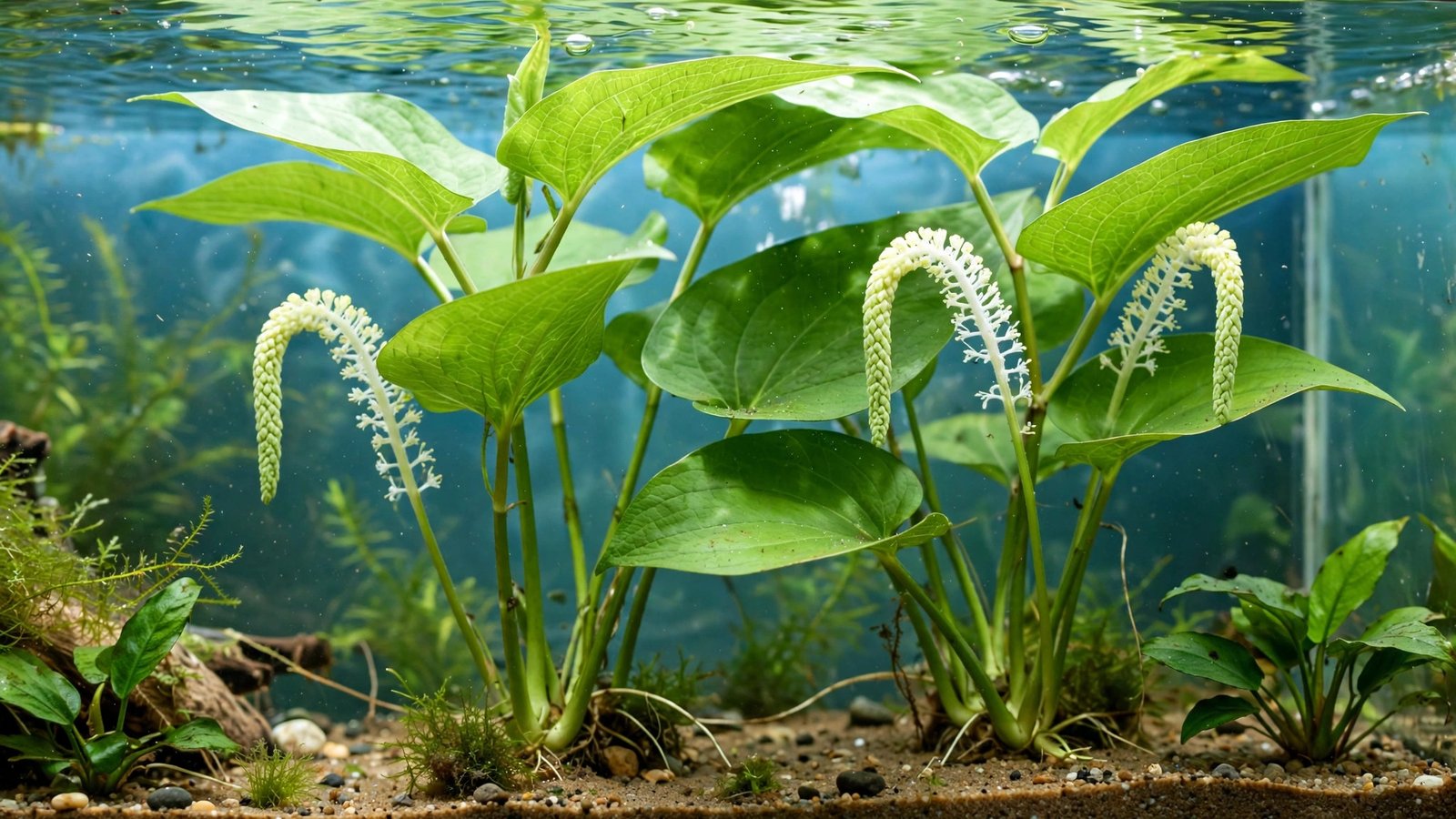
Here is the mistake that kills most lizard's tail: buying Saururus cernuus as if it were a normal submerged stem plant, burying it deep, and watching it melt. Proper Saururus cernuus care starts from the opposite assumption — this is a North American marginal wetland plant that merely tolerates life underwater, and it rewards aquarists who treat it that way with arching stems and heart-shaped leaves.
The short answer: Saururus cernuus survives submerged but thrives emersed, with the crown at or above the waterline. Give it bright light, a nutrient-rich substrate with the crown above the substrate surface, water of 25 °C or cooler, and only light CO2 if you use it at all. Propagate by replanting top cuttings; trim decaying leaves early. Flowgrow's plant database lists it as rarely fully submersed in nature, prescribing intense light plus adequate phosphate against spot algae.
What You Are Actually Buying: Identification
Lizard's tail is a Saururaceae wetland plant native to eastern North America — swamps, ditches, and stream margins. It is also sold in pond-plant sections as mouse-ear lizard's tail, so check which form you are buying.
Two signatures make identification easy: heart-shaped, glossy green leaves on upright stems, and the namesake flower — a drooping, curved spike of tiny white blooms. Submerged plants rarely flower, so no blooms means nothing is wrong. Potted emersed stock will shed its pond leaves during adaptation; that shedding is normal, not failure.
Saururus cernuus care: Light, Substrate, and Water
This is the heart of Saururus cernuus care: get the first three weeks right and the plant settles. Plant it in a nutrient-rich substrate but plant it shallow — the crown, where stems meet roots, must sit just above the substrate surface. Buried crowns rot reliably, and buried-crown melt is the most reported failure for this species in retailer Q&A threads.
Light decides the submerged form. Aim for bright light on the crown, 8 to 10 hours daily — this plant photosynthesizes like a sun-loving marginal, not a shade-tolerant crypt. In dim tanks it stretches and sheds lower leaves. If your tank already runs bright light for demanding stems, lizard's tail fits without special treatment; see the complete freshwater aquarium plant guide if you are still dialing in lighting.
Keep water at 25 °C or below. This is a cold-hardy species that overwinters outdoors in many temperate climates, but it sulks in warm tropical tanks — 22–24 °C is ideal. Regularly above 26 °C means leggy growth and faster decay of submerged leaves.
| Parameter | Target | Why it matters |
|---|---|---|
| Light | Bright, 8–10 h/day | Submerged leaves etiolate and drop in dim tanks |
| Substrate | Nutrient-rich aquasoil | Root feeder; crown above the surface |
| Temperature | 18–25 °C | Cold-hardy marginal; warmth accelerates decay |
| Flow | Gentle | Strong currents batter arching stems |
| pH / hardness | Wide tolerance | Adaptable; not a parameter diva |
CO2 and Fertilization: Less Than You Think
CO2 is optional — retailers describe "a little CO2" as a mild accelerant, not a requirement. If you inject for other plants, lizard's tail will enjoy it too. If you dose, start low, observe livestock, and raise only if you see consistent deficiency signs in the plants. A nutrient-rich substrate plus a standard all-in-one liquid fertilizer covers the rest.
The nutrient worth watching is phosphate. Submerged growth is slow, so green spot algae colonizes the leaves — and Flowgrow's database entry flags adequate phosphate, alongside strong light, as the countermeasure. Pair that with 25–30% weekly water changes; spot-treat stubborn colonies with liquid carbon by pipette (start low, observe livestock).
Submerged vs Emersed: Honest Expectations
The live question behind nearly every Saururus cernuus search: aquarium plant or pond plant? The honest answer is marginal — it tolerates submersion rather than preferring it. Expecting Rotala-like vigor and getting slow, leggy growth is the most common disappointment.
| Emersed (riparium/pond) | Submerged (aquarium) | |
|---|---|---|
| Growth | Vigorous; spreads by runners | Slow; seasonal bursts |
| Leaves | Large, glossy, heart-shaped | Smaller, thinner |
| Flowering | Reliable white spikes | Rare; usually never |
| Algae risk | Minimal | Spot algae is the norm |
In a riparium or paludarium, lizard's tail is one of the easiest wins in the hobby — crown at or just above the waterline and it shows its true form. In a filled tank, treat submerged specimens as a slower guest. En.aqua-fish.net's lizard's tail care guide echoes this: crown above the substrate, decay trimmed regularly.
Placement: The "Leiden Plant" of Dutch Aquascaping
Here is the angle worth owning. Saururus cernuus is a classic of Dutch-style aquascaping, where older hobby literature calls it the "Leiden plant" — one of the species used to build the famous straight plant streets. In Dutch-style plant streets it reads as a soft column: glossy heart-shaped leaves on an upright stem, best grouped in threes or fives and trimmed to a uniform height.
In a modern layout, place it midground to background, where its light-green arching habit contrasts against red stems like Alternanthera lilacina or fine-leafed greens like Rotala mexicana. Avoid aggressive growers that shade it out — Mayaca fluviatilis will bury it within weeks. For a first scape, the list of easiest aquarium plants for a beginner community tank is a safer shortlist than this plant.
Propagation: Cuttings and Runners
Propagation is the easiest part. Per Flowgrow's database: take a healthy top cutting of 8–12 cm, strip the lowest leaves, and replant with the crown at substrate level. Roots develop from the lower nodes within one to two weeks in bright light. Floated cuttings root well too — useful if your tank has diggers.
Emersed plants spread by stolons and runners; lift and divide plantlets once they have three or four leaves. Submerged specimens runner far less, so cuttings are your multiplication method in the aquarium. AquaSabi's Saururus cernuus profile confirms cuttings propagation and flags the species' cold-hardiness for pond keepers.
Pruning and Algae Management
Pruning is two jobs: shaping and housekeeping. Shape by trimming stems back to a leaf node — side shoots break below the cut, keeping a Dutch street dense and uniform. Housekeeping matters more: weekly, remove any submerged leaf that is yellowing or going soft. On a slow-growing plant, every spot-algae colony is a long-term tenant.
Green spot algae is the signature pest — round, hard dots on the oldest leaves. The verified countermeasures are bright light, adequate phosphate, and good water-change hygiene. If it recurs relentlessly, the plant is telling you it would rather be emersed.
Frequently Asked Questions
Can Saururus cernuus grow fully submerged in an aquarium?
Yes, for a time. It is a marginal plant, so submerged life is tolerated rather than natural: growth is slow, leaves are smaller, and flowering almost never happens underwater. Give it bright light, a nutrient-rich substrate with the crown above the surface, and water at 25 °C or below.
Why is my lizard's tail melting from the base?
The crown is almost certainly buried. When the junction of roots and stems sits below the substrate surface, the base rots upward. Lift the plant, trim mushy tissue back to firm roots, and replant with the crown above the substrate.
Does Saururus cernuus need CO2 injection?
No — CO2 is optional. It grows fine in low-CO2 tanks with bright light and a rich substrate, and retailers describe only a mild benefit from "a little CO2." If you already inject for other plants, it will accept it. Start low, observe livestock.
What is the "Leiden plant" in Dutch aquascaping?
"Leiden plant" is the traditional Dutch-style name for Saururus cernuus, referencing its long history as a street-building plant in Dutch tanks — the tall, ordered plant rows that define the style. Its upright stems and tidy habit take trimming well and hold a uniform column.
The Honest Verdict
Lizard's tail is neither the easiest plant you can buy nor the hardest. It has a strong opinion about where it wants to live, and Saururus cernuus care is simply the practice of listening: bright light, rich substrate, crown above the line, water on the cool side, and a willingness to move it up if it asks.