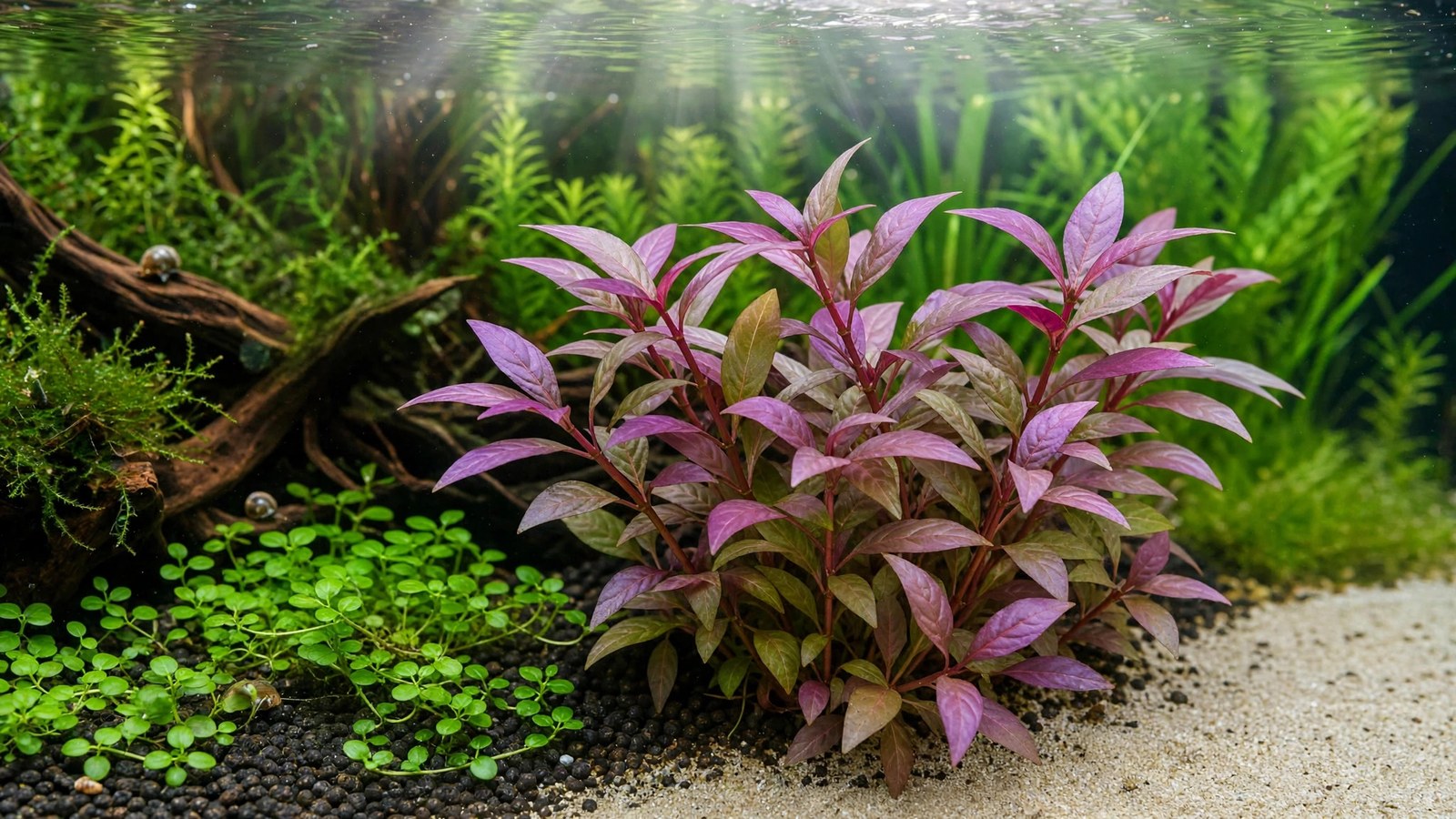
Most pink stem plants look muddy from across the room. Not this one. 'Lilacina' punches through a green carpet with a pink so bright it reads like a neon marker — and here is the trap: half the shops on the planet sell it as Alternanthera reineckii 'Lilacina', which is how people plant it like a generic red stem and watch the color wash out. The names describe the same plant, but the care is not interchangeable with its plain cousins.
Alternanthera lilacina care in one sentence: rich substrate, medium-high light, steady CO2, iron-rich fertilizer, and a trim every two weeks. Do that and it gives you rose-pink tops with violet undersides — brighter than standard Reineckii by a clear margin. This guide covers the full routine, from spotting the right variety to the trimming pattern that keeps Dutch-style bushes dense.
The identity problem: Lilacina vs Reineckii
Search shops and databases and you will meet two names. The trade mostly lists it as Alternanthera reineckii 'Lilacina' — Tropica's database carries it under that synonym — while hobbyists circulate the name Alternanthera lilacina. Treat them as the same plant with different labels, and always check the epithet: 'Lilacina' is the one you want.
It differs from plain Reineckii in three ways: narrower, longer leaves; a brighter, clearer pink on the upper surface under good light; and deep violet undersides rather than duller red-pink. Mixed in one tank, the difference is obvious from three meters away. To understand the baseline first, start with Alternanthera reineckii care, then read on for what makes 'Lilacina' special.
What 'Lilacina' looks like in a healthy tank
A thriving 'Lilacina' stem carries narrow lance-shaped leaves, 5–7 cm long, on upright stems. New growth at the tips is the brightest pink; older lower leaves deepen toward violet. Its fine texture is why Dutch-style aquascapers reach for it.
In low light or iron-poor conditions, the pink fades first — tops turn olive-green with a bronze tint. This is the most common "is my plant dying?" moment with 'Lilacina', and it is almost always a light-plus-iron problem.
Alternanthera lilacina care: the core routine
This is the week-in, week-out routine. Fix the setup before blaming the plant — 'Lilacina' is honest about what it gets.
Light
Give it medium-high light: roughly 50 PAR or more at substrate level. Under weaker light it grows, but green; the pink only appears once light crosses that threshold. An 8-hour photoperiod is the sweet spot — longer days invite algae on its fine leaves.
Substrate and root feeding
'Lilacina' is a hungry root feeder. Plant it in nutrient-rich aquasoil or add root tabs under inert substrate — bare gravel with only liquid fertilizer gives thin, pale growth. Push a fresh root tab within 5 cm of each group every two to three months.
CO2 and fertilization
Pressurized CO2 at a steady 25–30 ppm transforms this plant: faster, denser, pinker — but if you're new to injection, start low and observe livestock for several days before reaching that range. Without CO2 it survives but the color never fully develops. Dose a complete liquid fertilizer rich in iron and micronutrients — exactly the plant where the answer to do aquarium plants really need fertilizer is a clear yes. Keep nitrate low but present (5–15 ppm) to deepen the pink; zero nitrate causes stunting.
Water parameters
| Parameter | Target | Notes |
|---|---|---|
| Temperature | 22–28 °C | Below 20 °C growth stalls and lower leaves melt |
| pH | 6.0–7.5 | Stability matters more than the exact number |
| Hardness | Soft–moderately hard | Very hard water (GH above ~12) dulls color |
| Nitrate | 5–15 ppm | Low-but-present deepens pink; zero starves it |
| Phosphate | 0.5–1.5 ppm | Deficiency shows as stunted new growth |
 ★4.6
FZONE Glass CO2 Drop Checker Kit
Check Price on Amazon ★4.6Planting for Dutch-style streets
'Lilacina' earned its Dutch-staple reputation because it behaves: stems stay upright, groups hold their shape, and trimming triggers lateral shoots that thicken the bush. Plant 6–10 stems together, spaced 3–4 cm apart, in a slight wedge — tallest stems at the back stepping down toward the front.
Pair it with green stems for maximum contrast. A 'Lilacina' street running in front of a Ludwigia super red bank gives pink-against-deep-red layering; ahead of rotala rotundifolia or hygrophila polysperma it delivers the classic pink-on-green Dutch contrast. For the full picture of where stems fit in a layout, skim our complete guide to freshwater aquarium plants before finalizing your planting plan.
Trimming and propagation
Trim every 10–14 days in a CO2 tank — it reaches the surface from a midground group in three weeks. Cut each stem 10–15 cm above the substrate, strip the bottom 2–3 leaves from the top, and replant it. The stump sprouts two or more side shoots within days, doubling the bush's density with every cycle.
Don't let stems float at the surface; they shade themselves, drop lower leaves, and rot at the touch points. Never trim everything at once in a young tank — take the tallest half first, let the stumps resprout, then finish the rest. New to topping? Practice on ludwigia repens first — it forgives sloppy cuts more readily than 'Lilacina'.
Common problems and fixes
Green, leggy stems: not enough light. Raise intensity to 50+ PAR at the substrate; green tops under low light are a sign, not a death sentence.
Pink fading to bronze: low iron or missing micronutrients. Increase your iron-rich fertilizer and check that nitrate hasn't bottomed out at zero.
Lower leaves melting: a light or flow problem inside a dense group — inner stems get shaded and drop leaves. Thin the group by 20–30% and improve circulation.
Transparent new leaves: a CO2 or potassium issue. Confirm CO2 is steady at 25–30 ppm and your fertilizer includes potassium.
To confirm you bought the right variety, check the entry in Tropica's plant database — it carries this plant under the reineckii 'Lilacina' synonym.
Frequently Asked Questions
Is Alternanthera lilacina the same as Alternanthera reineckii 'Lilacina'?
The aquarium trade lists it as Alternanthera reineckii 'Lilacina', while hobbyists often use Alternanthera lilacina. They are the same plant — only 'Lilacina' has the narrower, longer leaves and brighter pink tops with violet undersides. If a shop sells you plain Reineckii under the Lilacina name, the duller color shows within weeks.
Can Alternanthera lilacina grow without CO2?
It survives without CO2 but never shows its signature pink. In low-tech tanks the tops stay greenish-bronze and growth is slow and leggy. For bright pink, pressurized CO2 at 25–30 ppm is effectively required.
Why is my Lilacina turning green instead of pink?
Almost always too little light, too little iron, or both. Raise light to 50+ PAR at the substrate and dose an iron-rich fertilizer with nitrate low but present (5–15 ppm). The pink returns on new growth within 1–2 weeks; existing green leaves rarely recolor, so trim and let the new tips do the showing.
How fast does Alternanthera lilacina grow?
In a CO2 tank with good light and fertilizer, expect 3–5 cm per week — a trim every 10–14 days. Without CO2 that drops to a few centimeters a month. Regular topping and replanting builds the dense Dutch-style bush; left alone it grows tall and bare at the base.
What plants pair well with Lilacina in a Dutch aquascape?
Classic partners are green stems and fine reds: rotala rotundifolia, hygrophila polysperma, and Ludwigia super red make excellent backdrops for a pink 'Lilacina' midground street. Its narrow leaves give fine texture contrast against broadleaf plants — exactly why Dutch layouts use it for pink accents rather than mass red areas.
A pink stem worth the CO2
'Lilacina' is not the easiest red stem, and it does not pretend to be. But among pink plants it has no real rival: nothing else gives you that clear, bright pink with violet undersides on such narrow leaves. Give it light, CO2, iron, and sharp scissors, and visitors will ask about it first.