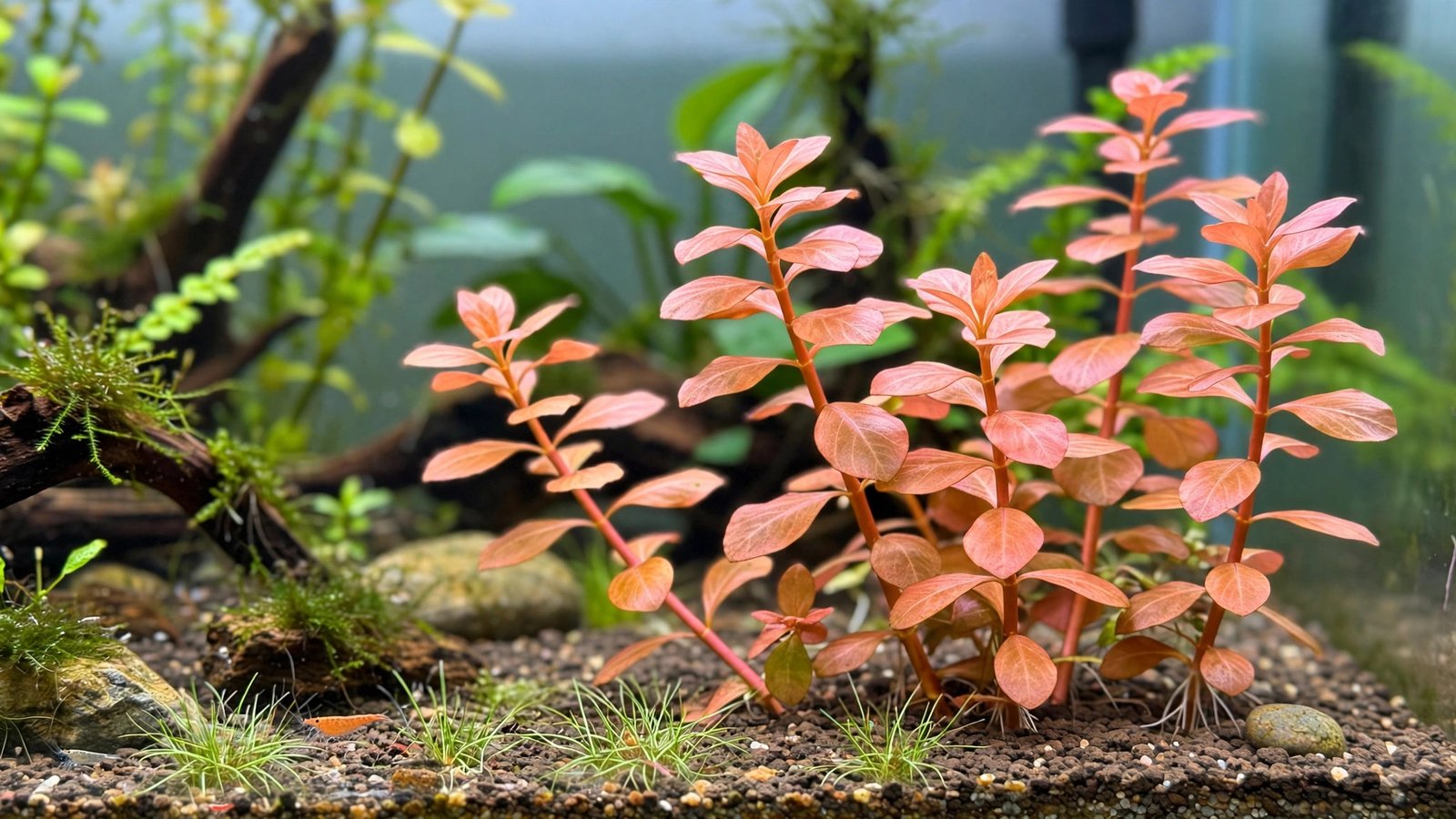
You bought it for the sunset colors on the label — pink, orange, red — and what’s growing in your tank is a plain green stem plant. That letdown is the most common Ludwigia ovalis story in the hobby, and it’s almost always fixable: color is a response to conditions, not a promise on a label.
This ludwigia ovalis care guide shows you exactly what flips the switch — light intensity, iron, and slightly lean nitrates — plus how to plant it without melt, trim it into a dense bush, and tell it from its near-twin Ludwigia repens at a glance.
ludwigia ovalis care: what actually drives the pink-orange color
Under medium light, ovalis grows soft green and perfectly healthy — just unremarkable. The pink-orange shift is driven by photons first: around 50 micromoles of PAR or more at the substrate. Below about 30 PAR, no fertilizer will paint it pink.
Iron is the second lever: dose a chelated iron supplement (like Seachem Flourish Iron, per the label) to hold iron around 0.05–0.1 ppm. First, read the honest answer to do aquarium plants really need fertilizer so you dose for your tank, not out of habit.
The third lever is nitrate: lean, not starved. Holding nitrate at 5–10 ppm with phosphate at 0.5–1 ppm deepens color; zero nitrate stalls growth and invites algae. CO2 is genuinely optional, but 20–30 ppm injected thickens stems and brings the pink on two weeks sooner. Run 7–8 hours of light at first, 8–9 once the tank is stable.
| Parameter | Target for best color |
|---|---|
| Light | 50–80+ µmol PAR at substrate |
| Photoperiod | 7–8 hours (8–9 once stable) |
| CO2 | Optional; 20–30 ppm if injected |
| Iron | 0.05–0.1 ppm Fe, chelated |
| Nitrate | 5–10 ppm |
| Phosphate | 0.5–1 ppm |
| Temperature | 20–28°C (68–82°F) |
| pH | 6.0–7.0 |
The one-leaf-per-node test: ovalis vs. repens
From across the room they look identical: oval leaves, reddish stems, pinkish tops. Up close the difference is binary — repens grows two leaves per node, opposite each other; ovalis grows one leaf per node, alternating sides. Check one node and you’ll never confuse them again (the Ludwigia repens care guide covers its twin in full).
Habit differs too: ovalis leans and sprawls, staying lower and bushier, while repens shoots straighter up. The palettes differ as well — ovalis tops out at pink-orange, repens leans orange-red, and true deep crimson belongs to Ludwigia Super Red or the near-black Ludwigia ‘Rubin’. For a fine needle-leaf alternative, see Ludwigia arcuata; and note young ovalis is sometimes confused with Rotala rotundifolia, whose leaves stay in opposite pairs.
Planting ovalis so it doesn't melt
Grab a potted or tissue-culture cup of Ludwigia ovalis — tissue culture arrives pest-free, but preparation matters more than the format:
- Remove rockwool, lead weights, or foam; rinse tissue-culture gel clean.
- Strip leaves from the bottom 2–3 cm of each stem — buried leaves rot and take the stem with them.
- With tweezers, push each stem 2–3 cm deep, spaced 2–3 cm apart, in groups of 8–12.
- Plant into stable water — new stems on rescape day, when parameters swing, are the classic melt trigger.
Tissue-culture plants are grown emersed, so expect the small round emersed leaves to melt over one to two weeks while submerged leaves grow in — transition, not death. Buce Plant’s Ludwigia ovalis care instructions describe the same prep routine.
Trimming and replanting: the two-week bush routine
In decent light, ovalis hits the surface in two to three weeks — that’s your signal. Snip the top 10–15 cm with sharp scissors and replant the cutting beside the parent; it roots within days. The stump sprouts two side shoots from the top node, so each trim roughly doubles the bush.
Don’t discard bare bottoms unless they’re algae-coated — they resprout from lower nodes. Every two to three months, pull the group, toss the leggy bases, and replant fresh tops to reset the stand. On this rhythm, one cup becomes a dense thicket within two months.
Emersed form, creeping habit, and tiny flowers
In its East Asian home waters — cool streams and wet banks — ovalis doesn’t stand up at all; it creeps along the ground, rooting as it goes. Given constantly wet soil and strong direct light, emersed plants produce small, inconspicuous yellowish flowers you’ll rarely see indoors.
In the aquarium the same plant grows upright with its characteristic slight slant. A dry start is possible but fiddly — emersed ovalis demands near-constant moisture and intense light — so most growers plant submerged from day one. Flowgrow’s Ludwigia ovalis plant database entry has the full botanical background.
Where ovalis fits in a community tank
Ovalis belongs in the foreground to midground (midground only in tall tanks) and follows one design rule: plant it against light-green background plants. Pink-orange glows hardest next to green; beside other reds it blends in. A trimmed bush also shelters shrimp and fry.
It’s forgiving enough for a first planted tank — see the easiest aquarium plants for a beginner community tank for good companions. Give it decent light and it keeps pace with anything in a low-tech setup.
Troubleshooting: melting, legginess, and algae
Most ovalis problems trace back to transition shock, too little light, or a light–nutrient imbalance.
| Symptom | Likely cause | Fix |
|---|---|---|
| Lower leaves melting, tops look fine | Emersed-to-submerged transition | Wait two weeks; keep water stable; don’t move the stems |
| Tall bare stems, small leaves on top | Light too weak | Raise intensity to 50+ PAR; trim and replant the tops |
| Staying green under strong light | Low iron or nitrate too high | Dose chelated iron; hold nitrate at 5–10 ppm |
| Hair or thread algae on leaves | Too much light for the nutrient level | Cut photoperiod to 6–7 hours; rebalance dosing; trim affected leaves |
| Stems rotting at the substrate | Leaves buried; poor flow at the base | Strip lower leaves; replant shallower; improve circulation |
Frequently Asked Questions
Why is my Ludwigia ovalis green instead of pink?
Almost always, the light is too weak: ovalis stays green below ~30 PAR and shifts pink-orange at 50+ PAR at the substrate. Dose chelated iron to 0.05–0.1 ppm and keep nitrate lean at 5–10 ppm, not zero. Expect visible change two to three weeks after conditions improve.
Does Ludwigia ovalis need CO2?
No — ovalis grows perfectly well in a low-tech tank, which is part of its appeal. Injected CO2 at 20–30 ppm still helps: stems grow thicker, growth speeds up, and the pink-orange arrives weeks sooner. Treat CO2 as an accelerator, not a requirement.
How can I tell Ludwigia ovalis from Ludwigia repens?
Count leaves at one node: ovalis grows one leaf per node, alternating sides; repens grows two, opposite each other. That trait separates them every time. Ovalis also sprawls with a slight slant and tops out pink-orange, while repens grows straighter and leans orange-red.
Why is my new Ludwigia ovalis melting?
Tissue-culture and nursery plants are grown emersed; their round emersed leaves almost always melt as submerged leaves grow in — transition, not failure. Keep water stable, don’t move the stems, and give it two weeks. New tip growth means it’s fine; intervene only if stems rot at the base.
Is Ludwigia ovalis good for beginners?
Yes, with one caveat: it’s easy to keep alive — tolerant of varied water, no CO2 needed, propagates from cuttings. The famous pink-orange color takes more intention: strong light, iron, lean nitrates. Think of it as a beginner plant that rewards you like an intermediate one once the light is dialed in.
A forgiving plant with one non-negotiable
Ovalis forgives almost everything — no CO2, modest substrate, a missed water change — except dim light. Give it real intensity and a little iron, and it pays you back with the easiest pink-orange in the hobby.