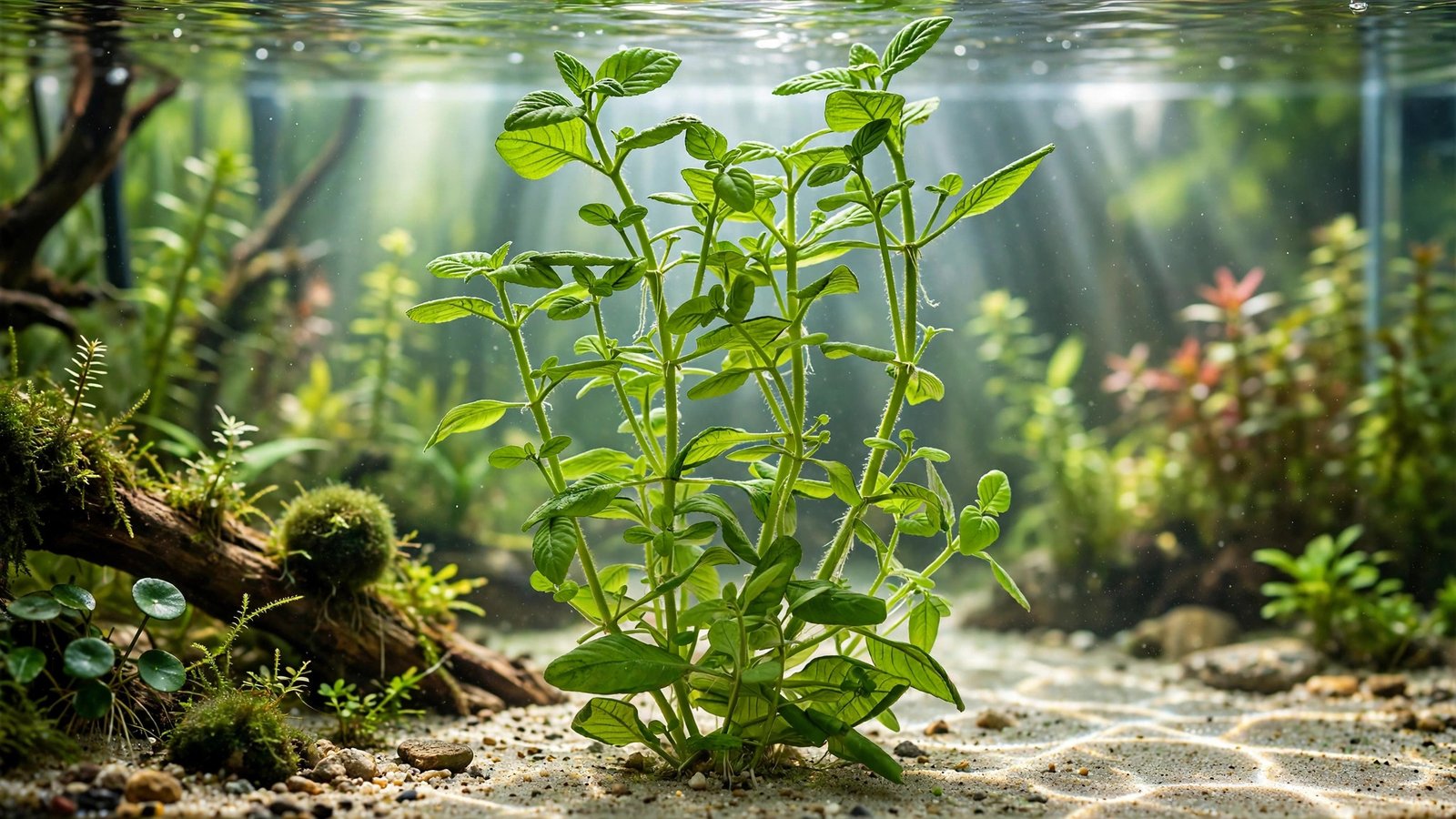
Crush a single leaf between your fingers and Limnophila rugosa does something no other common aquarium stem can: it perfumes your skin with sweet anise and basil. That scent doubles as your field identification test — at a glance the plant could pass for a grocery-store herb pot, but no impostor smells like that. limnophila rugosa care is genuinely straightforward once the plant settles in, yet most failures happen in the first month, when shipping melt and misread nutrient signals make a hardy stem look doomed. This guide gets you through that first month and everything after it.
Give Limnophila rugosa medium light (~30–50 PAR at the substrate), 22–28 °C water, and a steady all-in-one fertilizer schedule, and it forms a compact 10–50 cm midground stem with puckered, whorled leaves — no CO2 required, though injected CO2 tightens the form. It is the only common aquarium stem whose bruised leaves release a sweet anise–basil aroma, a trait tied to its real-world life as a fragrant herb and herbal tea in its native Asian range. Expect shipping melt, leaf holes when nutrients run lean, and slow growth that needs far less trimming than faster relatives.
limnophila rugosa care: the smell test and the wrinkled leaf
The name does half the identifying work: rugosa is Latin for "wrinkled," and the leaves are puckered like hammered copper, toothed at the edges, set in whorls around an upright stem. Aqua Essentials notes the same giveaway — whorled, textured foliage in fresh light green. Shops sell it as wrinkled marshweed, the more descriptive name.
Then comes the test nothing else on the shelf can pass: bruise a leaf and it breathes out sweet anise and basil. Plantiary documents exactly this scent, and the plant's home-range reputation backs it up — it is grown there as a fragrant herb and steeped as herbal tea. If the leaf you crush smells of nothing, you are holding the wrong plant.
The smell test earns its keep inside the genus, where everything resembles everything. Limnophila sessiliflora is feathery and fern-fine; Limnophila aromatica flushes crimson with its own crushed-leaf perfume. Quilted, green, basil-scented — that combination is rugosa.
Water, light, and heat: the parameter table
Rugosa's wild habit — marshy margins swinging between wet and submerged — explains the wide comfort band. Aim at the target column; lean on tolerance when life gets in the way.
| Parameter | Target |
|---|---|
| Light | Medium, ~30–50 PAR at substrate |
| Temperature | 22–28 °C (tolerates 15–30 °C) |
| Hardness | Soft to medium-hard |
| CO2 | Optional — tightens growth |
| Pace | Slow to moderate |
Note the pace row: a slow stem sips nutrients gently, but it still drinks. If your dosing routine is guesswork, settle whether aquarium plants really need fertilizer now, before the troubleshooting section's deficiency holes teach you the hard way.
Planting: clumps, spacing, and regimented rows
Rugosa reads best as one deliberate clump, never as scattered singles. Press five to seven stems into the substrate 3–4 cm apart in the midground, where pale quilted foliage contrasts with dark stone or driftwood — tight enough to read as one mass, loose enough that light reaches the lower whorls. Shrimp graze the clump constantly; the plant is safe for them. The upright, even habit also suits the regimented rows of a Dutch-style composition — orderly avenues of grouped stems, each species in its own lane. Rugosa anchors a midground lane, with Limnophila hippuridoides behind and Limnophila sp. "Vietnam" as the finer foreground.
The slow-grower maintenance rhythm
Forget the weekly haircut fast stems demand — rugosa runs on a monthly check-and-shape. When the clump reaches target height, cut the top third off the tallest stems; the bases branch, and the removed tops go straight back into the substrate as new plants. Maintenance and multiplication happen in one motion.
Slow growth has one tradeoff: in bright, rich water, leaves it cannot outgrow collect film algae. Medium light keeps the plant compact and algae unmotivated. Feed steadily but modestly — the plant's own leaves will tell you when you have starved it, which brings us to the article's most useful diagnostic.
Propagation: side shoots and top cuttings
A healthy clump multiplies without help. Watch the leaf axils: side shoots emerge, lengthen a few centimetres, and grow their own root nubs. Snap them free at the base and push them into the substrate — they root within days. One vigorous mother clump can fill a midground lane in two to three months this way.
The second method is the trimming you were doing anyway: removed tops replant directly and root just as reliably, while the cut bases bush outward. Between side shoots and replanted tops, rugosa is one of the few stems where maintenance and propagation are the same task.
Troubleshooting: holes, melt, film algae, and legginess
Holes in the leaves. Small perforations in healthy foliage are rugosa's signature distress signal: your nutrient supply has fallen behind. Damaged leaves never heal, so trim affected growth, start a consistent all-in-one schedule, and judge recovery by the new leaves — clean within about two weeks.
Melt after shipping. This plant commonly melts in transit and after big environment changes. A marsh plant at home above and below the waterline, it sheds old leaves and rebuilds for the new conditions. Leave the stems planted, hold everything stable, and expect fresh submerged foliage within two to three weeks — patience, not replanting, is the fix.
Film algae. Slow growth plus strong light turns any stem into an algae magnet: drop the light to medium, hold the photoperiod at 6–8 hours, and let shrimp clean the clump. Leggy stems with wide whorl gaps want more light or some CO2 — raise intensity first, add CO2 second.
Frequently Asked Questions
Is Limnophila rugosa good for beginners?
Yes, with one honest caveat: it appears in shops less often than faster stems, so sourcing stock takes more effort than growing it. Its demands are modest — medium light, 15–30 °C, steady nutrients — and it forgives inconsistent CO2. Slower growth also means far less trimming.
Does Limnophila rugosa need CO2?
No. It grows well without injected CO2 under medium light — CO2 is a form upgrade, not a survival requirement. With it, stems stay shorter, whorls sit tighter, and the wrinkled texture shows more clearly. Start without it; add it later only for a denser clump.
Why does my Limnophila rugosa have holes in its leaves?
Holes signal a nutrient shortage, usually potassium or a general macro shortfall. Start a consistent all-in-one schedule; new growth should come in clean within two weeks. Old holed leaves never repair themselves — trim damaged stems and let fresh shoots replace them.
How do you propagate Limnophila rugosa?
Two reliable ways. Detach side shoots from the leaf axils and plant them directly — they root within days. Or replant top cuttings from your monthly trim; the cut bases branch into bushier growth. One clump can become a full midground lane within a few months.
Is Limnophila rugosa safe for shrimp tanks?
Yes — retailers list it as shrimp-safe, and its sturdy foliage suits invert tanks. Shrimp graze film algae off the broad wrinkled leaves without damaging them, which conveniently solves the plant's one maintenance headache. A strong pick where the cleanup crew matters as much as the plants.
Should the wrinkled marshweed join your tank?
If you want a midground stem with genuine character — quilted basil-like leaves, a bruise-and-sniff aroma no other stem can fake, shrimp-safe foliage, and a maintenance calendar measured in months — rugosa earns its lane. Buy healthy submerged stock, ride out the first melt, and keep it fed. Then compare notes against the easiest aquarium plants for beginners — rugosa belongs on that shortlist more often than it lands there.