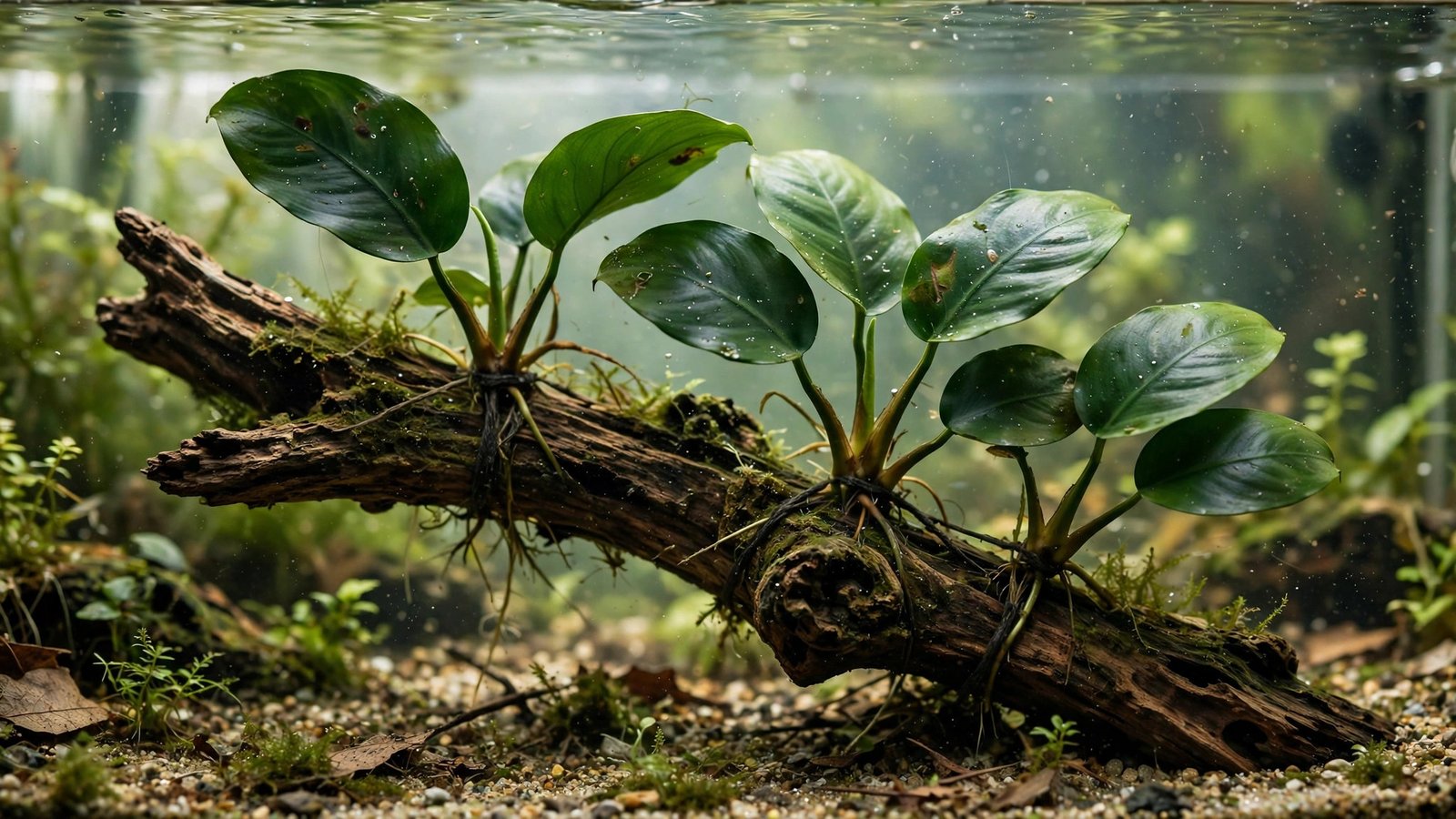
Anubias is strictly a freshwater plant — and if you've been wondering "is anubias freshwater or saltwater," the confusion is completely understandable. It survives the odd aquarium-salt treatment and pops up in brackish-tank plant lists, yet none of that makes it a saltwater plant. Below is the straight answer: what Anubias actually tolerates, what kills it, and what to do if salt has already gone into your tank.
So, Is Anubias Freshwater or Saltwater?
Freshwater. Every species and cultivar, from Anubias barteri var. nana to the tiny Anubias nana petite, grows in streams, rivers, and shaded marshes across tropical West and Central Africa. Tropica, the Danish aquatic plant nursery that supplies much of the hobby, lists Anubias varieties as freshwater plants that root on stone and wood (see their Anubias barteri var. nana entry) — and no reputable source has ever documented an Anubias species growing in the sea.
It belongs to the same family (Araceae) as other freshwater staples. Like Java fern and Bucephalandra, it's an epiphyte with a thick rhizome that must stay exposed — all freshwater ecology, all the way down. Our complete Anubias care guide covers light, mounting, and fertilization on that basis.
Why Beginners Ask This Question
Three real-world situations make the freshwater-vs-saltwater question genuinely tricky, and you've probably run into at least one of them:
- Brackish-tank plant lists include it. Anubias shows up on "plants that survive brackish water" lists because it tolerates mild salinity better than most freshwater plants. Tolerance gets misread as belonging — it doesn't mean the plant wants salt.
- Salt dips are a real algae treatment. Hobbyists dip Anubias in salt water to kill algae on its slow-growing leaves, then rinse and return it. Seeing a plant dunked in salt water naturally raises the question of whether it could live in it.
- Mislabeled listings. Some sellers and aggregators slap "marine safe" or "saltwater plant" tags on Anubias pots. They mean the plant is tough, not that it's a reef species.
The short version: all three situations involve brief exposure or borderline survival, never actual saltwater living.
How Much Salt Can Anubias Actually Tolerate?
Anubias is one of the tougher freshwater plants, and its tolerance has real, measurable limits — expressed here in the numbers that matter:
| Situation | Salinity / dose | What happens |
|---|---|---|
| Pure freshwater | 0–0.5 ppt (SG 1.000) | Optimal. Normal growth — about one new leaf every 2–3 weeks. |
| Lightly brackish tank | Up to ~1.003–1.005 SG | Survives for weeks, maybe months. Growth slows and older leaves may yellow. This is the absolute ceiling, not a recommendation. |
| Standard aquarium-salt dosing | 1 tbsp per 5 gallons (~1,000 ppm) | Measurable stress. Plants divert energy to fighting osmotic pressure instead of growing; roots and new leaves develop poorly. |
| Salt dip (separate container) | 2 tbsp per gallon, 1–3 min | Safe when rinsed after. Brief exposure kills algae without penetrating the rhizome. |
| Full marine water | SG 1.020–1.025 (~35,000 ppm) | Lethal. Leaf cells collapse within days; the rhizome follows. |
Notice the pattern: time matters as much as dose. A 3-minute dip at high concentration is survivable; a week at a tenth of that is damaging — the osmosis mechanics of salt stress in planted tanks work exactly like that.
What Salt Does to an Anubias Plant
When salt accumulates around Anubias, the damage follows a predictable sequence. First the leaves lose turgor and go limp — the plant is literally drying out from the inside, because water moves out of its cells toward the saltier water outside. Next, the oldest leaves yellow and melt. If exposure continues, the rhizome — the thick horizontal stem all growth depends on — softens and rots.
The cruel part is the delay. Anubias grows slowly, so salt damage often shows up a week or two after the exposure, long after you've assumed everything was fine. "I added salt last week and the plants still look OK" is a common trap: unlike fast-growing stem plants that signal trouble immediately, Anubias stores the injury in its rhizome and pays it out in melted leaves later.
What to Do If Salt Already Got Into Your Tank
Added salt for an ich treatment, a nitrite emergency, or because a bottle label said to? Anubias is tough, and recovery is straightforward if you act fast:
- Stop adding salt immediately. Also check additives like mineral supplements — some contain sodium chloride too.
- Do 30% water changes every other day for a week. Dilute the salt gradually; one massive change stresses fish more than the salt did.
- Run fresh activated carbon for a few days, and test with a refractometer until specific gravity reads a flat 1.000.
- Trim melted leaves at the rhizome with clean scissors. Don't cut the rhizome itself — our Anubias propagation guide shows how to tell healthy rhizome tissue from rot.
- Give it 2–3 weeks. If the rhizome is firm and green, new leaf buds will appear. Anubias recovers slowly but reliably from a single salt event.
If You Want a Salt-Tolerant Tank Instead
You can keep Anubias in a lightly brackish tank (SG 1.003–1.005) for a while, but it's on borrowed time there and will eventually need replacing. Better permanent choices for low-salinity setups include the marimo moss ball, which genuinely tolerates mild brackish conditions, and the dedicated brackish species in the brackish-water plants guide.
And if algae was what sent you down the salt route, skip the salt entirely: we tested whether hornwort helps reduce algae honestly, limits and all — a plant-based approach that doesn't risk your Anubias.
Frequently Asked Questions
Can Anubias survive in a saltwater (marine) aquarium?
No. Anubias is strictly freshwater, and full marine water at SG 1.020–1.025 destroys its leaf cells through osmotic dehydration within days, followed by rhizome rot. True saltwater aquariums use macroalgae like chaetomorpha and seagrasses instead — no Anubias species or variety is adapted to the sea.
Can I put Anubias in a brackish water tank?
Temporarily, yes — it survives very light brackish water up to about SG 1.003–1.005 for weeks to a few months. Growth slows and older leaves may yellow. For a permanent brackish setup, choose genuinely brackish-tolerant species instead, such as marimo moss balls.
Will aquarium salt kill my Anubias?
Standard dosing (1 tablespoon per 5 gallons) won't kill it outright, but it causes real stress — plants divert energy to fighting osmotic pressure, so growth slows and new leaves and roots develop poorly. Sustained dosing is what does the damage. Never add aquarium salt to a planted tank as a routine tonic.
Is a salt dip safe for Anubias with algae on its leaves?
Yes, when done correctly. Mix 2 tablespoons of aquarium salt per gallon of tank water in a separate bucket, dip the Anubias for 1–3 minutes only, then rinse it thoroughly in dechlorinated water before returning it to the tank. The brief dip kills algae without harming the rhizome — but never salt the tank itself.
Why does my Anubias look fine a week after I added salt?
Anubias grows very slowly, so salt damage takes 1–2 weeks to show — limp leaves, then yellowing and melting, and in bad cases rhizome rot. Looking fine at one week proves nothing. If salt went in, start 30% water changes every other day now rather than waiting for symptoms.
The confusion is honest, but the biology is settled: Anubias is a freshwater plant from African rivers, and that's the water it wants. Brief salt exposure — a dip, a treatment gone wrong — is survivable with quick action, but salt is never part of its care. Whether you're stocking it with bettas or anchoring it in a community scape, keep the water fresh and the rhizome exposed, and your Anubias will outlive almost everything else in the tank.