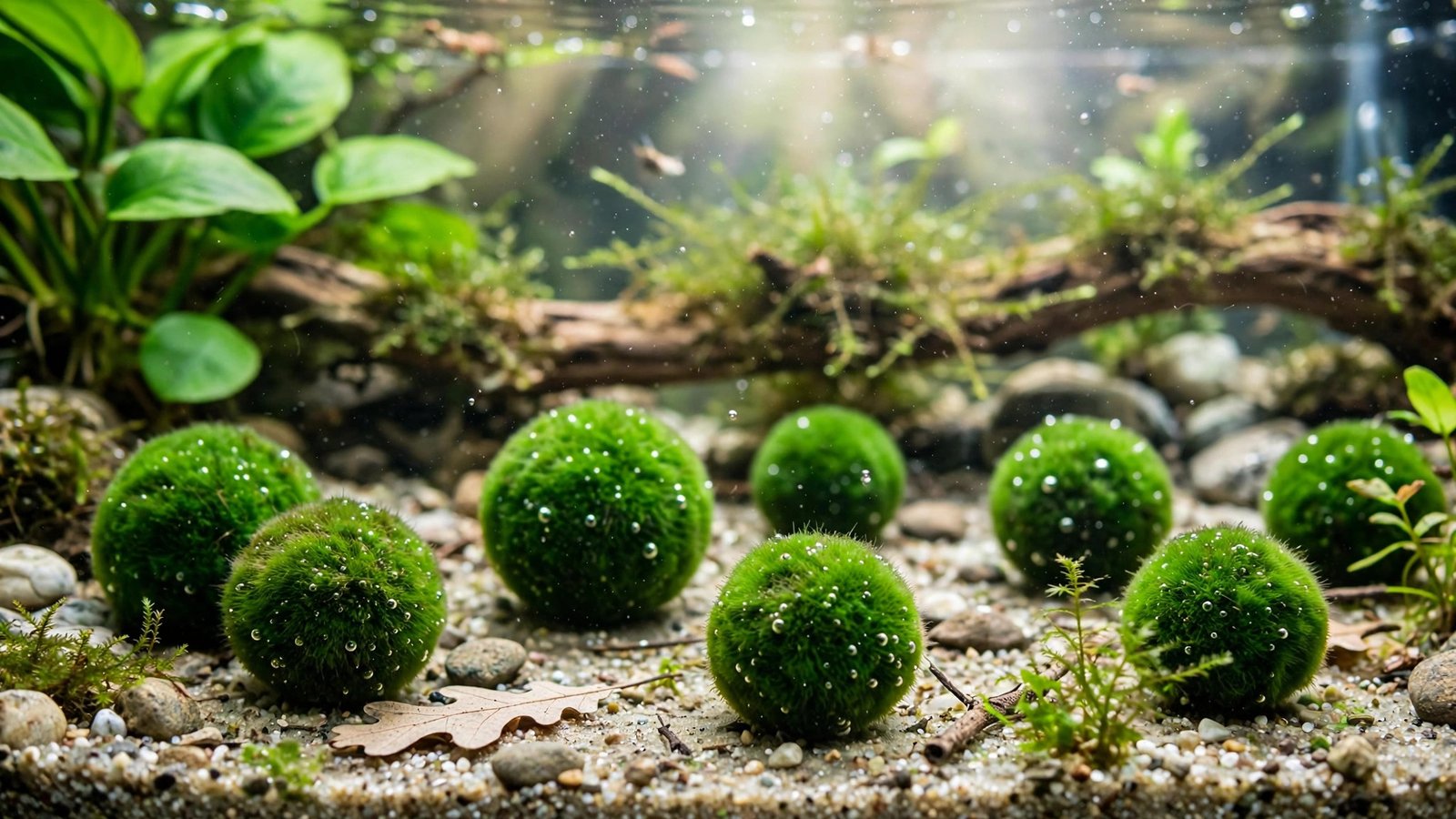
It's not a plant at all — it's a ball of algae, and it's adorable. Marimo moss ball care is the gentlest introduction to aquarium greenery: Aegagropila linnaei is a rare spherical colony of freshwater algae that grows into velvety green balls, needs almost nothing, and lives for decades — possibly over a century. If you want living decor with zero commitment, this is it.
This guide covers what marimo actually are, their minimal needs, the rolling ritual that keeps them round, propagation by division, and troubleshooting browning and floating.
Quick Care Reference
| Parameter | Requirement |
|---|---|
| Light | Low (indirect is fine) |
| CO2 | Not needed |
| Growth rate | Extremely slow (~5mm/year) |
| Placement | Anywhere (substrate, on decor) |
| Difficulty | Trivially easy |
| Temperature | 60–77°F (15–25°C); cooler preferred |
| pH | 6.0–8.5 |
| Size | 1–5 inches typical (2–12 cm) |
What Marimo Actually Are
Marimo ("bouncy ball" in Japanese) are colonies of a freshwater green algae species that, in a handful of cold lakes in Japan and Iceland, roll along lake beds shaped by gentle currents into spheres. The aquarium trade farms them — wild harvest is restricted — so your marimo is aquacultured, not lake-stolen.
They're alive and photosynthetic, growing outward roughly 5mm per year — one of the slowest-growing organisms you'll ever keep. Large marimo (4–5 inches) are decades old, which is part of their charm: you're keeping something genuinely ancient. In Japan they're a protected natural treasure with festivals in their honor.
Basic Care: Almost Nothing
Marimo need: water, a little light, and cool temperatures. That's the list. They tolerate low light beautifully — a bright room without direct sun is plenty; direct sunlight encourages brown spots and nuisance algae on their surface. They prefer cool water (60–77°F) and do best below 75°F; warm tropical tanks above 80°F stress them over time.
Water changes: rinse them gently in old tank water during water changes, squeezing lightly like a sponge to expel trapped debris. That's the entire maintenance routine. No fertilizer needed — though trace nutrients in normal tank water support their glacial growth. No CO2, obviously. They even tolerate the low-light, low-tech bowls and jars that kill everything else.
The Rolling Ritual
In lakes, currents roll marimo constantly, giving all sides light and keeping them spherical. In your tank, roll them yourself: turn each ball every week or two during water changes. Unturned marimo develop flat, brown undersides where light never reaches — not fatal, but ugly, and it takes months to green up again.
Gentle water movement helps — a mild current slowly rotates them, mimicking lake conditions. Some keepers put marimo in filter outflow paths for this reason. Don't overthink it: a weekly turn by hand is perfectly adequate.
Placement Ideas
Marimo suit anywhere: nestled in substrate foregrounds, perched on driftwood, in nano tanks, betta bowls, shrimp jars, even desk vases. They're one of the few "plants" safe for the tiniest containers, since their needs are so minimal. Groups of three in different sizes look natural; a single large specimen makes a striking minimalist statement.
They're compatible with everything — shrimp graze their surfaces, snails clean them, fish ignore them. In aquascapes, they add soft round contrast to angular hardscape. In low-tech nano setups, a marimo or two plus Anubias petite is a complete, nearly immortal composition.
Propagation: Division
Marimo propagate by division — pull or cut a ball apart into pieces. Each piece, kept in good conditions, slowly rounds itself over months to years. It's the slowest propagation in the hobby, but it's nearly foolproof: the pieces don't die, they just take forever to look like balls again.
You can also press marimo flat to create "moss carpets" — flattened marimo slowly spreads as a velvety mat. This works but looks sparse for a long time; patience required, as always with marimo.
Troubleshooting Common Problems
Turning brown
Too much direct light, water too warm, or the unturned underside browning. Move out of direct sun, verify temperature below 77°F, and roll regularly. Brown patches often green up again over weeks once conditions improve. Gently roll the ball in your palms under water to reshape and expose fresh surface.
Floating
Trapped air or oxygen bubbles inside make marimo float — usually harmless. Squeeze gently underwater to expel air; it'll sink again. Persistent floating with a foul smell indicates internal decay — rare, but inspect: healthy marimo smell like clean lake water, rotting ones smell swampy. Cut away any mushy sections.
White or gray patches
Often just new growth or mineral deposits. If fuzzy, it may be a fungal or bacterial film — rinse thoroughly and improve water quality. Marimo in dirty, stagnant water develop films; clean water and gentle flow prevent them.
Falling apart
Old or stressed marimo can loosen. Gently re-roll the ball in your palms underwater to re-compact it — the filaments re-entangle. If it keeps disintegrating, water conditions are likely poor (too warm, dirty, or chemically treated); address the environment.
Nuisance algae growing on the marimo
Hair algae colonizes marimo in bright, nutrient-rich tanks. Reduce light, manually remove the invader with tweezers, and consider a shrimp cleanup crew. A brief quarantine in a dark bucket for a few days can reset minor algae without harming the marimo — they're remarkably resilient to darkness.
Marimo in Different Setups
Betta tanks: ideal — bettas rest on them, much as they lounge on broad Anubias leaves, and the low-flow, warm-ish conditions suit marimo fine (keep under 78°F). Shrimp tanks: perfect — shrimp graze marimo constantly, and they pair beautifully with Christmas moss for a complete shrimp habitat, keeping them clean. Goldfish tanks: one of the few plants goldfish mostly ignore. Desk jars/vases: the classic — for a planted jar with more structure, see our Java moss options — a marimo in a jar with indirect light lives for years with just occasional water changes. They're the ultimate low-commitment living decor.
Marimo in Japanese Culture
In Japan's Lake Akan, marimo are a protected natural treasure — the Ainu indigenous people hold a festival honoring them, and removing them from the lake is prohibited. This cultural status is part of their appeal: you're keeping an organism revered enough to have its own celebration. Aquarium marimo are aquacultured, so the trade doesn't threaten wild populations, but the heritage adds meaning to the little green ball on your desk. They also make excellent gifts — a marimo in a jar is many people's first living aquarium organism, and its near-indestructibility means it survives even the most neglectful recipient. Pair a gift marimo with a care card noting just three rules: indirect light, cool water, and an occasional roll.
Marimo Sizing and Styling Tips
Marimo are sold from marble-size (1 inch) to softball-size (4–5 inches), with price rising steeply with diameter — remember, each extra inch represents years of growth. For most tanks, 1.5–2.5 inch balls offer the best value: substantial enough to see clearly, affordable enough to buy several. Odd-numbered groupings (3 or 5) of mixed sizes look most natural scattered in a foreground. For a striking minimalist composition, place a single large marimo on pale sand with nothing else — the contrast of perfect green sphere against empty substrate is genuinely artistic. Avoid burying them; they sit on the substrate surface, and half-buried marimo develop flat brown spots where substrate contacts the shaded side.
Frequently Asked Questions
Are marimo moss balls actually moss?
No — they're a spherical colony of freshwater green algae (Aegagropila linnaei), not moss at all. The name is a historical misnomer. This doesn't affect care: treat them as the ultra-hardy, slow-growing organisms they are. The misnomer is historic, but every hobbyist knows exactly what it means.
How long do marimo live?
Decades — potentially over a century. They grow about 5mm per year, so a 4-inch ball is decades old. With basic care (cool clean water, occasional rolling), your marimo will outlive most of your other aquarium inhabitants, possibly including you as its keeper.
Why is my marimo floating?
Trapped air or oxygen bubbles inside — squeeze it gently underwater to release air and it'll sink. Floating alone isn't a problem unless accompanied by foul smell or mushy texture, which indicates internal decay. Healthy floating marimo are just buoyant.
Do marimo need fertilizer or CO2?
Neither. Their glacial metabolism runs fine on trace nutrients in normal tank water. Fertilizer is unnecessary and CO2 is irrelevant. Clean, cool water and a little light are the complete requirements. Clean, cool water and a little light are the complete requirements for decades of life.
How do I propagate a marimo?
Pull or cut it into pieces — each piece slowly rounds itself over months to years. It's the slowest propagation in the hobby but nearly foolproof. You can also flatten marimo into velvety mats. Patience is the only skill required.
Can marimo live in a jar without a filter?
Yes — they're famous for it. A jar with clean water, indirect light, and weekly water changes keeps marimo healthy for years. Rinse the ball during water changes and roll it occasionally. It's the lowest-maintenance living thing you can keep indoors.
Bringing It All Together
Marimo moss balls are the houseplants of the aquarium world that aren't plants at all: ancient, adorable, and nearly indestructible. Give them cool clean water, indirect light, and an occasional roll, and they'll outlive your interest in everything else in the tank. Sometimes the best aquarium addition is the one you barely have to think about.