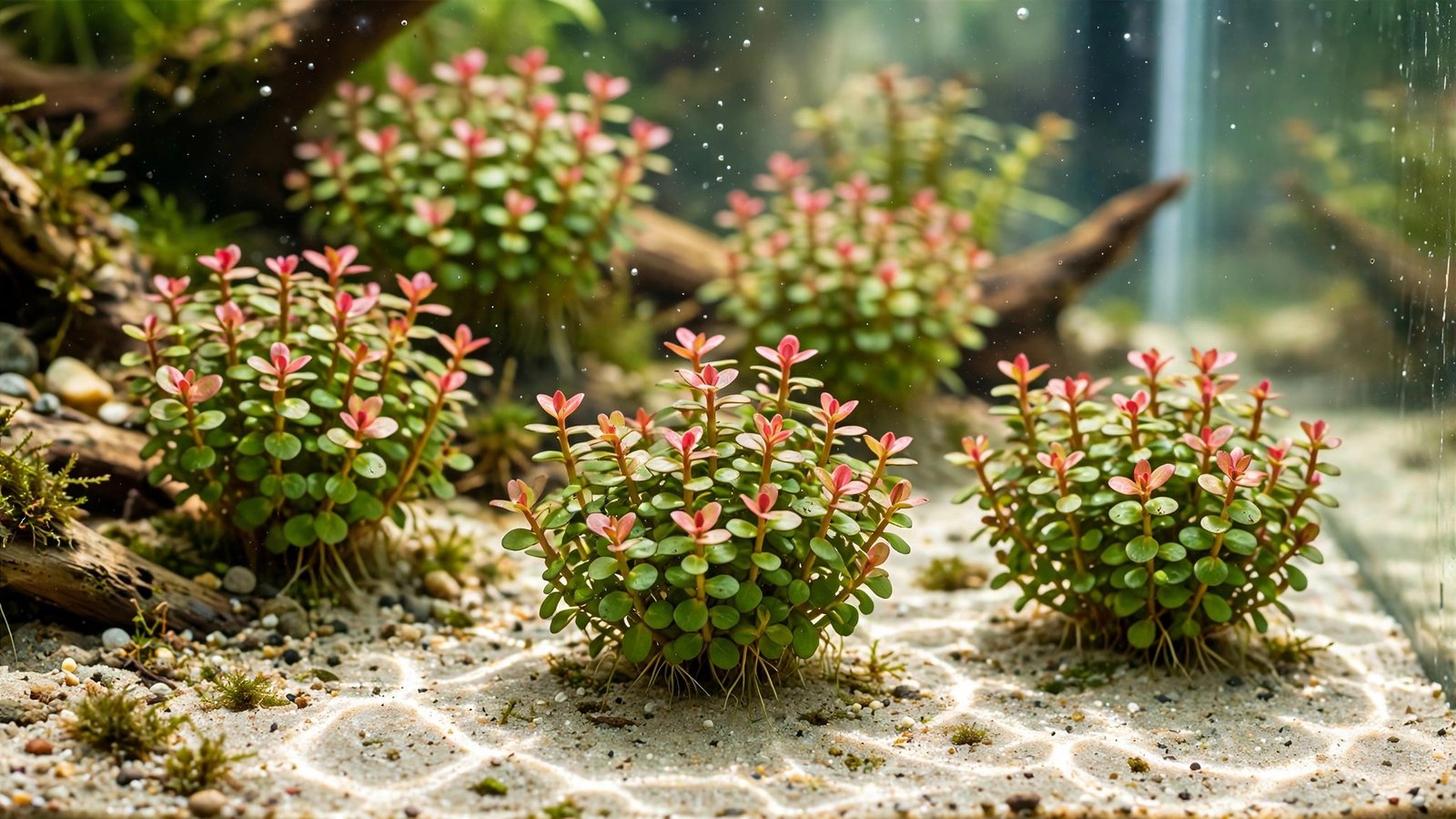
Few aquarium plants reward precision like the miniature tree hiding in the stem-plant aisle. Nail Rotala indica Bonsai care and you get a dense little canopy of coin-shaped leaves tipped in reddish-orange — a plant that genuinely looks like a bonsai. Get it wrong and it stretches into the same leggy green sprig as any neglected stem. This guide walks you through the exact conditions, trimming rhythm, and feeding it needs. If color is your main obsession, skim our red stem plants color guide first — but form is where this cultivar really earns its keep.
Rotala indica Bonsai care: light and CO2 first
This is the section that decides everything. Rotala indica 'Bonsai' — sold interchangeably as Ammannia sp. 'Bonsai' — is a compact cultivar with tiny round leaves and a horizontal-branching, tree-like habit. It is not a low-light plant, even though it looks delicate enough to be one. The single most common failure is treating it like Rotala rotundifolia: under 30–40 PAR it drops its signature form, internodes stretch, leaves space out, and the reddish-orange tips never appear.
Target 60–80+ PAR at the substrate for 7–8 hours a day. If you can't measure PAR, aim for a quality full-spectrum LED running near full power on a shallow tank — the plant rewards intensity. CO2 is the second pillar: 20–30 ppm through a proper injection setup — but start low, around 10–15 ppm, and increase gradually while you observe your livestock. The plant will survive without it, but it will never look like the photos — CO2 is what keeps the growth tight and the color saturated. Treat CO2 as required if you want the bonsai look.
Water parameters it actually likes
Good news: once light and CO2 are handled, this plant is forgiving about water chemistry. It tolerates a wide band of soft-to-moderately-hard water and standard tropical temperatures — stability matters far more than hitting exact numbers.
| Parameter | Target range | Notes |
|---|---|---|
| Temperature | 20–28°C (68–82°F) | Mid-range (~24–26°C) gives the tightest growth |
| pH | 6.0–7.5 | Slightly acidic to neutral is ideal |
| GH | 2–12 dGH | Adapts across soft to moderately hard water |
| Light | 60–80+ PAR | High intensity drives compact leaves and color |
| CO2 | 20–30 ppm | Required for the bonsai form and red tips |
| Photoperiod | 7–8 hours | Ramp intensity up and down if your light allows |
Planting: give every stem elbow room
Rotala 'Bonsai' is usually sold as in-vitro tissue culture — the format you want. Rinse the gel off, split the mat into 6–10 portions, and plant each with tweezers ½–1 inch apart in nutrient-rich substrate. Cram them together and the inner stems get shaded, melt from the base up, and float free within a week.
Plant in the midground where the miniature tree form reads clearly — a crowded background hides it, and it lacks the height for a true background role. It's also a natural for Dutch-style "streets" (tight rows of a single species) and nano tanks, where close viewing makes the tiny leaves impressive. It pairs well with compact Hygrophila Araguaia or a Cyperus helferi background for contrast.
Trimming: this is where the bonsai happens
Rotala 'Bonsai' responds to pruning better than almost any stem plant. Cut a stem and it reliably pushes 2–3 side shoots from just below the cut, each branching again at the next trim. Trim the canopy every 2–3 weeks — before internodes stretch — and the plant converts from a few vertical stems into a dense, rounded, genuinely tree-like bush. That's the entire bonsai effect; no fertilizer substitutes for it.
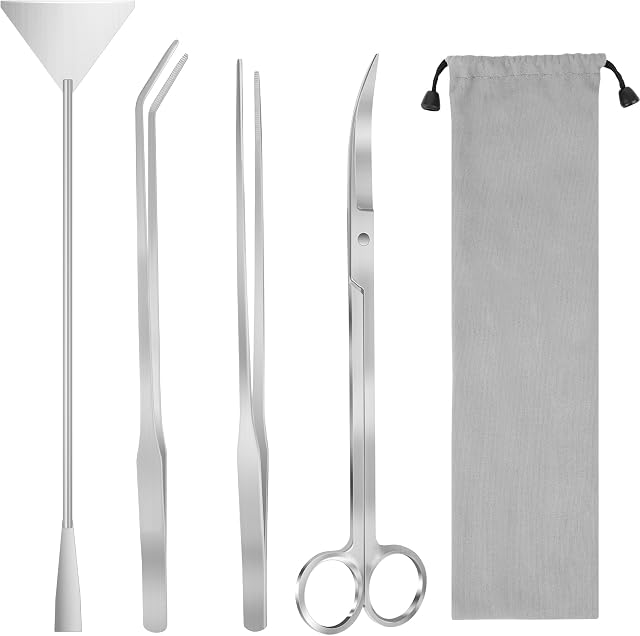
Cut horizontally with sharp aquascaping scissors at your canopy line. Don't let it grow wild for two months and then chop it in half — hard, infrequent cuts shock the plant and leave a bare lower half. Replant the trimmed tops beside the mother stems: they thicken a patch far faster than waiting for branching alone.
 ★4.7
Liveek 4-in-1 Aquascaping Tool Kit
Check Price on Amazon ★4.7Fertilizer: steady nutrients, extra iron
Nutrient stability is the third pillar. Dose a complete liquid all-in-one fertilizer on a steady schedule — daily micro-doses or a consistent weekly routine — and keep nitrates at 10–20 ppm. The reddish-orange tips come from high light plus iron and micros, not deprivation. Nutrient-rich substrate or occasional root tabs supports its strong root system, though water-column dosing does most of the work.
Watch new growth: pale or stunted tips mean iron or micros are low; pinholes in older leaves point at potassium. For deeper reds, compare notes with Rotala H'ra and the demanding Rotala macrandra — both run on the same iron-plus-intensity formula.
Rotala indica 'Bonsai' vs Rotala rotundifolia
These two get confused constantly, and the care difference is what trips beginners. 'Bonsai' is the compact specialist — smaller leaves, slower growth, fussier about light. Rotundifolia is the forgiving classic: faster, taller, happy in moderate light where 'Bonsai' would stretch into a mess. Pick rotundifolia for an easy background, 'Bonsai' for a midground showpiece.
| Trait | Rotala indica 'Bonsai' | Rotala rotundifolia |
|---|---|---|
| Leaf size | Tiny, coin-shaped | Small, rounded to oval |
| Habit | Compact, tree-like branching | Upright, fast, bushy |
| Difficulty | Moderate–advanced | Beginner-friendly |
| Light demand | Medium–high, CO2 for best form | Low–high, CO2 optional |
| Best use | Midground, nano, Dutch streets | Background masses |
For a wilder look in the same genus, delicate Rotala wallichii offers fine needle leaves in pink and red — but it's a step harder still, so master 'Bonsai' first. And if you want the absolute easiest stem in the hobby as a contrast planting, easy Bacopa monnieri or the beginner-friendly Cardamine lyrata both thrive on neglect by comparison.
Frequently Asked Questions
Is Rotala Bonsai hard to grow?
It's moderate-advanced, not beginner. The plant survives in average conditions, but keeping it compact, dense, and red-tipped demands medium-high light, CO2 injection, steady fertilization, and regular trimming. If you can already grow other CO2-hungry stems, you'll find it very manageable.
How do I keep Rotala Bonsai compact and red?
Three things: 60–80+ PAR of light, 20–30 ppm of CO2, and trimming every 2–3 weeks before internodes stretch. Add a complete fertilizer with iron and micros, and keep nitrates at 10–20 ppm. The red tips are a light-and-iron response — no special tricks beyond that.
Does Rotala indica 'Bonsai' need CO2?
For the bonsai look, yes. It will live without injected CO2 but grows leggy, sparse, and green — losing everything that makes it special. If you're running low-tech, choose a naturally easy stem like Bacopa monnieri or Cardamine lyrata instead of fighting this plant's nature.
Why is my Rotala Bonsai stretching and losing leaves at the base?
Almost always low light or no CO2. Long internodes and bare lower stems mean the plant is reaching for more energy. Increase light intensity toward 60–80+ PAR, confirm CO2 is actually dissolving (check your drop checker), and trim the stretched tops to force fresh side shoots.
Can I start Rotala Bonsai from tissue culture?
Absolutely — it's the best way to start. In-vitro cups are pest-free, algae-free, and adapt to submerged growth quickly. Rinse the gel off, split the mat into 6–10 portions, and plant ½–1 inch apart. See Buce Plant's Ammannia sp. 'Bonsai' care notes and Tropica's in-vitro profile for retailer-verified parameters.
The bottom line
Rotala indica 'Bonsai' is a specialist's plant that behaves exactly as advertised — if you give it intensity, CO2, and the scissors. Treat it as a small, precise project rather than background filler: plant it where you'll see it up close, trim it on schedule, and it will reward you with one of the most genuinely tree-like forms in the hobby.