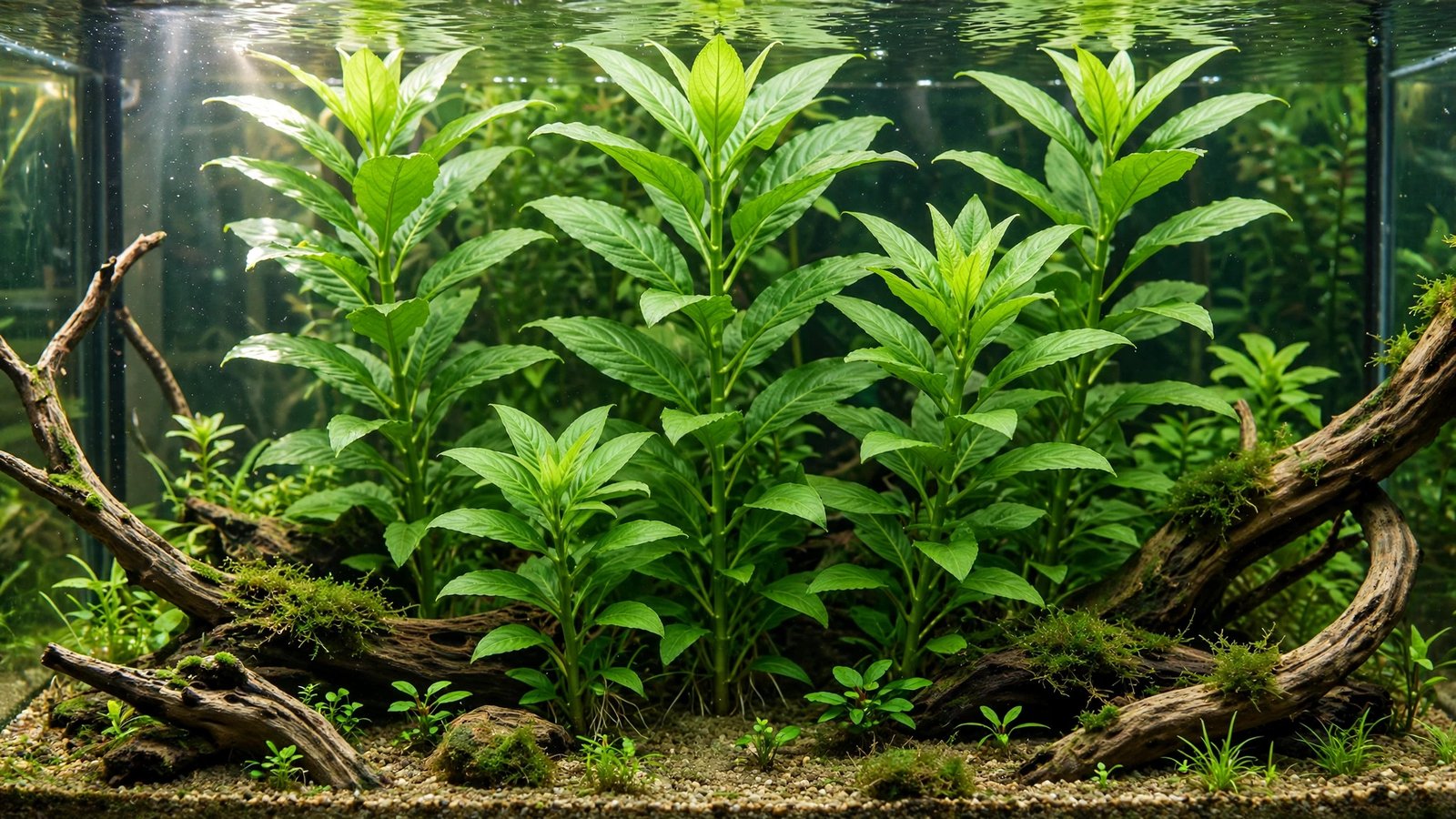
If you want a background plant that fills in fast, shrugs off beginner mistakes, and helps keep algae down, hygrophila corymbosa care is one of the easiest wins in the hobby. This fast-growing stem — better known as Giant Hygro or Temple plant — can rocket from a bare stem to the water surface in weeks, without CO2 injection or fancy lighting. Here is exactly how to plant it, feed it, trim it, and keep it looking like the dense green wall you pictured when you bought it.
Why Giant Hygro Earned Its Beginner Reputation
Giant Hygro (Hygrophila corymbosa, sold as Temple plant, Starhorn, or the Tropica cultivar 'Stricta') comes from the warm marshes and slow rivers of Southeast Asia. In the wild it lives half-submerged at the water's edge, and that dual lifestyle is the secret to its toughness: it keeps a marsh plant's rugged constitution and adapts it to life fully underwater. Where many stems melt at the first chemistry wobble, Giant Hygro pauses, adjusts, and carries on.
Its real superpower is growth speed. A single healthy stem can add several centimeters a week and throw out side shoots, turning a handful of stems into a bushy backdrop in a month or two. That speed makes it a natural nutrient sponge — it pulls nitrate and phosphate out of the water column fast enough to starve algae, which is why experienced aquarists plant it in brand-new tanks as a living cycling aid. It also tolerates pH 5.5–7.5 and water from soft to very hard, so it slots into almost any community setup.
The trade-off is simple: a plant that grows this fast demands regular trimming, or it will shade itself out and turn leggy at the base. If you enjoy working in your tank every few weeks, you will love it. If you want a plant you can ignore for months, this is not the plant for that job.
Planting and Positioning It Right
Giant Hygro is a true background plant in any tank under about 60 cm — individual leaves can reach 10 cm long, and a mature stand easily climbs 40–60 cm. Plant individual stems, not clumps: strip the lower 2–3 cm of leaves, press each stem 3–4 cm deep, and leave 3–4 cm between stems. That spacing feels sparse on day one and looks perfect by week four, because light between stems prevents lower leaves from rotting in the dark.
Substrate choice matters more than many guides admit. Giant Hygro is a heavy root feeder: stems in plain sand grow slowly with pale lower leaves, while the same stems in aquasoil or sand enriched with root tabs grow deep green and double in size. Push one complete root tab under every 3–4 stems when you plant, then replace them every 3–6 months. On inert substrate, that tab schedule is not optional — it is the whole fertilizer plan for the roots.
One rookie mistake is planting all the stems in a single tight bunch because it "looks full." Bunch planting traps detritus, starves inner stems of light, and melts the middles out within a month. Plant them spread out, be patient, and let growth do the filling.
Light, CO2, and Water Parameters
The good news first: Giant Hygro grows with no CO2 injection, and medium light is its comfort zone — roughly 30–60 PAR or a standard mid-range LED running 7–8 hours a day. Under dimmer light it survives but stretches: pale stems with wide gaps between leaf nodes. Push the light up and the internodes tighten, the leaves broaden, and the plant turns green like you see in planted-tank photos. Tropica's listing for Hygrophila corymbosa 'Stricta' says it flourishes under moderate to strong lighting and rewards CO2 with fuller form.
CO2 is the classic optional upgrade. Without it, expect steady, respectable growth. With pressurized CO2 at 20–30 ppm, growth accelerates and the plant responds to pruning with far more side shoots — you get a hedge instead of a handful of sticks. Keep CO2 stable, because fluctuating CO2 invites the algae you were trying to avoid.
| Parameter | Target range | Notes |
|---|---|---|
| Light intensity | 30–60 PAR (medium) | Tighter growth at 60–80 PAR |
| Photoperiod | 7–8 hours/day | Longer invites algae in young tanks |
| Temperature | 18–30 °C (optimal 22–28 °C) | Standard tropical range |
| pH | 5.5–7.5 | Very tolerant |
| Hardness | Soft to very hard | Adapts to most tap water |
| CO2 | Optional; 20–30 ppm if injected | Faster, bushier growth with CO2 |
Water flow deserves a mention: moderate circulation helps enormously because it carries nutrients and CO2 to the leaf surfaces of a plant this large. Position the stand where the filter outflow brushes past it rather than in a dead corner.
Feeding It: A Simple Fertilization Schedule
Giant Hygro is hungry, but its appetite is predictable. The fastest, most reliable combo is root tabs in the substrate plus a complete liquid fertilizer dosed weekly — the tabs drive growth from the base, the liquid feeds the leaves directly. Either method alone works, but together they give you the dense, even growth this plant is famous for.
Aim for these water-column targets, tested the same day each week: nitrate 10–20 ppm, phosphate 1–2 ppm, potassium 10–20 ppm, and iron 0.1–0.5 ppm. Giant Hygro is an excellent iron indicator — when new leaves come in pale or yellow while old leaves stay green, add an iron supplement. If the whole plant goes pale, check nitrate first.
| Task | Dose / action | Frequency |
|---|---|---|
| Root tabs | 1 tab per 3–4 stems | Every 3–6 months |
| Complete liquid fertilizer | Manufacturer's recommended dose | 1–2× per week |
| Iron supplement | Target 0.1–0.5 ppm Fe | When new leaves yellow |
| Water change | 30% weekly | Resets nutrients, prevents algae |
New tanks need one caution: fresh aquasoil leaches ammonia and nutrients on its own, so adding a full dosing schedule in the first two weeks often triggers an algae bloom. Start at half dose for the first month, then ramp up as the plants establish.
Corymbosa is a root feeder; tabs at the crown are the literal schedule the section names: Seachem Flourish Tabs placed near the crown.
Trimming and Propagation
Giant Hygro grows fast enough that your first trim arrives in 3–4 weeks, sometimes sooner. The technique is classic stem-plant topping: cut the stem with sharp aquascaping scissors about 5–7 cm below the water surface. The remaining base almost always sprouts two or more side shoots from the nearest leaf nodes — every cut multiplies stems, which is how a sparse row becomes a hedge. To get bushy fast, trim early and trim often.
Do not throw the cuttings away. Strip the bottom leaves from each top cutting and plant them back, spaced 3–4 cm apart. They grow roots within 5–10 days and become independent plants, so one purchase of stems can fill a whole background within two months. This is also how you replace old, woody bases: cut the healthy tops, plant them, discard the tired sections.
Plan for two kinds of trim: a light maintenance trim every 3–4 weeks to keep height in check, and a rejuvenation trim every 3–4 months that swaps aging woody bases for fresh young stems. When a base stops responding to pruning, cut the healthy tops, replant, and compost the rest.
Clean cuts need real tools; the section's trimming workflow assumes curved scissors: an aquascaping tool kit like the Liveek 4-in-1.
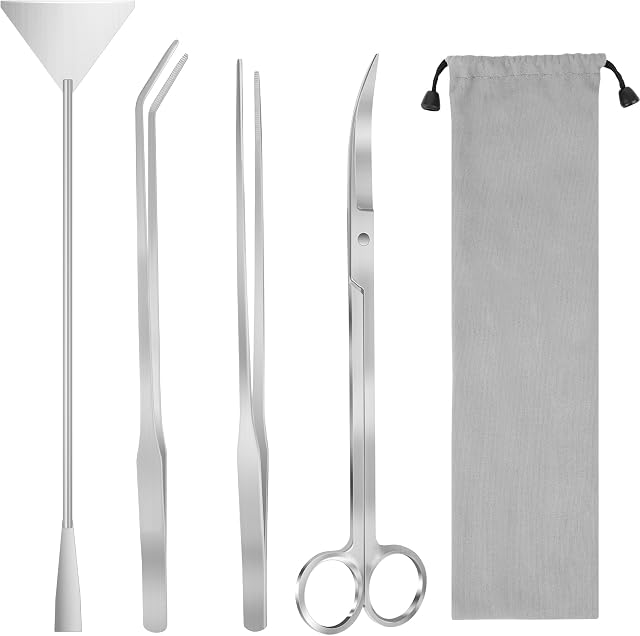 ★4.7
Liveek 4-in-1 Aquascaping Tool Kit
Check Price on Amazon ★4.7Emersed Growth and Flowering
Leave one stem untrimmed in an open-top tank and Giant Hygro reveals its wild side. Once a shoot breaches the surface, it shifts into emersed growth within days: leaves turn blue-green, thicker and waxier. In strong light it can climb 15–20 cm above the waterline.
The reward for letting it escape is the flower: emersed shoots produce small purple-blue blooms within two to three weeks of breaching the surface. It needs open air, humidity, and strong light — not something you can force — but in an open-top tank with a good lamp, it happens naturally and often.
Trim the escapees back underwater unless you are deliberately running a riparium look. One practical note: tortoises and herbivorous fish happily munch Giant Hygro, so do not let emersed leaves dangle into a turtle tank.
Hygrophila Corymbosa Care: Common Problems and How to Fix Them
For such an easy plant, most Giant Hygro complaints trace back to three causes: light not reaching the lower stems, nutrient gaps, or an overdue trim.
| Symptom | Likely cause | Fix |
|---|---|---|
| New leaves yellow, old leaves green | Iron deficiency | Add iron; target 0.1–0.5 ppm Fe |
| Whole plant pale, slow growth | Low nitrate / lean dosing | Raise liquid dosing; check 10–20 ppm NO₃ |
| Lower leaves melting, bare stems | Shade from overgrown tops | Trim tops, thin stand, replant cuttings |
| Holes in leaves, weak stems | Potassium shortage | Dose potassium; check 10–20 ppm K |
| Sudden melt after planting | Emersed-to-submerged transition | Leave roots alone; new growth in 1–2 weeks |
| Stems rotting at substrate level | Planted too deep / anaerobic spot | Replant shallower; space stems 3–4 cm apart |
Transition melt is the most common scare: nursery stems arrive with emersed leaves that dissolve within the first week or two underwater. This is normal. As long as the stems stay firm, leave them alone — fresh submerged leaves appear within one to two weeks. Pulling the plant up to "check" the roots during this window does more harm than the melt itself.
How It Compares to Its Hygrophila Cousins
The Hygrophila family is the backbone of beginner-friendly stems. Giant Hygro is the large-format option — broader leaves and taller reach than its relatives — which is why it dominates backgrounds while others fill midgrounds.
| Species | Typical height | Role | Standout trait |
|---|---|---|---|
| H. corymbosa (Giant Hygro) | 15–60 cm | Background | Fastest nutrient sponge; emersed purple flowers |
| H. polysperma | 25–60 cm | Background | Hardest to kill; check local legality |
| H. pinnatifida | 15–40 cm | Midground | Distinctive serrated leaves; slow for a Hygro |
| H. siamensis | 15–30 cm | Midground–background | Bushy side shoots when pruned |
| H. difformis (Water Wisteria) | 20–50 cm | Background | Lacy submerged leaves; rapid background filler |
If your goal is simply "fill the background fast and keep algae down," Giant Hygro and Water Wisteria are the two heavyweights, and Giant Hygro's broader leaves make it the better pick for a solid green wall rather than lace. For midground variety beside it, the rotala rotundifolia care guide and the ludwigia repens care guide cover two classic fast stems that contrast nicely with its big leaves.
For sourcing notes and the original plant database entry behind the 'Stricta' cultivar, see Tropica's Hygrophila corymbosa plant listing.
Frequently Asked Questions
Does Hygrophila corymbosa need CO2?
No — Giant Hygro grows perfectly well without CO2 injection, which is a big part of its beginner appeal. Without CO2 you get steady, healthy growth in medium light. Adding CO2 at 20–30 ppm simply accelerates growth and produces bushier stands with more side shoots. If you run low-tech, skip the CO2 and spend the money on root tabs and a complete liquid fertilizer instead.
Why are my Giant Hygro leaves turning yellow?
Yellow new leaves with green old leaves point to iron deficiency, and Giant Hygro is famous for showing it first — it is one of the hobby's iron indicator plants. Add an iron supplement and target 0.1–0.5 ppm Fe; new growth should green up within two weeks. If the entire plant including old leaves is pale, check nitrate instead (target 10–20 ppm), since whole-plant paleness usually means the plant is simply underfed overall.
How fast does Giant Hygro grow?
In medium light with decent fertilization, expect several centimeters of growth per week and a need to trim every 3–4 weeks. A single row of stems can become a full background stand within two months because every trim multiplies stems — each cut base typically sprouts two or more side shoots. With CO2 and high light, growth can be almost alarmingly fast, which is exactly why it is such an effective algae-fighting nutrient sponge in new tanks.
Can Hygrophila corymbosa grow above the waterline?
Yes, easily. In an open-top tank, untrimmed stems will breach the surface and switch to emersed growth with thicker blue-green leaves, and under strong light they can climb 15–20 cm above the waterline. Within two to three weeks of breaching, shoots often produce small purple-blue flowers. Just remember that emersed growth is even faster than submerged growth, so trim escapees back unless you want a riparium look.
How do you propagate Hygrophila corymbosa?
By stem cuttings — one of the easiest propagation methods in the hobby. Cut the healthy top from a stem, strip the bottom 2–3 cm of leaves, and press the cutting into the substrate. New roots form within 5–10 days in good conditions. Meanwhile the cut base sprouts multiple side shoots, so one trim simultaneously propagates new plants and thickens the mother stand.
Is Giant Hygro good for beginners?
It is one of the best beginner stem plants available. It tolerates a wide pH range (5.5–7.5), temperatures from 18–30 °C, and grows without CO2. It forgives inconsistent dosing, recovers from hard trims quickly, and its fast growth actively improves water quality for your fish. The only skill it demands is willingness to trim every few weeks — which is honestly the best training habit a new planted-tank keeper can build.
Your Giant Hygro Game Plan
Giant Hygro rewards simple, consistent care more than perfectionism. Plant the stems spaced out in the background over fresh root tabs, run medium light for 7–8 hours, dose a complete fertilizer weekly, and trim every 3–4 weeks to multiply your stand. Within two months you will have a lush green wall, cleaner water for your fish, and a steady supply of cuttings for your next tank. For a plant that asks so little, Giant Hygro gives back an awful lot.