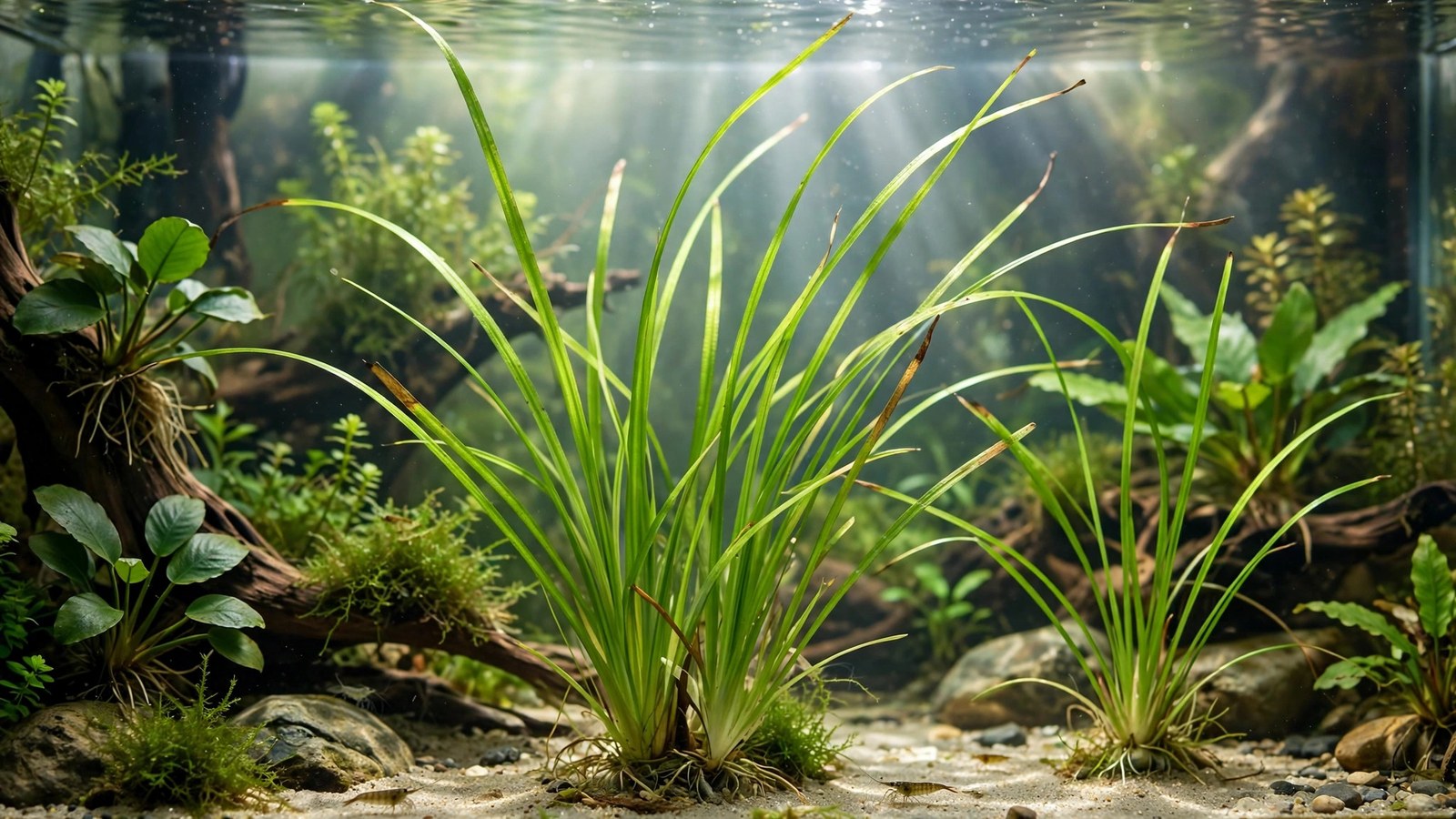
Most so-called aquarium grasses are either runners that swallow your aquascape or stem plants wearing a grass costume. Cyperus helferi care is different because the plant is different: the only true sedge that thrives fully submerged, growing as one tidy clump of bright green, arching blades that sway with your filter's current. This guide shows you how to plant it, feed it, and not panic during its gloomy first month.
Cyperus helferi care: the essentials
Here is the one fact that sells the plant: among hundreds of Cyperus species — papyrus, umbrella plants, pond sedges — helferi is the only one that lives its whole life underwater. You get not a runner factory but a single, defined clump of fine, bright green blades that ripple in gentle flow. That tidy habit makes it one of the best background plants for tall aquariums, where its height and movement fill vertical space without bullying its neighbors.
Do not confuse it with Pogostemon helferi (downoi). Both honor the same 19th-century plant collector, but downoi is a tiny foreground rosette from a different genus. If your "helferi" looks like curly lettuce, you ordered the wrong plant.
Planting Cyperus helferi so it actually settles
This plant feeds through its roots, so the substrate matters more than anything you dose into the water. Fine-grained, nutrient-rich soil gives young roots something to grip; coarse gravel starves them, and crushed coral or aragonite pushes the water alkaline, which it dislikes.
- Rinse off any rockwool and split one pot into 3–5 individual plantlets.
- Push a root tab into the substrate a few centimeters from where each group will sit.
- Plant each plantlet deep enough to anchor, keeping the crown — where blades meet roots — just above the substrate.
- Space plantlets 5–8 cm apart so the group reads as one clump once it fills in.
- Choose gentle, indirect flow — beside the filter outflow, never in front of it.
Pair it with bushy stems for contrast: Bacopa monnieri in front makes the fine blades behind look even more delicate, and fast midground fillers like Cardamine lyrata hide the bare crown while the sedge establishes.
 ★4.7
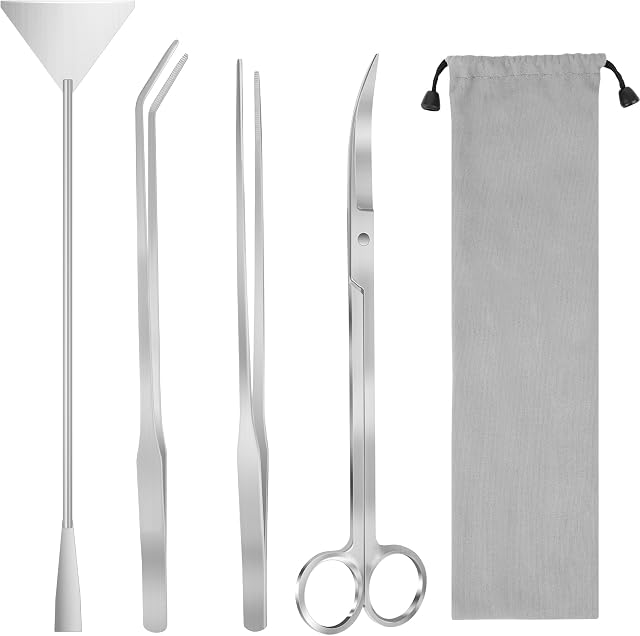
Liveek 4-in-1 Aquascaping Tool Kit
Check Price on Amazon ★4.7Light, CO2, and nutrients
Cyperus helferi is a strong root feeder with modest demands from the water column. Get the table below right and the plant largely looks after itself.
| Parameter | Target | Notes |
|---|---|---|
| Light | Medium–bright | ~10 hours daily; brighter light invites algae |
| CO2 | Optional | Not required; injected CO2 speeds acclimation |
| Root feeding | Root tabs every 8–12 weeks | Non-negotiable — this is how the plant eats |
| Liquid fertilizer | Light all-in-one dosing | Supports color; iron-rich formulas keep blades vivid |
| Flow | Gentle | Leaves sway in soft current; strong blast tatters them |
Retailer care sheets agree: Aquarium Plants Factory's Cyperus helferi care notes list medium light with no CO2 requirement. Compact midground plants like Hygrophila Araguaia make good neighbors under the same lighting.
The first month: surviving the melt
Almost every "my Cyperus is dying" post describes the same thing: the first month. Leaves yellow, go translucent, and melt from the tips inward. This is the plant converting from nursery growth to submerged growth — old leaves are sacrificed while new roots and underwater-adapted blades develop from the crown. It looks terrible. It is almost always normal.
What to do: nothing dramatic. Keep parameters stable, hold the photoperiod at 8–10 hours, and trim fully melted leaves at the base so energy goes to new growth. Do not move the plant — every relocation restarts the root-development clock. Most failures trace to impatience, not technique.
Genuine trouble looks different: the crown itself turning brown and mushy, or new blades rotting as they emerge. That means the crown is buried, the substrate is alkaline, or the plant sits in a powerhead blast zone.
Propagation and long-term maintenance
Once settled, it asks for very little. The clump slowly widens and sends up side shoots from the base, each with its own roots.
- Divide: every 6–12 months, lift the clump, tease it apart, and replant the divisions. Each piece with roots and a crown becomes a new plant.
- Replant side shoots: separate small base plantlets once they have a few roots of their own.
- Prune old leaves: cut aging outer blades at the base, never mid-leaf — half-cut blades brown and look ragged for weeks.
- Run a cleanup crew: slow growth plus bright light equals algae-prone leaves. Amano shrimp, nerite snails, and otocinclus keep blades grazed clean.
- Give it room: the clump widens a few centimeters per year — leave 10–15 cm of clear space so it never swallows a neighbor.
A red accent like Persicaria 'Sao Paulo' rising behind the green blades is a classic contrast, and the same root-tab routine that feeds the sedge suits growing Bacopa monnieri alongside it.
Cyperus helferi vs Vallisneria: picking your grass
Both read as "aquarium grass," but they behave like opposites. Pick based on how much control you want.
| Trait | Cyperus helferi | Vallisneria |
|---|---|---|
| Habit | Single defined clump, no runners | Runner factory — spreads across the tank |
| Control | Stays where planted; widens slowly | Needs regular runner removal |
| Leaf texture | Fine, soft, arching blades | Strap-like, stiffer ribbons |
| Light needs | Medium–bright | Low–medium |
| Best for | Controlled, elegant background accents | Filling large backgrounds fast and cheap |
Want the tall-grass look without surrendering control? Cyperus helferi wins. Other grassy background options include Murdannia keisak for a finer texture, while Equisetum hyemale suits open-top tanks with emergent growth. In front, a sculpted accent like Rotala indica 'Bonsai' contrasts beautifully with the sedge's wild sway behind it.
Frequently Asked Questions
Is Cyperus helferi a beginner plant?
Borderline. It is forgiving once established — no CO2 needed, tolerant of 68–82°F water, and it stays in one clump. The catch is the first month, when melting leaves convince beginners the plant is dead. If you can resist moving a sad-looking plant for four weeks, you will succeed.
Does Cyperus helferi need CO2?
No. Retailer care sheets list CO2 as not required, and it grows fine in low-tech tanks with medium-bright light and root tabs. Injected CO2 does help — it shortens acclimation and produces a denser clump — but good lighting and root feeding matter far more than carbon.
Why are my Cyperus helferi leaves melting?
In the first month, melting is normal acclimation — the plant sheds nursery-grown leaves while building submerged roots. Trim dead blades at the base and wait. If melting continues past six weeks or new blades rot as they emerge, check the real culprits: a buried crown, alkaline substrate, or strong current.
How do you propagate Cyperus helferi?
By division. Lift the clump every 6–12 months, tease it apart into pieces that each have roots and a crown, and replant. Side shoots around the base can also be separated once rooted. There are no runners to manage, so propagation happens entirely on your schedule.
Will it spread like Vallisneria?
No — that is its biggest selling point. Cyperus helferi is a true sedge that grows as one defined clump and never sends runners. It widens slowly over months, which suits controlled aquascapes where Vallisneria would need constant runner patrol. Division is the only way it multiplies.
Final word
Cyperus helferi rewards one virtue above all: patience. Plant it in groups in rich substrate, feed the roots, keep the current gentle, and leave it alone through the ugly first month. What emerges is the most graceful grass-like plant in the hobby — a swaying clump no runner plant can imitate.