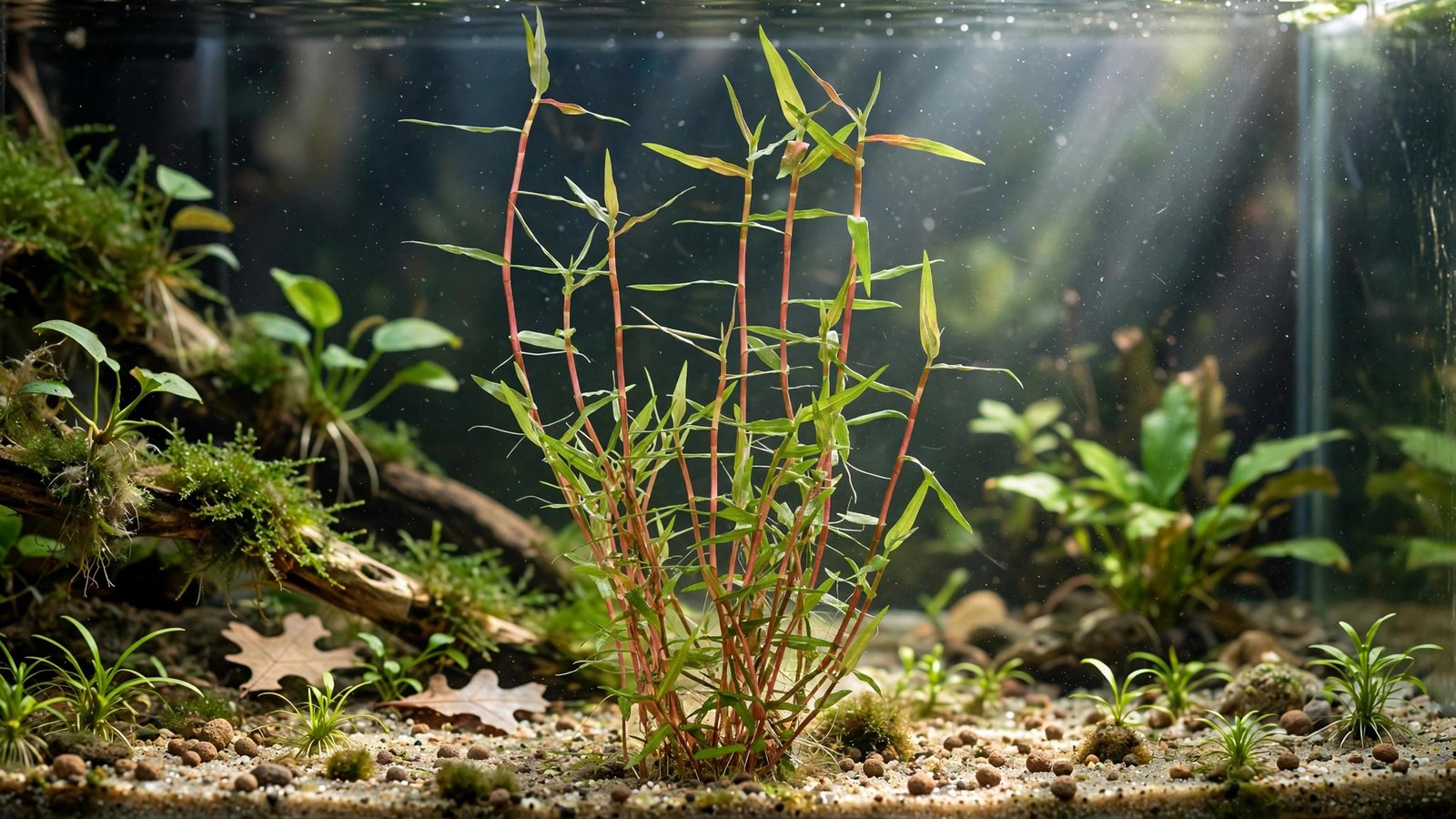
Most pink-red aquarium stems make you pay a tax: blast them with high light and pressurized CO2 or watch them fade to dull green. Murdannia keisak refuses that deal — it blushes copper-pink under moderate conditions that leave fussier reds sulking, so smart Murdannia keisak care beats hardware. This guide shows you how to plant it without melt, coax out the red tones, and propagate it into a full background wall. New to stems? See our best stem plants for beginners first.
Why aquascapers are switching to Murdannia keisak
Murdannia keisak — sold as marsh dewflower or under the Tropica 1-2-Grow line — arrived quietly and started appearing in contest tanks. The appeal: upright stems with paired, lance-shaped leaves grading from green at the base to copper, pink, and red at the tips. It delivers red-stem warmth without the punishing demands of the classics:
| Plant | Color potential | Light demand | CO2 | Forgiveness |
|---|---|---|---|---|
| Murdannia keisak | Pink–copper–red | Moderate–high | Helpful, optional | High |
| Rotala macrandra | Intense pink-red | High | Required | Low |
| Persicaria 'Sao Paulo' | Deep red | High | Required | Low |
| Rotala rotundifolia | Orange-red | Moderate | Helpful, optional | High |
Murdannia sits in the sweet spot: easier than the demanding reds, more color payoff than most easy stems — a solid first pink stem before committing to pressurized CO2.
Murdannia keisak care: the core routine
Light
Give it moderate to high light — roughly 40–70 PAR at the substrate. Moderate light grows it green and upright; push toward the high end and new growth blushes pink, then copper, then red at the tips. Light is the single biggest color lever — if your Murdannia stays stubbornly green, question light before fertilizer.
CO2 and fertilization
Murdannia grows fine without injected CO2, but CO2 changes its character: denser leaves, faster growth, far stronger color. If you inject, start around 20–25 ppm, watch livestock closely, and raise it only if fish and shrimp stay relaxed — never chase numbers at the expense of your animals.
Use a nutrient-rich substrate (aquasoil or a quality planted substrate) and dose a complete liquid fertilizer at the manufacturer's rate or slightly under. Keep iron and micronutrients consistently available rather than megadosing — color comes from steady supply plus light, not iron spikes. As always, start low, observe, and adjust slowly.
Water parameters
| Parameter | Target range |
|---|---|
| Temperature | 20–28 °C (68–82 °F) |
| pH | 6.0–7.5 |
| General hardness (dGH) | 3–8 |
| Carbonate hardness (dKH) | 1–6 |
| Nitrate (NO3) | 5–20 ppm |
It adapts across that whole range, which is part of why beginners do well with it — unlike ultra soft-water specialists such as Tonina fluviatilis, it won't punish you for ordinary tap water. Just keep parameters stable week to week.
How to get the pink-red color (and keep it)
Color is a formula, not a lottery. Three inputs, in order of importance:
- Light first. Nothing substitutes for intensity. Raise a dimmable fixture in 10% steps over two weeks and watch new growth — old green leaves rarely change; judge by the tips.
- CO2 second. Even modest, stable CO2 deepens the pink noticeably versus a non-CO2 tank at the same light.
- Nutrients third. Keep nitrates at 5–20 ppm with iron and micronutrients consistently present. Slightly leaner nitrates can intensify reds, but yellowing older leaves mean you've gone too far.
One caution: every knob you turn up (light, CO2, nutrients) raises algae pressure too. Increase light only when the tank is otherwise balanced — stable CO2, regular water changes, no nutrient spikes — or you'll trade green stems for green glass.
Planting and propagation: trim and replant
Plant individual stems 2–3 cm apart with tweezers — crammed stems rot at the base from poor flow and light. Push each stem about 2–3 cm deep, just enough to anchor. In aquasoil roots take hold within a week; in inert sand or gravel, expect slower establishment and dose liquid fertilizer more attentively.
Propagation is the classic stem-plant loop — identical to trimming Bacopa monnieri:
- Wait until a stem reaches the surface or shades its neighbors (usually 3–5 weeks).
- Cut the top 7–10 cm with sharp scissors, just above a leaf node.
- Strip the lowest 2 cm of leaves and replant the cutting.
- Leave the rooted base — it sprouts two or more side shoots, making the stand bushier every cycle.
As the stand thickens, thin aggressively from the middle: the prettiest Murdannia walls come from regular harvesting, the same way growers manage bushy Hygrophila siamensis stands. Sell or trade the trimmings — local club members will take them.
Troubleshooting: melting and green growth
Why is it melting after planting?
Nursery stock — especially tissue-culture cups like Tropica 1-2-Grow — is grown emersed, so its leaves often melt in the first 1–3 weeks submerged while new underwater leaves grow from the nodes. This is normal adaptation, not failure. Keep a steady 6–8 hour photoperiod, don't move the stems, and watch for tiny new leaves at the nodes — proof it's working. Remove fully melted leaves, but leave any stem with green at the nodes. Melt starting after a month points at the environment instead: a parameter swing, CO2 outage, or timer failure.
Why is mine staying green?
Green and healthy means the plant is fine — it's telling you conditions are "good enough to live, not good enough to blush." Walk the ladder: raise light first, stabilize CO2 second, verify iron and micronutrients third. Give each change two full weeks before judging; stems recolor on new growth only.
Frequently Asked Questions
Is Murdannia keisak easy to grow?
Yes — it's one of the more forgiving pink-toned stems. It grows in moderate light without CO2 and tolerates a wide pH and hardness range. The only "moderate" part is color: maximum pink-red needs high light and preferably CO2. Give new stems 4–6 weeks to settle in and color up.
Does Murdannia keisak need CO2?
No, but it's transformative. Without CO2 expect healthy green-to-copper growth at a moderate pace; with stable CO2 around 20–30 ppm, growth speeds up, leaves grow denser, and the pink-red coloration becomes dramatically stronger. Start low, watch livestock, and increase gradually.
Why is my Murdannia keisak staying green instead of turning red?
Insufficient light is the cause in roughly nine cases out of ten. Raise intensity in 10% steps over two weeks and judge only the new growth at the tips — old leaves rarely recolor. If light is already high, add or stabilize CO2 next, then confirm steady iron and micronutrients. Green, healthy growth means the plant is fine; it just needs stronger conditions to blush.
How do you propagate Murdannia keisak?
Trim and replant. Cut healthy top sections 7–10 cm long just above a leaf node, strip the lowest leaves, and plant the cuttings 2–3 cm apart. Leave the rooted bases in place — each sprouts multiple side shoots, so one trim cycle can double your stand within a month.
Why is my Murdannia keisak melting after planting?
It's emersed-to-submersed transition. Tissue-culture and nursery plants are grown out of water, and their emersed leaves melt within 1–3 weeks submerged while new underwater leaves grow from the nodes. Keep conditions stable, remove fully melted leaves, and don't move the stems — recovery shows as tiny new leaves within two weeks.
Final word: a red stem for real-world tanks
Murdannia keisak earns its reputation because it meets hobbyists where they are: moderate light, no CO2, ordinary tap water — and still rewards you with warm copper-pink growth. Upgrade the light and add CO2 when ready, and it rewards you again. Plant once, ride out the melt, trim the tops, and replant: within two months you'll have a contest-ready background. For the authoritative species reference, see the Tropica plant database.