The shop tag reads Cryptocoryne petchii. The online listing calls it Cryptocoryne beckettii 'Petchii'. Tropica lists one name, your local store the other — and both bags can hold the same plant. Getting cryptocoryne beckettii care right starts at the label, because which form you actually buy decides how tall it grows, how it colors up, and where it belongs in your layout.
Direct answer: Cryptocoryne beckettii needs no injected CO2, grows 10–15 cm tall in low to moderate light, and tolerates pH 5.5–8.0 at 22–28 °C. Expect crypt melt in the first weeks; the rhizome survives and regrows from runners. The name to remember: the 'Petchii' form in the trade is a triploid variant of C. beckettii, originally described as its own species (Cryptocoryne petchii Alston) and kept in aquariums for over 60 years — identical-looking pots under the two names are usually the same plant.
Cryptocoryne Beckettii Care: The Naming Confusion, Settled
Here is the short version: Cryptocoryne beckettii is the valid, accepted name. Decades ago, a smaller triploid form was described as a separate species, Cryptocoryne petchii Alston, named for the Thai aquarist Petch Petchkasem. Botanists later folded it back into C. beckettii as the cultivar form 'Petchii', but the old species name never left the trade. Retailers still label pots as C. petchii, C. beckettii, or C. beckettii 'Petchii' — often interchangeably, as the species' cultivation and naming history documents.
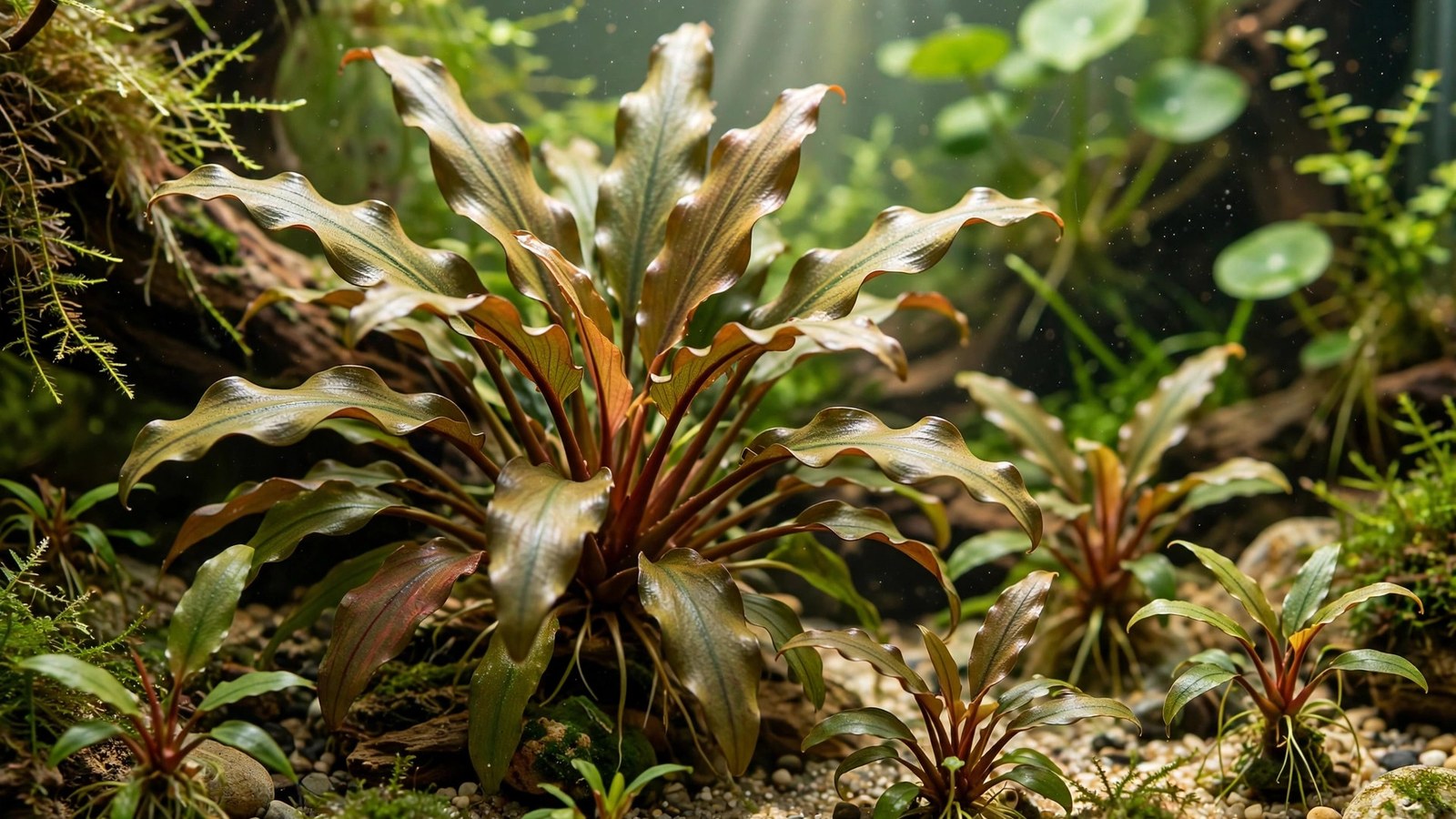
What matters at the shop is size and leaf margin, not the label. True 'Petchii' stays compact with narrower, slightly fluted (ruffled) leaf edges; the standard C. beckettii grows a little larger with broader leaves. If you are setting up a planted tank from scratch, the step-by-step planting sequence in the complete guide to freshwater aquarium plants covers root-feeder planting depth, which applies directly to this species.
How to buy the right form
| Label you may see | What it usually is | Expect |
|---|---|---|
| C. beckettii 'Petchii' | Triploid compact form | 10–15 cm, fluted margins, bronze |
| C. petchii | Same triploid form, old name | Identical to 'Petchii' above |
| C. beckettii (no cultivar) | Standard species form | 10–20 cm, broader leaves, greener |
| Unlabeled "crypt" | Usually a wendtii, not beckettii | Check leaf shape before buying |
What It Looks Like: Bronze Rosette, Fluted Leaves
This is a rosette plant: every leaf rises from a central crown, forming a low, spreading mound. Submerged blades are 3–9 cm long, olive-green to bronze-brown above with the signature red-to-violet tinge below. Under moderate light the bronze deepens; under low light it stays greener but still healthy.
It belongs to the C. wendtii group of Sri Lankan crypts. If you want the taller, fluted bright-green rosette instead, Cryptocoryne wendtii covers it — but beckettii is the better pick when you need warm bronze tones and a plant that refuses to outgrow its spot.
Planting and Tank Parameters
Push the roots into a nutrient-rich substrate so the crown sits just at the surface — never bury the leaf bases. Sand, fine gravel with root tabs, or aquarium soil all work; clay-heavy mixes suit it well, and it appreciates calcium in the water from its limestone-stream origins. Space individual plantlets a few centimeters apart so each rosette has room to widen. Choose a permanent spot on day one: like all crypts, it resents being moved.
Water chemistry is forgiving. It grows in soft and hard water alike, pH 5.5–8.0, and handles the usual community-tank range of 22–28 °C, with growth slowing noticeably below about 23 °C. Stability matters more than a perfect number — a steady pH 7.6 beats a swinging pH 6.8. Buce Plant's specification sheet for Cryptocoryne beckettii lists these same ranges.
Light, CO2 and Feeding
Low to moderate light is the sweet spot. The basic stock light on a kit tank grows this plant fine, which is why it sits comfortably on any list of the easiest aquarium plants for beginner community tanks. More light deepens the bronze-brown color, but it is never required for health.
CO2 is optional in the true sense: the plant grows without it, just slowly, and responds to injected CO2 with faster, fuller rosettes. Crypts are heavy root feeders; push a root tab 3–5 cm from each crown every 2–3 months in inert substrates. Liquid fertilizer helps the whole tank, but it will not substitute for nutrition at the roots.
Crypt Melt: What to Expect and What to Do
Crypt melt — old leaves turning translucent and dissolving after planting — is normal for this species. It happens when the plant sheds shop-grown foliage and rebuilds leaves adapted to your water. The rhizome underground is usually alive and will push new growth within 2–4 weeks.
When melt starts: trim away only the fully dissolved leaves with sharp scissors, leave anything still green, keep water parameters stable, and do not uproot the plant to "check" it — that restarts the clock. The general Cryptocoryne care guide covers melt recovery in full: patience beats intervention.
Propagation by Runners
Once established, beckettii spreads on its own through underground runners, sending up daughter rosettes a few centimeters from the parent. When a daughter has 4–5 leaves, sever the runner with scissors and replant — or let the colony merge into a dense bronze bush. It also propagates by rhizome division: split a large crown, keeping roots on each piece.
Growth is slow: give a new planting weeks, not days, to settle. Pair it at the front edge with something shorter, like Cryptocoryne parva, and let Staurogyne repens carry the bright green foreground while beckettii anchors the midground in bronze.
Frequently Asked Questions
Is Cryptocoryne petchii the same plant as Cryptocoryne beckettii?
Effectively, yes. The 'Petchii' form sold in the trade is a triploid variant of C. beckettii that was originally described as its own species, Cryptocoryne petchii Alston. The name was later folded back into C. beckettii, but retailers still use the old species name. It is the smaller, fluted-margin form with bronze-brown leaves and a violet underside.
Does Cryptocoryne beckettii need CO2?
No. It grows fully submerged without injected CO2 and is a solid low-tech choice. CO2 speeds up its naturally slow growth and produces denser rosettes, but it is never required for health. Good root nutrition matters far more than carbon supplementation for this species.
Why did my Cryptocoryne beckettii melt after planting?
Crypt melt is a normal response to new water conditions: the plant sheds shop-grown leaves and rebuilds foliage suited to your tank. Trim only fully dissolved leaves, keep parameters stable, and never uproot the plant to inspect it. The rhizome is usually alive and pushes new growth within 2–4 weeks.
How tall does Cryptocoryne beckettii grow?
The 'Petchii' form stays 10–15 cm tall, making it suitable for the foreground in larger tanks and the midground in smaller ones. The standard species form can reach 10–20 cm. Each rosette spreads 12–15 cm wide over several months, so give it room to widen.
What substrate is best for Cryptocoryne beckettii?
A fine, nutrient-rich substrate suits it best — aquarium soil, or sand and fine gravel supplemented with root tabs every 2–3 months. As a heavy root feeder it draws most nutrition through its roots, so root tabs in inert substrates are more effective than liquid fertilizer alone.
A Slow Bronze Anchor for the Midground
Cryptocoryne beckettii rewards the patient aquarist: a bronze rosette that holds its ground for years on stable water and fed roots, with warm color no green crypt matches. Buy the compact 'Petchii' form, plant it once, feed the substrate — and let it anchor your midground.