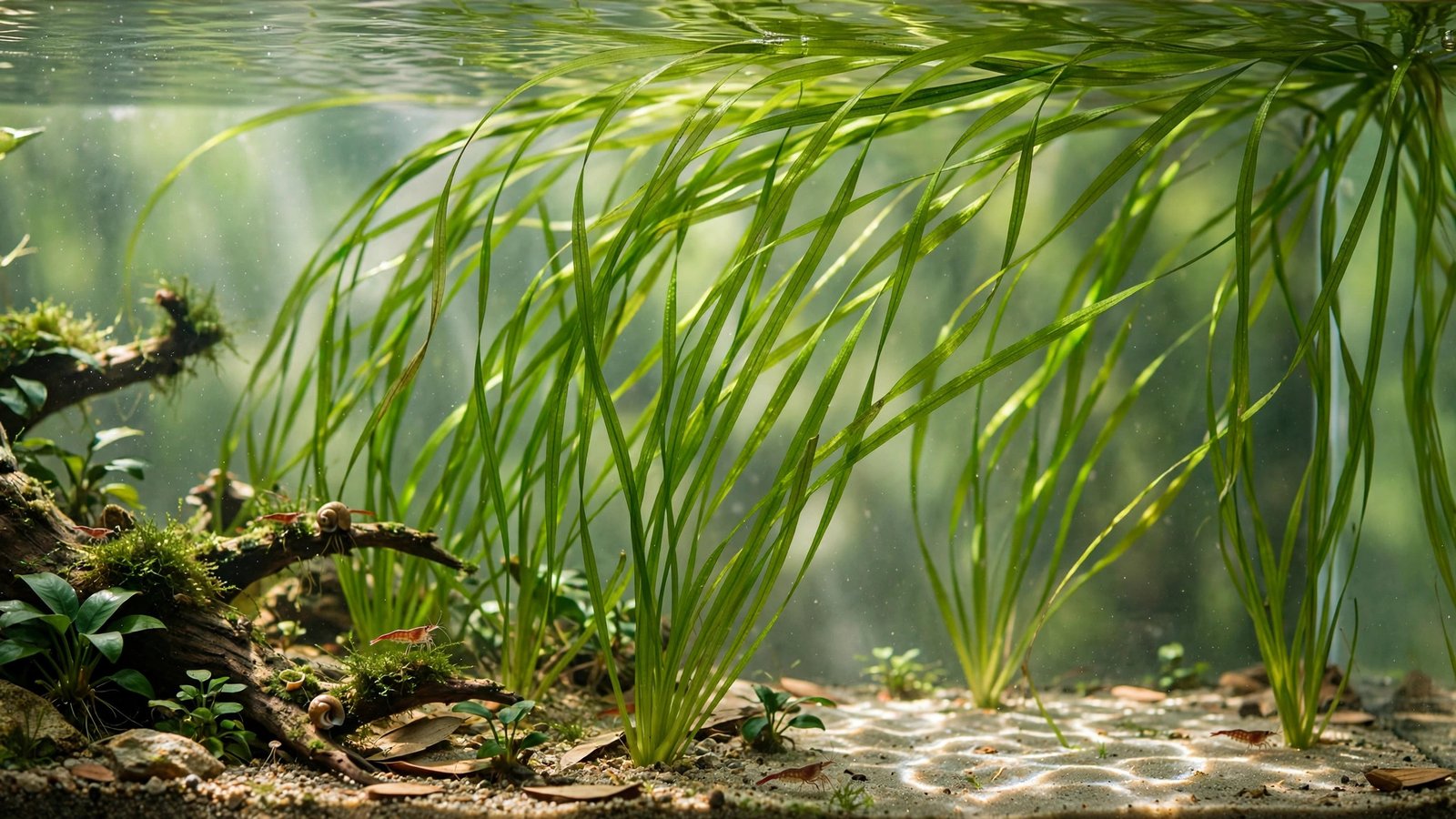
Picture the classic planted tank — a flowing curtain of straight, ribbon-like leaves swaying along the back glass. That plant is almost certainly Italian val. Buy one modest pot, and three months later it has staged a quiet takeover of your substrate. Good vallisneria spiralis care is not about keeping it alive. It is about giving it room to thrive while keeping its ambitions in check.
The short answer: Vallisneria spiralis — Italian val — is the most forgiving background plant in the hobby: 20–40 PAR, no injected CO2, and 6+ cm of substrate for its roots. Plant it at the back and patrol the runners. It tolerates KH up to 12+ dKH because it uses bicarbonate as a carbon source — the unique fact behind its hard-water advantage.
Vallisneria Spiralis Care: Light, Water, and Roots
Italian val grows under a budget LED strip that would starve an Amazon sword, and tolerates soft acidic water or liquid limestone alike. To get lush, dense ribbons instead of a few pale blades, get three things right.
First, light: 20–40 PAR at the substrate. Below ~15 PAR blades stretch thin and pale; above ~50 PAR you mostly grow algae on the leaves. A standard low-tech LED hits this range in most 45–60 cm tall tanks.
Second, root nutrition. Italian val is a heavy root feeder — its runners hunt nutrients in the substrate, not the water column. Root tabs placed 5 cm from each crown every 8–12 weeks turn a few stray blades into a dense stand. Our roundup of the best substrates for planted tanks covers which options hold nutrients longest under runner networks like this.
Third, water chemistry: 18–28 °C, pH 6.0–8.5, any reasonable hardness. Hard water is a genuine advantage — V. spiralis uses bicarbonate directly, so it performs better as KH rises.
| Parameter | Sweet spot | Tolerated range |
|---|---|---|
| Light (PAR) | 20–40 | 15–60 |
| Temperature | 22–26 °C | 18–28 °C |
| pH | 6.5–7.8 | 6.0–8.5 |
| KH / GH | 3–10 dKH | 0–15+ dKH |
| CO2 | None needed | Liquid carbon optional |
| Substrate depth | 6–8 cm | 5 cm minimum |
Italian Val vs. the Other Vals
The name "val" covers several species that look interchangeable at the shop but behave very differently. Italian val sits in the middle: straight blades, taller than dwarf val, far shorter than jungle val. Buy the wrong one and jungle val swallows a 60 cm tank, while dwarf val looks lost across a 120 cm background.
| Species | Blade shape | Height | Best for |
|---|---|---|---|
| V. spiralis (Italian val) | Straight ribbon, 8–12 mm | 30–60 cm | Tall-tank backgrounds |
| V. nana (dwarf val) | Straight, narrow, 3–5 mm | 10–30 cm | Nano tanks, midground |
| V. americana 'Gigantea' | Straight, broad, 15–25 mm | 80–150+ cm | Very large tanks |
Naming quirk: despite the species name, V. spiralis blades are straight — the "spiral" refers to the coiled flower stalk. For the genus-wide picture, see our vallisneria genus care guide, plus the sibling profiles: dwarf val (Vallisneria nana) care and jungle val (Vallisneria americana 'Gigantea') care.
Planting It Properly: Depth and Spacing
Vallisneria melts more from bad planting than from bad water. The crown — the pale junction where blades meet roots — must sit just at or slightly above the substrate, with roots fanned 3–5 cm deep. Bury the crown and it rots within days; plant the roots too shallow and it drifts up overnight.
Plant each crown individually, out of the rockwool pot, 8–10 cm apart along the back glass. It looks sparse on day one and exactly right by week six — 3–5 crowns make a full background wall in a 60 cm tank within two months. Leave every blade alone for the first two weeks while roots establish.
Runners, Containment, and the Trimming Rule
Italian val spreads by stolons — horizontal runners that push through the substrate and pop up daughter plants 10–20 cm away. A healthy stand can extend a runner 15 cm in a week — that is how a background plant ends up mid-foreground by month three.
Patrol every two weeks. Push unwanted runners back toward the rear, or lift daughter plants out with roots intact to replant or gift. Never release aquarium plants into local waterways — V. spiralis is a regulated "unwanted organism" in New Zealand. A 6 cm strip of plastic edging buried 2 cm under the substrate along the planting line is a maintenance-free border — runners hit it and turn back.
The trimming rule that defines success: never cut a blade mid-length. A sliced blade dies back to the base, leaving a brown, algae-attracting stub. Remove whole blades at the base with a gentle pull, thinning the oldest, outermost blades first.
Why Italian Val Melts — and How It Recovers
Almost all V. spiralis melt is transplant shock. Old blades were grown emersed or in different water; the plant sacrifices them while the crown builds adapted new blades. If the crown is firm and white, the plant is fine.
| Melt cause | What you see | What to do |
|---|---|---|
| Transplant shock | Leaves turn glassy, disintegrate in 1–2 weeks | Leave the crown; new blades in 2–3 weeks |
| Crown buried too deep | Base turns brown and mushy | Excavate until the crown is exposed |
| Liquid carbon dosing | Blades go translucent within 48 hours | Stop dosing; recovery takes 3–4 weeks |
| Light starvation | Long pale threads, no new blades | Raise light to ≥20 PAR at substrate |
The Tall-Tank Background Showpiece
Italian val was made for tall tanks. In a 60–75 cm deep aquarium its blades reach the surface and trail across it, creating a flowing canopy shorter plants cannot achieve. A dense row 5–8 cm from the back glass becomes a living backdrop within eight weeks — hiding equipment while giving shy fish shaded refuge.
It needs no CO2, no demanding light, and no constant replanting, making it arguably the best beginner background plant in the hobby. It anchors a low-tech planted tank setup perfectly: set it up once, patrol the runners every couple of weeks, and it carries the back half of your aquascape for years. The species identity is fully settled in the taxonomic record for Vallisneria spiralis.
Frequently Asked Questions
How fast does vallisneria spiralis grow?
Expect a new blade every 7–14 days per crown, plus runners that travel 10–20 cm and pop up daughter plants. One crown can fill a 60 cm tank background in 8–12 weeks. Below 20 PAR or in nutrient-poor substrate, growth slows — root tabs make the biggest visible difference within a month.
Can I trim the leaves of Italian val shorter?
No — never cut a blade mid-length. A cut blade dies back to the base and leaves a brown, algae-attracting stub. Remove the tallest whole blades at the base with a gentle pull. For genuine height control, choose dwarf val instead: it tops out at 10–30 cm.
Why is my new vallisneria melting?
Almost always transplant shock: old blades are sacrificed while the crown builds adapted new growth. If the crown is firm and white, leave it alone — new blades appear within 2–3 weeks. The real dangers are a buried crown, which rots from below, and liquid carbon, which destroys vallisneria within days.
How do I stop it from taking over the tank?
Patrol for runners every two weeks — redirect them toward the rear glass, or lift daughter plants out with roots intact to share. A strip of plastic edging buried 2 cm under the substrate along the planting line blocks runners.
The Bottom Line
Italian val asks very little and gives a lot: a flowing green backdrop, cleaner water from its nutrient appetite, and free plants forever via runners. Plant the crown correctly, feed the roots, and respect the whole-blade trimming rule. From there, your vallisneria spiralis care routine is just two-weekly runner patrols — and the quiet satisfaction of watching it fill a background faster than anything else you own.