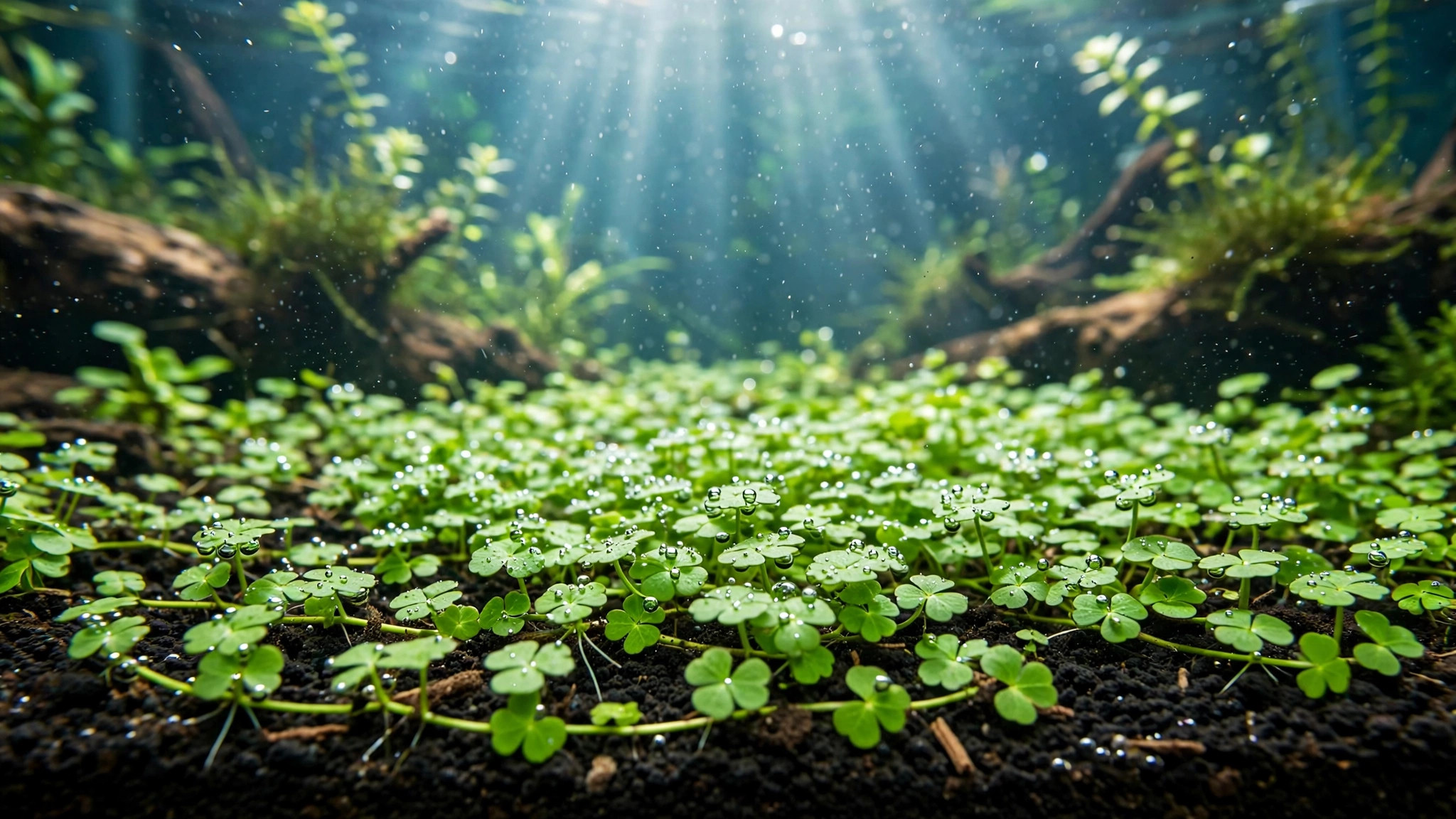
Hydrocotyle tripartita care is easier than the plant's award-winning looks suggest. Sold for years under the trade name Hydrocotyle sp. "Japan", this bright-green creeping plant — nicknamed Japanese clover — is a staple of competition-style aquascapes for one simple reason: it can act as a foreground carpet, a midground mound, and an epiphyte cascading over driftwood, all in the same tank. It grows fast, roots at every node, and forgives more mistakes than most carpet plants.
But "fast" is also the warning label. Give it good light, decent nutrients, and a bit of carbon, and it will spread with genuine ambition — over rocks, up hardscape, and into your neighbors' territory. This guide covers how to harness that energy: the three layout roles, the light and CO2 it actually needs, its hearty nutrient appetite, melt-free planting, and the trimming routine that keeps runners on a leash — plus a head-to-head against Monte Carlo and pearl weed.
Hydrocotyle Tripartita Care Basics: What This Plant Is
Hydrocotyle tripartita is a creeping stem plant in the pennywort family, native to Southeast Asia. Its signature feature is the leaf: small, bright-green, three-lobed blades that genuinely resemble tiny clover leaves — the three-parted leaves the species epithet tripartita refers to. Individual leaves stay modest, roughly 1–3 cm across, but the density is what catches the eye, forming a fresh lawn-like texture that contrasts beautifully with fine-leaved carpets and broad-leaf midground plants.
The "Japan" trade name came from aquascaping forums, where hobbyists circulated it as Hydrocotyle sp. "Japan" before it was confirmed as a variant of the Southeast Asian tripartita. It's most often sold as a sterile tissue-culture cup (Tropica's 039B), arriving snail-free and pest-algae-free — a real advantage in shrimp tanks. It works equally well as a submerged carpet, an emersed paludarium plant, and a climbing accent on damp hardscape above the waterline.
How the Creeping Growth Habit Works
Hydrocotyle tripartita spreads by runners (stolons) — horizontal stems that crawl along the substrate, throwing down roots at each node and sending up vertical leafy shoots. This is the same basic strategy as a lawn grass, and it means the plant can colonize bare substrate surprisingly fast once established. New shoots appear every few centimeters along a runner, so a single well-placed portion can weave into a continuous patch within weeks under good conditions.
How it grows is tunable. In good light it hugs the ground, producing short internodes and a tight clover lawn; in dimmer light it stretches upward — internodes lengthen, leaves shrink, and the plant reaches for the surface instead of creeping. That stretch is your early-warning system: climbing runners mean the tank needs more light, not more fertilizer.
- Short internodes + dense leaves: the plant is creeping happily; light is sufficient.
- Long internodes + sparse leaves: the plant is stretching; raise intensity or duration of light.
- New white roots at every node: the runner is anchoring; leave it alone and let it weave in.
- Runners climbing wood or rock: normal behavior — redirect or trim if you don't want the overhang.
Three Roles in the Aquascape
Few plants are this versatile: how you trim it largely decides which of these three jobs it plays.
1. As a Foreground Carpet
Planted in patches and kept trimmed, it forms a living clover lawn roughly 3–8 cm tall. Compared to a fine-leaved Monte Carlo carpet, the texture is bolder and brighter, each leaf individually visible — ideal when you want the foreground to read as "meadow" rather than green blur. A classic trick is to press the carpet down with your palm during maintenance (mechanical retardation), encouraging even lower, denser growth.
2. As a Midground Mound
Left untrimmed, it climbs into a soft, billowing mound 8–15 cm tall — perfect for softening the transition between low foreground and tall background stems. A mounded clump beside a tidy row of Staurogyne repens gives a lovely wild-versus-manicured contrast; shape it with weekly trims into domes, wedges, or a driftwood-draping cascade.
3. As an Epiphyte on Wood and Rock
It will happily root onto driftwood, lava rock, and stone ledges, then spill over edges in a trailing curtain. Wedge small portions into crevices or tie them with cotton thread until roots grip — no glue needed once anchored. This overhanging habit is one of its most distinctive looks, and most carpet plants (looking at you, dwarf hairgrass) simply can't do it.
Light and CO2: What It Actually Needs
The honest version: tripartita is adaptable, but its best form demands decent light. Tropica rates it a medium-light, low-to-medium-CO2 plant, which matches hobbyist experience. It survives in a low-tech tank under medium light, growing slower and leggier; it thrives under medium-high light with injected CO2, carpeting densely and staying compact.
Unlike HC Cuba, which more or less requires pressurized CO2 and strong light to survive, tripartita treats CO2 as a performance enhancer rather than a lifeline. In low-tech setups, a liquid carbon supplement and good surface agitation lift growth noticeably; in high-tech ones, 15–25 mg/L of CO2 with 7–8 hours of strong light produces the densest, most competition-worthy carpets.
- Low-tech (medium light, no injected CO2): survives and creeps; trim more aggressively to fight legginess.
- Mid-tech (medium-high light, liquid carbon or modest CO2): the sweet spot for most hobbyists — fast, compact, forgiving.
- High-tech (high light, pressurized CO2, lean-to-rich ferts): tightest carpet, fastest fill-in, most trimming work.
Photoperiod matters as much as intensity: start with 6–7 hours daily in a new tank and extend toward 8 as plant mass grows and algae stays absent.
Water, Substrate, and a Real Nutrient Appetite
Water chemistry is the least of your worries — it tolerates 10–30°C, pH roughly 5 to 7.5, and soft to moderately hard water. It's genuinely one of the most parameter-tolerant aquascaping plants you can buy.
Nutrients are the real story. A fast grower that builds a leaf at every node burns through fertilizer: in nutrient-rich aquasoil it can feed for months on substrate alone, but in inert sand or gravel it needs a complete liquid fertilizer (macros and micros) from day one. Watch leaf color as your gauge — deep saturated green means feeding is on target, while pale new growth or yellowing older leaves usually signal a fertilizer shortage, not a light problem. Root tabs under dense patches are cheap insurance, since those rooting nodes drink from the substrate.
Planting: From Tissue Culture to Established
Most hobbyists start with a tissue-culture cup of clean, compact, snail-free plantlets. Because cup plants are raised emersed (above water), they face the same transition melt as any nursery plant: older leaves may yellow and dissolve in the first 1–2 weeks while the plant swaps air-grown leaves for submersed ones. This is normal, not a failure — runners and roots are establishing while old leaves let go.
- Rinse the gel from the cup under lukewarm tap water until the plantlets are clean.
- Divide the mass into 6–8 small portions with your fingers or sharp scissors.
- Using planting tweezers, press each portion 1–2 cm into the substrate, spaced a few centimeters apart across the target area.
- Fill the tank slowly so the portions aren't dislodged; a light dusting of substrate over runner nodes helps anchoring.
- Run moderate light for the first week, then raise to target intensity once new growth appears.
Expect the first new runners within 7–14 days in good conditions. Resist the urge to "fix" early melt by ripping up struggling portions — leave them in place, keep nutrients steady, and the plant outgrows the transition. For a professional staging reference, Tropica's Layout 66 uses Hydrocotyle tripartita as its vivid front lawn, and Tropica's 1-2-Grow planting notes describe the portion-and-press technique.
Trimming the Runners: Keeping the Creep in Check
Maintenance is the price of the lush clover look: in a healthy tank, trim every 1–3 weeks — this is not a plant-it-and-forget-it carpet. Skipped trims produce a thick matted layer whose lower portions rot from lack of light and flow, inviting algae and debris pockets.
- Top-trim the carpet with curved aquascaping scissors, 1–2 cm above the substrate, leaving healthy rooted runners behind. The stubble resprouts within days.
- Thin overcrowded patches by pinching out every second or third shoot — light and flow must reach the lower layers.
- Redirect escape runners the moment they head somewhere unwanted; they root fast and become much harder to extract later.
- Replant healthy trimmings to fill bare spots — any trimmed stem with a node will root and start a new patch.
- Press the carpet down with your palm after trimming to keep it low and tight (mechanical retardation).
Never let trimmings sit on the carpet — floating cuttings shade the leaves below and can seed algae. A quick gravel-vacuum pass after each trim keeps the lawn clean and healthy. Dispose of trimmings responsibly: this is a fast-growing plant, so never release cuttings into ponds, rivers, drains, or any outdoor waterway — compost or bag them for the trash instead.
Hydrocotyle Tripartita vs Other Carpet Plants
Choosing between carpet plants is really choosing between textures, speeds, and maintenance styles:
| Plant | Growth speed | Leaf look | Light / CO2 | Trimming effort |
|---|---|---|---|---|
| Hydrocotyle tripartita | Fast | Clover-like, 1–3 cm lobed leaves | Medium / low–medium | High (every 1–3 weeks) |
| Monte Carlo | Moderate | Small round leaves, fine texture | Medium–high / medium | Moderate |
| Pearl weed | Very fast | Small oval leaves on upright stems | Low–medium / low | Very high (grows wild quickly) |
| Dwarf hairgrass | Moderate | Fine grass blades | Medium–high / medium | Low–moderate (mow occasionally) |
| Glossostigma | Fast | Tiny spoon-shaped leaves | High / high | Moderate–high |
| HC Cuba | Slow–moderate | Tiny 1–2 mm pearls | High / high | Low (slow grower) |
The pattern is clear: tripartita occupies the middle ground between the near-bulletproof Pearl weed and the demanding, tiny-leaved Glossostigma. Pick tripartita for a bold, bright, clover-textured lawn with moderate light needs when you don't mind regular trims; pick Monte Carlo for a finer texture with less maintenance.
Troubleshooting Common Problems
Most Hydrocotyle tripartita problems trace back to three causes: insufficient light, nutrient gaps, or neglected trims.
- Melting after planting: almost always transition melt from emersed-grown stock. Leave runners planted, keep conditions stable, and wait 2–3 weeks for regrowth.
- Leggy, sparse, upward growth: the classic low-light signal. Increase intensity (or extend the photoperiod toward 8 hours) and trim hard to reset the plant into creeping mode.
- Pale or yellowing leaves: usually a nutrient shortage — nitrogen first. Feed consistently and new growth greens up fast.
- Algae on the carpet: overgrown, matted patches trap detritus and stagnate flow. Thin aggressively, improve circulation, and remove trimmings promptly.
- Runners escaping everywhere: the plant doing what it evolved to do. Redirect weekly; in tanks under ~30 liters it may simply be too vigorous — a valid reason to choose a slower carpet instead.
Frequently Asked Questions
Does Hydrocotyle tripartita need CO2?
Not strictly — it grows in medium light without injected CO2. But CO2 is the biggest lever for carpet quality: at 15–25 mg/L, growth gets noticeably denser, faster, and more compact. If you inject CO2, start at the low end and raise it slowly over a week or two, observing your livestock closely — gasping at the surface or unusual lethargy means back off immediately. In low-tech tanks, a liquid carbon supplement and good surface agitation offer a meaningful middle ground; expect slightly leggier growth you can offset with firmer trimming.
How tall does Hydrocotyle tripartita get?
Trimmed as a foreground carpet, it stays 3–8 cm tall; left alone it climbs to 10–15 cm or more as a midground mound. Unlike plants with a fixed mature height, tripartita's size is mostly a function of your scissors and your light. Decide which role you want — lawn, mound, or trailing epiphyte — and trim to enforce it every one to three weeks.
Why is my Hydrocotyle tripartita melting?
The most common cause is transition melt: tissue-culture and nursery plants are grown emersed, and their air leaves dissolve as submersed replacements grow. This resolves in two to three weeks if runners stay planted and conditions are stable. Melt beyond that window points to poor lighting, nutrient deficiency, or sudden parameter swings — remove rotting leaves promptly so they don't seed algae.
Is Hydrocotyle tripartita good for beginners?
Yes, with one caveat: it's easy to keep alive but demands regular maintenance. Beginners will find it forgiving of parameter mistakes and fast to recover from rough trims — it roots at every node and bounces back within days. The challenge is discipline: skip trims for a month and you'll face a matted, algae-prone tangle instead of a lawn. If you're willing to trim every week or two, it's a rewarding first carpet.
Can Hydrocotyle tripartita grow on driftwood?
Absolutely — it's one of the few carpet-type plants that works as a genuine epiphyte. Wedge small portions into crevices or tie them with cotton thread until the nodes root onto the wood, usually within one to two weeks. From there it creeps across the surface and spills over edges in a trailing curtain. Trim the wood portion so it doesn't shade the carpet below, and feed the water column since it can't draw from substrate.
Hydrocotyle tripartita vs Monte Carlo: which carpet is better?
It depends on the look and workload you want. Tripartita gives a bolder, brighter, clover-textured lawn, tolerates lower light and less CO2, but grows fast and needs trimming every one to three weeks. Monte Carlo offers a finer, more uniform carpet with slower, more predictable growth and less maintenance, but asks for stronger light and CO2 to stay compact. Meadow look in medium light: tripartita. Manicured lawn in high-tech: Monte Carlo.
Is Hydrocotyle Tripartita Right for Your Tank?
Choose Hydrocotyle tripartita if you want a fast, bright-green, clover-textured plant that can carpet your foreground, mound up your midground, or trail off your driftwood — and you're willing to trim regularly in exchange. It's more forgiving than Monte Carlo or HC Cuba about light and CO2, more refined than pearl weed for structured layouts, and tougher than its delicate looks suggest. Plant it in small portions, feed it well, keep the scissors handy.
Tissue-culture plants are the exception — they’re grown in sterile gel and adapt with minimal melting, which is part of what you’re paying for. Plants bought submersed from another hobbyist’s tank also transition with little melt, since they’re already in the right form.
Which Plants Melt Most (and Least)
Heavy melters (expect significant leaf loss)
- Cryptocorynes — infamous for “crypt melt,” sometimes dropping every leaf after any disturbance. They almost always recover from the roots within weeks.
- Stem plants grown emersed — rotala, ludwigia, and hygrophila often shed lower emersed leaves while the growing tips transition.
- Amazon swords — emersed-grown swords typically lose their broad oval aerial leaves and replace them with longer submersed ribbon leaves.
Light melters
- Anubias, java fern, bucephalandra — slow-growing rhizome plants transition gradually; occasional old-leaf melt but rarely dramatic.
- Vallisneria — usually transitions well, though it dislikes the move itself and may sulk for a week.
- Floating plants — minimal melt since their leaves were already at the air-water interface.
The Acclimation Protocol
Step 1: Quarantine or dip first
Before acclimating to your tank’s conditions, make sure you’re not acclimating pests along with the plant. Run new arrivals through our quarantine and dip protocol — it adds days upfront but prevents months of regret.
Step 2: Float to temperature-match (30 minutes)
Float the bag or container in your tank for 20–30 minutes to equalize temperature. Plants are less temperature-sensitive than fish, but a 10°F shock on top of transplant stress is an avoidable insult.
Step 3: Trim before planting
Remove any leaves that are already damaged, yellowing, or heavily algae-covered — they won’t recover and they’ll rot in your tank, feeding algae. For stem plants, trim off the bottom inch and any emersed leaves that look unlikely to adapt; the plant wastes energy maintaining leaves it’s going to shed anyway. Keep the healthy growing tips — that’s where recovery starts.
Step 4: Plant correctly the first time
Follow our planting guide — right depth, crown exposed on rosettes, rhizomes unburied on epiphytes. Every uprooting and replanting restarts the acclimation clock, so get placement right on the first attempt. Decide where each plant goes before it goes in the water.
Step 5: Run a gentle first week
For the first 7 days after planting:
- Moderate light — run your normal photoperiod but consider dropping intensity 20–30% if your light is dimmable. Blast-level light on a melting plant grows algae on the dying leaves, not recovery.
- Stable CO2 — if you inject CO2, keep it consistent. Fluctuating CO2 during acclimation is a melt accelerator. If you’re low-tech, this doesn’t apply — see growing without CO2.
- Half-strength fertilizer — new plants with damaged leaves can’t use full dosing, and the excess feeds algae. Ramp to full strength over 2–3 weeks per our fertilizer schedule.
- No disturbance — don’t move, trim, or “check on” new plants for at least two weeks. Every touch resets root establishment. This is especially critical for crypts.
Step 6: Remove melt, keep the base
As emersed leaves melt, remove the mushy material promptly — decaying leaves release ammonia and grow fungus that can spread to healthy tissue. But never discard the plant while the crown, rhizome, or roots are firm and alive. A crypt that’s lost every leaf but has firm roots is a plant that’s about to recover, not a dead plant. Give it 3–4 weeks before judging.
Telling Normal Melt From Real Problems
Normal transition melt:
- Affects oldest/emersed leaves first, newest growth last
- New submersed leaves emerge even as old ones dissolve
- Roots and crown stay firm and white/green
- Timeline: 1–4 weeks, then obvious new growth
Concerning melt (see our full melting diagnosis guide):
- New growth also melts or emerges deformed
- Rhizome or crown turns mushy and brown — this is rot, not transition
- Entire plant dissolves within days with no new growth after 4+ weeks
- Melting spreads to established plants that weren’t recently moved
Buying Tips to Minimize Melt
- Buy submersed-grown when available — hobbyist-grown cuttings transition with almost no melt.
- Choose tissue culture for sensitive species — crypts and delicate stems establish far more reliably from sterile cups.
- Avoid plants already melting in the store tank — some melt is normal, but a plant that’s mostly mush at purchase has less energy for recovery.
- Transport carefully — keep plants damp and out of direct sun/heat. A plant that dries out or cooks in a hot car melts far worse than one transported properly.
The First-Month Timeline: What to Expect Week by Week
Knowing what’s normal when removes most acclimation anxiety. Here’s the typical timeline for a healthy plant adapting to a new tank:
Week 1: The quiet week
Almost nothing visible happens. The plant is growing roots you can’t see and assessing its new environment. Some species (vallisneria, stem plants) may start shedding their lowest leaves. This is normal. Resist the urge to “help” — no moving, no extra fertilizer, no light changes. The most common beginner mistake is intervening during a week when the correct action is nothing.
Week 2: Melt peaks
This is when emersed leaves give up in earnest. Crypts may drop everything; swords shed their broad aerial leaves; stem plants lose lower foliage. It looks catastrophic and it’s usually fine. Keep removing mushy material, keep conditions stable, and watch the crown and growing tips — if those are firm and green, recovery is already underway.
Week 3: The turn
New submersed-adapted leaves emerge — smaller, thinner, often a slightly different shade of green than the emersed foliage. Stem plant tips start growing visibly; crypts push tiny curled leaves from the crown; swords unfurl narrow ribbon leaves. This is the moment most beginners exhale for the first time.
Week 4+: Established
New growth outpaces melt, and the plant is functionally yours. You can resume full-strength fertilizer, normal trimming, and stop treating it as fragile. Some slow growers (anubias, bucephalandra) take 6–8 weeks to show obvious progress — that’s their normal speed, not a problem.
Acclimating Different Plant Formats
Tissue-culture cups
Sterile, pest-free, and already adapted to high-humidity (not emersed) growth — tissue cultures melt the least of any format. Rinse the agar gel off gently (leftover gel rots and feeds fungus), split the portion into small plantlets, and plant per our planting guide. They establish slowly for the first two weeks, then accelerate. No dip needed, minimal acclimation stress — this is the premium experience you’re paying for.
Potted plants
Remove the pot and strip away the rockwool completely — leftover rockwool traps debris and rots. Tease the root mass apart gently; if it’s a dense mat, splitting it into 2–3 smaller portions actually establishes faster than planting one big clump (more growing points, better water flow around roots). Potted plants are usually emersed-grown, so expect the standard 2–4 week melt cycle.
Bare-root / bunched stems
Typically sold as weighted bunches. Remove any bands, foam, or weights, strip the lower leaves, and plant stems individually or in small groups. Bunched stems from the store are often already transitioning — check for new submersed growth at the tips, which tells you the plant is mid-adaptation and will settle quickly.
Hobbyist cuttings
Already submersed-grown and the fastest to establish — often showing new growth within days. The main acclimation factor is water-parameter difference between the two tanks. Float to temperature-match, plant promptly, and they’ll usually take off with minimal melt. This is why experienced hobbyists prefer trading cuttings over buying potted plants.
Frequently Asked Questions
Should I use a “plant starter” or transplant fertilizer?
Products marketed for transplant shock are mostly B-vitamins and mild hormones. They don’t hurt, but there’s no strong evidence they help aquarium plants specifically. Stable conditions and patience outperform any bottle. Save the money for more plants.
My new plant melted completely — bare crown, no leaves. Is it dead?
Probably not, if the crown or rhizome is firm. Crypts and swords routinely lose 100% of their leaves and regrow from the base within a month. The test is firmness: firm and pale/green means alive; mushy and brown/black means rot. Give firm-but-leafless plants a full 4 weeks before declaring them dead.
Can I speed up acclimation with extra light or CO2?
No — and trying usually backfires. A melting plant can’t use extra light; the excess just grows algae on its dying leaves. Keep light moderate and CO2 stable (not boosted) during acclimation. Growth speed comes from the plant’s own adaptation timeline, which you can’t rush, only avoid delaying.
Should new plants go straight into my main display tank?
After quarantine/dipping, yes — there’s no benefit to a separate “growing-in” tank for most plants. They acclimate to your water fastest in the tank they’ll live in. The exception is very delicate species going into a tank with boisterous fish; give those a few weeks in a calm corner or breeder box first.
The Patience Rule
The single most important acclimation skill is restraint: plant it right, set gentle conditions, remove decay, and then leave it alone for a month. The hobbyists with the best plant growth aren’t doing something clever in week one — they’re simply not interfering in weeks two through four while the plants do what they’ve evolved to do. Melt looks like failure and feels like failure, but in most cases it’s the visible part of a plant successfully becoming yours.