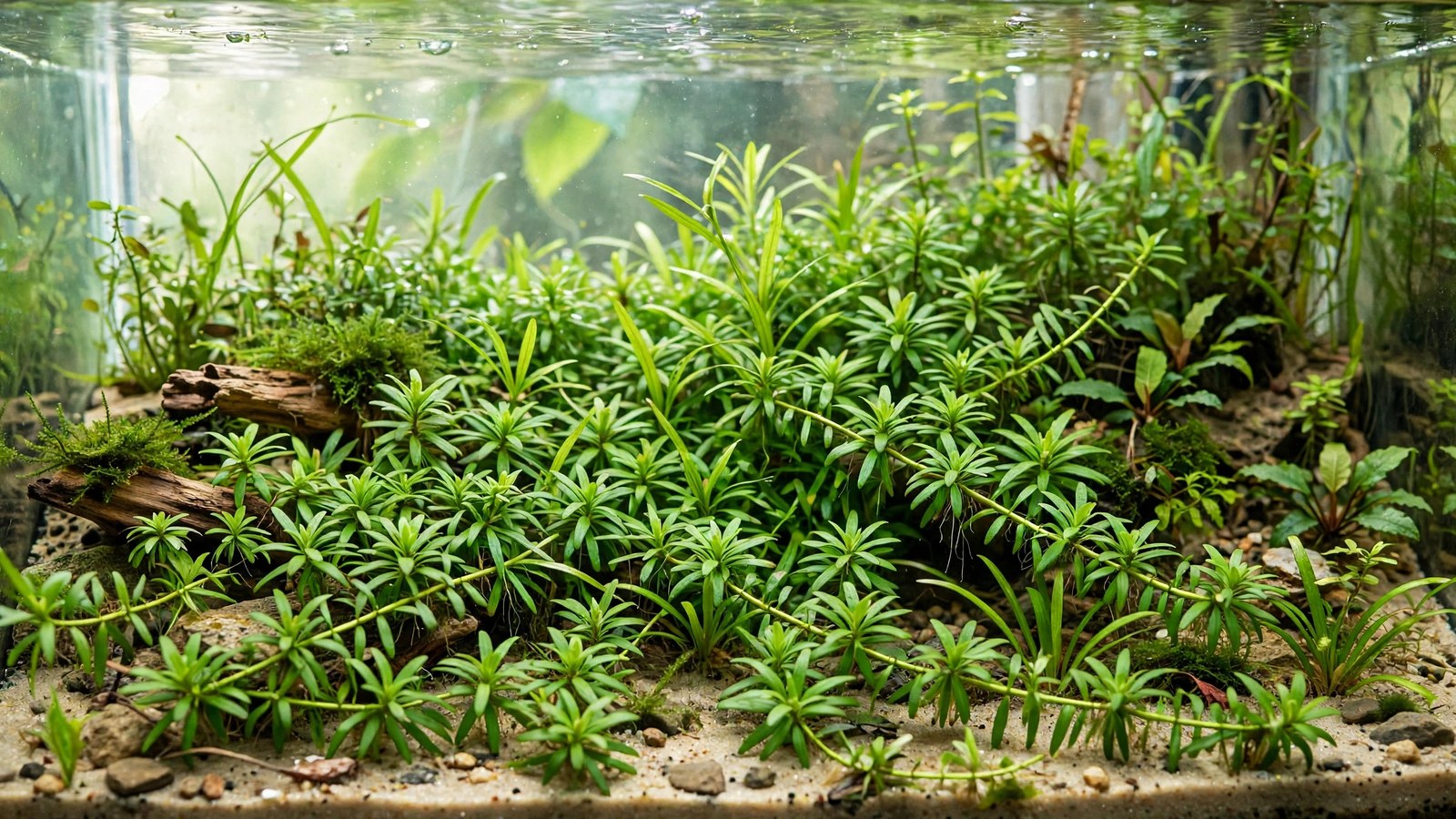
Some of the lushest tank carpets started as one forgotten pot of dwarf chain sword that finally got proper root nutrition. Reliable helanthium quadricostatus care comes down to two things: feeding the roots and restraining the runners. Master both and this bright green rosette becomes a soft lawn in two to three months.
Helanthium quadricostatus care is straightforward: plant individual rosettes 3–5 cm apart in nutrient-rich substrate, give medium light for 8–10 hours daily, hold water at 20–28 °C with pH 6.0–7.5, and it spreads by runners into a green lawn 7–10 cm tall. This is a root feeder — it draws most of its nutrition from the substrate, not the water column.
Sorting Out the Name: Helanthium Quadricostatus Taxonomy Honesty
A word about the label: this plant is sold most commonly as Helanthium bolivianum ‘Quadricostatus’, but older labels read Echinodorus bolivianum ‘Helanthium Quadricostatus’ or Echinodorus quadricostatus. When the chain swords were moved from Echinodorus to Helanthium, the trade never updated its labels consistently — so all three forms still circulate.
Do not pay a premium for a "rarely named" variant. Buy from a reliable seller and judge the plant by its form — a low rosette of narrow, bright green leaves 7–10 cm tall submerged — not the Latin on the label.
Planting Dwarf Chain Sword for a Fast Carpet
Planting technique decides whether you get a carpet in two months or struggling rosettes. From a tissue-culture cup, rinse the gel off the roots — leftover gel can rot and foul the substrate. From a pot, remove the rock wool and split the clump into rosettes with 3–5 leaves each.
Push each rosette in so the roots are buried but the crown — the pale point where leaves meet roots — sits just above the surface. Burying the crown invites rot; planting too shallow lets it float free. Space rosettes 3–5 cm apart in a grid: you are planting for runner spread, not instant coverage.
Substrate decides the outcome. As a heavy root feeder, it appreciates nutrient-containing soil — see our guide to the best substrate for planted tanks. Plain gravel or sand works too, but only with root tabs under each planting zone from day one. It ranks among the most forgiving easy foreground carpeting plants for beginners, tolerating the mistakes that doom fussier carpets like Glossostigma.
Helanthium Quadricostatus Care: Your Weekly Routine
Once planted, it asks for ordinary maintenance: a 25–30% weekly water change, light algae removal from older leaves, and a check that runners are spreading where you want them. Feed the roots: a fresh root tab under each group every two to three months, since aquasoil depletes.
| Parameter | Target range | Notes |
|---|---|---|
| Temperature | 20–28 °C | Best at 22–26 °C; tolerates 18 °C briefly |
| pH | 6.0–7.5 | Neutral to slightly acidic is ideal |
| Hardness | 2–12 dGH | Hardness is not a major factor |
| Light | Medium, 8–10 h/day | Stronger light = more compact growth |
| CO2 | Optional | Densifies and speeds growth; not required |
| Root nutrition | Root tabs / aquasoil | Re-dose tabs every 2–3 months |
| Submerged height | 7–10 cm | Stays low under good light |
Light is your main lever. Under medium to strong light the leaves stay short and the carpet thickens; under weak light they stretch toward 12–15 cm and the carpet goes thin and weedy. CO2 is the optional accelerator — it shortens time to full coverage by roughly a third — but healthy carpets grow without it if the substrate is fed.
Runner Control: Keeping the Carpet Defined
The plant sends thin stolons across the substrate; each runner node forms a daughter rosette that roots and sends out runners of its own. In a healthy tank, expect the carpet edge to advance a few centimetres per week — one plant can colonise a surprising area in three to four months.
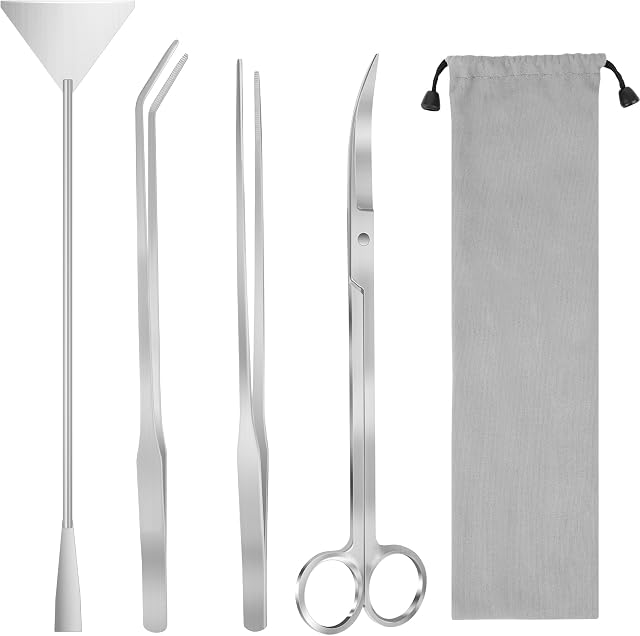
Check runners monthly. To expand the carpet, let them run and tuck daughter rosettes where they surface. To hold a boundary, snip runners with aquascaping scissors and replant the daughter inside the carpet.
 ★4.7
Liveek 4-in-1 Aquascaping Tool Kit
Check Price on Amazon ★4.7Quadricostatus vs. Tenellum: Which Chain Sword Fits Your Tank?
Often confused with Helanthium tenellum, the pygmy chain sword — a much smaller relative. For the fine, lawn-like texture of the smaller species, read our Helanthium tenellum care guide; for a bolder, grassier carpet, quadricostatus is the pick.
| Trait | Quadricostatus | Tenellum |
|---|---|---|
| Submerged height | 7–10 cm | 2–5 cm |
| Leaf texture | Broad, grassy blades | Fine, hair-like blades |
| Carpet look | Lush, meadow-like | Tight, lawn-like |
| Spread speed | Fast via runners | Moderate |
| Best fit | Mid-size and large tanks | Nano and small tanks |
| Difficulty | Easy | Easy |
Unlike dwarf hairgrass, which needs higher light and CO2 to carpet, quadricostatus is the easier low-tech choice. It pairs well with Cryptocoryne walkeri, and Echinodorus vesuvius makes a striking taller backdrop from the same family heritage.
Emersed Growth, Flowers, and Paludariums
Like many sword plants, it grows well emersed, making it a strong candidate for wabi-kusa, ripariums, and paludariums. Emersed rosettes grow larger — up to about 20 cm across — and produce small white flowers on stalks, followed by fruits and seed. The emersed form looks different enough that you might not recognise it.
Growing a stock emersed in a humid container is an easy way to multiply plants — the transition to submerged form is smoother than with many stem plants, with some leaf melt over the first two to three weeks, then fresh growth from the crown.
Troubleshooting: Yellow Leaves, Melting, and Thin Growth
Three problems cover nearly every complaint. Yellow or pale older leaves almost always mean hungry roots: in inert gravel this appears within weeks if you skipped root tabs. Add tabs and new growth comes in green within two to three weeks. Melting right after planting is transplant shock, not a dying plant — trim melted leaves at the base.
Thin, leggy growth is a light problem: increase your photoperiod toward ten hours, and new runners come in shorter and denser.
Frequently Asked Questions
Does dwarf chain sword need CO2?
No. Helanthium quadricostatus grows well without CO2 injection, which is why it suits low-tech tanks. CO2 helps: it speeds growth by roughly a third and gives a denser carpet. Without CO2, use medium light and well-fed roots through aquasoil or root tabs.
How fast does it spread?
Under medium light and fed roots, expect runner spread within two to three weeks, with daughter rosettes rooting along each stolon. A grid spaced 3–5 cm apart typically closes into a carpet in eight to twelve weeks. Low light or poor root nutrition can double that timeline.
Why are the leaves turning yellow?
Yellowing older leaves almost always mean hungry roots — this root feeder starves in inert substrate even when the water column is fertilised. Push root tabs around each group; new growth should emerge green within two to three weeks. If yellowing persists, check your light and remove algae from leaves.
Can I grow it in plain gravel or sand?
Yes, with root tabs from day one. Plain gravel and sand contain no nutrition, so press a tab under each planting zone and replace them every two to three months. Fine gravel or coarse sand works best — very fine compacted sand suffocates runners and slows spread.
Is it the same as Helanthium tenellum?
No, though the names and looks confuse many buyers. Helanthium tenellum, the pygmy chain sword, is much smaller at 2–5 cm tall with fine hair-like leaves, while quadricostatus reaches 7–10 cm with broader grassy blades. Tenellum suits nano tanks; quadricostatus fits mid-size and larger tanks.
The Bottom Line
Dwarf chain sword earns its reputation as a beginner-proof carpet: feed its roots, give it medium light, and it does the rest itself. Your real job is keeping it where you put it — check the runners monthly and keep root tabs fresh.