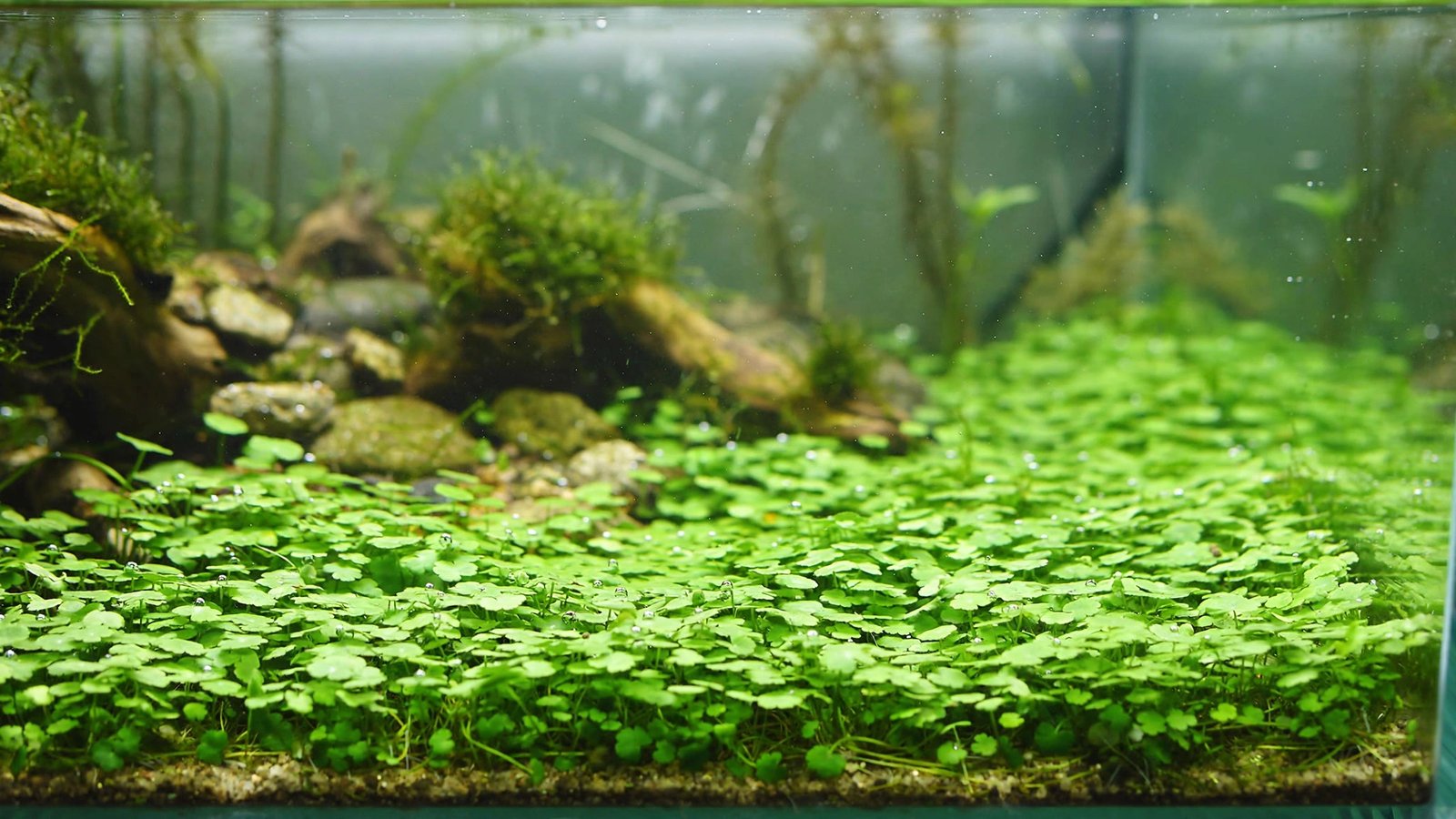
One detail decides whether this plant becomes the carpet you imagined or a tangle of climbing stems: the light you give it. Get that right, and hydrocotyle sibthorpioides care is surprisingly straightforward — tiny round leaves on wiry runners that knit into a dense, penny-sized lawn. This guide covers the light level that keeps it flat, the tissue-culture transition, and the planting method that carpets a foreground in weeks.
Hydrocotyle Sibthorpioides Care: Light, CO2, and Water Parameters
First, an identity check: if you expected the plant sold as "Hydrocotyle Japan," that is the Hydrocotyle tripartita 'Japan' care guide — a different species with softer, three-lobed leaves. Dwarf pennywort (H. sibthorpioides, also sold as lawn marsh pennywort) is its own species: round, thick, coin-like leaves about 1–2 cm wide on wiry creeping runners. Retailers stocking both contrast them directly, and the consensus favors sibthorpioides as the hardier, more forgiving of the two.
The plant is amphibious — it grows emersed and submerged alike — which is why retailers sell it mostly as pest-free tissue-culture plantlets. The parameters below assume a submerged tank.
| Parameter | Target | Notes |
|---|---|---|
| Temperature | 68–82°F (20–28°C) | Tolerates cooler water but slows down below 65°F |
| pH | 6.0–7.5 | Adapts across soft to moderately hard water |
| Light | Medium–high | The deciding factor |
| CO2 | 20–30 mg/l | Recommended; growth stalls without it |
| Nitrate | 10–50 mg/l | Keep levels detectable, never zero |
| Phosphate | 0.1–3 mg/l | Adequate phosphate helps prevent green spot algae on the leaves |
| Substrate | Nutrient-rich or root tabs | Runners root at the nodes — they appreciate food at the root zone |
Treat CO2 as required. The detailed botanical profile on Flowgrow is plain: without CO2 and strong light the species decays; with both it grows fast. Pair it with steady nitrate, phosphate, iron, and micronutrients. Many hobbyists rate it among the more rewarding beginner-friendly foreground carpeting plants because it forgives the nutrient swings that crash fussier carpets.
Carpet or Climber: Why Light Decides the Shape
The honest angle every retailer agrees on: light literally decides this plant's growth habit. Under medium-to-high light, runners stay flat, root at the nodes, and spread into a dense, lawn-like mat. Under low light, the same plant reaches upward and climbs like a vine. Same plant, two different aquascapes.
The mechanism is simple: with enough light at the substrate, the plant has no reason to stretch. Most keepers target roughly 40–60 PAR at the substrate for a carpeting habit. If runners start climbing, the fix is almost always more light, not fertilizer: lower the fixture, raise the photoperiod toward 7–8 hours, or clear floating-plant coverage, and stems pin down within days. Keep lighting even — a bright center with dim corners grows a patchwork of carpet and climber in the same tank.
How to Plant It for a Carpet
Most cups arrive as tissue culture: small emersed-grown plantlets in sterile gel. Rinse every trace of gel off under lukewarm water — leftover gel rots and fouls the water — then divide the contents into portions of 4–6 plantlets, keeping roots and runners intact.
Plant each portion 2–3 cm apart, pressing roots just into the substrate with tweezers; leave runners lying flat — they root at the nodes on their own. A nutrient-rich substrate starts fastest, but plain sand works with a root tab near every few portions. It pairs well with other easy aquarium plants for beginner community tanks.
Expect a transition: emersed-grown leaves melt within 1–2 weeks as submerged leaves take over. This is normal — leave the portions in place, since new growth emerges from the nodes once CO2 and light are dialed in. Carpets close in 4–8 weeks with CO2, or 8–12 without. Most attempts start from cups like the Hydrocotyle Sibthorpioides Vitro Culture from Aquarium Plants Factory, whose grower's notes confirm the rule: light keeps it flat instead of climbing.
Trimming, Propagation, and Maintenance
Maintenance is simple. Once the carpet closes, mow it with aquascaping scissors every 2–3 weeks, trimming the top third like a lawn. Trimming pushes the runners to branch laterally, thickening the mat instead of letting it creep upward. Remove the trimmings — decaying leaves left in a dense carpet invite algae.
Propagation needs no technique: runners do the work. When the mat extends past its borders, lift a runner, cut it between rooted nodes, and replant the pieces 2–3 cm apart — each rooted node becomes a new plant. One established carpet yields dozens of portions.
Watch for two common issues. Green spot algae on the leaves usually signals a phosphate dip rather than too much light — restore phosphate to 0.1–3 mg/l and new growth comes in clean. If the carpet starts lifting, the mat grew too thick and shaded its own roots; trim harder and replant the healthiest runners. Compared with demanding carpets like glossostigma, dwarf pennywort is far more forgiving, and unlike Hydrocotyle verticillata — whose rhizomes run inside the substrate — it roots at the surface nodes, so rescues are easy. For a slower alternative, marsilea hirsuta plays the same role with less trimming.
Is Dwarf Pennywort Right for Your Tank?
Choose it for a carpeting plant with genuine forgiveness: tougher leaves than H. tripartita 'Japan', pest-free tissue-culture availability, and a habit that responds visibly to your corrections. It suits foregrounds and midgrounds in any tank size and handles moderate flow that would tatter softer carpets. Skip it only if you cannot commit to medium-high light and CO2 — without those it climbs or declines, and no fertilizer saves it.
Frequently Asked Questions
Is Hydrocotyle sibthorpioides the same as Hydrocotyle tripartita 'Japan'?
No — they are distinct species. Hydrocotyle sibthorpioides ("dwarf pennywort") has round, thick, coin-like leaves on wiry runners, while H. tripartita 'Japan' has softer, three-lobed leaves. Retailers selling both explicitly call sibthorpioides "the sturdier pennywort" — it tolerates flow, handling, and grazing better. Check the label before buying.
Why is my dwarf pennywort growing upward instead of carpeting?
Low light at the substrate is the cause. Under medium-to-high light the runners hug the substrate; under dim light the stems elongate and climb. Increase light (target roughly 40–60 PAR at the substrate), clear floating-plant shading, and wait three to four days — the runners will pin down. Do not try to fix climbing with extra fertilizer.
Does Hydrocotyle sibthorpioides need CO2?
Practically, yes. Injected CO2 at 20–30 mg/l is the difference between a fast-spreading carpet and a plant that stalls or decays. The species struggles without CO2, especially under strong light. With injected CO2, hobbyists report carpets closing in 4–8 weeks; without it, growth stays slow and leggy.
How do you plant tissue-culture dwarf pennywort?
Rinse all nutrient gel off under lukewarm water, divide the plantlets into portions of 4–6, and plant each 2–3 cm apart with tweezers, pressing roots gently into the substrate. Expect emersed leaves to melt over 1–2 weeks — leave the runners in place, since new submerged growth emerges from the nodes. A nutrient substrate or root tabs speeds establishment.
Can dwarf pennywort grow in a low-tech tank?
It can survive low-tech, but it will not form the classic dense carpet. Expect slower, leggier growth with stems leaning toward climbing. For a low-tech foreground, marsilea hirsuta is a better pick — for dwarf pennywort at its best, CO2 and strong light are the entry price.
Give it the light it asks for and feed it CO2, and dwarf pennywort repays you with one of the toughest, most forgiving carpets in the hobby.