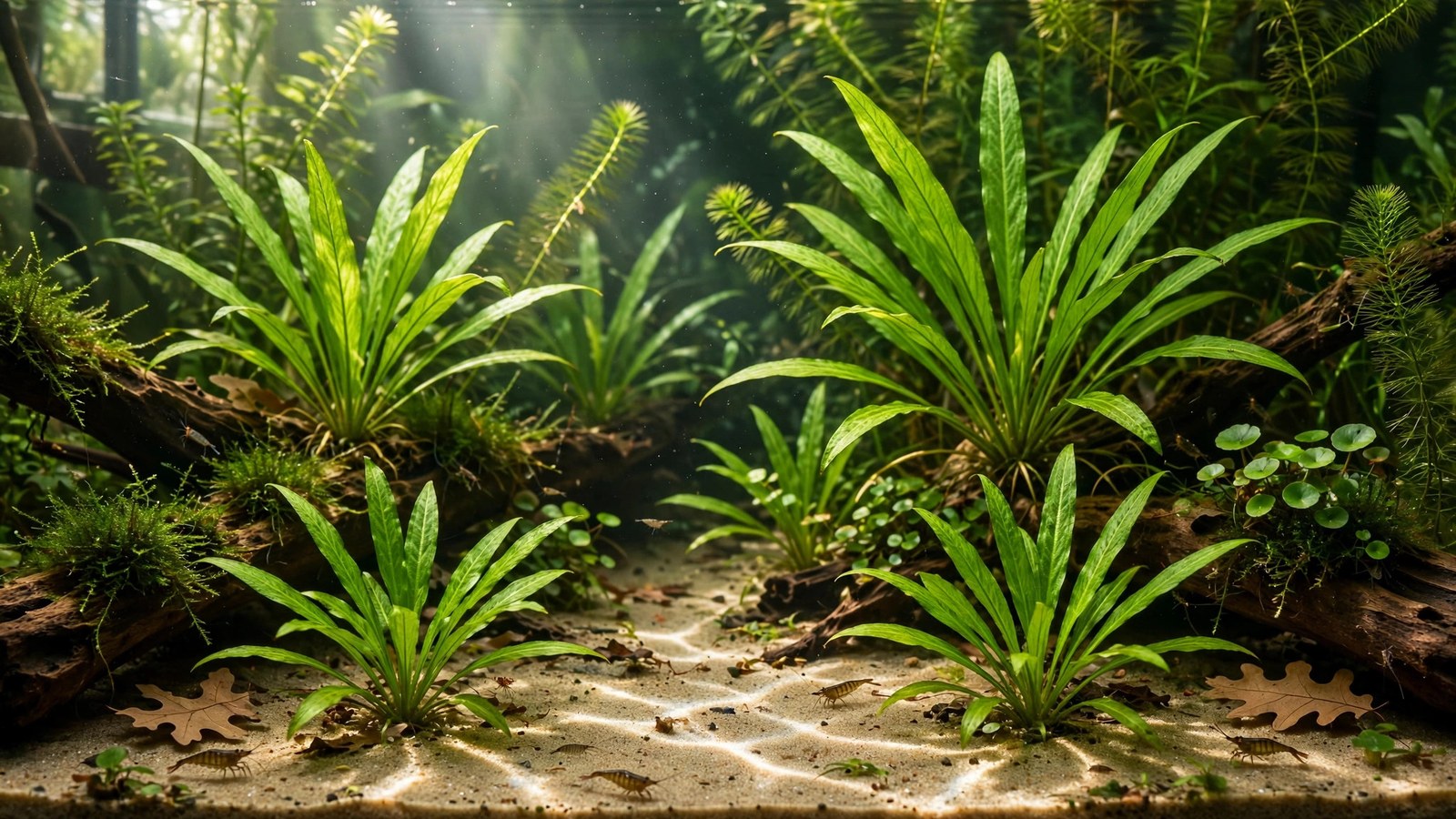
If your tank runs cool — no heater, or just room temperature through winter — you've probably watched a broad Amazon sword sulk: glassy leaves, stalled growth, a crown that never fills out. Most swords are tropical plants living in subtropical water, and they're telling you so.
The Uruguay sword is the exception. Echinodorus uruguayensis comes from the cooler rivers of Uruguay, Argentina, and southern Brazil, and it thrives at 64–79°F — the range that makes tropical swords miserable. That's why echinodorus uruguayensis care deserves its own guide, not a copy-paste from the Amazon playbook. Feed the roots, plant the crown at substrate level, and you get a fountain of long, arching leaves and a 10–24 inch background presence with no heater in sight.
Short answer: Echinodorus uruguayensis is a subtropical sword plant that grows best at 64–79°F (18–26°C), reaching 10–24 inches with narrow, arching leaves. Plant the crown at substrate level — never buried — feed the roots with root tabs or aquasoil instead of liquid fertilizer alone, and allow 6–8 weeks for submerged leaves to replace the old emersed ones. It spreads via plantlets on aerial flower stalks, and the tricolor form adds green-red striping to the same cool-water routine.
Why the Uruguay sword breaks the sword rules
Most swords follow one script: big tropical plant, broad oval leaves, warm water. The Uruguay sword rips it up. Its leaves are narrow ribbons — often under an inch wide — with softly wavy margins, arching outward like a fountain instead of standing up like paddles. Three plants read as flowing grass; one alone reads as a centerpiece.
The real difference is temperature. The classic Amazon sword wants 72–82°F and stalls below that; uruguayensis is comfortable from 64°F to about 79°F, with many keepers reporting the best growth in the low 70s. If you run an unheated tank, a goldfish setup, or a room that dips at night, this is the sword that finally behaves. For the tropical comparison, read our Amazon sword care guide — then notice how few of its temperature warnings apply here.
A tricolor variegated form is also in the trade: green leaves striped and flushed with red and cream on new growth. Same cool-water routine, but the red tones deepen under medium-high light. If you're building a cool-water tank from scratch, the complete guide to freshwater aquarium plants will help you plan the layout around it.
Planting: the crown rule and the root-tab rule
Two rules decide whether your Uruguay sword thrives or melts. First, planting depth: push the root mass into the substrate, then settle the crown — the pale nub where leaves meet roots — exactly at substrate level, never buried. A buried crown rots from the base up, and by the time the outer leaves yellow the plant is usually past saving.
Second, feed the roots. This is a heavy root feeder: press one root tab 1–2 inches under and slightly beside the crown (two tabs for a mature plant), or plant it in nutrient-rich aquasoil. Liquid fertilizer alone gives short, pale, stunted leaves — the classic sign of a starving sword. When you do dose liquid ferts, start low, observe livestock for any sign of stress for 24–48 hours, and only then hold the dose. Unsure what your setup needs? Read do aquarium plants really need fertilizer.
Rinse off rockwool, trim damaged roots to 2 inches, and plant. Expect the nursery-grown emersed leaves to melt over 2–3 weeks — normal, not failure. New submerged leaves emerge from the center; judge the plant at 6–8 weeks, not week two.
echinodorus uruguayensis care: the weekly routine
Once established, this is a low-drama plant. Weekly work: a 25–30% water change, a glance at the crown for detritus, and a check that outer leaves are still green. Trim any yellowing outer leaf at its base — never tear — and remove leaves that have gone translucent.
Root tabs dissolve over 2–3 months, so replace them on schedule instead of waiting for pale leaves to tell you. Half the label dose of a comprehensive liquid fertilizer once a week rounds things out — but start low, observe livestock for stress, and only increase if growth looks hungry and your animals are unaffected. Keep nitrates at 10–20 ppm; this plant will happily eat them.
| Task | Frequency | Notes |
|---|---|---|
| Replace root tabs | Every 8–12 weeks | 1 per young plant, 2 for mature rosettes |
| Liquid fertilizer | Weekly, half dose | Start low, observe livestock, then adjust |
| Water change | Weekly, 25–30% | Keeps nitrates 10–20 ppm |
| Trim outer leaves | As needed | Cut at the base; never uproot to "check" |
Propagation: free plantlets on flower stalks
A happy Uruguay sword sends up a long aerial stalk — sometimes reaching the surface — with small plantlets at the nodes, occasionally topped with tiny white flowers. Leave plantlets attached until each has 4–5 leaves and visible roots, then snip the stalk below the plantlet and press the baby into the substrate with its own root tab. One stalk can yield three to six new plants over a few months.
Want the mother plant's energy in leaves instead? Cut the stalk at its base as soon as it appears. The twisted Echinodorus 'Vesuvius' guide and the spotted Ozelot sword care guide throw similar stalks — but uruguayensis plantlets are the most vigorous of the narrow-leaf bunch in cool water.
Uruguay sword vs. Amazon sword: an honest contrast
In a heated 78°F tank, the Amazon sword gives bigger, bolder leaves. In anything cooler — unheated, room-temp, or seasonally swinging — the Uruguay sword wins outright, growing where the Amazon merely survives.
| Trait | Uruguay sword | Amazon sword |
|---|---|---|
| Leaf shape | Narrow ribbons, wavy, arching | Broad ovals on long petioles |
| Best temperature | 64–79°F | 72–82°F |
| Height | 10–24 in | 12–24+ in |
| Footprint | Slim, grass-like cluster | Wide rosette |
| Cool-water growth | Strong | Stalls, leaves go glassy |
Taxonomists have even moved this species to the genus Aquarius (as A. uruguayensis) — see the Aquarius uruguayensis species page — but the trade still sells it as Echinodorus, and its care is pure sword: feed the roots, respect the crown, give it light.
Frequently Asked Questions
Can Echinodorus uruguayensis grow in an unheated tank?
Yes — this is its superpower. It stays healthy from 64°F to about 79°F, so room-temperature tanks and unheated setups suit it perfectly. Below 64°F it slows but rarely dies; above 80°F for long stretches, leaves shorten and growth stalls.
Why are all the leaves melting after I planted it?
Nursery plants grow emersed, and those leaves can't survive underwater — they melt over 2–3 weeks while new leaves emerge from the crown. If the crown is firm and new leaves are appearing, the plant is fine; judge it at 6–8 weeks, not week two.
Does it need CO2 injection?
No. CO2 speeds growth and thickens leaves, but the Uruguay sword grows well without it as long as the roots are fed — root tabs matter far more than injected CO2 for this plant. Add CO2 only if you're already running it for the rest of the tank.
How big will it get — will it outgrow my tank?
Expect 10–24 inches tall with an 8–12 inch spread, so it suits 20-gallon tanks and up as a background plant. Remove outer leaves regularly to keep it in check, and plant it 3–4 inches from the back glass so the arching leaves have room.
What is the tricolor form, and is it harder to keep?
The tricolor form is a variegated selection with green, red, and cream striping on the same narrow leaves. Care is identical — cool water, root tabs, crown at substrate level — with red tones showing best under medium-high light (40–50 PAR).
Is the Uruguay sword right for your tank?
If your water runs cool and your swords have always underwhelmed, this plant ends the frustration. One root tab, a correctly placed crown, and eight weeks of patience buy you a fountain of arching leaves that asks for almost nothing afterward. In the world of swords, the Uruguay sword is the quiet overachiever — it just needed someone to stop treating it like a tropical.