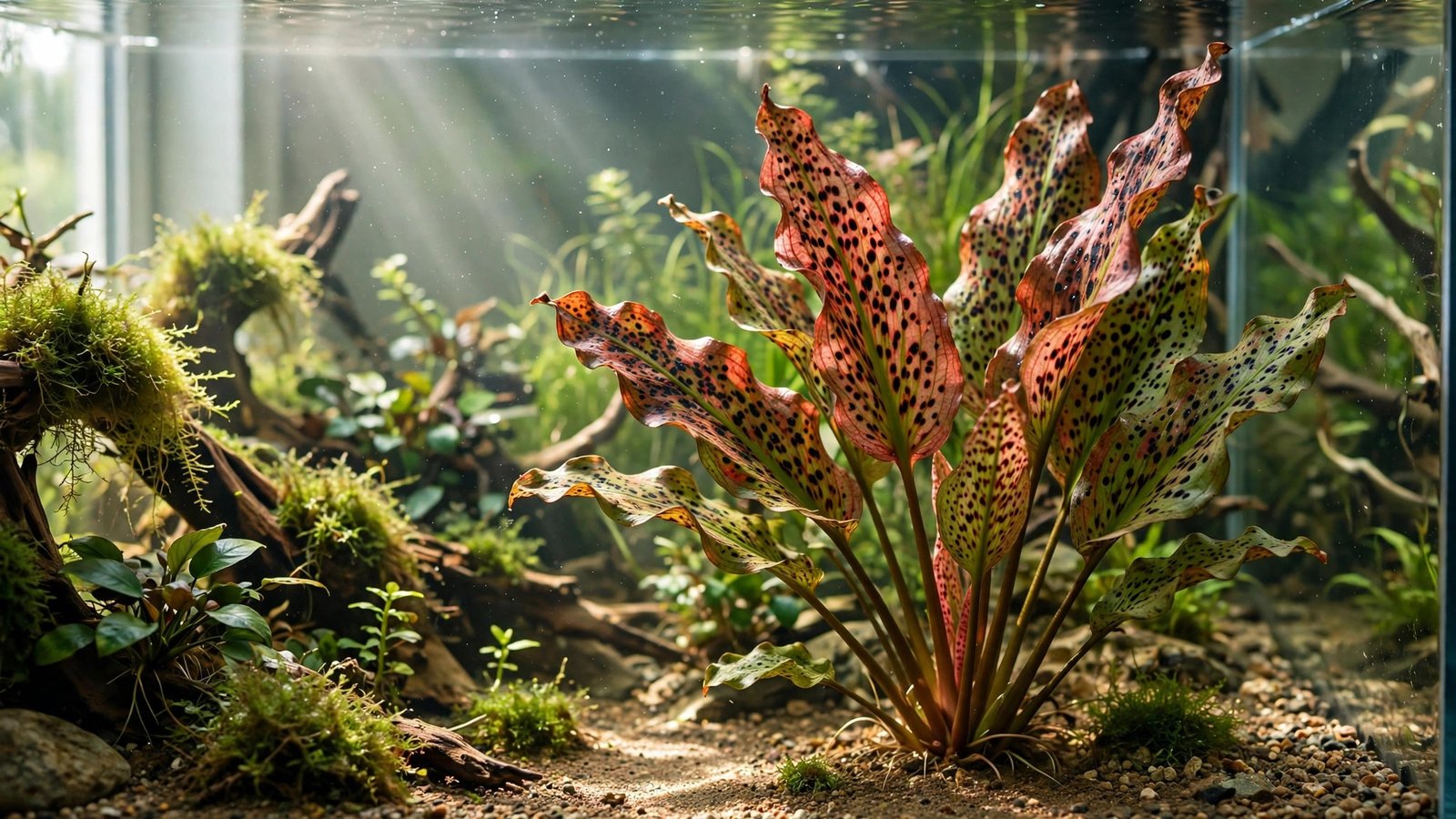
Few plants punish impulse buyers like a sword — and few reward patient aquarists like the Ozelot. Its broad, burgundy-spotted leaves can turn an ordinary tank into a showpiece in eight weeks, but the tidy rosette in the shop cup can swallow half your 29-gallon within a year. This ozelot sword care guide covers which form to buy, feed it, keep the spots vivid, and turn one plant into five.
Note: this is the spotted Echinodorus 'Ozelot' hybrid — not the plain green cultivar in our Amazon sword care guide.
Why the Ozelot sword stands out
Most swords are solid green workhorses — beautiful, but visually quiet. The Ozelot, bred from Echinodorus schlueteri 'Leopard' lineage, is the loud exception: every leaf carries irregular dark-red to burgundy spots, like leopard print on foliage. A tissue-cultured hybrid, so every plant is genetically identical — no reversion.
That hybrid vigor cuts both ways. Ozelots grow faster and larger than most sword cousins, and they are ravenous root feeders. Starve one in plain gravel under modest light and you'll get a yellowish, spotless plant. Feed it properly and it's the most photographed plant in your tank.
Ozelot sword care: the full routine
Ozelot sword care comes down to one idea: this plant eats through its roots, not its leaves. Master feeding and placement, and the rest nearly takes care of itself.
Planting: set the crown at or just above the substrate surface — buried crowns rot. Fan roots out, mound 2–3 inches of substrate around them, and space plants 8 inches apart.
Feeding: push one large root tab (e.g. Seachem Flourish Tabs, 1 tab per 4–6 inch radius) under the crown every 6–8 weeks — by the time leaves yellow you've lost a month of growth. In rich aquasoil delay the first tab to month three or four, plus weekly liquid fertilizer at half to full strength.
Light: 40–70 PAR keeps spotting vivid. Below ~30 PAR the plant stretches tall, thins out, and spots fade to muddy green. At 60+ PAR the red form shows its deepest burgundy — but guard broad leaves against algae with steady CO2 and dosing discipline.
Water: 68–82°F (20–28°C), pH 6.5–7.5, soft to moderately hard. Ozelots convert between tanks better than most swords, melting only the oldest outer leaves.
| Parameter | Ideal range | Notes |
|---|---|---|
| Temperature | 72–78°F (22–26°C) | Growth stalls below 70°F |
| pH | 6.5–7.5 | Adaptable; avoid sudden swings |
| GH / KH | 3–12 dGH / 2–8 dKH | Very soft water slows growth |
| Light (PAR) | 40–70 | Under 30: leggy, spotless growth |
| CO2 | Optional, 20–30 ppm | Deepens color, increases size |
| Nitrates | 10–25 ppm | Pale new leaves = nitrogen shortage |
Green vs red Ozelot sword
Two forms dominate the trade, and the difference decides your light budget:
| Form | Leaves | Spots | Light needed |
|---|---|---|---|
| Ozelot Green | Medium green | Dark reddish-brown, high contrast | Moderate (40–50 PAR) |
| Ozelot Red | Olive to reddish-bronze | Deep burgundy | Medium-high (55–70 PAR) |
The green form is forgiving: crisp spots under moderate LEDs, fine without CO2. The red form needs strong light to earn its name — under dim light it looks disappointingly brown-green. Same size, same feeding; the choice is light budget and taste. Compare photos on Tropica's Echinodorus 'Ozelot' plant profile before buying.
Is the Ozelot sword too big for your tank?
Here's the truth most product pages bury: a mature Ozelot is 14–18 inches tall with a 10–12 inch spread. Not a nano-tank plant — and not a 20-gallon plant unless you commit to yearly division.
Minimum honest tank size: 40 gallons (36-inch / 90 cm) for one specimen as a centerpiece. In anything smaller, leaves reach the surface, fold over, and shade everything below — and swords store energy in those broad blades, so hard pruning backfires.
Already own one in a small tank? Divide the crown: unpot, find the seams between leaf fans, and slice through with a clean razor so each division keeps roots and 4–5 leaves — then trade or sell the extras. Or make it the focal point of a 40+ gallon scape, flanked by low carpets like dwarf sagittaria or Helanthium tenellum.
Set it slightly off-center in the midground-to-background transition, with open water in front so the rosette reads cleanly. Pair it with fine-textured background plants — water wisteria behind it for lacy contrast, or sculptural Crinum calamistratum beside it.
Propagating your Ozelot sword
Plantlets (easiest): happy plants send up a flower stalk with tiny plantlets at the nodes. When one has 4–5 leaves and inch-long roots, bend the stalk down and pin it into the substrate with a plant weight; after 2–3 weeks anchored, snip the stalk.
Crown division: unpot a large specimen, find the seams between leaf fans, and cut straight down through the crown with a sharp razor so each division carries 4–6 leaves and roots. Replant immediately with a fresh root tab under each.
Troubleshooting: fading spots, melt, and algae
Spots fading almost always means too little light — raise intensity toward 40–70 PAR on a 7–8 hour photoperiod, and keep GH at 4+, since soft water dulls color.
Pale new leaves mean root hunger. Push a fresh root tab under the crown even if the last "should" still be active — heavy feeders exhaust tabs faster than labels claim.
Transplant melt is normal for 2–4 weeks, especially from emersed shop stock. Leave melting leaves until fully transparent — the plant reclaims their nutrients.
Algae on leaves: broad blades are algae magnets under high light. Keep nerites or otocinclus on patrol, wipe leaves during water changes, and cap strong light at 8 hours without CO2.
New to the sword family? The Echinodorus sword varieties overview shows where the Ozelot fits — the spotted show-off of a very large family. If floating plants are dimming your swords, the azolla mosquito fern guide covers a fast floater that needs regular thinning to keep light reaching the substrate.
Frequently Asked Questions
Is the Ozelot sword good for beginners?
Yes, with one caveat: the care is easy (feed the roots, give moderate light), but the size is not beginner-proof. New aquarists often plant it in a 20-gallon and get overwhelmed. Start with 40 gallons or more and refresh root tabs regularly.
What's the difference between green and red Ozelot sword?
Ozelot Green has medium-green leaves with dark reddish-brown spots and keeps its pattern under moderate light. Ozelot Red has olive-to-bronze leaves with deep burgundy spots but needs 55–70 PAR to show its color — under dim light it looks muddy. Same size, same feeding needs.
How big does an Ozelot sword really get?
Expect 14–18 inches tall with a 10–12 inch spread, reached in 12–18 months with good feeding — hence the 40-gallon honest minimum. In smaller tanks, divide the crown yearly; weekly leaf-chopping starves the plant rather than keeping it small.
Does the Ozelot sword need CO2?
No — it grows well without injected CO2 as long as root feeding and light are adequate. CO2 at 20–30 ppm is a genuine upgrade: faster growth, larger leaves, and deeper spot color, especially on the red form.
How do you propagate an Ozelot sword?
Let the stalk's baby plants grow 4–5 leaves with inch-long roots, pin them into the substrate while attached, and snip the stalk after 2–3 weeks. Or divide a large crown with a clean razor so each piece keeps 4–6 leaves and roots, replant with fresh root tabs, and expect new growth within two weeks.
A spotted centerpiece worth planning around
The Ozelot asks for three things — substrate fed on schedule, honest light, and a tank big enough for the plant it will become — and repays them with the most dramatic foliage any sword offers. Buy the form that matches your light, give it room, and in a year you'll hand free divisions to friends.