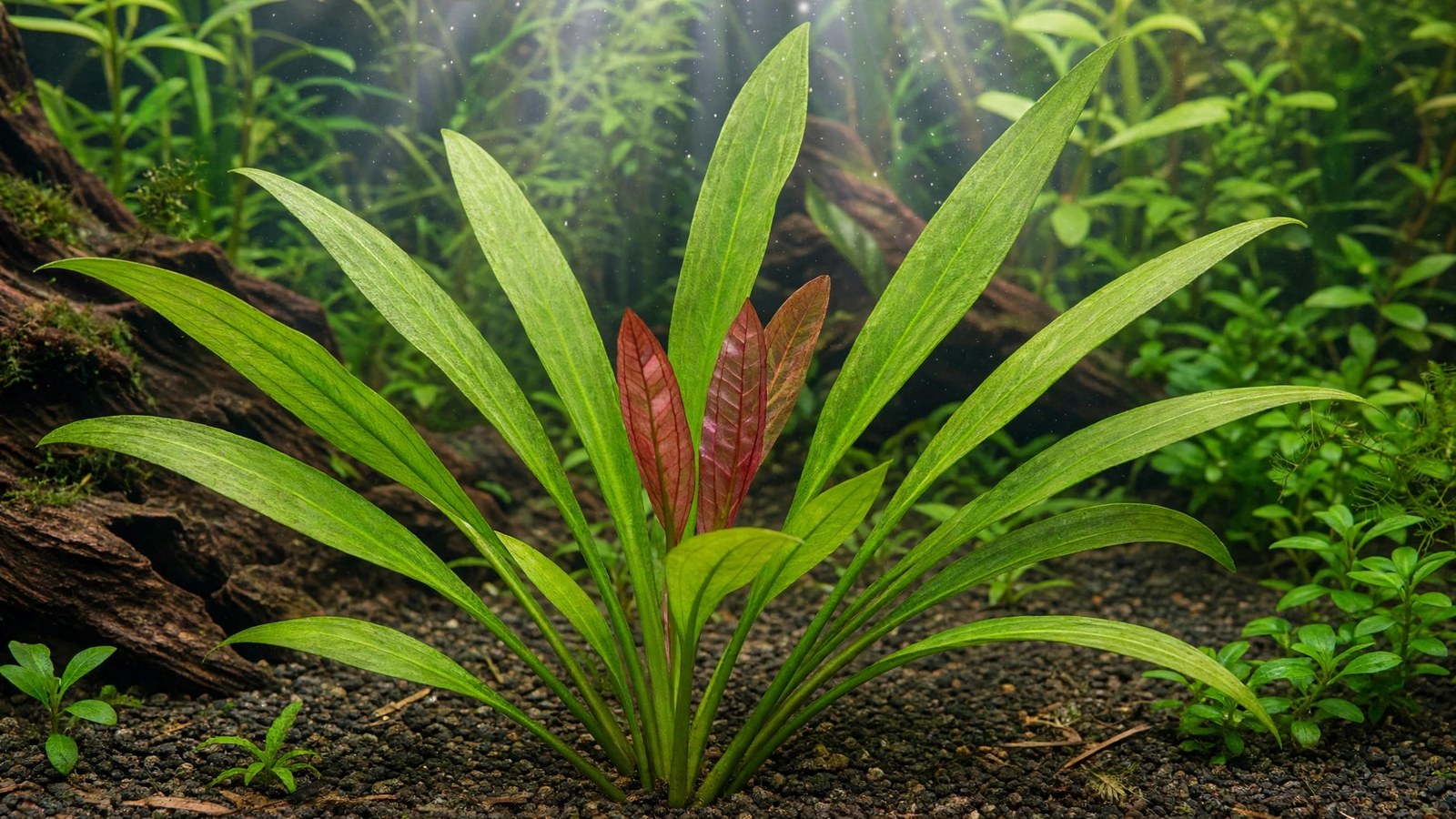
The plant in the nursery pot may not be the plant you think it is. When you look up echinodorus horemanii care, you discover two different plants — a dark-green strap-leaf rosette sold as "Green" and a red-brown one sold as "Red" — sharing one label, and the care advice splits with them. This guide untangles the trade names first, then the substrate, light, and CO2 formula for either form. Both are heavy root feeders: plant into a nutrient-rich planted-tank substrate with root tabs pressed in under the crown.
The short answer: Echinodorus horemanii care means feeding the roots and matching light to the form you bought. The citable fact: trade-labeled "Green" is likely Echinodorus uruguayensis, not a true horemanii; the "Red" is likely a uruguayensis-allied hybrid with 40 cm strap leaves at 25–40 cm mature height. Give both forms root tabs; give the Red form medium-high light and CO2 to hold its color.
Green vs Red: The Trade Split You Must Know
Here is the honest taxonomy, because it shapes every care decision. For years, nursery stock sold as Echinodorus horemanii "Green" was, in the nurseries' own words, several forms of E. uruguayensis under the horemanii name — and the "Red" is likely a hybrid resembling dark forms of E. uruguayensis. Horizon Aquatics' notes on the Green form state it probably belongs to E. uruguayensis, while AquariumPlantsFactory's Red form profile calls the Red form closely allied to it.
Both are proven aquarium plants — but shop by appearance, not by the Latin name on the pot. The forms share the strap-leaf architecture and heavy root-feeding habit, yet diverge on light and CO2; treating them as identical is why the Red form so often underwhelms.
You may also meet the retail label Echinodorus horemanii "E. Barthii" on Red Rubin swords — a shop alias for red hybrid stock, not a separate species. The true 'Rubin' hybrid has its own profile — the Echinodorus Rubin care guide — so this guide stays on the Green and Red forms sold as horemanii.
| Feature | 'Green' | 'Red' |
|---|---|---|
| Likely identity | E. uruguayensis forms | uruguayensis-allied hybrid |
| Submerged leaves | Dark green, broadly strap-shaped, up to 40 cm | Red-brown, broadly strap-shaped, up to 40 cm |
| Light | Moderate suffices | Medium–high; intensity sets how deep the red runs |
| CO2 | Optional; promotes growth | Recommended — holds color and form |
| Growth rate | Moderate to fast | Medium |
| Best use | Solitary or small group, midground–background | Focal plant, midground–background |
Echinodorus Horemanii Care: Substrate, Light, and CO2
Like all sword plants, horemanii is a heavy root feeder, and the substrate is where this plant is won or lost. Press root tabs in a ring around the crown at planting and refresh them every 2–3 months — thinning older leaves usually mean a starving plant. Aquasoil beats plain gravel plus tabs, since the whole root zone stays charged.
Light is the color dial, especially for the Red form. Moderate light keeps the Green form lush and the Red form alive, but the Red form's deep red-brown tones only hold under medium-to-high intensity. Unsure where your tank sits? This guide to how much light aquarium plants need matches your fixture to the form you bought.
CO2 is the dividing line. The Green form grows well without injection — CO2 merely speeds it up. The Red form benefits far more: injection holds the red coloration and keeps the rosette compact. Stay conservative: roughly 20–30 ppm, starting near one bubble per second per 25 gallons, then start low and observe livestock for a week before raising it. Shrimp and sensitive fish outrank plant color.
Water chemistry is forgiving, which suits broad community tanks. Iron matters more than pH: a chelated-iron liquid fertilizer at the bottle's weekly dose supports the Red form's pigment and the Green form's color. Keep nitrates above zero (5–20 ppm) so root tabs are not the plant's only nitrogen source.
| Parameter | 'Green' | 'Red' |
|---|---|---|
| Tank size | 20 gallons and up | 20 gallons and up |
| Temperature | 20–28 °C (68–82 °F) | 22–28 °C (72–82 °F) |
| pH | 6.5–7.5 | 6.0–7.5 |
| Light | Moderate | Medium–high |
| CO2 | Optional | Recommended |
| Fertilizer | Root tabs + weekly iron | Root tabs + weekly iron (heavier) |
Planting, Propagation, and Maintenance
Set the crown — where roots meet leaves — level with or just above the substrate. Sword crowns rot when buried, the most common planting mistake with the genus. Fan the roots into a shallow pit, backfill gently, and leave clearance from hardscape — a mature plant throws dozens of leaves.
Maintenance is minimal: snip yellowing outer leaves at the base, and give the plant a week or two to settle — swords often shed emersed-grown leaves before pushing submerged growth, which is normal. Wipe algae film from the broad leaves during water changes, since a big rosette under strong light is a tempting surface for it.
Propagation follows the uruguayensis playbook: the plant forms a long, creeping rhizome in the substrate. Once established, lift it and cut the older leafless sections into pieces — each develops a new rosette. Plants also produce plantlets on aerial floral stalks; let them grow a few leaves and roots, then snip and replant. One specimen fills a background within a season.
Horemanii vs Its Sword Cousins
Horemanii sits on a crowded shelf of background swords. The classic Amazon sword is the bigger, broader beginner anchor; horemanii is the narrower, more architectural alternative. The Ozelot sword is the patterned cousin — green or red leaves flecked with dark spots. Buy horemanii Red only when you have the light and CO2 to keep it red.
Frequently Asked Questions
Is Echinodorus horemanii a real species?
The name is murky in the trade. Nursery notes say horemanii "Green" probably belongs to Echinodorus uruguayensis, and the "Red" is likely a uruguayensis-allied hybrid. Treat the label as a trade name for a strap-leaf architectural sword, and care for the plant you received.
Why is my Red horemanii turning green or olive?
Fading color is usually a light or iron problem. The Red form needs medium-to-high light for its deep red-brown tones, plus CO2 to hold them. First, dose chelated iron weekly and confirm the root tabs are fresh — deficiency alone can bleach the red out within weeks.
Does Echinodorus horemanii need CO2?
The Green form does not — CO2 merely speeds growth. The Red form is different: injected CO2 around 20–30 ppm keeps its color deep and its rosette compact. If you inject, start low and observe livestock for several days before increasing; shrimp and fish outrank plant color.
How do you propagate Echinodorus horemanii?
Lift the creeping rhizome and cut the older leafless sections into pieces — each piece grows a new rosette. The plant also produces plantlets on aerial floral stalks; let them develop a few leaves and roots, then snip and replant; it has no runners, so division multiplies it.
How big does Echinodorus horemanii get?
Expect 25–40 cm (10–16 inches) of arching, broadly strap-shaped leaves at maturity, with blades up to 40 cm — a true background plant for tanks of 20 gallons and up. Leave several centimeters of clearance on all sides so the leaves arch without shading everything beneath.
A Sword Worth the Name, Whatever the Label Says
Horemanii rewards the aquarist who reads past the label: feed the roots, match the light to the form you bought, and give the Red version the CO2 it needs to stay red. Do that, and you get one of the most architectural swords in the hobby.