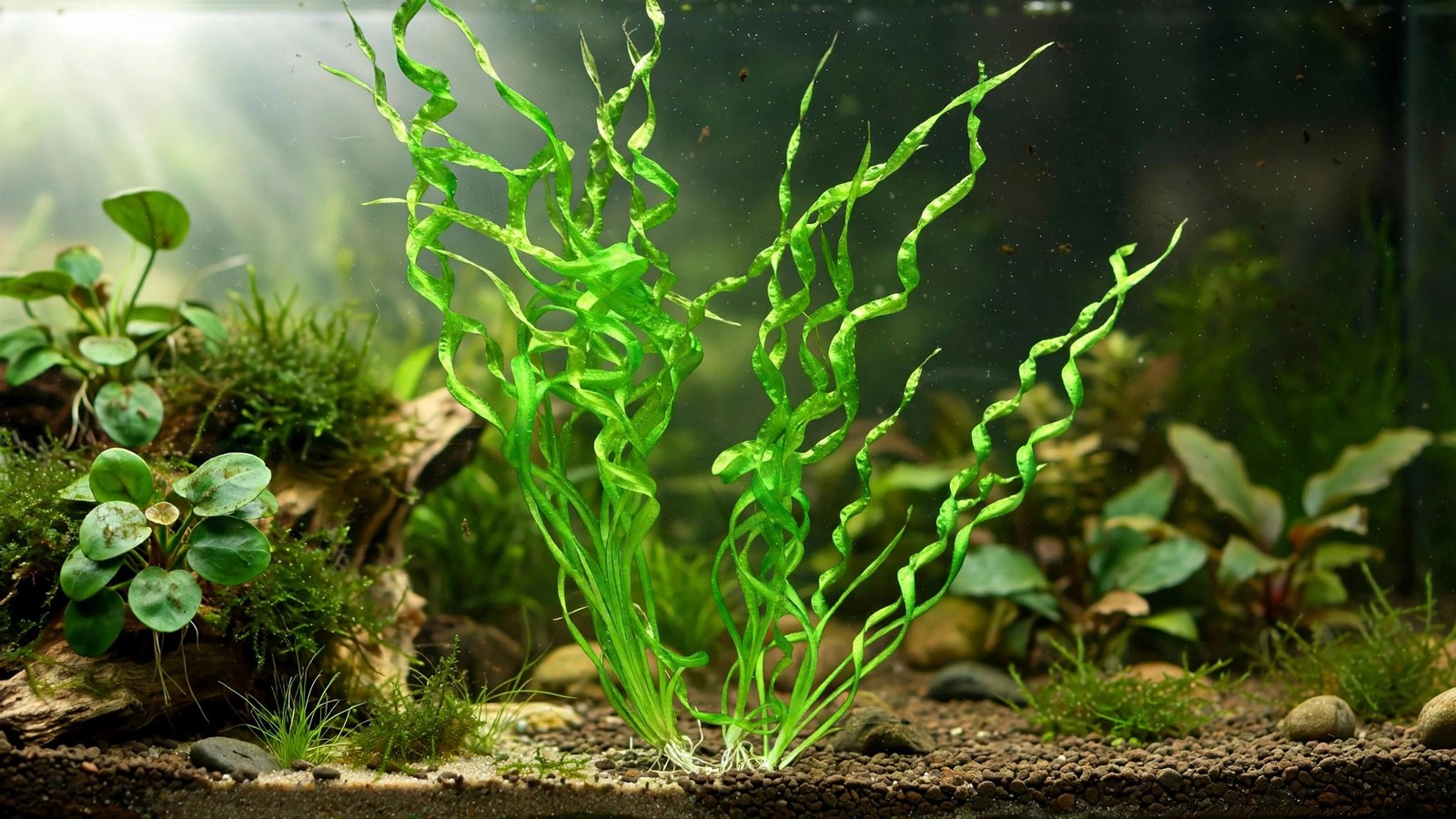
Your Vesuvius arrives looking like ordinary grass — broad, straight leaves, maybe flower buds — and within two weeks it melts into a brown soup. Most beginners throw it away at this point. That is the mistake. Underneath that collapsing nursery foliage, Echinodorus 'Vesuvius' is doing exactly what it was bred to do: shedding its emersed form and growing the slender, spiraling corkscrew leaves that made it famous. This guide to echinodorus vesuvius care covers the real conversion timeline, why tight curls come down to light and root feeding, and how one pot becomes a swirling cluster.
Quick answer: Echinodorus 'Vesuvius' care is easy to moderate — plant the crown above a nutrient-rich substrate, feed roots with tabs, and give medium to high light. Unique fact: Tropica now classifies this cultivar as Helanthium bolivianum 'Vesuvius', though the trade still sells it under the old Echinodorus name — so search both names when shopping. It reaches 10–20+ cm with a 10–15 cm rosette, suits tanks of 20 litres and up, and needs no injected CO2.
Mastering echinodorus vesuvius care for the corkscrew sword
The name tells the story. Bred by Oriental Aquarium Plants from Helanthium angustifolia, this cultivar was christened for Mount Vesuvius because its narrow leaves rise in spirals like smoke wisps from a crater. A mature rosette is a swirl of green ribbons — more tightly twisted than corkscrew vallisneria, and far smaller than a classic Amazon sword, which makes it the sword for small tanks.
It is a true rosette plant with a heavy root system: more biomass sits below the substrate than above it. That single fact drives almost every care decision, starting with this guide to the best substrate for planted tanks before you plant a single root.
Planting it right the first time
Sword plants die most often from one error: a buried crown. The pale point where leaves emerge from the roots must sit exactly at the substrate surface. Bury it and it rots within weeks, taking the whole plant with it.
- Depth over area. At least 5 cm of substrate; 7–8 cm is better. Pair your choice with our complete guide to freshwater aquarium plants.
- Spread the roots. Trim any damaged roots to 3–4 cm, fan them outward, and press the plant in gently.
- One root tab now. Press one comprehensive root tab 3–5 cm away from the crown, at two-thirds substrate depth. In inert sand or gravel this is not optional.
- Leave it alone. Swords sulk when lifted. Decide the position once, then let it settle for a month.
The emersed-to-submersed conversion timeline
Commercial nurseries grow this plant emersed — leaves in humid air, roots in wet soil. Emersed leaves are broader and straighter, which is why your new plant may look nothing like the photos. Planted underwater, it abandons that foliage and grows its true submersed form. Expect this:
| Week | What you will see | What to do |
|---|---|---|
| 1 | Original leaves yellow from the tips inward | Leave them; they still feed the crown |
| 2–3 | Narrow, curled new leaves emerge from the center | Trim only fully melted leaves at the base |
| 3–4 | Submersed leaves reach 8–12 cm, spirals tighten | Replace root tab if growth stalls |
| 5–6 | Rosette fills out; first runners may appear | Normal maintenance from here |
The transition takes 3–5 weeks. A half-dose of all-in-one fertilizer helps weak stock, but never dose full strength during conversion — the plant cannot use it yet, and algae will.
Light and CO2 for tight curls
Light is the dial that controls the corkscrew. Under medium to high light — roughly 30–50 µmol PAR at the substrate — new leaves twist tightly, the signature look. Under low light the plant still grows, but leaves relax into loose, wavy blades. Run 7–8 hours daily and keep the glass clean; it tolerates gentle shade from taller stems, but do not bury it behind a thicket.
CO2 is optional, not required. Injected CO2 (a stable 1-point pH drop via drop checker) speeds conversion and deepens the green, but this sword grows well in low-tech tanks as long as root feeding is solid. It pairs well with dwarf sagittaria, which tolerates the same lighting and substrate.
Root feeding: the non-negotiable
Like all swords, Vesuvius is a heavy root feeder. The classic Amazon sword thrives in lean water columns because it eats from the substrate, and this cultivar is no different. In aquasoil, replace tabs every 2–3 months. In inert sand or gravel, start with two tabs per plant and replace every 6–8 weeks.
Signs of underfeeding: new leaves emerge pale, older leaves yellow at the edges, and growth stalls at 8–10 cm. A weekly half-dose of comprehensive liquid fertilizer covers the water column, but root tabs deliver most of this plant's nutrition.
Propagation: runners, not cuttings
You cannot propagate a rosette sword by trimming stems — there are none. Vesuvius spreads by runners: a horizontal stem creeps along the substrate and a daughter plantlet forms at a node. Once the plantlet has 4–6 leaves and its own small root tuft, snip the runner and replant it 5–10 cm away. One healthy mother throws 2–4 runners per season, so a single pot can become a cluster of five within a year.
Where it fits in your layout
At 10–20+ cm, this is a midground specimen in medium tanks and a background accent in nanos down to 20 litres. One rosette against a calm backdrop works beautifully; a staggered group of three at different depths reads even better. It also sits well beside Cryptocoryne wendtii: two contrasting rosette textures with near-identical care needs, served by one fertilization schedule.
Frequently Asked Questions
Is Echinodorus 'Vesuvius' actually an Echinodorus?
Taxonomically, no — Tropica now lists it as Helanthium bolivianum 'Vesuvius', a nursery cultivar of Helanthium angustifolia. The aquarium trade, however, still sells it as Echinodorus 'Vesuvius' almost everywhere. Search both names when shopping, since labels and care sheets mix the two freely.
Why is my Vesuvius melting after I planted it?
You almost certainly bought emersed-grown stock. Those broad, straight nursery leaves are grown in air and cannot function underwater, so the plant sheds them and grows narrow, twisted submersed leaves instead. Melting over 2–4 weeks is normal. Remove only fully disintegrated leaves, and add a root tab if new growth looks weak.
Does Echinodorus 'Vesuvius' need CO2?
No. It grows well without injected CO2 as long as root feeding and medium light are in place. Adding CO2 will speed up the emersed-to-submersed conversion and tighten the leaf twist, but it is an accelerator, not a requirement. Many hobbyists grow lush specimens in simple low-tech tanks.
How do you get the tightest corkscrew curls?
Give it medium to high light — 30–50 µmol PAR at the substrate — for 7–8 hours daily. Light intensity drives the twist; low light produces looser, wavier leaves. Keep root feeding consistent: each new leaf curls tighter once the plant is fully converted.
Can I keep Vesuvius in a nano tank?
Yes — it is one of the few true swords that suits tanks from about 20 litres up. Its 10–20 cm height and 10–15 cm rosette work as a midground focal point in nanos and medium tanks alike. Plant a single specimen with space around it so the spiral form stays visible, and trim older outer leaves at the base to control width.
The bottom line on the corkscrew sword
Echinodorus 'Vesuvius' rewards patience once and routine care forever. Survive the 3–5 week conversion without panicking, feed the roots on a calendar, give it real light, and you get the most architectural small-tank sword in the hobby. Retailers' cultivar data matches this guide: see the Corkscrew Sword care guide at PlantedPro and the Echinodorus Vesuvius care sheet from Florida Aquascaping.