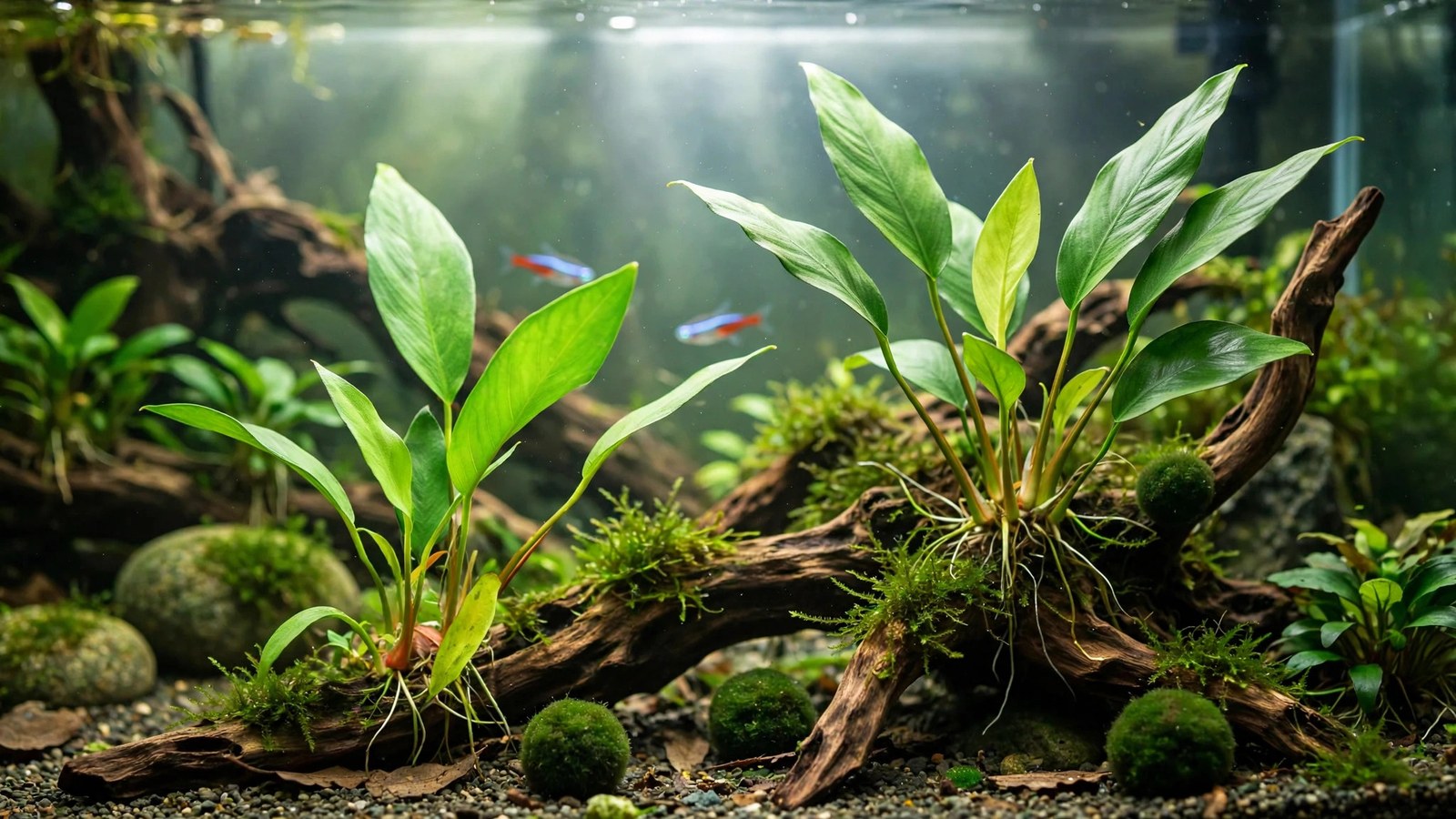
Most "rare" Anubias are renamed classics with a markup. Frazeri is the exception worth paying for: a tall, broad-leafed hybrid that gives low-light tanks real midground structure. Learning anubias frazeri care takes an afternoon — the plant is nearly indestructible — but buying is where people get burned, because this cultivar trades under confused names. See our full Anubias care guide for the genus basics, then buy the real plant and keep it thriving.
The short answer: Anubias 'Frazeri' is a cultivated hybrid of Anubias barteri × Anubias congensis (listed in some shops as A. barteri var. 'Frazeri'), reaching 20–30 cm with broad, slightly elongated dark-green leaves. It needs low to moderate light, 22–28°C water, no CO2, and a new leaf every two to four weeks. Never bury the rhizome — attach it to hardscape — and propagate by dividing the rhizome.
Anubias Frazeri Care: A Low-Light Routine That Just Works
Frazeri asks less of you than almost any plant with its visual presence. Give it dim light, stable water, and a piece of hardscape, and it quietly builds a bushy, upright clump. As an epiphyte that grips rock and wood instead of rooting in soil, it belongs in any freshwater aquarium plants guide for low-tech setups.
Light is the main lever: low to moderate light (roughly 20–40 PAR at the leaves) and a 6–8 hour photoperiod keeps algae off leaves that take weeks to replace. Temperature is forgiving — 22–28°C suits community, shrimp, and most tropical tanks — and pH anywhere from 6.0 to 7.5 works.
Feed it leanly: a half-strength all-in-one liquid once a week is plenty. Heavy dosing only feeds algae. Skip CO2 — it speeds growth marginally but adds maintenance the plant doesn't need.
Telling Frazeri Apart from Anubias Barteri
Frazeri is frequently mislabeled, and paying cultivar prices for ordinary barteri is the most common scam in the Anubias aisle. Real Frazeri carries broad, slightly elongated leaves with a wavy margin, forming an upright, bushy clump. Standard barteri leaves are rounder and held horizontally; nana 'Petite' — see Tropica's Anubias plant database — stays under 5 cm, so any "petite Frazeri" label is nonsense.
The trade describes Frazeri as a barteri × congensis hybrid, while some listings sell it as A. barteri var. 'Frazeri' — the parent species record lives in Kew's Plants of the World database for Anubias barteri. At the shop, look for a plant noticeably taller and more elongated than nana forms.
| Trait | Anubias 'Frazeri' | Anubias barteri (standard) | Anubias nana 'Petite' |
|---|---|---|---|
| Height | 20–30 cm | 25–45 cm | Under 5 cm |
| Leaf shape | Broad, slightly elongated, wavy margin | Broad, rounded | Tiny, rounded |
| Habit | Upright, bushy clump | Spreading, horizontal | Low, dense mat |
| Placement | Midground to background | Background | Foreground on stone |
| Price tier | Cultivar premium | Budget | Mid-range |
To compare against the standard form before paying cultivar prices, see our Anubias barteri care guide — size, looks, and best tank spot.
Planting It Right: The Rhizome Rule
Nearly every Frazeri death traces back to one mistake: the rhizome got buried. The rhizome is the thick horizontal stem the leaves sprout from, and smothering it in substrate starves it of water flow until it rots — a slow melt starting at the oldest leaves. Keep it fully exposed and the plant is nearly unkillable.
- Rinse the plant and trim mushy roots or damaged leaves with clean scissors.
- Pick a spot on driftwood, lava rock, or decor — Frazeri looks best framing hardscape.
- Anchor the rhizome with cotton thread, fishing line, or cyanoacrylate gel. It should touch the surface, not be entombed.
- Tuck only the fine roots into crevices; leave the rhizome in open water.
- Within 4–8 weeks the roots grip on their own and you can snip the thread away.
Frazeri's other parent, the lance-leaf giant, is covered in our Anubias congensis care guide — useful if you're comparing the hybrid against both parent species.
Keeping the Leaves Algae-Free
Frazeri's leaves live for months, making each one prime real estate for algae — especially green spot algae, hard green dots that anchor onto slow leaves and shrug off scrapers. The fix is environmental: dimmer light, a shorter photoperiod, and stable nutrients.
Start with 6–7 hours of light daily. If spots appear, cut to 6 hours and move the plant into shade before reaching for treatments. Keep phosphate detectable but lean — zero phosphate actually invites green spot algae. Nerite snails and amano shrimp graze the film that precedes it, and Frazeri's tough leaves are among the few they won't damage. Wipe spots with a soft toothbrush; trim ruined leaves at the leaf stem.
Propagating Frazeri by Rhizome Division
Wait until the rhizome is 8–10 cm long with several leaf clusters — usually 12–18 months in a low-tech tank. Then, with a sterile sharp blade, cut it into sections of at least three healthy leaves plus a few roots.
Attach each section to its own hardscape and return it to low light. Don't dose extra fertilizer — the cutting runs on reserves for weeks, and extra nutrients feed algae on wounded tissue. Expect a month of stillness before the first new leaf; that silence is normal. One mother plant divided yearly furnishes a whole aquascape within two seasons. The detailed method is in our Anubias propagation guide: rhizome division step by step.
Frequently Asked Questions
Can I plant Anubias Frazeri in the substrate?
Only the fine roots may touch the substrate — the rhizome must stay fully exposed. A buried rhizome rots from lack of water flow, starting as a melt of the oldest leaves. Wedge the rhizome between stones or against driftwood and let the roots dive into the substrate on their own.
How fast does Anubias Frazeri actually grow?
Expect one new leaf every two to four weeks in stable low-tech conditions, and a few centimetres of rhizome growth per year. It's far slower than stem plants but slightly faster than Anubias nana 'Petite'. If months pass with no new leaves, check the rhizome is exposed and light isn't excessive.
Does Anubias Frazeri need CO2 injection?
No. Frazeri grows perfectly well in low-tech tanks without CO2 — one of its main selling points. CO2 speeds growth slightly but also accelerates algae on the plant's slow leaves, so most keepers skip it. Stable water and modest light matter far more.
Is Anubias Frazeri the same plant as Anubias barteri?
No. Frazeri is a hybrid of Anubias barteri × Anubias congensis, sometimes sold as A. barteri var. 'Frazeri'. It grows taller and more upright than standard barteri, with narrower, more elongated leaves. Compare leaf shape and height against the table above before paying a cultivar premium.
Why is my Frazeri covered in green spot algae?
Almost always too much light. Frazeri's slow leaves accumulate spot algae when the photoperiod exceeds about 8 hours or the plant sits in bright direct light. Cut it to 6–7 hours, shade the plant, keep phosphate detectable rather than zero, and add nerite snails or amano shrimp.
Can Anubias Frazeri grow emersed or in a paludarium?
Yes — like most Anubias, Frazeri transitions to emersed growth well in humid paludariums, where it often grows faster and may even flower. Keep the rhizome moist but not waterlogged, humidity above 70%, and avoid drying air currents. Emersed leaves grow thicker and rounder than submerged ones, which is normal adaptation, not a problem.
Why Frazeri Deserves a Spot in Your Tank
Most low-light plants are filler; Frazeri is architecture. One well-placed clump gives a 60-litre tank vertical structure that usually demands CO2, bright light, and weekly trimming — on a routine of nothing. Buy the real cultivar, respect the rhizome rule, keep the light modest, and in a year you'll be dividing it, not shopping for it.