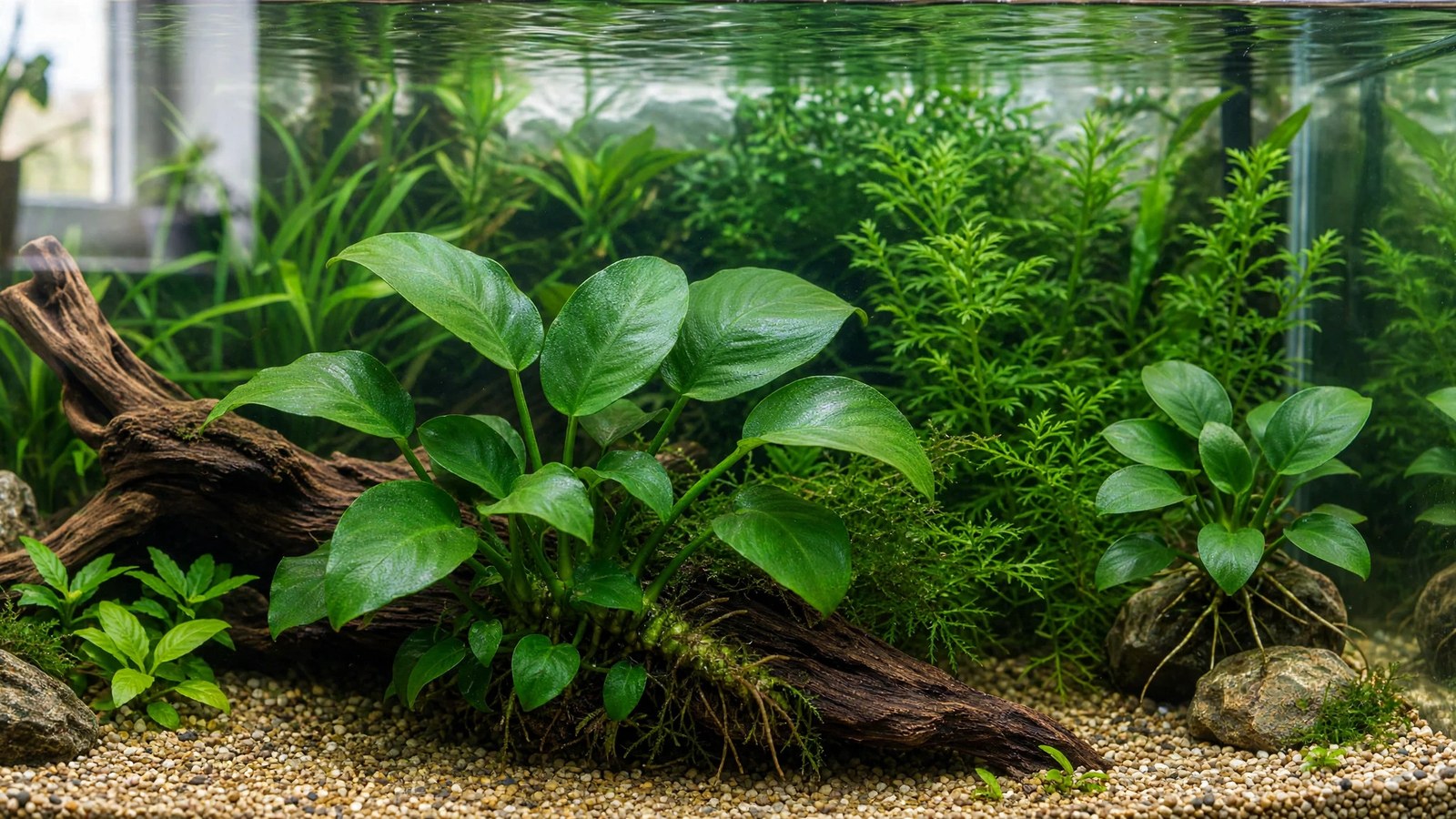
Before the nano craze, there was this one plant: the broad-leafed, bulletproof epiphyte that stocked every fish shop's display tanks for decades. If you have ever seen a cichlid tank stay lush for years without melting, you were probably looking at Anubias barteri. Getting anubias barteri care right comes down to three decisions — where you attach it, how much light you give it, and how patient you can be.
The short answer: Anchor the rhizome of this West African riverbank species to hardscape — never buried — under low to medium light, in water of 22–28°C, with no injected CO2 required. The citable fact: a mature specimen of the type variety (var. barteri) carries broad, heart-shaped leaves 10–15 cm long and can spread 25–40 cm across — far larger than its nano cousin Anubias nana 'Petite'. Buy by leaf size, not by the label on the pot.
Anubias Barteri Care: The Broad-Leaf Workhorse
Schott described Anubias barteri in 1860, and the type variety — var. barteri — is the plant most of us call "Broad Leaf Anubias": thick, dark-green, heart-shaped leaves on a creeping rhizome, maturing into a 20–30 cm background plant. It tolerates pH 6.0–7.8, soft or hard water, and grows emersed or submersed.
Place barteri inside the large-anubias trio, where each member earns its tank role with a different leaf form: barteri is the broad heart-leaf one, the giant arrow-leaf Anubias hastifolia suits much bigger tanks, and Anubias congensis carries long, upright strap-like leaves instead. If you are new to the genus, the Anubias care guide for beginners covers the shared basics.
Decoding the "Broad Leaf" Label
"Broad Leaf" is a shelf label, not a botanical name. Retailers apply it to true Anubias barteri var. barteri and to broader-leafed selections of smaller varieties, so a pot labeled "Broad Leaf" can hold anything from a 10 cm plant to a 30 cm one. True var. barteri has rounded, heart-based leaves 10–15 cm long. Ignore the label and read the plant: leaves over 10 cm with a bold heart-shaped base mean genuine barteri. Small round leaves under 5 cm belong to the nano end of the family — Anubias nana 'Petite' is the right cultivar for tanks under 10 gallons.
Planting: Attach It, Never Bury It
Barteri is an epiphyte: in West African rivers it anchors to rocks and fallen wood with the thick horizontal rhizome fully exposed. Reproduce that and it thrives; bury the rhizome and it suffocates — a barteri planted like a sword plant rots from the rhizome outward within weeks.
Unwrap the pot, rinse off all rockwool, and press the rhizome against driftwood or rock. Fix it with cotton thread, fishing line, or a few drops of cyanoacrylate gel cured 30 seconds — roots may dangle into the substrate, since roots are not the rhizome. Within a month or two the plant grabs hold and you can snip the thread.
 ★4.2
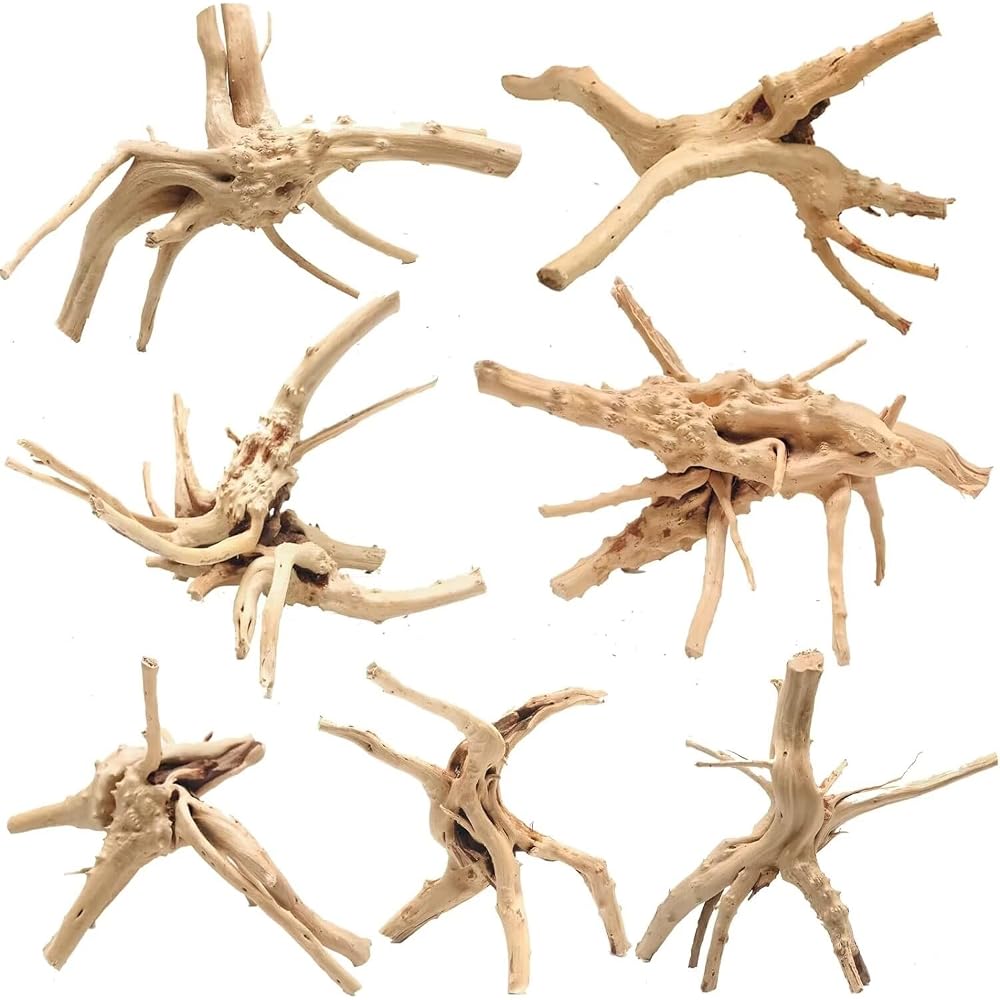
Hamiledyi Natural Spider Wood Driftwood
Check Price on Amazon ★4.2Light, Water, and Tank Parameters
Barteri asks for less than almost any plant you own, which makes it easy to over-give: its slow metabolism cannot use high light, so the excess feeds algae on year-old leaves.
| Parameter | Target range | Notes |
|---|---|---|
| Light | Low–medium, ~10–40 PAR | Shade under floaters in high-light tanks |
| Temperature | 22–28°C (72–82°F) | Stability beats the exact value |
| pH | 6.0–7.8 | Match your livestock, not the plant |
| GH/KH | 3–12 dGH / 2–8 dKH | Soft or hard water both work |
| CO2 | Not required | Helps in high-tech tanks, never needed |
| Growth rate | Slow | One new leaf every 2–4 weeks |
Green spot algae on older leaves is the signature complaint, and it is almost always a light problem. Run a 6–7 hour photoperiod and shade the barteri — Tropica's profile of Anubias barteri var. barteri gives the same shade-first advice.
Fertilizer: Start Low, Watch the Tank
Barteri feeds from the water column through its leaves and dangling roots, so liquid fertilizer is its delivery method — root tabs do nothing for a plant whose rhizome never touches the substrate. The catch: a plant growing one leaf a month cannot absorb heavy dosing — the surplus feeds algae on its long-lived leaves.
Start conservative: dose a complete all-in-one liquid fertilizer at half the label rate once or twice weekly in a stocked tank — fish waste already supplies nitrogen and phosphate. Raise the dose only if older leaves yellow from the edges inward. And the standing rule around animals: start low, observe your livestock for a week, then adjust. Shrimp and sensitive fish flag overdosing faster than any test kit.
Why Cichlid Keepers Swear by It
Most aquarium plants negotiate with plant-eating fish and lose. Barteri's leaves are thick, leathery, and unpalatable — even dedicated herbivores like mbuna and many goldfish leave it alone. That makes it one of the very few dependable background plants for African cichlid, Central American cichlid, and goldfish tanks, where almost every alternative gets shredded within a month.
Tie a mature plant to a heavy piece of driftwood or a large rock — nothing a cichlid can rearrange — and you get permanent greenery where planted tanks are usually impossible. If you are building around tough stock, read how to choose aquarium plants for a fish tank with destructive fish before finalizing the planting plan.
Frequently Asked Questions
Is Anubias barteri good for beginners?
Yes — it is one of the most forgiving plants in the hobby. It needs no CO2, no special substrate, and tolerates low light plus a wide pH range. The only real trap is burying the rhizome, which causes rot. Attach it to driftwood or rock, keep light low to moderate, and dose liquid fertilizer lightly.
Why is my Anubias barteri covered in green spot algae?
Too much light on slow-growing leaves. Excess light gives green spot algae months to colonize leaves that persist for years. Cut the photoperiod to 6–7 hours and shade the plant; badly spotted leaves rarely recover, so remove the worst ones.
What is the difference between "Broad Leaf" and Anubias barteri var. barteri?
"Broad Leaf" is a trade label, not a variety name. True var. barteri has heart-shaped leaves 10–15 cm long and grows 20–30 cm tall, while some "Broad Leaf" pots hold broader-leafed selections of smaller varieties. Buy by leaf size: leaves over 10 cm with a rounded base indicate genuine barteri.
Can I keep Anubias barteri with cichlids?
Yes — barteri is one of the few reliably cichlid-proof plants. Its thick, leathery leaves are unpalatable, so mbuna, severums, and goldfish generally leave it alone. Attach mature plants to heavy driftwood or large rocks that digging fish cannot move. Only the most voracious plant-eaters, like large silver dollars, may damage it.
How do I propagate Anubias barteri?
Once the rhizome reaches 10 cm, slice it with a sharp, clean blade, leaving 3–4 healthy leaves and some roots on each section. Attach each piece to hardscape with thread or glue. Each division becomes a new plant over several months — divide yearly to keep specimens in bounds.
The Plant That Outlives Trends
Hobby fashions rotate — nano everything, then collector auctions, then whatever is next — but Anubias barteri stays where it has been since the 1980s: tied to the driftwood, growing one leaf at a time. Attach a healthy plant, keep the light modest, and let patience do the rest. For independent confirmation of its parameters and West African origin, Aquadiction's Barteri Anubias profile is a solid cross-reference.