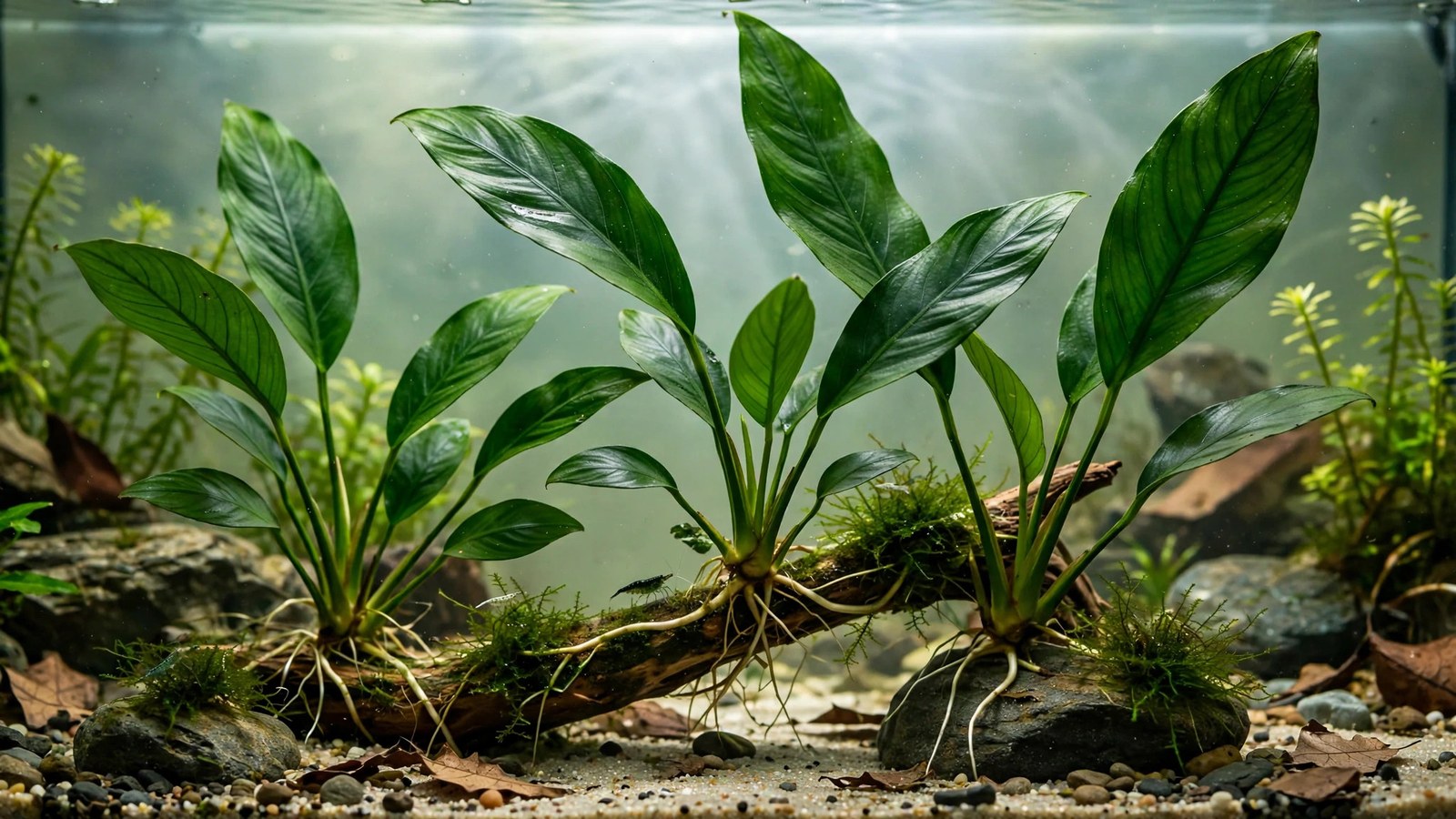
The hardest thing about Congo Anubias isn't growing it — it's reading the label. Buy a pot marked Anubias congensis today, and next month you could buy the exact same plant sold as Anubias heterophylla, while a third shop hands you something else entirely under the "congensis" tag. The good news: whatever name the label carries, anubias congensis care is straightforward. This tall, lance-leafed anubias is one of the most forgiving large plants you can own, and this guide untangles the naming first.
The short answer: Anubias congensis — the name most shops still use — is botanically accepted today as Anubias heterophylla Engler, with A. congensis N.E.Br. kept as a synonym. This slow-growing rhizome epiphyte from West and Central Africa sends strap-like leaves 25–60 cm up from upright rhizomes. Care is simple: anchor the rhizome out of the substrate, give it low to medium light, and leave it alone for years.
The Name on the Label vs the Name in the Books
Brown described it as Anubias congensis, but later taxonomic work — summarized in the botanical record for Anubias heterophylla — concluded Brown's plant and Engler's Anubias heterophylla are the same species, and Engler's older name takes priority. So heterophylla is the accepted name, and congensis survives as a synonym.
The aquarium trade never got the memo. Nurseries and retailers still print "congensis" on cups and pots — some even sell both names side by side, as if they were different plants. One honest warning: the trade also mis-applies the "congensis" label to Anubias afzelii, a separate species with broader, shorter leaves. If the plant in front of you has long, narrow, strap-like leaves on an upright rhizome, you're holding the real thing. When in doubt, shop by leaf shape — the Anubias care guide for beginners covers the genus-wide basics this profile builds on.
Anubias Congensis Care: The Lance-Leaf Giant
Congensis earns its reputation honestly. The leaves are long, narrow, and lance-shaped — like grass blades made of leather — rising from a thick, unusually upright rhizome. A healthy specimen stands 25–60 cm tall, making it one of the most architectural background plants in the genus.
It helps to see where it sits among the three large anubias:
| Plant | Leaf form | Mature size | Personality |
|---|---|---|---|
| Anubias barteri, the broad-leaf classic | Broad, heart-shaped | 25–40 cm spread | Stocky, cichlid-proof background anchor |
| Anubias hastifolia, the giant arrow-leaf | Giant arrow-shaped | 30–60 cm | Biggest footprint; dramatic showpiece |
| Congensis (A. heterophylla) | Long lance / strap | 25–60 cm | Elegant, narrow vertical accent |
Congensis fills the narrow-vertical slot the other two don't: use it to flank tall driftwood, soften a filter intake, or break up a wall of stems. Slim leaves read as texture, not mass — height without bulk.
Planting: The Rhizome Stays Out
Like every anubias, congensis is an epiphyte: in the wild it clings to rocks and submerged wood along shaded African riverbanks, feeding from the water column. That dictates how you plant it.
Never bury the rhizome. A buried rhizome rots — slowly, then all at once — and by the time the leaves yellow, the damage is done. Sit the thick green stem fully above the substrate and fix it with cotton thread, fishing line, or a dab of cyanoacrylate gel superglue (reef-safe once cured). The roots will wander down into sand or gravel and grip on their own. Space specimens at least 20 cm apart — leaves can span 30 cm at maturity. For splitting a large clump, see the Anubias rhizome propagation guide.
Light: Less Is More on Slow Leaves
Congensis is genuinely low-light tolerant — 20–40 PAR at the leaf level is plenty. Its leaves grow slowly, and slow leaves under strong light invite algae: green spot dots the older leaves first, followed by black brush algae on leaf edges if the imbalance persists.
Run medium tank lighting on a 6–8 hour photoperiod, shading the plant under taller stems if your light runs hot. If green spot appears on the oldest leaves, dim the light before reaching for chemicals — the plant won't suffer, and the algae will stall. The explainer on how much light aquarium plants actually need covers matching intensity to growth rate for exactly this kind of plant. CO2 is optional: it speeds leaf production but is unnecessary — congensis thrives in low-tech setups for years.
Feeding: Start Low, Observe Livestock
This is a light feeder, and over-fertilizing a slow grower is the fastest route to algae. Aim for modest, stable water-column nutrients:
| Parameter | Target | Notes |
|---|---|---|
| Nitrate | 5–20 ppm | Fish waste covers most of it in stocked tanks |
| Phosphate | 0.5–2 ppm | Stability beats chasing numbers |
| Potassium | 5–10 ppm | Pinholes in older leaves signal a shortfall |
| Iron / micros | Trace | Pale new growth = add a micro mix, lightly |
Start liquid fertilizer at half the bottle's dose and watch for two weeks: deep-green, firm new leaves mean you're dialed in; pale growth or pinholes mean a gentle increase. Root tabs are optional — nice in inert gravel, unnecessary in aquasoil. Start low and observe livestock before raising doses, since invertebrates notice nutrient spikes long before plants do.
Water parameters are forgiving: 22–28 °C, pH 6.0–7.5, soft to moderately hard. It tolerates normal community-tank drift — just keep it out of coldwater setups.
Buying and Long-Term Care
Buy by leaf form, not by the label — you now know why. Look for firm, dark-green leaves, no blackened rhizome ends, and no algae already on the leaves. Tissue-culture cups are the cleanest option; potted plants are fine once you rinse the rockwool and check the rhizome.
Expect patience: a new leaf every 2–4 weeks is normal. Old leaves last for years — remove only fully melted or heavily algae-coated ones, cutting the petiole at the rhizome.
Frequently Asked Questions
Is Anubias congensis the same as Anubias heterophylla?
Yes — same species. Anubias heterophylla Engler is the accepted botanical name; Anubias congensis N.E.Br. is its synonym. The trade still overwhelmingly prints "congensis" on labels, so you'll meet both names in shops. Buy by the long, lance-shaped leaf form, not by whichever Latin name the cup carries.
How big does Anubias congensis get?
A mature plant reaches 25–60 cm tall, with strap-like leaves that can exceed 30 cm — a genuine background plant in standard tanks, a midground accent only in very large ones. Plan for the size it will reach, not the pot you bought.
Can I plant Anubias congensis in the substrate?
Only the roots — never the rhizome. Burying the thick horizontal stem rots it and usually kills the plant within weeks. Attach it to driftwood or rock with thread or gel superglue, or wedge it between stones so the rhizome sits fully above the substrate.
Why are my Anubias congensis leaves getting algae?
Almost always too much light for too slow a plant. Congensis makes a leaf every 2–4 weeks, and leaves that persist for months under strong light collect green spot and brush algae. Dim to low–medium, shorten the photoperiod to 6–8 hours, and shade the plant under taller growth. New leaves will emerge clean.
The Bottom Line
Call it congensis or heterophylla — the trade name or the textbook name — this is the tall, elegant, lance-leafed anubias that fills the vertical gaps other anubias leave behind. Keep its rhizome exposed, its light modest, and its feeding light — and it will stand in your background for years. For a second reference on the accepted name, see Tropica's plant database, which lists heterophylla among its species entries.