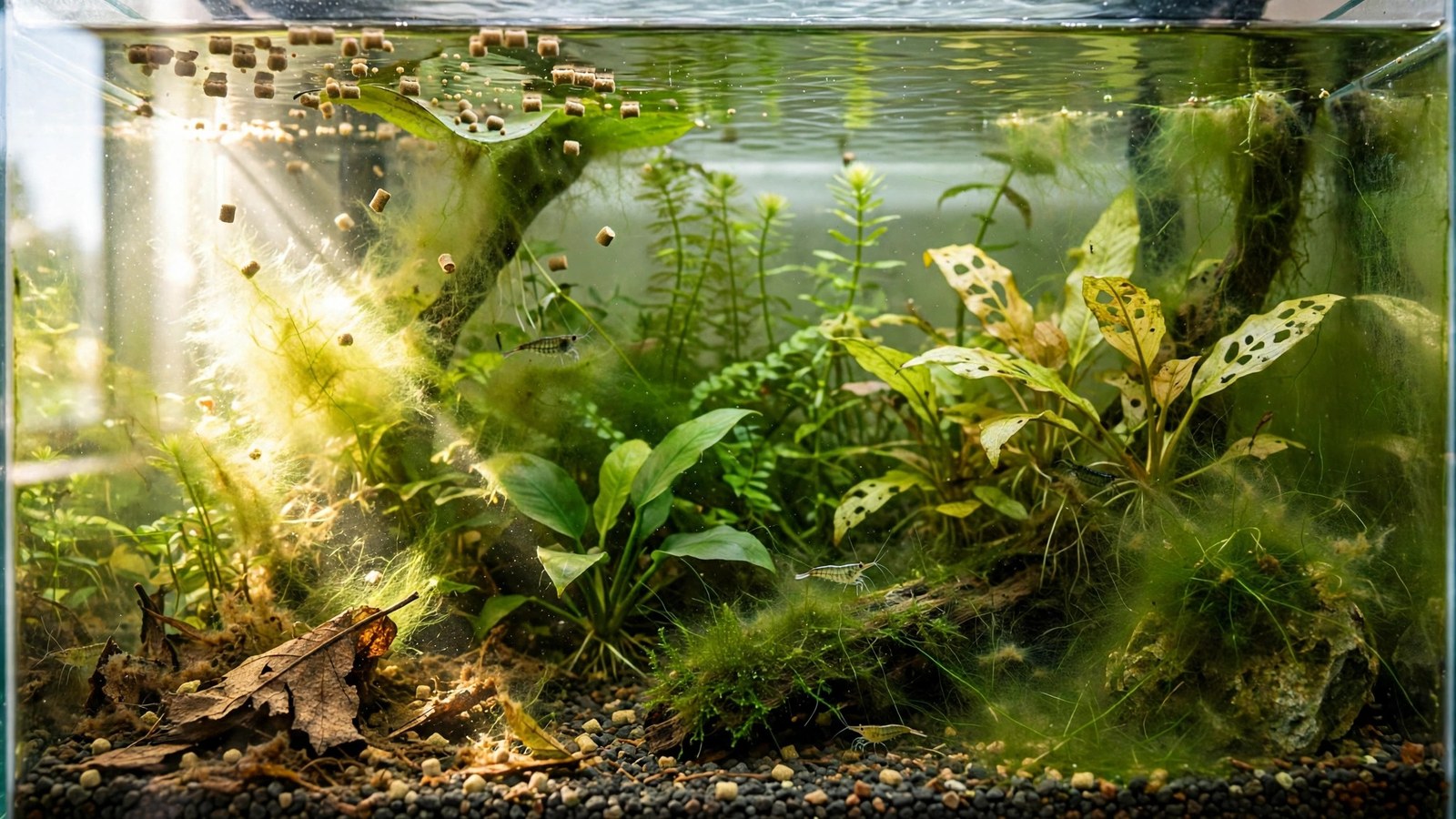
The wispy green threads showed up three days after you upgraded the light — a few strands on the Anubias, then the driftwood, then practically everything. Hair algae is the planted tank's most honest alarm system: it doesn't grow because your tank is "dirty." It grows because one of five specific imbalances is handing it an open invitation.
If your tank is already smothered in the stuff and you want a battle plan, our complete hair algae removal guide walks through treatment step by step. This article is about the "why": the causes you have to fix so the algae never comes back.
What Causes Hair Algae? The 5 Imbalances That Feed It
Hair algae (most commonly Oedogonium or Spirogyra species) is an opportunist. It can't outcompete healthy, fast-growing plants in a balanced tank, but the moment the balance tips in one of five directions, it colonizes fast. Learn to recognize each trigger and you're halfway to a permanently algae-free tank.
1. Too much light, or too long a photoperiod
Light is the single most common cause. If you recently upgraded to a stronger fixture, cranked intensity to chase red coloration, or stretched the photoperiod past 8 hours, you flooded the system with more energy than your plants can use — and algae happily absorbs the surplus. Hair algae explodes fastest where light is brightest: the substrate directly under the fixture, the top of the hardscape, the leaves closest to the surface.
The fix is immediate and costs nothing: drop the photoperiod to 6–7 hours for two weeks and observe. If the strands stop spreading, light was your driver. New tanks should start at 5–6 hours and ramp up gradually as plant mass grows — many hobbyists learn this the hard way during the new-tank algae phases described by the 2hr Aquarist team.
2. A nitrate–phosphate skew
Hair algae doesn't need high nutrients — it needs unbalanced ones. Two classic scenarios: phosphate at zero while nitrates sit at 20+ ppm (starves plants, algae doesn't care), or the reverse after heavy fish feeding pushes nitrates sky-high with phosphate to match. Either way, plants stall and algae moves in. The infamous "green dust on glass plus hairy strands" combo is often a phosphate crash signature.
Test before you dose. Use a proper liquid test kit for your planted tank rather than guessing — target roughly 10–20 ppm nitrate and 1–2 ppm phosphate. And check nutrient deficiency symptoms on your plants: pale new growth or stunted tips alongside hair algae almost always points at a skew, not a total shortage.
3. Unstable CO2
In CO2-injected tanks, inconsistency is worse than a low level. A solenoid on a flaky timer, a diffuser that clogs mid-week, or CO2 that only runs when the lights are already on all create daily swings — and plants stressed by fluctuating carbon eject waste compounds from their leaves that algae spores read as an invitation. This is the same mechanism that triggers black beard algae, but hair algae responds to it too.
Stability beats raw ppm. Run CO2 on a timer starting 1–2 hours before lights-on, aim for a roughly 1.0 pH drop, and keep it the same every single day. If you're spotting signs your plants are CO2-deficient — pinholes, stalled tips, melting under strong light — the carbon side of your triangle needs attention before anything else.
4. Dead zones and poor flow
Algae spores settle where the water doesn't move. Behind the driftwood, in the dense carpet corner, along the back glass where the filter output can't reach — detritus collects there, rots there, and releases a slow drip of ammonia and organics right where hair algae strands anchor. A tank can test perfectly clean at the water surface and still be feeding algae in its stagnant corners.
Watch your flow: leaf tips should sway gently everywhere, not just in front of the outlet. Aim the filter output so it breaks the surface and circulates the full loop, add a small powerhead if one corner is motionless, and vacuum detritus out of dead zones during each water change. Mulm left to rot is algae fertilizer.
5. Plants too weak to compete
This is the meta-cause hiding inside all the others. Healthy, fast-growing plants produce compounds that suppress algae attachment, absorb nutrients before spores can use them, and shade out colonizers. Hair algae almost never smothers a thriving stem plant — it smothers the struggling ones. A sparsely planted tank with a handful of slow growers is a banquet hall with no security.
The prescription is mass: plant heavily from day one, favor fast stems and floaters for the first 2–3 months, and replace failing species instead of nursing them. Over-fertilizing while plants are stalled won't fix the weakness either — it just feeds the algae. Get the plants growing, and the algae starves.
How to Pin Down Which Imbalance Is Yours
Hair algae tells on its trigger if you know where to look. Match your pattern:
| Imbalance | Classic sign | What to test |
|---|---|---|
| Too much light | Algae densest directly under the fixture; appeared after a light upgrade | Photoperiod length; fixture intensity vs. tank depth |
| Nutrient skew | Plants pale or stunted while algae thrives; phosphate reads zero | Nitrate + phosphate with a liquid kit; leaf symptoms |
| Unstable CO2 | Algae on struggling leaves; drop checker swings day to day | pH before lights-on vs. mid-day; solenoid timer schedule |
| Poor flow | Algae in corners, behind hardscape, carpet edges only | Visual: dead leaf corners, detritus buildup, no leaf movement |
| Weak plant mass | Algae on the weakest species; tank looks sparse | Growth rate of fastest stems; planting density |
Frequently Asked Questions
Is hair algae caused by too much fertilizer?
Rarely by fertilizer alone. Hair algae is triggered by imbalance, not abundance — most often too much light, unstable CO2, or a nitrate/phosphate skew. Heavily dosed tanks with strong, healthy plant mass stay algae-free. If anything, under-dosing while plants stall makes the problem worse, because weakened plants can't compete with the algae.
Can hair algae appear in a tank with no fish?
Absolutely. Fish waste is only one nutrient source among many — substrate leaching, tap water phosphates, decaying plant matter, and overfeeding all feed algae without a single fish. Fishless cycling tanks and plant-only setups still get hair algae if the light-to-CO2-to-nutrient triangle is off balance.
Does hair algae mean my tank is cycling?
It often coincides with cycling. Tanks under 2–3 months old lack mature microbial communities and stable plant mass, so hair algae blooms are a normal phase. Keep the photoperiod short, change water frequently, and plant densely — as beneficial bacteria and microfauna establish, the algae usually retreats on its own within a few weeks.
Why does hair algae keep coming back in the same spot?
A recurring patch points at a localized trigger: a dead zone with no flow, a light hotspot, or detritus trapped behind hardscape. Manually removing the algae without fixing the spot-specific cause guarantees regrowth. Improve circulation there, vacuum the detritus out, and check whether that area gets disproportionately strong light from your fixture.
Can too little water change cause hair algae?
Indirectly, yes. Skipped water changes let organic waste accumulate, which decays into ammonia spikes and dissolved organics — exactly what algae spores wait for. A weekly 30–50% water change exports these fuels before they build up. In neglected tanks, restoring the water-change routine alone often halts new hair algae growth within two weeks.
Fix the Imbalance, and the Hair Algae Starves
Hair algae is never the real problem — it's the messenger. Scrape it, trim it, even treat it if you want fast results, but until you shorten the photoperiod, steady the CO2, balance your nutrients, fix the flow, and give your plants the mass to fight back, the messenger will keep returning. Fix the imbalance, and the algae starves on its own. That's the difference between a tank you maintain and a tank that maintains itself.