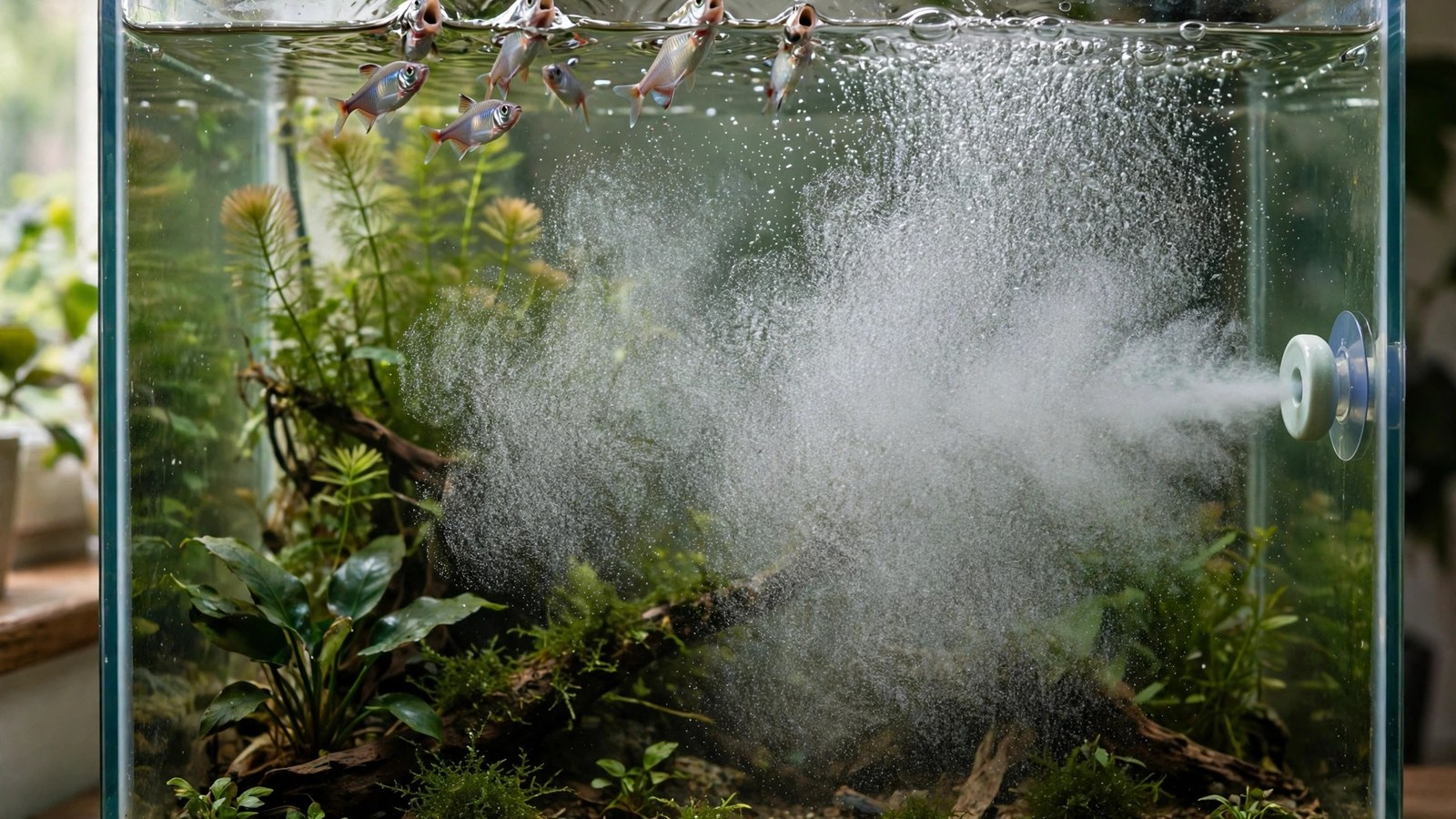
Most planted-tank disasters involving CO2 don't come from too little of it — they come from too much. Hobbyists chase faster growth, crank the needle valve "just a little," and wake up to fish hanging at the surface, gulping air. Too much CO2 in a planted tank kills livestock faster than any algae outbreak ever will, yet it is one of the easiest problems to diagnose and fix once you know what to look for. This guide walks you through the warning signs, the emergency response, and a safe method for dialing your injection rate back in.
Why Excess CO2 Is More Dangerous Than Too Little
CO2 deficiency stunts plants. It melts leaves, invites algae, and makes your carpeting plants look sad — but it does all of that slowly, over weeks. Excess CO2, on the other hand, can kill a full tank of fish in a single night. The difference is the victim: deficiency hurts plants, while overdose suffocates animals.
Here is the plain-language chemistry. Dissolved CO2 lowers your tank's pH — not in a dramatic, one-step plunge, but as a steady push. In a healthy injected tank, the pH might drop about 1.0 point from its degassed level by the end of the photoperiod. Push past that and the water becomes progressively harder for your livestock to breathe. Fish don't breathe air; they extract dissolved oxygen through their gills, and high CO2 interferes with that exchange. The result is a fish that is drowning in water with plenty of oxygen in it.
This is why the "start low, observe livestock" principle matters more with CO2 than with any other additive in the hobby. Plants are patient about CO2; animals are not.
The Early Warning Signs of Too Much CO2
Catch excess CO2 early and it is a five-minute fix. Miss the signs and it becomes a tank emergency. The symptoms below appear in roughly the order most hobbyists notice them.
Fish hanging at the surface
This is the signature sign. Fish gather near the surface, mouths breaking the film, visibly pumping their gills. It often follows a pattern tied to your photoperiod: you may see it in the morning before the lights come on, when overnight accumulation has peaked, or in the late evening, after a full day of injection. If the behavior appears an hour after CO2 switches on and fades when it switches off, you have your answer.
Be careful about one confound: surface gasping can also mean low oxygen or ammonia. If a big water change and strong surface agitation resolve the gasping within an hour but it returns the next evening, CO2 is the repeat offender. A guide to water test kits for planted tanks helps you rule out ammonia and nitrite so you can trust the CO2 diagnosis.
Drop checker color semantics
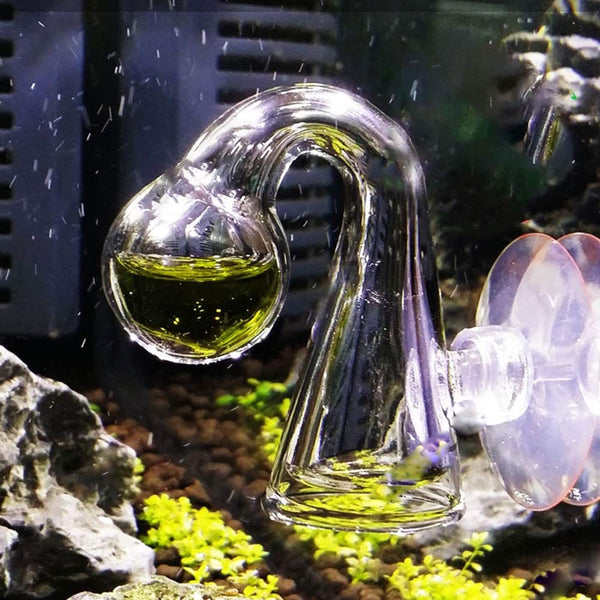
Your drop checker is a CO2-specific diagnostic tool, and its color has a simple vocabulary:
| Drop checker color | Approximate CO2 level | What it means |
|---|---|---|
| Blue | Below ~15 ppm | CO2 low — plants may be underfed, but livestock are safe |
| Green | ~20–30 ppm | The safe target zone for most planted tanks |
| Lime / light green | ~30–40 ppm | Upper edge — acceptable for experienced keepers with calm livestock |
| Yellow | Above ~40 ppm | Danger — reduce CO2 immediately and watch your animals |
Two things trip people up here. First, the drop checker lags 1–2 hours behind the real CO2 level — it tells you what the concentration was an hour or two ago, not what it is now. Second, a checker that is yellow at lights-on but green by midday still means your overnight level was too high; the color history matters, not just the current reading. The UK Aquatic Plant Society's guide to CO2 levels in the planted aquarium explains the drop-checker chemistry and the roughly 30 ppm target in more depth.
Species-specific stress signs
Not all livestock react at the same threshold, which is exactly why sensitive species are valuable. Watch for these:
- Shrimp (Neocaridina and Caridina): the canaries of the planted tank. They go lethargic and stop grazing, often gathering near the surface or filter outflow. If your shrimp act strangely while fish look fine, do not assume the shrimp are the anomaly — they are usually the early warning. See our guide to shrimp deaths in planted tanks for the full differential.
- Bettas: as labyrinth breathers they tolerate surface conditions better, but excess CO2 still stresses them — watch for loss of appetite, clamped fins, and hiding. A betta that suddenly ignores food is telling you something is wrong with the water, not the menu.
- Small tetras (neons, cardinals, embers): tight schooling near the surface, rapid gill movement, and faded color. Tetras that normally spread through the tank and now hug the top corners are a red flag.
What plants do under excess CO2
Here is a nuance most articles skip: plants rarely complain about high CO2 directly — growth may even accelerate. What you may notice instead is indirect fallout, like leaves that looked perfect suddenly melting after a CO2 change. If you are comparing the two sides of the coin, our guide to CO2 deficiency signs in plants covers the opposite end — slow, twisted growth and holes in leaves, a very different pattern from the sudden livestock crisis of overdose.
 ★4.6
FZONE Aquatic Glass Drop Checker Kit
Check Price on Amazon ★4.6Emergency Response: What to Do in the First Hour
If you find livestock in distress right now, do not troubleshoot first — act first. Run this protocol in order:
- Turn off the CO2 immediately. Close the needle valve or switch off the solenoid. Nothing else matters until injection stops.
- Maximize surface agitation. Point a filter output or powerhead at the surface, add an air stone if you have one, and remove any glass lid or cover trapping air. Surface agitation drives excess CO2 out of the water and pulls oxygen in — it is the fastest way to reverse the crisis. Note that this is the one situation where you want to waste CO2; efficiency can wait until the animals are safe.
- Perform a 30–50% water change. Use dechlorinated water matched to tank temperature. Fresh water dilutes dissolved CO2 immediately and buys your livestock time.
- Observe for at least an hour. Most animals recover within 30–60 minutes once CO2 drops. Fish that were surface-gasping should return to mid-water swimming. Shrimp should resume grazing.
- Leave CO2 off for 24 hours. Do not turn it back on the same day. Give the system a full reset and start the re-dialing process tomorrow at a lower rate.
Dialing CO2 Back In: The Safe Method
Once the crisis is over, the goal is a setting that grows plants while livestock behave completely normally — reached with conservative ranges and patience, never rushed.
Start low: bubble-rate guidelines
Bubble rate is not a scientific measurement — bubble size varies by counter — but it is the practical dial most hobbyists use. As a conservative starting point after an overdose event, begin at roughly 1 bubble per second per 10 gallons (38 liters) of tank volume. For a 20-gallon tank, that means about 2 bubbles per second; for a 40-gallon, about 4.
These numbers are intentionally conservative. Your tank's correct rate is simply the one where the checker holds green and every animal behaves normally all day, every day.
The one-week observation rule
After setting your starting rate, change nothing for seven full days. During that week:
- Check livestock behavior every morning before lights-on and every evening after lights-off.
- Note your drop checker color at lights-on, midday, and lights-off.
- Only raise the rate — by no more than one additional bubble per 2–3 seconds — if all of these are true: checker never passes lime-green, no surface gasping, shrimp grazing normally, and fish eating eagerly.
Each increase restarts the seven-day clock. Slow is the entire point. Most stable, thriving tanks end up somewhere the hobbyist arrived at over a month, not a weekend.
Time CO2 to your photoperiod
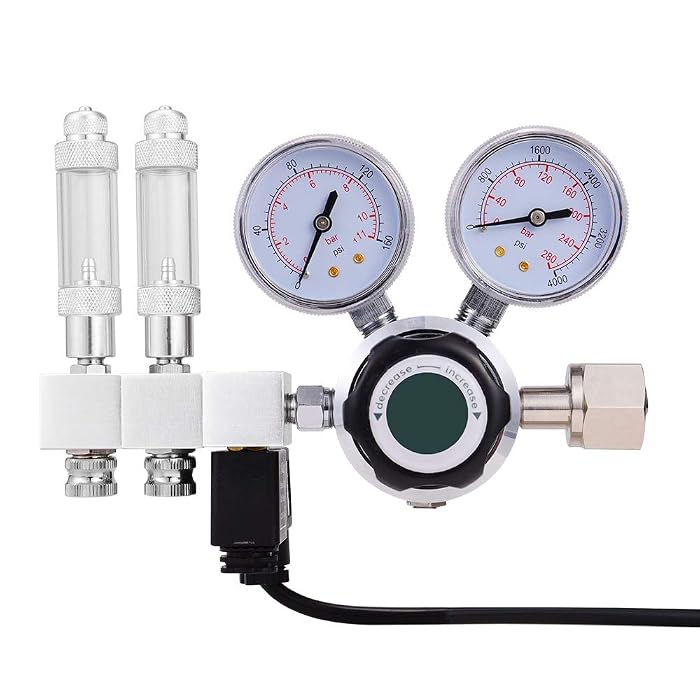
Plants only use CO2 while the lights are on, so running injection around the clock is pure waste and pure risk. Use a solenoid valve on a timer so CO2 turns on 1–2 hours before lights-on and switches off 1 hour before lights-off. The pre-lights head start saturates the water just as photosynthesis begins; the early shutoff lets levels fall before night.
If you are using a pH controller instead of a timer, set the shutoff point conservatively — a controller that holds a green drop checker with margin is doing its job. Never use a controller alone without a timer backup; a failed probe reading low can hold the solenoid open indefinitely. For more on safe dosing routines across the board, compare with the conservative approach to over-fertilizing symptoms — the "start low, observe, increase slowly" principle is identical.
Long-Term Safety Habits
A few low-effort habits prevent most repeat overdoses:
- Check the drop checker daily during your first month of injection, then at least a few times per week forever. Refill the indicator solution monthly — stale solution reads wrong.
- Re-dial after every equipment change. New diffuser, new tubing, a refilled CO2 cylinder, or a moved filter output all change dissolution efficiency. Treat any hardware change as a reset: drop the rate and run the one-week observation cycle again.
- Watch for end-of-tank dump. As a CO2 cylinder nears empty, output can surge (the "dump") in some regulator setups. If your checker drifts toward yellow with no settings changed and the cylinder is low, suspect the dump and swap the cylinder.
- Keep surface agitation moderate during normal operation. You want enough ripple to keep oxygen healthy without blowing all your CO2 into the room — a gentle shimmer across the surface is the classic target. Aggressive agitation forces you to inject more to hold green, which raises your risk ceiling for no benefit.
 ★4.1
Clscea CO2 Regulator with Dual Gauge, Bubble Counter and Solenoid
Check Price on Amazon ★4.1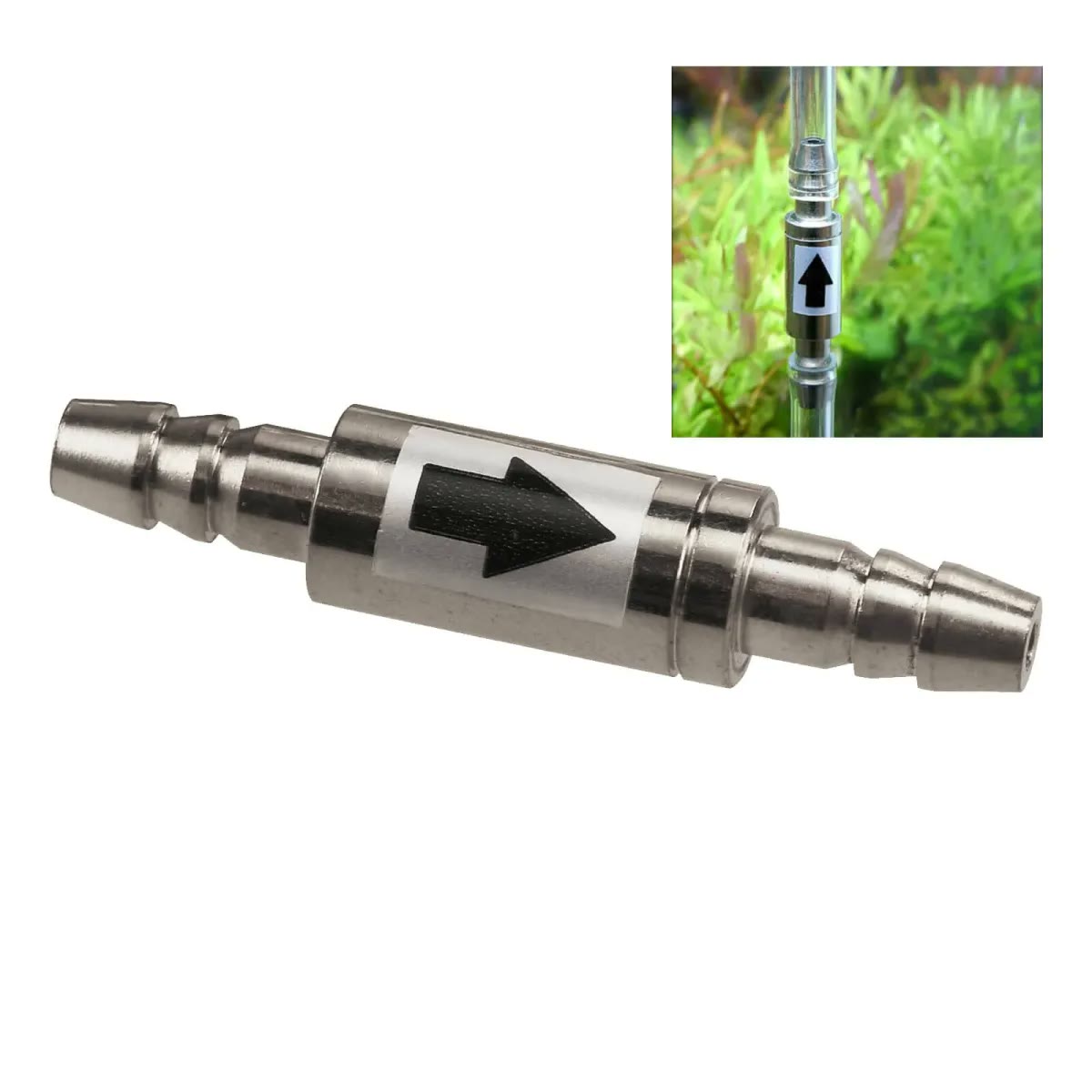 ★3.6
E-outstanding Stainless Steel CO2 Check Valve
Check Price on Amazon ★3.6Frequently Asked Questions
Can too much CO2 kill fish even if my drop checker is green?
Yes, occasionally. The checker lags 1–2 hours behind actual levels, so a brief midday spike can stress fish while the checker still shows green. More commonly, the checker solution is stale or the checker sits in a dead spot with poor circulation, reading lower than the tank average. If livestock are gasping and everything else tests normal, trust the animals over the instrument — reduce CO2 and see if behavior normalizes within an hour or two.
How long does it take for fish to recover from CO2 overdose?
Most fish recover within 30–60 minutes once dissolved CO2 falls back to safe levels, which strong surface agitation and a water change accomplish quickly. Shrimp often bounce back even faster. If animals are still in distress after two hours with CO2 off and good aeration, something else is wrong — test ammonia, nitrite, and temperature, and treat the situation as a general water-quality emergency rather than a pure CO2 event.
Should I run an air stone at night in a CO2-injected tank?
Running an air stone or increased surface agitation at night is a widely used safety practice. Plants stop consuming CO2 when lights go out, so overnight levels can creep up, especially in tanks with low surface movement. A timer that runs the air stone only at night gives you the safety margin without wasting injected CO2 during the day. Just confirm your morning drop checker still reaches green during the photoperiod.
What is the safest CO2 level for a tank with shrimp?
Shrimp-only or shrimp-heavy tanks do best at the lower end of the green range, around 20–25 ppm, and many keepers run even leaner with excellent results. Start at the conservative bubble rate in this guide, confirm a full week of active grazing and normal behavior, and resist the urge to push higher for faster plant growth. Shrimp reward stable, modest CO2 far more than they reward aggressive injection — and they will be the first to tell you when you have gone too far.
Can high CO2 cause algae?
Not directly, but unstable CO2 can. Algae thrives on inconsistency — a tank that swings between high and low CO2, or one where an overdose forces you to shut injection off for days, creates the fluctuating conditions many algae types exploit. The fix is the same boring answer as always: a stable, moderate CO2 level held constant through the photoperiod. For the specific case of sudden blooms, our guide to fixing green water algae blooms walks through the full recovery process.
Is a pH controller safer than a timer and solenoid?
It can be, but it is not automatically safer. A pH controller reacts to actual conditions, which helps in tanks with variable conditions — but a failed or uncalibrated probe can hold CO2 on when it should shut off. The safest setup is both: a controller with a conservative setpoint as the primary control and a timer as a hard backup that cuts injection at lights-off regardless. Calibrate the probe monthly and never skip the drop checker — it is your independent verification.
Respect the Ceiling
CO2 injection is one of the hobby's most powerful tools and one of the easiest to overdo — the difference between thriving growth and a livestock emergency is often a quarter-turn of the needle valve. Keep the checker green, increases slow, the solenoid on a timer, and your eyes on the animals every morning, and too much CO2 stays a story you read about instead of a mistake you survive.