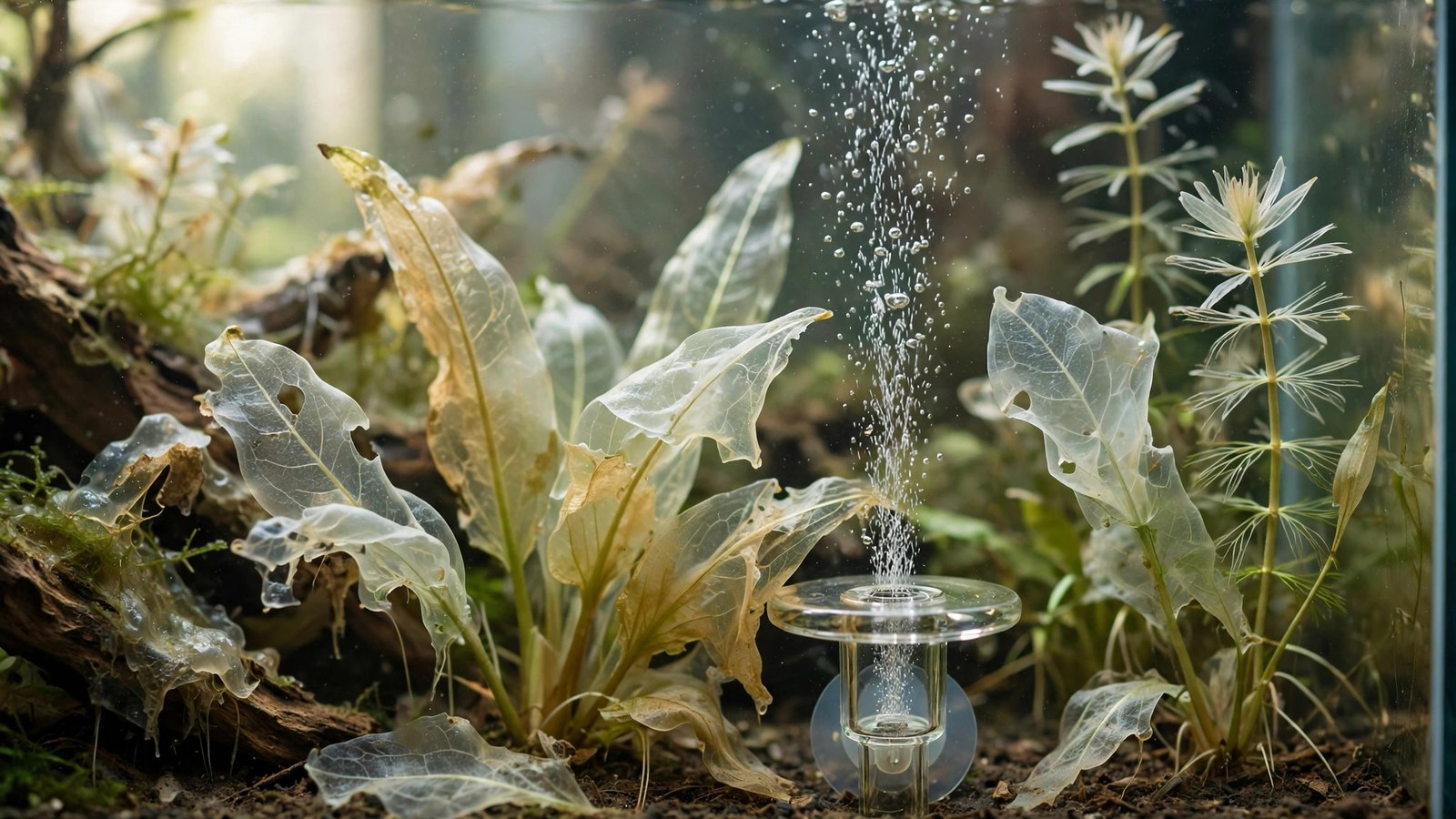
Your CO2 cylinder ran empty over the weekend. By Wednesday, your rotala is dissolving, the ludwigia looks boiled, and leaves are coming off in your fingers. Nothing else changed — same light, same fertilizer, same water — except the carbon. Welcome to the carbon crash: melting after CO2 changes, the most abrupt and panic-inducing melt in the hobby. The good news: it's predictable, the mechanism is well understood, and recovery follows a clear protocol. The bad news: the melted leaves aren't coming back — but the plants almost certainly are.
What the Carbon Crash Is
Plants grown under CO2 injection restructure themselves for high carbon: thinner cuticles, more photosynthetic machinery per leaf, enzyme systems tuned to abundant CO2. This is an adaptation, not a luxury — the plant commits its architecture to the carbon level it experiences.
When CO2 drops suddenly — empty cylinder, solenoid failure, clogged diffuser, timer error — that architecture becomes a liability. The plant cannot maintain high-CO2 tissue at low CO2. Photosynthesis collapses, the plant starts consuming its own leaves for energy, and within days to two weeks the most CO2-dependent tissue melts. It's not disease, not deficiency, not bad water — it's architectural obsolescence, and it's fast.
What triggers it
- Empty CO2 cylinder — the classic. Weekend away, Monday disaster.
- Solenoid or timer failure — CO2 stuck off (or stuck on, then corrected abruptly).
- Clogged diffuser — ceramic diffusers clog gradually, but the recognition is sudden: you clean it, blast CO2 back to full, and the swing itself triggers melt.
- Regulator creep or dump — end-of-tank dump spikes CO2, then the replacement cylinder starts at a different rate. The spike-to-normal transition melts plants too.
- Deliberate CO2 removal — deciding to "go low-tech" by simply turning off injection. The plants experience this as a crash, not a gentle transition.
- Major rescape with CO2 interruption — equipment disconnected for hours during a rescape, then restored.
Which Plants Crash Hardest
- Fast-growing stems (rotala, ludwigia, hygrophila) — highest CO2 adaptation, fastest melt. Often within 3–5 days.
- Carpeting plants (HC Cuba, dwarf baby tears, monte carlo) — melt from the substrate up; particularly devastating because replanting carpet is labor-intensive.
- Red plants — high metabolic demand makes them early crash victims.
- Resilient: anubias, java fern, bucephalandra, mosses, crypts — slow growers with conservative architecture ride out crashes with minor grumbling.
The pattern is diagnostic: if the fast growers melt and the slow growers shrug, it's carbon. See our CO2 deficiency signs for the broader picture.
The Crash Timeline
- Days 1–3: Subtle. Growth stalls, pearling stops, colors dull. Most keepers miss this window — it's the only one where intervention prevents melt.
- Days 3–7: Older leaves on fast growers turn translucent and mushy. Stem tips may stay green while lower foliage dissolves.
- Days 7–14: Full melt of CO2-adapted tissue. Stems go bare, carpets detach in sheets, red plants collapse. Looks catastrophic.
- Weeks 2–4: If conditions stabilize, surviving crowns and nodes push new low-CO2-adapted growth — smaller, tougher leaves. Recovery begins.
Emergency Response: The Crash Protocol
Step 1: Restore CO2 — but not all at once
The instinct is to blast CO2 back to full immediately. Don't. Plants mid-crash can't use full CO2 anyway, and another abrupt swing compounds the damage.
- Restore CO2 at half your previous rate for the first week.
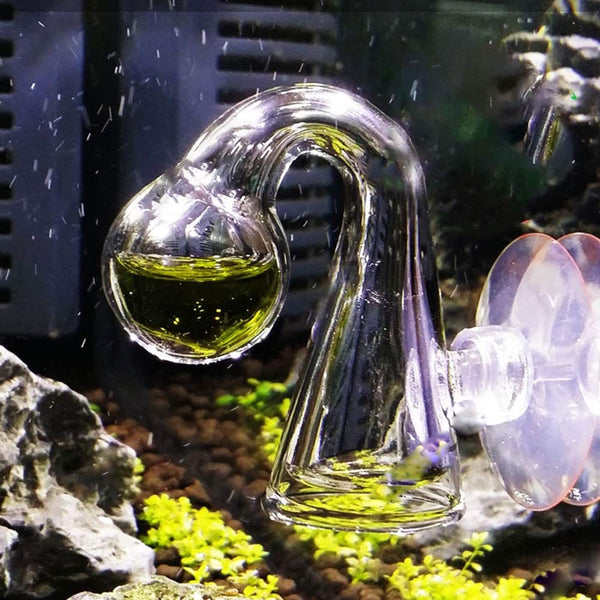
- Verify with the drop checker — aim for blue-green, not lime green, initially.
- Ramp back to full over 2 weeks, watching new growth response.
- Fix the root cause properly: refill/replace the cylinder, service the solenoid, clean or replace the diffuser, check timers.
Step 2: Cut light immediately
Drop to a 6-hour photoperiod and reduce intensity if possible. Light drives carbon demand — with CO2 compromised, full light just accelerates the melt and feeds algae on dying tissue. This is the single most impactful emergency step.
Step 3: Remove melted tissue aggressively
- Siphon out all mushy material daily during the crash. Dissolving leaves release ammonia, which triggers algae and further stresses surviving plants.
- Trim stems back to firm, healthy nodes — bare stems with live nodes resprout; mushy stems rot.
- For melting carpet, remove detached sheets but leave rooted runners — they resprout faster than replanting.
- Don't uproot anything with live roots. The root system is the recovery engine.
Step 4: Big water changes
40–50% water changes every 2–3 days during the acute phase. This exports the ammonia and organics from melting tissue — the secondary killer in a crash. Dechlorinate, temperature-match, and keep them gentle (don't blast the substrate).
Step 5: Hold fertilizer steady (don't starve, don't spike)
Maintain normal dosing — recovering plants need nutrients to rebuild. Don't increase ("more food will help" — it won't; carbon is the limiter) and don't stop (starved plants rebuild slower). Steady as she goes. If you're unsure about your baseline, our deficiency guide helps you read the signs.
Step 6: Deploy algae prevention
Crash + full light + ammonia from melt = algae explosion. You're already cutting light and water-changing; add Amano shrimp if you don't have them, and manually remove any algae daily. The crash window is when hair algae and BBA establish — prevention now saves a second battle later.
Liquid carbon bridge while CO2 stabilizes; the crash protocol's stopgap: Seachem Flourish Excel.
Protects livestock from ammonia spikes during the crash response: Seachem Prime.
Recovery: What Comes Back and When
- Stem plants: trimmed to healthy nodes, most resprout within 1–2 weeks of stable CO2. Fast and reliable.
- Carpets: surviving runners send up new shoots in 2–4 weeks. Patchy at first, fills in over two months.
- Swords and crypts: lose leaves but crowns survive; new leaves in 2–3 weeks. Crypts may do their infamous full melt and return — normal for them.
- What doesn't come back: fully melted leaves, dissolved stems with no firm nodes, carpet with no live runners. Remove and replant these — they're compost now.
Full visual recovery: 6–10 weeks for a bad crash. The tank looks rough for the first month — this is normal. Judge by new growth, not old damage.
Prevention: Never Crash Again
- Dual-stage regulator — prevents end-of-tank dump, the sneakiest crash cause.
- Low-pressure alarm or regular weighing — know when the cylinder is getting low. Weigh it monthly; a cylinder near empty gets refilled before the weekend, not after.
- Keep a spare cylinder — or at minimum, know your refill source's hours. A same-day swap prevents the crash entirely.
- Clean diffusers on schedule — monthly bleach soak (then dechlorinate) prevents the gradual clog that ends in a sudden "cleaning swing."
- Battery backup for solenoids/timers — power blips that reset timers cause CO2/light mismatches.
- Never quit CO2 cold turkey — transitioning to low-tech requires weeks of gradual reduction paired with light reduction and plant swaps toward low-demand species. It's a planned conversion, not a switch-flip.
Continuous CO2 monitoring so a crash never sneaks up again: FZONE CO2 drop checker.
 ★4.6
FZONE Glass CO2 Drop Checker Kit
Check Price on Amazon ★4.6Frequently Asked Questions
How long can plants survive without CO2 before melting?
It varies by species and how CO2-adapted they were. Fast stems show stress in 3–5 days and melt within two weeks; slow growers tolerate weeks. The critical factor isn't just duration but abruptness — a gradual decline over a month causes far less melt than an overnight cutoff. If your cylinder died Friday and you refill Monday, fast growers may be stressed but usually survive; two weeks empty is a full crash.
Should I replant everything after a carbon crash?
No — assess first. Stems trimmed to firm nodes resprout reliably; carpet runners recover; crowns of swords and crypts regenerate. Only remove what's fully mushy with no live tissue. Mass replanting after a crash wastes the surviving root systems that are your fastest path to recovery, and new transplants face the same unstable conditions. Patience and pruning beat replanting.
Can I prevent a crash when going on vacation?
Yes: refill or replace the CO2 cylinder before you leave (even if it's half full), verify the solenoid and timer, clean the diffuser, and reduce the photoperiod to 6 hours while you're away — lower light means lower carbon demand, buying margin. An automatic feeder prevents the overfeeding-by-pet-sitter ammonia spike that compounds crashes. Most vacation crashes are just empty cylinders meeting full light.
Is melting after a CO2 change the same as transplant melt?
Related but distinct. Transplant melt (see our melting guide) is emersed-to-submersed adaptation — expected, gradual, and the plant planned for it. Carbon crash is submersed-to-submersed architectural failure — unexpected, fast, and the plant has no adaptation ready. Transplant melt resolves as new submersed leaves grow; crash melt resolves as new low-CO2 leaves grow. Different cause, similar look, different urgency.
My CO2 is back but plants still melt weeks later. Why?
Because the melt you're seeing is delayed architectural failure — leaves built during the low-CO2 window are now failing under restored high CO2, or tissue damaged during the crash is only now giving up. As long as new growth looks healthy, the plant is recovering — keep removing the failing old tissue and stay the course. If new growth also melts, something else is wrong (check our full melting diagnosis).
Respect the Carbon Commitment
CO2 injection is a commitment — your plants rebuild themselves around it, and breaking that commitment has consequences measured in melted foliage. But crashes are survivable: restore carbon gradually, cut light, clean relentlessly, change water, and let the root systems do what they evolved to do. And then buy the spare cylinder, set the refill reminder, and never meet the carbon crash twice.