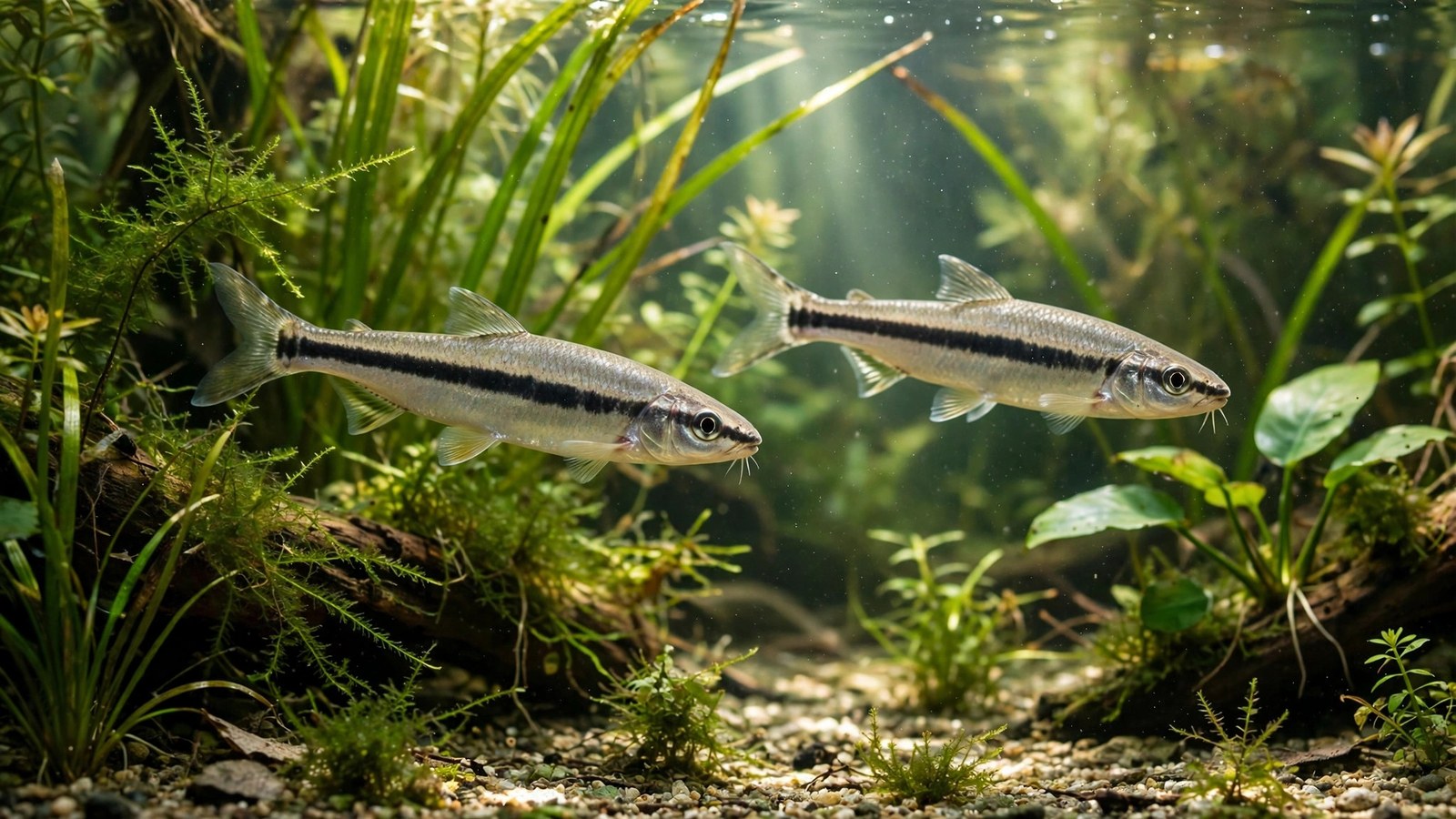
The fish you bought to destroy your black beard algae probably isn't the fish that eats it. Most fish sold as "Siamese algae eaters" are actually flying foxes or Chinese algae eaters — lookalikes that ignore BBA or turn into territorial bullies as adults. This siamese algae eater vs flying fox guide teaches you to tell all three apart in five seconds, shows which one actually eats BBA (and when it stops), and covers what to do if the impostor already swims in your planted tank.
Siamese Algae Eater vs Flying Fox: Why This Mix-Up Matters Most
Black beard algae is the planted tank's most stubborn enemy: it clings to Anubias and Java fern, shrugs off spot treatments, and ruins good aquascapes. Ask "what eats BBA?" and the answer is always the Siamese algae eater — the true Crossocheilus oblongus is one of the only freshwater fish that genuinely grazes on it. That recommendation created a perfect trap. Demand for SAEs is enormous, farmed supply is inconsistent, and all three species look nearly identical as two-inch juveniles in a shop tank. So wholesalers and shops routinely substitute whichever is cheapest and label it "Siamese algae eater," "Siamese flying fox," or just "algae eater." You take home what you think is a BBA destroyer, and three months later your BBA is untouched while your "SAE" is harassing your tetras. No fish fixes BBA alone, so fix the tank conditions behind algae outbreaks too.The Five-Second Field ID: Stripe, Mouth, and Barbels
Forget the tank label. These three features separate the species every time, and you can check them in seconds while the fish swims in the shop's display tank.| Feature | True SAE (C. oblongus) | Flying fox (E. kalopterus) | Chinese algae eater (G. aymonieri) |
|---|---|---|---|
| Black lateral stripe | Runs continuously through the tail fin, with ragged/zigzag edges | Stops cleanly at the base of the tail; edges smooth and straight | Mottled, irregular blotches rather than one clean stripe |
| Stripe at the tail | Visible on the fin itself, fading toward the tip | Absent from the fin; tail is clear with a dark base spot | No distinct stripe on tail |
| Band above stripe | No gold band — brownish back, camouflage coloring | Distinct gold/amber band above the black stripe | No gold band |
| Mouth | Smooth, downturned mouth without a sucker | Slightly downturned, smooth lips | Obvious round sucker-disc mouth |
| Barbels | One pair, small | Two pairs | None visible |
| Adult size | ~6 inches (15 cm) | ~6 inches (15 cm) | ~10 inches (25 cm) |
| Adult temperament | Peaceful schooling fish | Territorial, chases tankmates | Aggressive, sucks slime coats off fish |
| Eats BBA? | Yes, especially juveniles | Rarely — prefers prepared food | No meaningful BBA grazing |
The stripe test is the fastest
Memorize the tail. A true SAE's black stripe runs onto the caudal fin, fading toward the tip with ragged, torn-looking edges. On a flying fox the stripe ends abruptly where the tail starts, and a metallic gold band sits above it — true SAEs have plain brownish backs with no gold band.The mouth and barbel test is the tiebreaker
Check the face. True SAEs have a smooth mouth with one small pair of barbels; flying foxes have two pairs. The Chinese algae eater is unmistakable: a round sucker-disc mouth like a tiny pleco. If a juvenile is clinging to the glass by its mouth, it is almost certainly a Chinese algae eater — the worst BBA purchase of the three.Why Every Fish Shop Gets This Wrong
This is supply-chain reality, not conspiracy. All three species come from the same Southeast Asian farms, arrive in mixed shipments, and look nearly identical at the 1.5–2 inches shops stock. Wholesalers mislabel batches, wrong names propagate through shop inventory systems for years, and trade names like "Siamese flying fox" and "golden algae eater" (usually the golden Chinese algae eater) blur everything further. The average employee genuinely cannot tell you which species they are selling. That is why the check sits with you: thirty seconds looking at the tail beats any shop assistant's assurance. Buy from specialist planted-tank shops and reputable online vendors that list the scientific name — the true Siamese algae eater's species profile confirms the markings to look for. If the label just says "algae eater," assume nothing. Newcomer mix-ups destabilize young setups in other ways too — one reason shrimp die in freshly stocked planted tanks and why most planted tanks crash within their first 60 days. Quarantine new fish and confirm their identity before they meet your display tank.Which One Actually Eats Black Beard Algae?
Here is the honest answer most shop staff won't give you: only the true Siamese algae eater eats meaningful amounts of BBA — and mostly when young. Juveniles under a year old are genuine BBA machines: five of them can strip a moderate infestation off Anubias and driftwood within two to three weeks. They also graze hair algae and leftovers, making them one of the few cleanup fish worth their tank space. SAEs get lazy with age. By 18–24 months, at three to four inches, their algae-eating drive drops sharply — adults strongly prefer pellets and vegetables, and BBA grazing becomes rare. This is normal aging: a six-year-old SAE school is lovely community fish, no longer a cleanup crew.How to keep them working longer
You cannot stop the diet shift, but you can slow it. Feed lightly: one modest feeding per day plus one fast day per week keeps an appetite for algae without starving them — twice-daily full pellet meals remove all incentive to graze. Supplement with blanched zucchini weekly, and when the school ages past its prime, add young SAEs rather than expecting the veterans to work — juveniles do the job while adults school beautifully. Flying foxes are poor BBA cleaners at every age — omnivores that prefer prepared food, with territorial behavior that makes them a net negative in planted tanks. Chinese algae eaters are worse: as adults they latch onto slow fish and rasp slime coats off tankmates, causing real injury. Neither is a BBA solution.Stocking True SAEs the Right Way
True Siamese algae eaters are schooling fish that reach six inches and live eight to ten years. Stock them like the substantial fish they become, not like the two-inch juveniles in the shop.| Parameter | Target |
|---|---|
| Group size | 5–6 minimum; 6+ is noticeably calmer and more active |
| Tank size | 30 gallons minimum for a group; 40+ gallons ideal long-term |
| Temperature | 72–79°F (22–26°C) |
| pH / hardness | pH 6.5–7.5, soft to moderately hard |
| Flow and cover | Moderate flow, dense planting, and driftwood — they come from flowing streams |
| Tankmates | Peaceful community fish, tetras, rasboras, corydoras, shrimp (may snack on newborn shrimplets) |
You Already Bought Flying Foxes — Now What?
First: do not panic, and do not dump them anywhere. Releasing aquarium fish into local waterways is illegal in most places and ecologically destructive — it is never the answer. You have three legitimate options. Option one: return them. Many shops will take back mislabeled fish — bring a clear photo of the stripe stopping at the tail base, explain calmly, and ask for store credit toward true SAEs within a week or two of purchase. Option two: rehome them. Local aquarium clubs, Facebook groups, and forums always have hobbyists running larger semi-aggressive tanks where a territorial flying fox fits fine. Option three: keep them and adjust expectations. Flying foxes are attractive, active fish that do fine in 40+ gallon tanks with robust tankmates (barbs, larger tetras, gouramis — nothing slow or long-finned), grazing soft algae as they go. Just do not count on them for BBA, and do not add true SAEs alongside them — the flying foxes will harass them. If you keep them, feed at both ends of the tank so the dominant fish cannot guard all the food, and break sight lines with plants and hardscape. A lone flying fox in a small tank with docile tankmates is the worst configuration — aggression peaks at feeding time and in cramped quarters. If the mislabeled fish is a Chinese algae eater, act faster. Rehome or return it as soon as the sucker mouth is confirmed — at six inches it becomes a genuine menace to slow tankmates like angelfish and discus.Frequently Asked Questions
Can true Siamese algae eaters and flying foxes live together?
They can survive together, but it is a poor pairing — flying foxes chase true SAEs around food, stressing them and suppressing their grazing. In 40+ gallon tanks with heavy planting and feeding at several spots, conflict drops. Long-term, rehome the flying foxes and keep a proper SAE school.
How many Siamese algae eaters do I need to clear BBA?
Five to six juveniles are the standard crew for a 30–40 gallon tank with moderate BBA; expect visible progress in two to three weeks. They work best alongside root-cause fixes — stable CO2, lower light, better flow — because fish alone cannot outpace BBA growing in unbalanced conditions.
Do adult Siamese algae eaters stop eating algae completely?
Their appetite for algae — especially BBA — drops dramatically after 18–24 months. Adults prefer prepared foods and graze only soft algae opportunistically. Light feeding slows the shift, and adding young SAEs to an aging school restores the cleanup function: juveniles are the crew, adults are display fish.
Will Siamese algae eaters eat my plants?
Healthy plants are safe. True SAEs occasionally nibble damaged or dying leaves, and they can uproot new stems while foraging — a common frustration with bottom-foragers. Secure new plantings (see safe plant weights), let roots establish for two to three weeks, and damage from a proper SAE school is rare.
Are flying foxes completely useless for algae control?
They graze soft green algae and biofilm, especially as juveniles — but they are unreliable BBA eaters at every age, and territorial adults suit peaceful planted tanks poorly. Buy true SAEs for algae control; if you already own flying foxes, enjoy them as active display fish in a suitable setup instead.
How can I be sure the shop is selling true SAEs?
Check the tail: the stripe must continue onto the caudal fin with ragged edges, with one small pair of barbels and no gold band. Buy from shops or vendors listing Crossocheilus oblongus by name. If the label just says "algae eater," walk away.