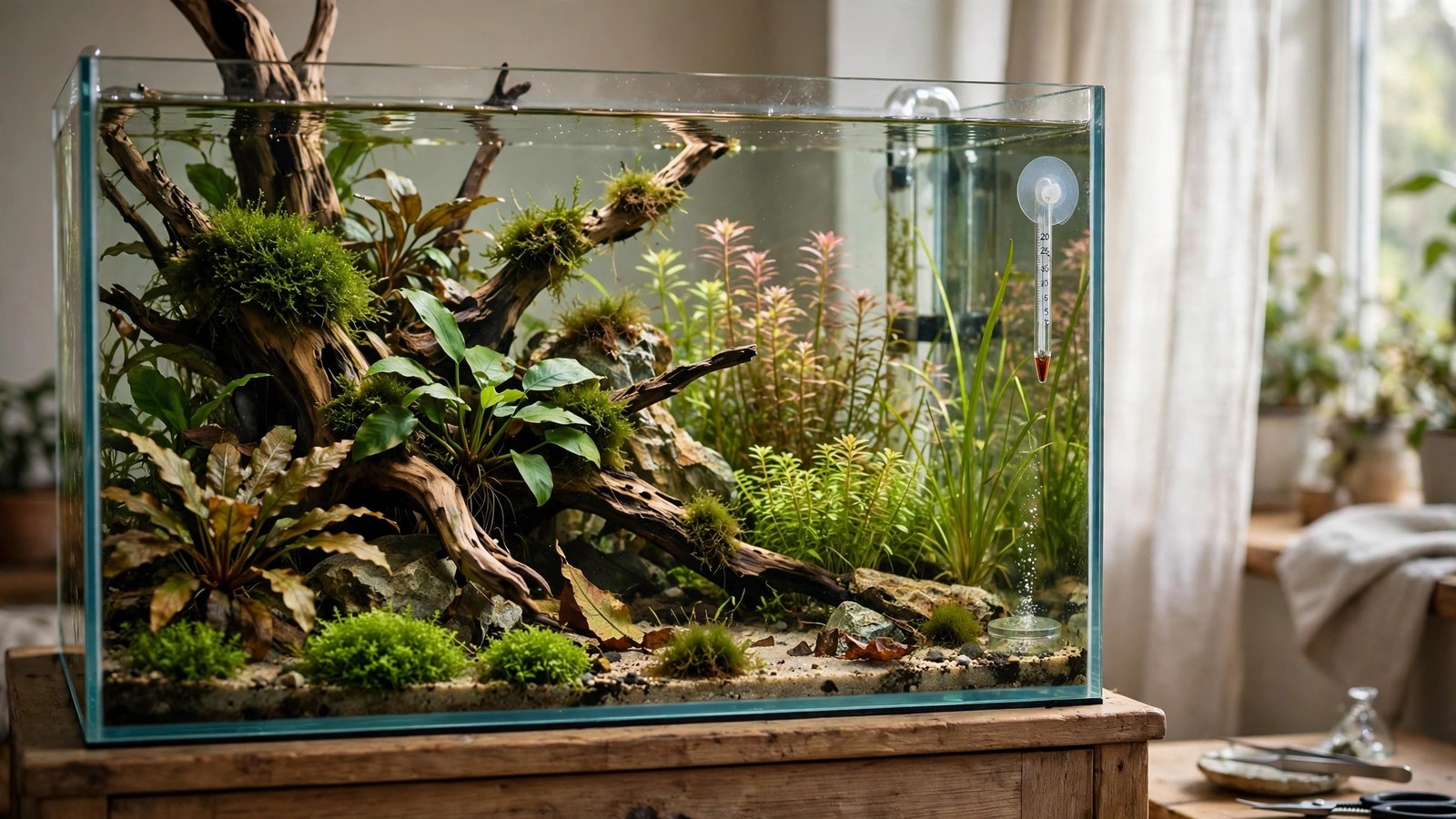
Here is the pattern almost every aquarist lives through: week two, your new planted tank is the pride of your living room — bright green stems, glass-clear water, the whole dream. By week eight it is a different story: brown fuzz coats the glass, stems have melted into mush, and you are searching for why planted tanks fail at midnight while your fish stare at you accusingly. These collapses are not bad luck. They follow seven predictable causes, and every one has a concrete fix you can apply this week.
1. The nitrogen cycle was never finished
The most common reason a planted tank falls apart in two months is invisible: it was never properly cycled. Plants consume ammonia, which tricks beginners into thinking a planted tank can skip the cycle. It cannot. Livestock and decaying matter produce more ammonia than young plants and an immature bacterial colony can process, so ammonia and nitrite spike in weeks 1–3 — burning plant tissue just as it burns fish gills. Leaves yellow, stem bases turn translucent, and the scape looks like it is dissolving.
Then comes the calling card of the uncycled tank: brown diatom dust coating everything around week 2–4. Diatoms thrive on new-tank instability; heavy blooms smother slow leaves and convince beginners the tank is doomed. Learn to tell a passing phase from a real problem in our guide to brown diatom algae in new tanks.
The fix: cycle like you mean it
Run a fishless cycle: dose ammonia to 2 ppm, or plant heavily from day one (70% substrate coverage) with seeded filter media if you can get it. Ammonia and nitrite must read 0 ppm for a full week while nitrate reads above zero — that takes 3–6 weeks. Stock a few small fish per week, and change 30% of the water twice weekly for the first month with aquasoil, which leaches ammonia early.
| Timeline | What is happening | What to do |
|---|---|---|
| Days 1–7 | Ammonia rises; some transition melt | Plant heavily, dose ammonia to 2 ppm, test every 2 days |
| Days 7–21 | Nitrite spike | No livestock; 30% water changes twice a week |
| Days 21–42 | Ammonia/nitrite at 0; nitrate appears | Confirm 0 ppm for 7 days, then add first fish |
2. Too much light, too soon
Algae's favorite setup is a new tank blasted with 10–12 hours of intense light and almost no established plant mass. In month one your plants are still rooting and converting leaves to underwater form — they cannot use all that light. Algae can. It needs almost nothing and colonizes every surface first, which is why green dust appears on the glass by week 3 and hair algae strangles stems by week 5.
Beginners over-light because full blast looks spectacular in the shop and plants "seem to love it" for ten days. They are coasting on stored energy while algae builds an army. If growth has stalled under bright light, read our guide to aquarium plants that are not growing — light excess plus stalled growth is the signature combo.
The fix: start dim and short
Weeks 1–2: 6 hours daily at 50–70% intensity. Weeks 3–4: 7 hours. Week 5+: 8 hours at full intensity only with dense plant mass and stable CO2. Use a timer — manual switching drifts to 12-hour days within a fortnight. If algae appears, cut intensity first, duration second, never the reverse.
| Phase | Photoperiod | Intensity |
|---|---|---|
| Weeks 1–2 | 6 hours | 50–70% |
| Weeks 3–4 | 7 hours | 70–85% |
| Week 5+ | 8 hours max | 100% only with stable CO2 |
3. CO2: the missing (or chaotic) ingredient
Carbon is the raw material of growth — plants are ~40% carbon by dry weight — yet it is the input most beginners skip. The doomed recipe: bright light over a tank with only ambient CO2 from the air. Plants burn through that supply by mid-morning, stall, and leak sugars that feed algae. Signs: stunted tips, pinholes in older leaves, transparent new growth. Check the full list in our guide to CO2 deficiency signs in plants — three or more matches and you have your culprit.
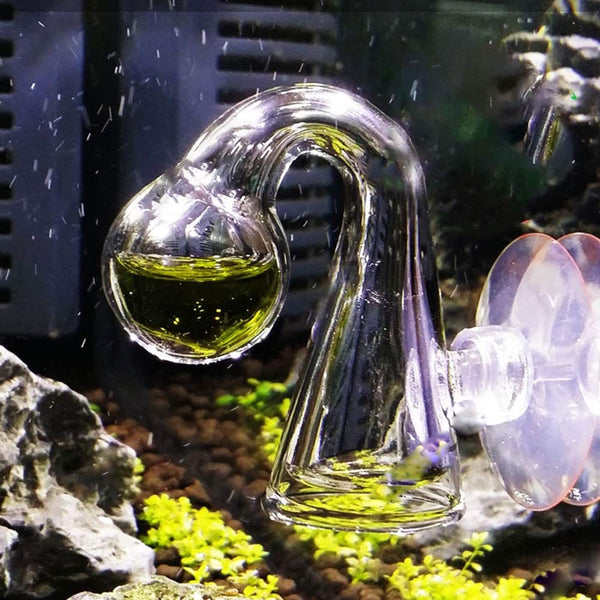
The opposite failure is equally common: CO2 installed but run chaotically — bubbles adjusted by feel, gas switched on with the lights, a drop checker nobody reads. Fluctuating CO2 is worse than none; it stresses plants and hands algae a permanent opening. First check your species' actual needs in Tropica's plant database — many popular "easy" plants do fine without injected CO2.
The fix: stable CO2 on a timer
Start pressurized CO2 at ~1 bubble per second per 30 liters (8 gallons), adjusting from there. Timer: CO2 on 1–2 hours before lights, off 1 hour before lights-out — the drop checker should read lime green when the photoperiod starts. Keep gentle surface agitation for overnight oxygen.
 ★4.6
FZONE Glass CO2 Drop Checker Kit
Check Price on Amazon ★4.64. Nutrients dosed by vibes
By weeks 4–6 most failing tanks hit nutrient confusion. One camp doses nothing because "the substrate has nutrients" — but aquasoil's charge depletes in 2–3 months and inert gravel never had any. The other camp dumps fertilizer at random, skips water changes, and builds organics until algae throws a party. Both end the same way: yellowing, stalled, hole-ridden plants.
Starvation and excess look alike: yellow leaves can mean nitrogen deficiency or ammonia damage. Get systematic with our aquarium plant nutrient deficiency guide, and memorize this cheat sheet:
| Symptom | Missing nutrient | Where it shows |
|---|---|---|
| Old leaves yellow, translucent | Nitrogen | Lower foliage first |
| Pinholes with yellow edges | Potassium | Older leaves |
| New leaves pale, veins green | Iron | New growth |
| Yellowing between veins | Magnesium | Older leaves |
| Stunted, dark small leaves | Phosphate | Whole plant |
The fix: schedule, dose, reset
Dose a complete all-in-one fertilizer three times a week at label dose, and change 30–50% of the water every week. The water change is the reset button that makes dosing safe — it exports excess before algae uses it. Push root tabs (one per 15 cm / 6 inches) under heavy root feeders like Amazon swords and Cryptocoryne every 2–3 months. Target 10–20 ppm nitrate; near-zero with hungry plants means under-dosing. Seachem's official dosing chart for Flourish is a solid baseline reference.
5. The substrate was an afterthought
Plants anchor, feed, and breathe through the substrate, yet beginners think about it least. Classic mistakes: decorative gravel with no root tabs, starving root feeders within weeks; or premium aquasoil with no warning that it leaches ammonia for 2–4 weeks. Depth matters — a 2 cm dusting cannot anchor stems or host waste-processing bacteria. Carpeting plants are the canary: if your foreground will not spread, suspect the substrate first, as covered in our guide to carpet plants not spreading.
The fix: give roots a real home
Use aquasoil (5–7 cm front, sloping to 8–10 cm back) or inert gravel/sand plus root tabs from day one — commit to one strategy. With aquasoil, expect the ammonia leach: test daily, change 30–50% of the water twice a week for the first month. Never cap aquasoil with fine sand for rooted stems; the cap compacts, traps gases, and rots roots. After week 2, stop deep-vacuuming the bed — each deep disturbance releases trapped organics and restarts solved problems.
6. Planted wrong on day one
Many 60-day failures were sealed in the first hour. The top planting crime: burying the rhizome of Anubias or Java fern — that thick horizontal stem must sit above the substrate or it rots within weeks. Tie or glue rhizome plants to wood and rock; details in our guide to Anubias melting causes. Close behind: planting emersed (grown-out-of-water) stems and panicking when the old leaves melt. That melt is normal — underwater leaves replace them in 2–3 weeks. What is not normal is glassy, transparent leaves on established submersed growth; see our guide to aquarium plant leaves turning transparent.
The fix: plant once, then leave them alone
Trim emersed leaves and mushy tissue before planting so energy goes to new growth. Space stems 2–3 cm apart, bury only the bottom 1–2 cm, and strip the lowest leaves so none rot underground. Then the hardest thing in the hobby: do not move anything for 4–6 weeks. Every uprooting destroys the fine root hairs the plant spent days growing — a plant moved three times in a month has effectively been planted for one week.
7. The tinker's curse: changing everything at once
The final cause is behavioral. Faced with early algae, the anxious aquarist changes the light, fertilizer, CO2 rate, and scape — all in one weekend. Now nothing is diagnosable. Chasing test-kit numbers worsens it: pH and GH fluctuate naturally daily, and "correcting" them stresses everything alive. The most destructive tinker: rinsing filter media under tap water — chlorine kills the bacterial colony and triggers a mini-cycle that melts plants. Deep substrate stirring belongs here too: it releases trapped organics that can fuel a cyanobacteria outbreak within days.
The fix: one change, two weeks, written down
One adjustment at a time, then wait two full weeks before judging. Log the date, the change, and what you observe. Rinse sponges only in old tank water, and never clean all media at once — alternate halves monthly. Stability grows plants; constant "improvement" grows algae.
How to read your tank's distress signals
Match the symptom before reaching for a product. The most common first-60-day failures:
| Symptom | Likely cause | First action |
|---|---|---|
| Brown dust on glass/leaves (weeks 2–4) | Diatoms — normal new-tank phase | Wipe glass, keep water changes; fades on its own |
| Green spots on glass, slow leaves | Too much light, low phosphate | Cut light to 6 h, check PO4, add nerite snails |
| Hair algae on stem tips | CO2/light imbalance | Stabilize CO2, remove by hand, trim worst stems |
| Leaves glassy, transparent | Transition melt or CO2 deficiency | Trim melt, wait 3 weeks for regrowth |
| Pinholes in older leaves | Potassium deficiency | Increase all-in-one dose |
| Blue-green slime, earthy smell | Cyanobacteria, excess organics | 3-day blackout + siphon, fix light and organics |
Frequently Asked Questions
Why are my aquarium plants melting in the first two weeks?
Almost always transition melt: nursery plants are grown emersed, and those leaves cannot survive submerged. They dissolve within 2–3 weeks while underwater-adapted leaves grow in. Trim the mush, keep parameters stable, and judge the plant only after a month. Melt continuing past week 4 on new submersed growth points to ammonia or unstable CO2 instead.
How long should I run my aquarium lights each day?
Start at 6 hours daily for two weeks, 7 hours in weeks 3–4, and cap at 8 hours once the tank has dense plant mass and stable CO2. Use a timer — manual control drifts toward 12-hour days fast. If algae appears, cut intensity first and duration second, and never exceed 8 hours in a high-energy tank.
Do I really need CO2 injection for a planted tank?
Not always. Low-tech tanks with moderate light and easy species (Anubias, Java fern, Cryptocoryne, mosses) thrive without it. But with strong lighting or fast stems and carpets, pressurized CO2 near 30 ppm is effectively mandatory — bright light without CO2 is the fastest recipe for an algae farm. Match CO2 to your light level, not your ambition.
How often should I do water changes in a planted tank?
Change 30–50% weekly without exception — it exports nutrients and organics before algae uses them, which is what makes regular fertilizing safe. With aquasoil, change twice weekly for the first month since it leaches ammonia. Skipped water changes are the quiet accomplice behind most month-two algae explosions.
Why did my plants grow well for a month, then suddenly stop?
The classic month-two stall: aquasoil's initial nutrient charge depletes, or an inert substrate with no root tabs runs out. Test nitrate — near zero with hungry plants means under-fertilizing. Add root tabs under heavy root feeders, dose all-in-one liquid three times a week, and growth usually resumes within 2–3 weeks.
Can I save a planted tank already covered in algae?
Yes — nearly every algae disaster is reversible. Remove as much manually as possible, do a large water change, then fix the underlying imbalance (light duration, CO2 stability, dosing schedule) instead of attacking the algae. For cyanobacteria or severe blooms, a 3-day total blackout works wonders. Skip algaecides as a first resort — they treat symptoms and can harm plants and bacteria.
Why Planted Tanks Fail: Your 60-Day Reset Plan
Weeks 1–2: stabilize — timer to 6 hours, CO2 lime green by lights-on, weekly 30–50% water changes. Weeks 3–4: feed — all-in-one fertilizer three times a week, root tabs under heavy feeders, trim melted or algae-covered leaves. Weeks 5–8: observe — change nothing but routine maintenance, log what you see, let new growth judge the balance. Tanks that survive day 60 rarely have the priciest gear. They belong to owners who fixed causes instead of symptoms, changed one thing at a time, and gave plants the one input no product sells: patience.