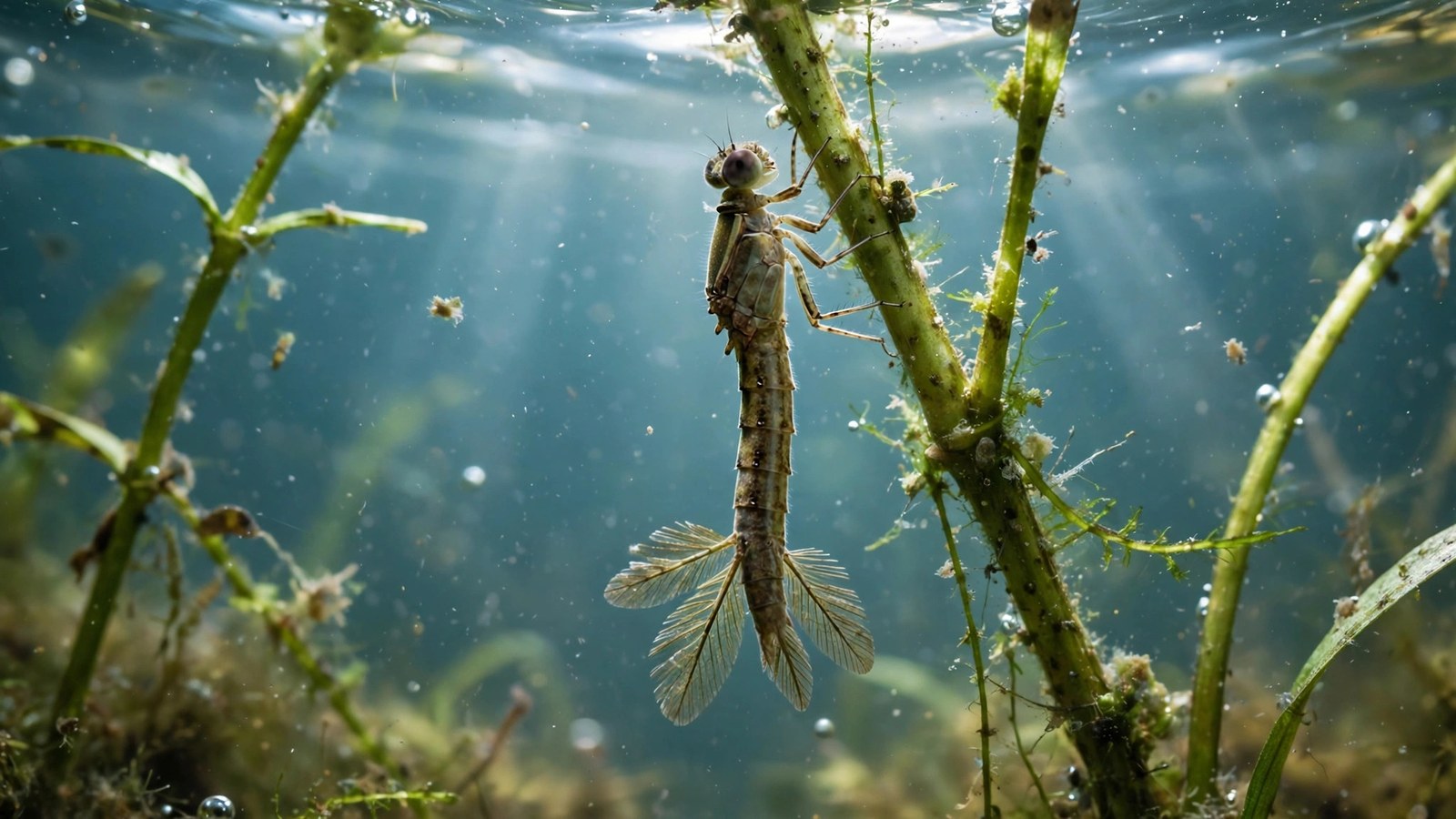
Shrimp babies keep vanishing overnight, and nothing in the tank looks guilty. No ammonia spike, no disease — just fewer babies every morning. If that sounds familiar, the culprit may be something you never added: a tiny predator with three feathery tails and a jaw that shoots out like a harpoon.
A damselfly nymph in aquarium setups is one of the hobby's most frustrating hitchhikers: invisible eggs embedded in plant tissue, hatching weeks later to hunt your smallest livestock. The good news: once you can identify it, it is beatable — no tear-down required.
A damselfly nymph in aquarium tanks is an aquatic predator larva, usually 1–3 cm long, recognizable by three external tail gills that dragonfly nymphs lack. It arrives hidden as eggs inside plant tissue, hunts shrimplets and fry with an extendable jaw, and is best removed manually or with a bottle trap; a 2–4 week plant quarantine prevents reintroduction.
What a Damselfly Nymph in Aquarium Tanks Actually Does
A damselfly nymph is the aquatic juvenile stage of a damselfly — a slender ambush predator that sits motionless among plant leaves, waiting. Its thin body, 1–3 cm in a tank, is colored like whatever it lives on: greenish among stems, brownish against wood. It hunts by shooting out its lower jaw (the labium) in a fraction of a second, snaring anything soft and slow nearby.
The prey list is depressingly specific: baby cherry shrimp, fry, and microfauna. Adult fish are far too big to care. That selectivity is what makes the damage invisible — water tests read fine, adults look healthy, and the colony quietly fails to recruit any young. Before you act, learn how damselfly nymphs differ from dragonfly nymphs: the dragonfly kind grows larger and takes bigger prey.
Identification: The Three Tails That Give It Away
Damselfly nymphs look like brown twigs with legs until you notice the rear end: three flat, leaf-like paddles fanning out behind the body. Those are external gills (caudal lamellae) — the single most reliable ID feature, pulsing gently in the current and doubling as swim fins. Six jointed legs and antennae complete the insect look.
Confusing it with hydra, another ambush predator, is unlikely — hydra are tiny and sessile, looking like miniature sea anemones. A damselfly nymph is mobile and unmistakably insect-like.
| Feature | Damselfly nymph | Dragonfly nymph |
|---|---|---|
| Tail gills | Three external leaf-like paddles | None — internal rectal gills |
| Body shape | Long, thin, twig-like | Short, stocky, chunky head |
| Typical tank size | 1–3 cm | 2–5 cm |
| Behavior | Sits in plants, waits | Crawls openly, bolder |
| Prey range | Shrimplets, fry, microfauna | Same, plus small adult fish |
How They Sneak In: Eggs You Cannot See
Nobody buys a damselfly nymph on purpose. The entry route is always the same: eggs laid by a female inside plant tissue — slits cut into stems and leaves of pond-grown or farm-grown stock. The eggs are invisible in transit and protected from every dip you can throw at them.
Weeks after planting, a pinhead-sized nymph emerges, already armed. Dips done before planting do nothing to unhatched eggs — this is why quarantine outperforms dipping for this pest. Pond-grown stem plants are the highest-risk source; tissue-culture cups are zero risk.
What They Hunt — and What Is Safe
Shrimp tanks are the worst-case scenario. A single nymph can pick off baby cherry shrimp one by one for weeks while you blame mysterious shrimp losses on water parameters. Fry-rearing setups are equally vulnerable; a nymph barely a centimeter long can eat fry in a single night.
Adult nano fish like neon tetras are generally safe (their dragonfly cousins are another story). Snails, adult shrimp, and plants are untouched. Watch for this pattern: healthy adults, excellent water, and no surviving babies.
How to Remove Damselfly Nymphs Without Tearing Down the Tank
There is no chemical fix worth the collateral damage — insecticides also threaten shrimp and the biofilter. Manual and mechanical removal is the whole strategy, and it works.
- Night-time tweezer hunt. Nymphs hunt after lights-out. An hour after dark, scan leaves and glass with a flashlight — they freeze when lit, giving you a few seconds for one firm grab with long tweezers.
- Bottle trap. Cut the top off a small plastic bottle, invert it into the base as a funnel, and bait it with a scrap of fish food. Nymphs walk in for the scent and can't get back out. Check it morning and night.
- Predator fish — with judgment. A hungry betta or gourami clears small nymphs in a fish-only tank. Never use this in a shrimp or fry tank; the cure deletes the livestock you're protecting.
- Siphon ambushes. During water changes, nymphs disturbed from plants often cling to glass — the siphon intake does the rest.
Keep trapping until a full fortnight passes with no sightings — eggs hatch on staggered schedules, so one pass is never the whole job.
Prevention: Quarantine Beats Every Dip
Since the eggs live inside plant tissue, dips only kill nymphs that have already hatched. Dips still catch free-swimming hitchhikers, but only quarantine covers the full egg-hatching window:
| Method | What it kills | How to do it |
|---|---|---|
| Alum dip | Hatched nymphs, snail eggs | 1 tbsp per gallon, soak 2–3 days, rinse well |
| Potassium permanganate | Nymphs, algae, pathogens | 10 mg/L (pale pink), 10–30 minutes, rinse well |
| Bleach dip | Nymphs, algae, snail eggs | 1:19 bleach-to-water, 1–2 minutes, dechlorinate after |
| Quarantine tank | Catches what hatches from eggs | New plants isolated 2–4 weeks, inspect weekly |
Inspect quarantine plants with a flashlight after dark once a week — hunting nymphs are far easier to spot at night. Stressed plants recovering from shipping deserve quarantine anyway, so fold the habit into one routine. For sourcing advice, the freshwater aquarium plants complete guide covers tissue-culture and pond-grown stock, including the stems most likely to carry eggs. And treat new additions like pest-snail-infested plants: quarantine first, dip second, plant third.
Frequently Asked Questions
Can a damselfly nymph kill adult fish?
Almost never. Damselfly nymphs top out around 3 cm and their extendable jaw is built for soft, slow prey — shrimplets, fry, and microfauna. Adult nano fish like tetras are far too large and fast. Their larger dragonfly-nymph cousins are a different story.
How long do the eggs take to hatch?
Typically two to four weeks at normal tropical tank temperatures, though some eggs wait longer in cooler water. Because hatching is staggered, keep removing and watching for at least two full weeks after your last sighting — one quiet week is not a clean tank.
Will my betta eat a damselfly nymph?
Yes — bettas, gouramis, and other opportunistic predators readily eat small nymphs, making them a fine cleanup tool in a fish-only tank. But never try this in a shrimp-breeding or fry-rearing tank: the predator will also eat the babies you're protecting.
Can damselfly nymphs live without food?
Yes, and that is what makes them so persistent. These nymphs are famously hardy and can survive weeks between meals by slowing their metabolism, so starving them out of an established tank does not work. Active removal with traps and night-time hunting is the only reliable approach.
Are damselfly nymphs dangerous to humans?
No. They are far too small to bite or sting a person, and they are not venomous. Handle them with tweezers to avoid crushing them (a squished nymph fouls the water) — and never release aquarium hitchhikers into local waterways.
The Quiet Tank Is the Giveaway
A damselfly nymph in aquarium life announces itself not with damage but with absence: babies that should exist and don't. If your adults are healthy yet no young survive, scan the plants after dark and look for those three telltale tails. One nymph, one bottle trap, a few weeks of patience — and the nursery goes back to normal.