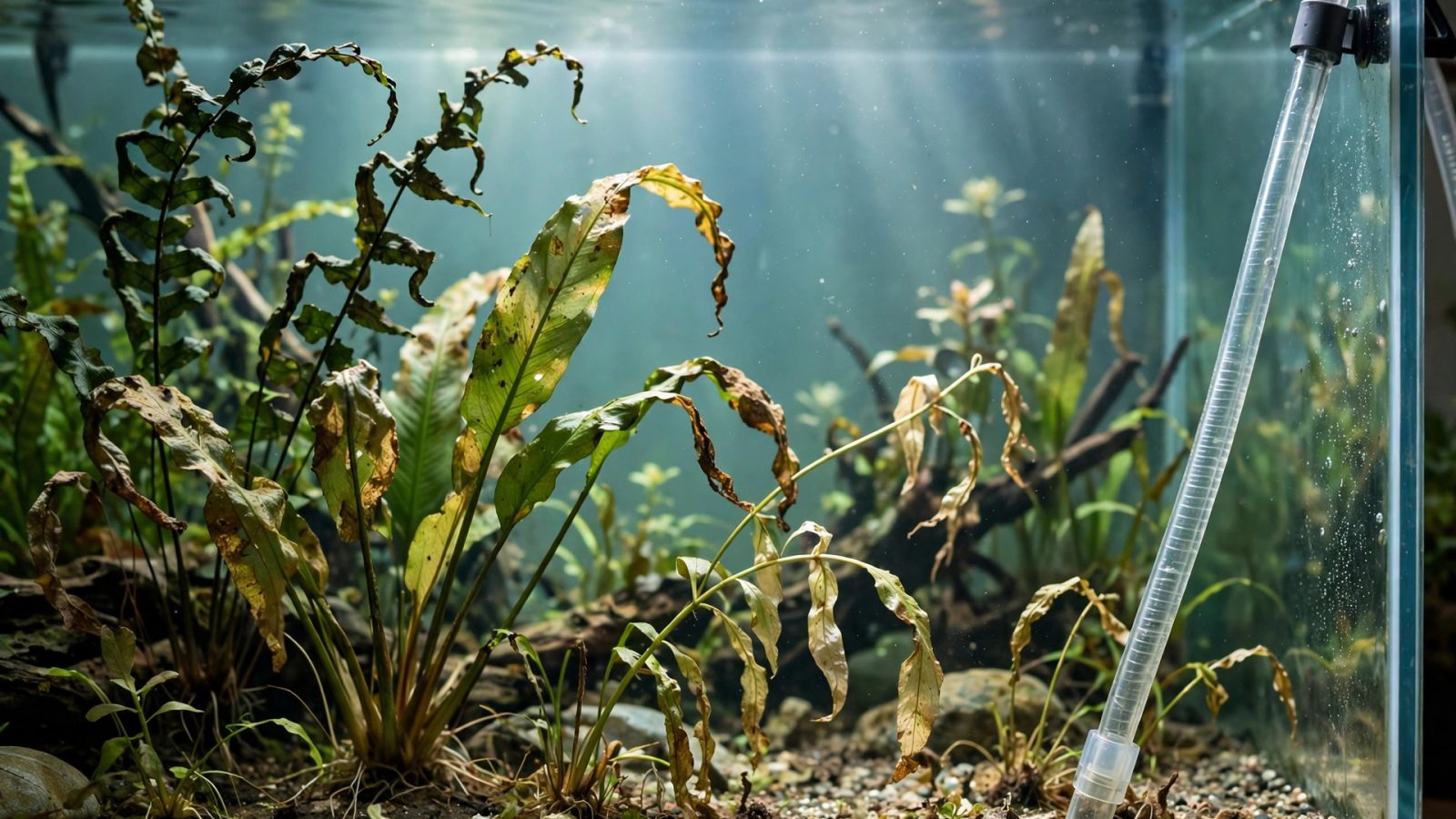
It is deeply confusing when aquarium plants start dying after a water change — the very maintenance meant to help them seemingly hurts them. Leaves go limp, transparent, or melt within 24–72 hours of fresh water going in. The good news: this is one of the most diagnosable problems in the hobby, because the trigger is obvious (the water change itself) and the suspect list is short. Work through the causes below in order.
Cause 1: Chlorine or Chloramine
The most common and most damaging cause. Municipal tap water contains chlorine or chloramine to kill microbes — and it damages plant tissue just as effectively. Under-dosing dechlorinator, forgetting it entirely, or using an old/expired product exposes plants to an oxidizer that burns leaves transparent and melts delicate species.
Diagnosis: damage within hours of the water change; affects delicate plants first (fine-leafed stems, mosses, vallisneria); may coincide with fish gasping too.
Fix: immediate large water change with properly dosed conditioner, or dose conditioner for the full tank volume directly. Going forward: dose dechlorinator for the entire tank volume (not just the replaced water) when filling directly with a hose, add it before the new water hits the tank, and replace conditioner bottles yearly. Know whether your water uses chlorine or chloramine — chloramine needs a conditioner that specifically neutralizes it, and it does not gas off by sitting like chlorine does.
Cause 2: Temperature Shock
Cold water hitting tropical plants ruptures leaf cells — the classic transparent-leaf aftermath. This is most common in winter, when tap cold water runs much colder than the tank, and with large water changes where the temperature swing is biggest.
Diagnosis: transparency and limp tissue after the change; you did not temperature-match; winter or cold climate.
Fix: mix to within 1–2°C of tank temperature before adding — a thermometer takes ten seconds. For the science of cell damage and recovery, see our guide to transparent aquarium plant leaves. Trim destroyed tissue; stable warmth brings regrowth.
Cause 3: pH / KH Swing
If your tap water’s pH or KH differs sharply from the tank’s (common with CO2 injection lowering tank pH, or soft-water tanks receiving harder tap water), a large water change swings the chemistry suddenly. Plants adapted to the tank’s parameters suffer osmotic and pH shock — crypts famously melt from exactly this.
Diagnosis: you run CO2 or keep soft-water species; large water change; sensitive plants (crypts especially) melt within days.
Fix: smaller, more frequent water changes (20% twice weekly instead of 50% once) keep swings gentle. For CO2 tanks, do the water change with CO2 off and let pH stabilize before resuming. Long-term, consider whether your tap parameters suit your livestock and plants — remineralized RO gives full control if tap and tank are fundamentally mismatched.
Cause 4: Disturbed Substrate Releasing Trapped Waste
Aggressive gravel vacuuming in a long-neglected substrate releases a pulse of trapped organics, ammonia, and possibly hydrogen sulfide (the rotten-egg smell of anaerobic pockets). Plants — and fish — suffer in the resulting spike.
Diagnosis: you deep-cleaned substrate that had not been touched in months; rotten-egg smell during the change; ammonia reads above zero afterward.
Fix: water change again to dilute, test ammonia daily for a week, and go easier next time: vacuum a third of the substrate per session, never the whole bed at once. Anaerobic pockets in very deep fine substrate may need a long-term rethink of substrate depth and grain size.
Cause 5: CO2 Fluctuation in Injected Tanks
Water changes drive off dissolved CO2 — fresh tap water holds little, and the agitation gasses out what was there. In high-tech tanks, the sudden CO2 crash followed by the system’s ramp back up is exactly the instability that melts sensitive plants and triggers algae.
Diagnosis: injected tank; melting or transparency in the days after each water change; possibly recurring algae blooms on the same schedule.
Fix: turn CO2 off during the change, refill gently to minimize agitation, then resume CO2 — some hobbyists run it slightly higher for an hour after to rebuild levels faster. Keep water changes modest (30% or less) so the swing stays small.
Cause 6: Contaminated Water Source
Rare but real: plumbing work, a new hose leaching plasticizers, cleaning products used on the bucket, or a municipal water event (flushing, treatment changes) introduces something toxic. Garden hoses are a classic culprit — many contain algicides or lead.
Diagnosis: everything suffers simultaneously including fish; recent plumbing/hose/bucket change; neighbors’ water also affected (municipal event).
Fix: switch to a dedicated aquarium-only hose or buckets, never use soap on aquarium equipment, and run fresh activated carbon. If you suspect a municipal event, call the water utility — they will tell you about flushing or treatment changes.
The Safe Water Change Protocol
Prevent all six causes with one routine:
- Prepare: dedicated bucket/hose, thermometer, conditioner, test kit nearby.
- Temperature-match new water to within 1–2°C.
- Dose conditioner for the full tank volume before new water enters (hose filling) or treat each bucket before pouring.
- Change 25–30%, not 50%+, unless you have a specific reason. Smaller is gentler.
- Vacuum lightly and rotationally — a section per week, not the whole bed.
- CO2 off during, resume after. Let chemistry settle.
- Observe for 48 hours. Early catching of any issue beats late treatment.
Recovery After a Bad Water Change
- Identify the cause from the list above — the fix differs completely.
- Dilute the problem: for chemical causes, another careful water change with perfect technique.
- Trim dead tissue — transparent and melted leaves will not recover and foul the water. See melting vs browning guides to classify the damage.
- Stabilize everything: no fertilizer experiments, no rescapes, steady light. The tank needs boredom, not intervention.
- Test daily for a week (ammonia, nitrite, pH) to confirm the chemistry has settled.
Frequently Asked Questions
How quickly can water-change damage appear?
Chemical damage (chlorine, contamination) can show within hours — limp, glassy tissue the same evening. Temperature and pH shock typically appear within 24 hours. CO2-crash melting in injected tanks unfolds over 2–5 days. If damage appears a full week later, the water change was probably not the cause; look at fertilizer lapses or equipment changes instead.
Are some plants more vulnerable than others?
Yes. Fine-leafed stems (cabomba, myriophyllum), mosses, vallisneria, and crypts are the canaries — they show damage first and worst. Anubias, Java fern, and swords usually shrug off all but the most severe shocks. If only your sensitive species suffered, the event was real but mild; if the tough plants melted too, something seriously toxic entered the water.
Should I stop doing water changes if they hurt my plants?
No — the answer is better water changes, not fewer. Plants need the waste removal and mineral replenishment that water changes provide. Fix the technique using the protocol above.
Can I use straight RO water to avoid tap problems?
RO avoids chlorine and parameter surprises, but pure RO lacks the minerals plants and fish need — it must be remineralized. Many hobbyists blend RO with tap to get the best of both.
How do I know if my conditioner handles chloramine?
Read the label — it will say explicitly. If your municipality uses chloramine (check their water quality report online) and your conditioner only mentions chlorine, upgrade the conditioner.
Water Parameters Worth Knowing: Tap vs Tank
Many water-change problems come from not knowing how different the tap is from the tank. Once, test both side by side and write down the numbers:
- pH: tap vs tank (tank with CO2 runs lower; a difference over 0.8 is a shock risk in large changes).
- GH/KH: soft-water tanks receiving hard tap water swing with every change.
- Temperature: seasonal — test in winter, not just summer.
- Chlorine/chloramine: call your utility or check their annual report; treatment changes seasonally in some municipalities.
- Nitrate in tap: some tap water carries 10–20 ppm nitrate — useful to know when diagnosing algae or deficiency.
Keep this card taped inside your stand. When something goes wrong after a change, it tells you exactly which difference to suspect.
Special Situations
Well water
Well water has no chlorine but its own risks: possible heavy metals (copper from pipes is toxic to invertebrates and stressful to plants), very high CO2 (causes pH swings as it gasses off), or hydrogen sulfide. Test well water comprehensively once, and consider a heavy-metal-binding conditioner.
Water softener systems
Ion-exchange softeners replace calcium/magnesium with sodium — bad for plants (sodium interferes with potassium uptake) and many fish. Bypass the softener for aquarium water, or use RO. This is a common hidden cause of chronic plant struggles in hard-water regions.
Apartment building plumbing
Old buildings can deliver water with elevated copper or lead, especially from hot-water taps (always use cold water for the tank — hot water dissolves more pipe metals). If plants and invertebrates struggle despite good technique, test for copper.
Building a Water-Change Station
For tanks over 100 liters, a simple station removes most error sources: a food-grade brute trash can or barrel, a small heater, a thermometer, a dedicated pump or siphon hose, and conditioner. Fill the barrel the night before, heat and treat it, and water changes become a calm 15-minute task with perfectly matched water — instead of a rushed wrestling match with a cold hose. The investment pays for itself the first time it prevents a shock event.