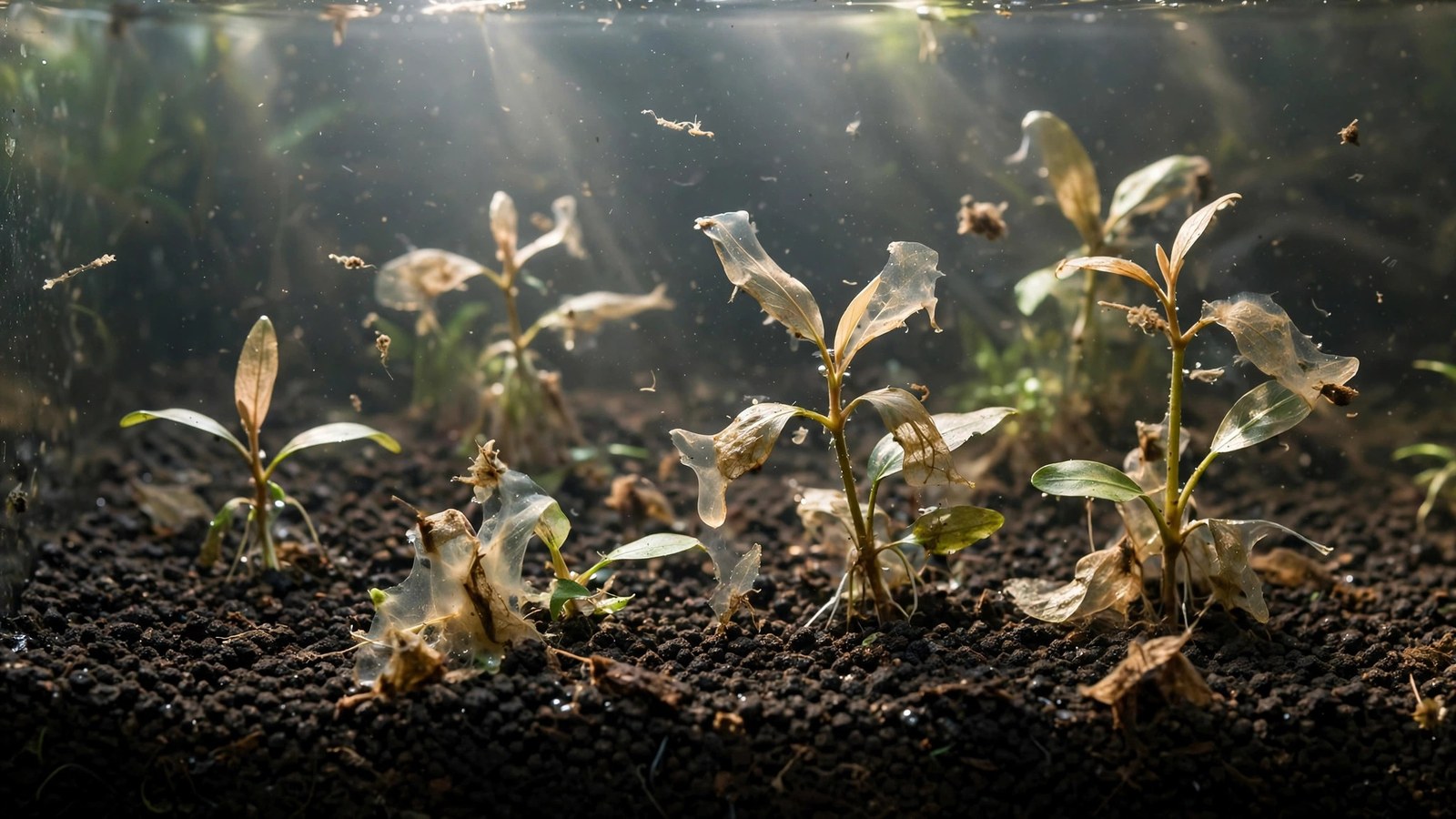
You set up a beautiful new aquasoil tank, planted it densely on day one, and within a week your plants are melting — translucent leaves, mushy stems, the whole sad spectacle. The soil is premium, the plants were healthy, so what happened? Ammonia melt: new aquasoil releases a massive pulse of ammonia as it matures, and that ammonia burns plant tissue faster than the young tank's biology can process it. It's the most common new-tank planting failure, it's entirely predictable, and it's entirely preventable once you understand the cycle.
Why New Aquasoil Melts Plants
The ammonia pulse
Commercial aquasoils (ADA Amazonia, Fluval Stratum, and similar) are nutrient-charged baked soils — that's their virtue and their danger. Fresh out of the bag, they leach ammonia (NH3/NH4+) into the water column at levels that would alarm any fishkeeper: 4–8 ppm in the first week is typical for rich soils like Amazonia.
Ammonia at these levels burns plant tissue directly — it damages cell membranes, disrupts photosynthesis, and triggers the melt response. Delicate new transplants, already stressed from planting, are the most vulnerable. The result: ammonia melt, concentrated in the first 1–3 weeks.
Why it hits some plants harder
- New transplants — roots not yet established can't regulate uptake; damaged shipping tissue is extra vulnerable.
- Delicate stems and carpets — thin leaves and small biomass mean less buffering capacity.
- Tissue-culture plants — ironically, the sterile, pest-free plants melt more in fresh aquasoil because their tiny root systems are overwhelmed.
- Resilient: established potted plants with robust roots, anubias, java fern — tougher tissue rides it out.
The maturation curve
The ammonia pulse peaks in week 1–2 and tapers over 4–8 weeks as the soil's readily-soluble nutrients exhaust and bacterial colonies establish. Rich soils (Amazonia) pulse harder and longer; leaner soils (Stratum, controsoil) pulse milder. By month two, the soil becomes what you paid for: a stable, nutrient-rich, plant-growing paradise. The melt window is the price of admission.
Ammonia Melt vs. Other Melts
| Feature | Ammonia melt (new aquasoil) | Transplant melt | Carbon crash |
|---|---|---|---|
| Timing | Days 3–21 after setup | Weeks 1–4 after planting | Days after CO2 interruption |
| Pattern | All plants, worst on delicate/new | Emersed leaves only | Fast growers first |
| Water test | Ammonia 2–8 ppm | Ammonia normal | Ammonia normal |
| Smell | None (ammonia is odorless in water) | None | None |
Test ammonia. If it's elevated and the soil is fresh, that's your answer — no further diagnosis needed. See our full melting guide for other melt types.
Daily ammonia tests distinguish aquasoil melt from other causes: API Freshwater Master Test Kit.
Prevention: The Dark Start Method (Best Practice)
The professional approach: cycle the soil before planting.
How to dark-start
- Set up hardscape and soil — fill the tank, install filter and heater. No plants, no light (or minimal light).
- Run for 2–4 weeks with the filter going. The ammonia pulse happens with nothing alive to burn.
- Water changes: 50% twice weekly for the first two weeks, then weekly. Each change exports ammonia and speeds maturation.
- Test ammonia weekly. When it reads zero for a full week, the soil is tamed.
- Plant into mature soil. Transplants establish in days instead of melting for weeks. The difference is dramatic.
Dark-starting adds weeks upfront and saves months of melt-recovery. Every serious aquascaper does some version of this. The impatience tax for skipping it is paid in melted plants.
If you already planted (the rescue path)
Planted on day one and melting? Don't tear down — manage through it:
- Massive water changes: 50% daily for the first week, 50% every other day for week two, then twice weekly until ammonia reads zero. This is the core treatment — dilution defeats the pulse.
- Don't add livestock until ammonia and nitrite read zero for a week. Fish-in cycling over fresh aquasoil is cruelty with extra steps.
- Remove melted tissue daily — rotting leaves add their own ammonia to the soil's pulse.
- Reduce light to 6 hours — stressed plants can't use full light; excess grows algae on melting tissue.
- Hold fertilizer — the soil is already force-feeding nutrients; water-column dosing during the pulse is redundant and risks algae.
- Seed bacteria: add established filter media or a bacterial starter to accelerate ammonia processing.
What Survives and What to Replant
- Stems: trim melted portions back to firm nodes; most resprout once ammonia drops. Don't discard the root systems.
- Carpets: the hardest hit and slowest to forgive. Melted carpet often needs replanting after the soil matures — budget for it.
- Crypts: will crypt-melt (their signature) and return from roots in weeks. Leave them alone.
- Anubias/ferns: usually survive with minor leaf loss. Remove mushy leaves, keep rhizomes.
- Replanting strategy: let the soil mature 3–4 weeks, then replant the casualties. Second plantings into matured soil establish explosively — many keepers report the replant outperforms the original ever would have.
Aquasoil Types and Their Pulse Strength
- ADA Amazonia (normal/powder): strongest pulse — 4–8 ppm ammonia, 4–8 weeks to mature. Richest long-term. Dark-start strongly recommended.
- ADA Amazonia Light: milder pulse, 2–4 weeks. A compromise for the impatient.
- Fluval Stratum: moderate pulse, 2–4 weeks. Popular beginner soil partly for this reason.
- Tropica / Controsoil: mild pulses, faster maturation.
- Inert substrates (sand/gravel): no pulse at all — but no nutrients either. Different trade-off, different planting strategy (root tabs + water-column dosing from day one).
The Ammonia–Algae Connection
Fresh aquasoil doesn't just melt plants — the ammonia pulse is algae's favorite trigger. Diatoms, hair algae, and green water all love week-two aquasoil tanks. The same water changes that protect plants also prevent algae; the reduced photoperiod serves double duty. If algae blooms during the pulse, treat it as a symptom — our diatom guide and hair algae guide cover the specifics, but the underlying fix is always: water changes until the soil matures.
Water Change Logistics During the Pulse
The "50% daily water changes" prescription sounds simple until you're hauling buckets for two weeks. Make it sustainable: use a Python-style siphon or a pump — manual buckets burn out keepers by day five, and burnout means skipped changes, which means ammonia spikes. Prepare dechlorinated water in advance (a brute trash can with a heater works for large tanks), temperature-match roughly, and pour gently to avoid blasting the fresh soil into clouds.
One caution: don't vacuum the soil surface aggressively during the pulse. The soil is still settling and its granules are fragile when fresh — aggressive gravel-vacuum churning breaks granules into mud and releases more ammonia. Hover the siphon just above the surface to lift detritus and melted plant matter without disturbing the soil bed. Deep substrate cleaning comes months later, once the soil has stabilized and bacterial colonies are established throughout.
Locks up the ammonia pulse from fresh aquasoil between water changes: Seachem Prime.
Frequent large water changes are the logistics; this is the tool: Aqueon siphon vacuum.
Frequently Asked Questions
How long does new aquasoil leach ammonia?
Typically 4–8 weeks for rich soils like ADA Amazonia, 2–4 weeks for milder soils like Fluval Stratum. The peak is weeks 1–2. Test weekly: when ammonia reads zero for seven consecutive days with no water change in between, the pulse is over. Dark-starting (cycling without plants) burns through this period with nothing at risk.
Can I put fish in a new aquasoil tank right away?
Absolutely not with rich soils — 4–8 ppm ammonia kills fish quickly and cruelly. Wait until ammonia and nitrite read zero for a full week, then stock gradually. This typically means 4–6 weeks for Amazonia. The soil's pulse is a fishless-cycle feature, not a bug — use it to build bacteria, then add livestock to a mature system.
Should I rinse aquasoil before using it?
No — rinsing destroys the soil's structure (it crumbles into mud) and washes away the nutrients you paid for. Aquasoil goes in dry, straight from the bag. The dust cloud on first fill is normal; it settles within hours with filtration. Cloudiness that persists for days is a different issue (usually disturbed soil or bacterial bloom), not a rinsing failure.
My plants melted but ammonia reads zero. What else could it be?
Then it's not ammonia melt — check the timeline and pattern against transplant melt (emersed leaves only, normal ammonia — our melting guide), carbon crash (CO2 interruption — our CO2 crash guide), or simple transplant shock. Zero ammonia with melting in week one often means the plants were already compromised (shipping damage, store neglect) rather than a water problem.
Can I cap aquasoil with sand to reduce the ammonia pulse?
Capping slows the pulse slightly but doesn't prevent it — ammonia diffuses through sand readily. Worse, capping complicates the soil's long-term function (nutrient exchange, root penetration) and makes replanting messy. It's a marginal gain for real trade-offs. Dark-starting or aggressive water changes are more effective and don't compromise the substrate. Cap for aesthetics if you like the look, not for ammonia control.
Pay the Price Upfront, Profit for Years
New aquasoil's ammonia pulse is the entrance fee to the best planted-tank substrate available. Pay it with a dark start — or pay it in melted plants and daily water changes. Either way the soil matures into exactly what you bought: rich, stable, and capable of growing plants that make inert-substrate keepers weep. The melt is temporary; the soil is for years. Plan for the pulse and it becomes a footnote instead of a disaster.