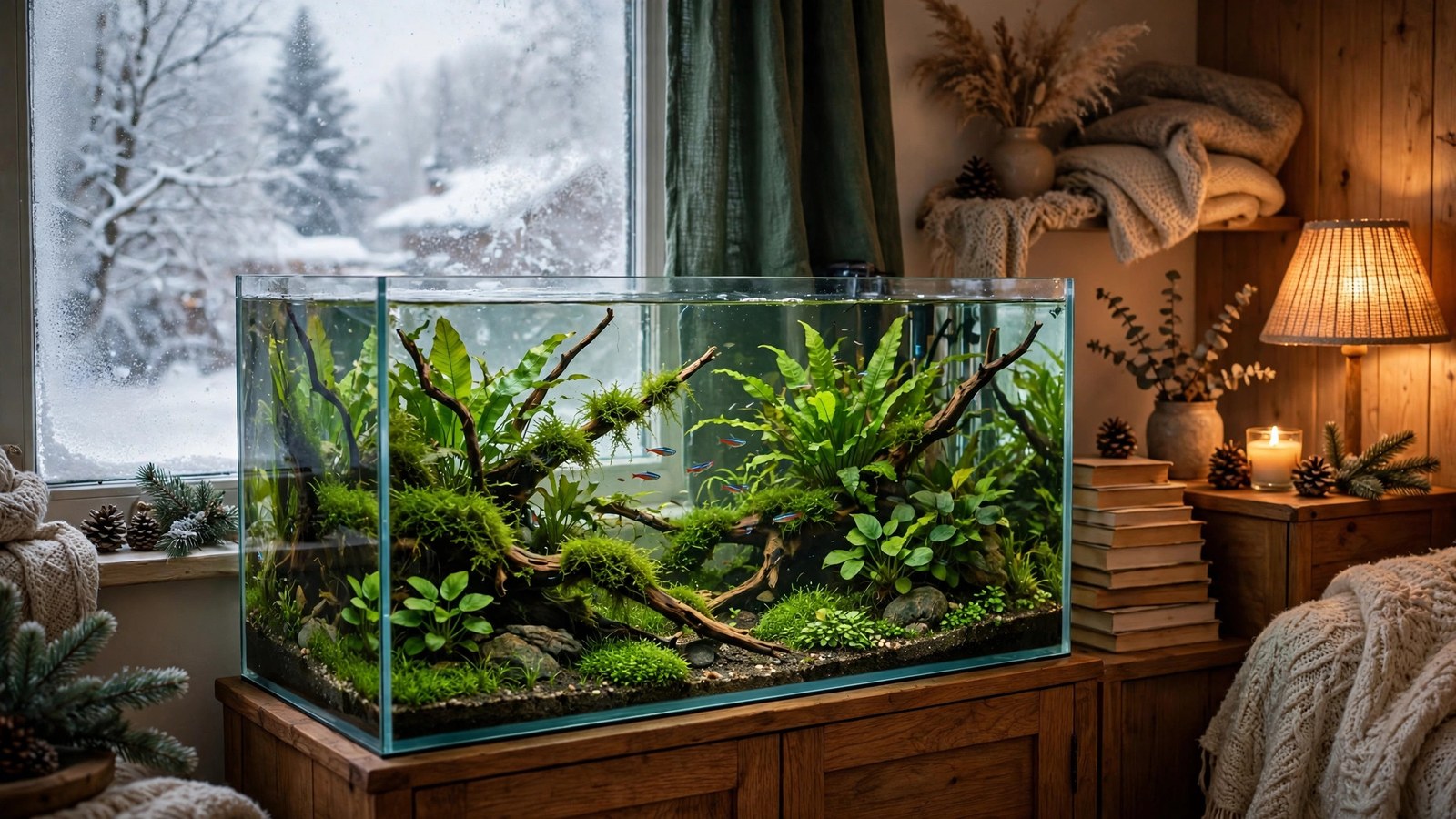
When October arrives, the days shorten, rooms cool down, and indoor planted tanks start behaving differently. Algae creeps in where plants used to outcompete it, stem plants stall, and a heater you ignored all summer suddenly matters. Learning how to winterize planted aquarium setups means recalibrating light, nutrients, and temperature for months of lower ambient light and slower growth — not sealing anything off.
This fall and winter care checklist covers every adjustment a planted tank needs: photoperiod and intensity changes, fertilizer and CO2 recalibration, a pre-winter pruning routine, heater strategy and cold-snap backup plans, and the seasonal pitfalls that catch even experienced aquarists. Make these tweaks in October and your tank will glide through March looking better, not worse.
Why Planted Aquariums Change in Fall and Winter
Indoor tanks are not immune to the seasons. The biggest factor is ambient light: most planted tanks receive meaningful natural light from windows for much of the year, and that contribution can fall to nearly zero on short, overcast winter days. Plants that were cruising on artificial light plus bright window light are suddenly living on the artificial light alone, and their growth rate drops accordingly.
Room temperature is the second shift. Heating systems cycle on and off, indoor air dries out, and rooms can swing several degrees between day and night — affecting water temperature, evaporation, and heater consistency. The practical upshot: winter growth is slower, so everything you dose for fast growth — light, fertilizer, CO2 — must be scaled back in proportion. Tanks that are not recalibrated are where winter algae blooms come from.
Step 1: Adjust Your Photoperiod and Light Intensity
Light is the throttle for everything else in a planted tank. When ambient light drops, keeping summer settings usually means one of two failures: too much light for slowed plant growth (algae), or plants that are light-limited while nutrients are still dosed for high-energy growth (deficiencies and melting).
Shorten the photoperiod
Drop the main light period by 1–2 hours for winter. A tank that ran 8 hours through summer typically does best at 6–7 hours from October through February — trim 30 minutes per week so you can watch how algae and plant color respond. Keep the schedule consistent; use a timer if you are not already, since irregular lighting causes more algae trouble than slightly too much lighting.
If your fixture has dimming, consider reducing intensity 10–20% rather than shortening the period further. Do one or the other — shorter period or lower intensity — not both at once, so you can attribute changes correctly.
Manage window light
Tanks near windows deserve special attention in winter. Low-angle winter sun can rake across a tank for an hour or two and trigger algae on the glass and slow growers, while contributing almost nothing useful to photosynthesis. A sheer curtain or background film on the window side smooths out that spike. Watch for the telltale sign: a band of algae mapping exactly to the window's light path.
Step 2: Recalibrate Fertilizer and CO2 for Slower Growth
Plants growing at half speed need roughly half the inputs. Continuing full summer dosing through winter is one of the most common causes of the January algae explosion.
Scale back fertilizer dosing
Reduce liquid fertilizer dosing by 30–50% when you shorten the photoperiod. If you dose an all-in-one weekly, try half-strength for two weeks and observe new growth: healthy new leaves with normal color mean the reduced dose is sufficient; pale new growth or pinholes suggest you cut too far. Root-feeding plants such as swords and crypts need root tabs on their normal replacement interval — which already accounts for slower uptake — not an accelerated winter schedule.
If you run an automated dosing system, this is the season to revisit its program; our guide to automatic fertilizer dosers for planted tanks covers how to dial schedules down without destabilizing the tank. Shrimp keepers should stay conservative year-round: stick with formulas proven safe for invertebrates, as covered in our shrimp-safe fertilizer guide, and resist chasing deficiencies with double doses.
Recalibrate CO2 injection
On injected tanks, slower growth means lower CO2 demand. A drop checker that sat at lime green all summer may drift toward yellow as plant uptake falls — that is a signal to reduce the bubble rate, not to celebrate. Cut the injection rate 20–30%, keep the solenoid schedule matched to the shortened light period, and re-check the drop checker after a few days. Leaving CO2 at summer levels while plants slow down risks stressing livestock for no plant benefit.
Seasonal dosing comparison
| Parameter | Summer setting (fast growth) | Winter setting (slow growth) |
|---|---|---|
| Photoperiod | 7–9 hours | 6–7 hours |
| Light intensity | Full | 80–90% or shorter period |
| Liquid fertilizer | Full dose | Half to two-thirds dose |
| CO2 bubble rate | Full rate | Reduce 20–30%, re-check drop checker |
| Water changes | Weekly 30–50% | Weekly 25–30% (stable, slightly lighter) |
| Pruning cadence | Weekly–biweekly | Monthly, lighter trims |
Step 3: Do a Pre-Winter Pruning and Grooming Session
October is the ideal month for a thorough tank tidy before growth slows. Dense summer canopies shade lower leaves, and dead or shaded foliage rotting through winter fuels algae and ammonia spikes.
Thin out stem-plant tops so light reaches the lower stems, remove leaves showing advanced decay, and replant healthy tops where gaps have formed. Fast growers that filled the background all summer can be cut back harder now — they will not rebound quickly, and an overgrown winter tank traps detritus. Follow a consistent aquarium plant pruning schedule and the methods in our plant grooming guide rather than improvising one heavy cut.
If you are replanting trimmings, trim tired root masses first — our guide to root pruning before replanting explains how a modest root trim encourages fresh feeder roots instead of a rotting tangle. Clean the filter gently (rinse media in tank water, never tap water), vacuum visible detritus, and wipe the glass. A clean baseline in October makes winter maintenance almost boring, which is exactly what you want.
Step 4: Lock In Your Heater Strategy
Most tropical planted tanks target 24–26°C (75–79°F). The heater is the one piece of equipment winter will expose if it is undersized or aging.
Check sizing and condition
The rule of thumb is roughly 1 watt per liter (about 4 watts per gallon) for rooms that stay reasonably warm, and more if the room drops below 18°C (65°F) at night. Test every heater in October: confirm it holds the set temperature overnight, verify against a separate thermometer (heater thermostats drift with age), and inspect cords and seals for damage. A heater that ran fine all summer in a 22°C room can fail to keep up when the room hits 15°C in January.
Consider a heater controller as cheap insurance. An external thermostat adds a second, independent cutoff — if the heater's internal thermostat sticks on, the controller kills power before the tank overheats.
Plan for cold snaps and power outages
Winter storms cause the outages that kill tanks. Prepare a simple emergency kit before you need it:
- Battery-powered air pump with an airstone — oxygen is the first crisis in a still tank, before temperature.
- Insulation: blankets or towels wrapped around the tank slow heat loss dramatically.
- Warm water bottles: float sealed bottles of warm (not hot) water to nudge temperature up gradually. Never pour hot water directly into the tank.
- Do not feed during an extended outage — uneaten food and reduced filtration compound the problem.
- Keep the lid on to retain heat; resist the urge to keep checking.
Plants tolerate short temperature dips far better than fish and shrimp do, so outage planning centers on livestock — but a tank that swings 8°C will often show a week of melted leaf tips afterward. Stability is the goal.
A reliable adjustable heater is the core of the winter plan: EHEIM Jager heater.
Step 5: Review Stocking and Feeding for Winter
Cooler rooms and shorter days subtly slow livestock metabolism. Fish may eat slightly less and move less; that is normal, not illness. Reduce feeding to what is consumed in 2–3 minutes once or twice daily, and siphon uneaten food promptly — decaying food in a slow-growing winter tank feeds algae, not plants.
Autumn is a fine time to finalize stocking before winter, but avoid adding large numbers of new fish in December or January. New arrivals stressed by cold shipping water plus a biologically quieter tank are a recipe for problems. The same cold-weather caution applies to plants bought online: read our guide to shipping aquarium plants so you know what proper cold-weather packaging looks like — and what to do when a package arrives chilled.
Step 6: Fight the Winter Algae Traps
Winter algae follows predictable patterns. Knowing them in advance lets you respond in days instead of discovering a green tank in February.
- Light/nutrient mismatch: the number one cause. If algae appears within weeks of your photoperiod change, you cut light but not dosing (or vice versa). Rebalance using the table above.
- Window sun bands: as described earlier, low winter sun raking across glass. Diffuse it.
- Decaying summer growth: shaded lower leaves rotting after the canopy closes. The October pruning session prevents this.
- Overfeeding quiet fish: uneaten food in a slow tank. Feed less, siphon more.
- UV sterilizer season: some aquarists run a UV unit through the darker months as green-water insurance when the tank's balance is shifting. If you go that route, size it correctly and understand the trade-offs — our UV sterilizer guide for planted tanks covers when it helps and when it is unnecessary.
Resist drastic "winter clean" overhauls — tearing down substrate or replacing all filter media in November destabilizes the biology right when you need stability most. Small, consistent maintenance beats heroic interventions.
How to Winterize Planted Aquarium Tanks: The October Checklist
Work through this once and your tank is set until spring:
- Shorten photoperiod to 6–7 hours (or dim 10–20%); put lights on a timer.
- Diffuse low-angle winter sun from nearby windows.
- Cut liquid fertilizer dosing 30–50%; review auto-doser schedules.
- Reduce CO2 bubble rate 20–30%; re-check the drop checker.
- Do the pre-winter prune: thin canopies, remove decay, replant healthy tops.
- Rinse filter media in tank water; vacuum detritus; wipe glass.
- Test every heater against a separate thermometer; confirm sizing for cold nights.
- Assemble the outage kit: battery air pump, blankets, warm-water bottles.
- Ease off feeding to match slower livestock metabolism; hold major stocking additions until spring.
- Keep water changes steady — weekly 25–30%, no skipped months.
Frequently Asked Questions
Should I turn my aquarium heater off in winter if the room is warm?
No — keep it plugged in and set. Indoor heating cycles on and off, and rooms can drop several degrees overnight or during a cold snap while you sleep. A heater set to your target temperature simply stays idle when the room is warm enough and engages when it is not. Unplugging it removes your safety net for exactly the nights you need it, and re-plugging a cold tank forces the heater to work much harder to recover.
Do aquarium plants go dormant in winter?
Most tropical aquarium plants do not go truly dormant, but they slow down substantially when light and temperatures drop. Expect slower stem elongation, smaller new leaves, and reduced nutrient uptake from roughly November through February. This is normal and not a deficiency — the mistake is treating slow winter growth as a problem to fix with more fertilizer or light, which usually just feeds algae instead.
How cold is too cold for a planted tank during a power outage?
Most tropical plants tolerate brief dips into the high teens Celsius (low 60s Fahrenheit) without lasting damage, though you may see some leaf-tip melt afterward. The livestock sets the real limit: tropical fish and shrimp stress below about 20°C (68°F) and face serious danger under 15°C (59°F). Focus outage efforts on insulation and gentle warming, prioritize aeration, and avoid sudden temperature swings, which harm tank inhabitants more than a slow, moderate drop.
Should I stop dosing fertilizer entirely in winter?
No. Plants still grow in winter, just more slowly, and zero dosing invites deficiencies — pale new growth, pinholes, melting — that are harder to correct in a low-energy tank. The right move is a reduced, consistent dose matched to your shorter photoperiod: typically half to two-thirds of summer levels. Watch new growth for two to three weeks after any change and adjust in small steps.
Can I still trim and replant in winter?
Yes, but trim lighter and less often. Monthly light maintenance trims are plenty when growth is slow, and heavy replanting projects are better saved for spring when plants rebound quickly. If you do replant trimmings in winter, keep root systems modest and give new plantings stable conditions — disturbed plants in a low-energy tank take longer to establish, so minimize the number of plants you move at once.
Is algae in winter a sign my tank is failing?
Not necessarily — it usually means the tank's inputs no longer match its slower growth rate. Winter algae is most often caused by summer-level light or fertilizer persisting into the darker months, a burst of low-angle window sun, or decaying foliage from an untrimmed summer canopy. Rebalance light and dosing together, remove decay, and diffuse window light. Persistent algae after those fixes points to an underlying imbalance worth investigating, not a seasonal quirk.
Boring Winter Tanks Are Healthy Winter Tanks
The best winter outcome is an uneventful one: steady parameters, slow but healthy growth, and glass you only clean on schedule. That is what it means to winterize planted aquarium systems properly — the light adjustment, the dosing recalibration, the big prune, the heater check — and it buys you four months of calm. When spring lengthens the days, reverse the process gradually: add light and nutrients back in small steps as growth visibly accelerates. Your plants will reward the patience with a vigorous spring flush, and you will have skipped the winter algae saga entirely.