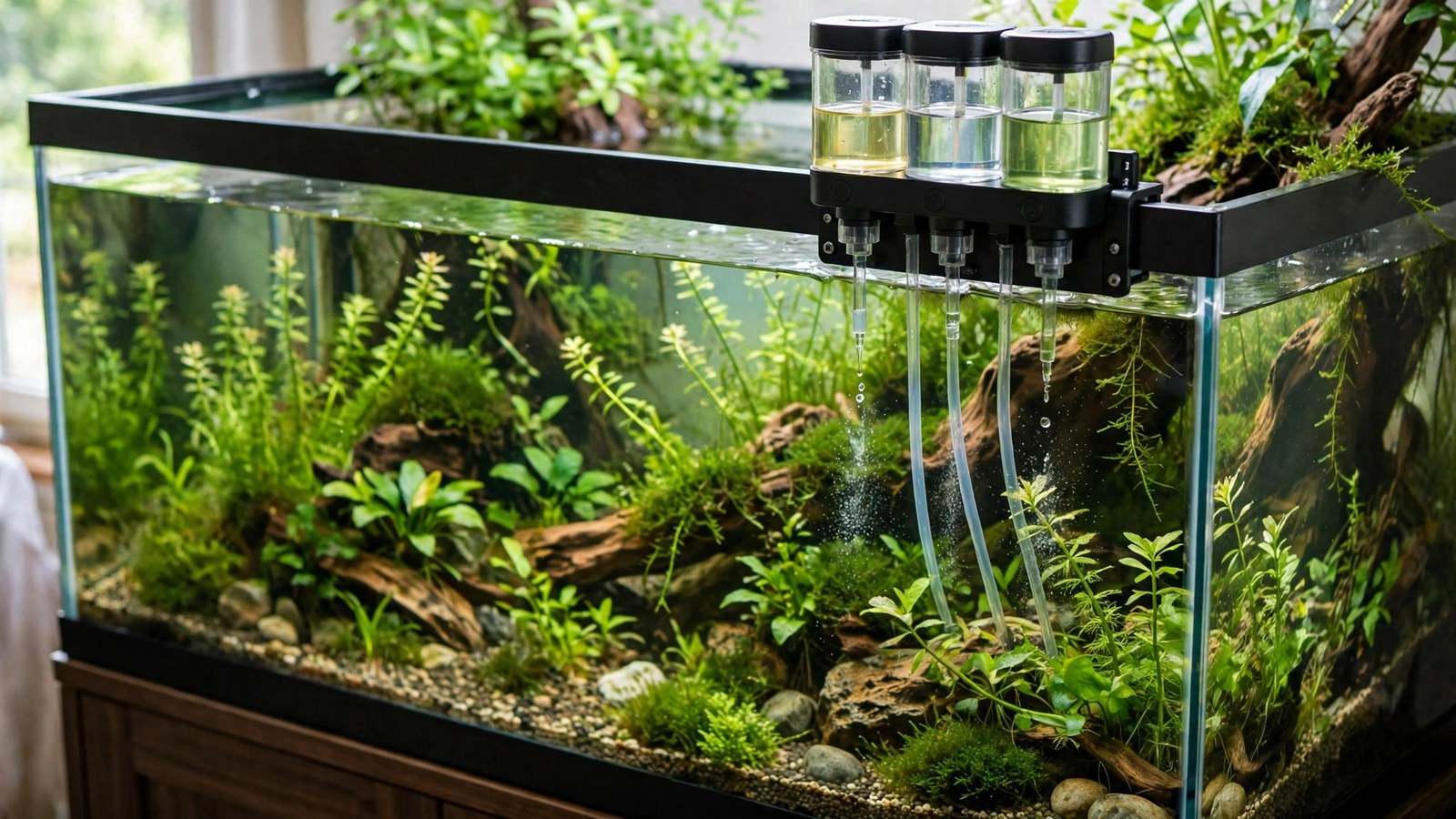
An automatic fertilizer doser aquarium setup is one of those gadgets you do not know you need until you see a lush high-tech tank being fed on a timer while its owner is away. These small programmable pumps drip precise milliliters of liquid fertilizer into your tank on a schedule you set — no more daily squeeze-bottle routine. But at fifty to two hundred dollars, are they genuinely worth it? This guide covers how automatic dosers work, pump types and costs, setup and calibration, pairing with your dosing method, and who actually benefits.
What an Automatic Fertilizer Doser Actually Is
Strip away the marketing and an automatic fertilizer doser is simply a peristaltic pump with a timer. Rotating rollers squeeze a flexible tube, pushing a tiny measured volume of liquid forward with every rotation. Because the fertilizer never touches the pump mechanism itself, these pumps handle fertilizer solutions and DIY dry-salt mixes without corroding the motor.
This design is what makes dosing pumps so precise. A decent unit can dispense volumes down to a tenth of a milliliter, day after day — steadier than any hand with a cap, and it never forgets whether yesterday's dose went in. The doser's value is not power but relentless consistency: the same small dose at the same time, with no skipped days and no double doses.
The Main Types of Dosing Pumps
Not all dosers are the same machine. The right choice depends on how many different fertilizers you want to dispense and how much control you want over timing.
Single-Head Dosers
A single-head doser has one pump channel and moves one liquid. These are the cheapest entry point and suit aquarists running a simple all-in-one liquid fertilizer, where macros and micros arrive pre-mixed in one bottle. If your whole plan is one daily pump of all-in-one, a single-head unit does the job — but it cannot dose macros and micros separately.
Multi-Channel Dosing Pumps
Multi-channel pumps pack two, three, four, or more independent pump heads into one box, each on its own schedule — the standard choice for serious planted tanks, where DIY methods demand separate solutions. A three-channel unit can dose a nitrate solution, a phosphate solution, and a trace-element mix on staggered timers, with extra channels left for extras like a liquid carbon supplement.
Standalone vs. App-Controlled Models
Cheaper dosers use onboard buttons and a small screen; pricier units connect over Bluetooth or Wi-Fi so you can adjust schedules from your phone — handy, since the schedule is the thing you adjust most. Common categories in shops include standalone single-head hobby dosers, app-controlled multi-channel reef-style dosing pumps (standard equipment in the saltwater world), and larger laboratory-style multi-head units.
The classic entry-level 4-head doser most guides benchmark against: Jebao DP-4 dosing pump.
What a Doser Can (and Can't) Do for Your Tank
A doser automates the delivery of fertilizer — it cannot design your fertilization plan. If your recipe is wrong, a doser simply delivers the wrong recipe with superhuman discipline, and algae does not care whether excess phosphate arrived by hand or by robot.
What the machine genuinely improves:
- Consistency: daily doses land at the same time every day, smoothing out the peaks and valleys of weekly lump dosing.
- Small, frequent doses: splitting a weekly dose into seven daily drips reduces the nutrient spikes that can trigger algae in high-energy tanks.
- Absence-proof feeding: the tank gets fed during holidays and busy weeks — when most manual routines quietly collapse.
What it cannot do: observe your plants, notice slowed growth, read pale new leaves as iron deficiency, or adjust the recipe when you add CO2 or upgrade lights. The doser is a pair of tireless hands, not a brain. You still set the amounts — conservative, and adjusted to what you actually see in the tank.
Setting Up an Automatic Doser, Step by Step
- Mix and label reservoirs. Prepare each fertilizer solution in a clearly labeled bottle with the mixing date. Keep macro and micro mixes separate — combined, iron and phosphate can precipitate into unusable sludge. Dark bottles under the cabinet slow the light degradation of chelated trace elements.
- Mount the pump above the reservoir. Position the pump higher than the liquid level in the reservoirs and, ideally, above the tank water line. Then gravity cannot drain a bottle into the aquarium if a check valve fails or the pump sticks open.
- Route the tubing cleanly. Run the intake into the bottom of each reservoir and the output into the tank or filter return stream, secured so it cannot slip out. Keep runs short and tidy — sagging lines hide air bubbles and kinks.
- Prime and calibrate each head. Run the pump until liquid reaches the tube end, then measure what it dispenses into a syringe over one minute and enter that rate into the controller. Re-check after the first month — new tubing beds in and flow rates drift.
- Program the schedule. Convert your weekly recipe into daily amounts (weekly dose ÷ 7 is the usual starting point) and stagger macro and micro doses by several hours. Dose while the filter is running so the output mixes instantly.
- Run a test week. For the first seven days, verify each dose actually landed — a syringe at the tube end once or twice confirms it. Only after a clean test week should you trust the doser while traveling. Start low, observe plants and livestock, and adjust up only when the tank's response tells you to.
Pairing a Doser with Your Dosing Method
A doser does not replace your dosing philosophy — it executes it. Whatever method you follow, the workflow is the same: calculate the dose, mix the reservoirs, program the schedule, calibrate, then observe and tweak:
- Estimative Index (EI): put each dry salt's solution on its own channel and let the doser handle the alternating macro/micro days. Our Estimative Index beginner's guide covers the recipe; the doser just automates the delivery.
- PPS-Pro: this method's whole identity is small daily doses of lean solutions — exactly what dosing pumps do best. Follow the PPS-Pro dosing approach for solution strengths, then let the pump deliver them.
- All-in-one fertilizers: the simplest pairing — one bottle, one channel, one daily program. See our guidance on choosing the right liquid fertilizer before you load the reservoir.
One conservative principle travels across all methods: when you automate, begin at half to three-quarters of your previous manual dose and creep upward over two to three weeks while watching new growth and algae. Build the doser's program into your regular fertilizer schedule, and fold reservoir-refill checks into your weekly plant routine so an empty bottle never goes unnoticed.
An all-in-one keeps the reservoir simple: NilocG Thrive all-in-one.
Cost vs. Convenience: Manual Dosing Compared
| Factor | Manual Dosing | Automatic Doser |
|---|---|---|
| Upfront cost | Near zero (syringe or measuring cup) | $50–$200+ for the pump, plus tubing and reservoirs |
| Daily time | 2–5 minutes per tank | Near zero after setup |
| Consistency | Depends on memory and discipline | Mechanical — same dose, same time |
| Risk of error | Missed days, double doses | Calibration drift, clogs, empty reservoirs |
| Holiday coverage | Needs a tank sitter | Runs unattended for weeks |
| Fine-tuning | Instant — just pour differently | Menu or app edit, still quick |
The honest math: for one small tank and one fertilizer, manual dosing wins on cost for years. The doser pays back when the daily routine is a genuine burden — multiple tanks, a demanding high-tech setup, or frequent travel. The community's collected data on weekly nutrient consumption in planted aquariums from UKAPS is a good sanity check for your recipe — and a reminder to keep automated doses conservative.
Maintenance and Failure Modes
A doser is low-maintenance, not no-maintenance. Most failures are mundane and preventable:
- Clogged tubing and check valves: crystallized fertilizer in the output line is the classic cause of a channel that silently stops delivering. Flush lines with warm water at each refill.
- Siphon accidents: a reservoir above the tank with no anti-siphon measure can drain fertilizer into the tank if a check valve fails. Keep the pump above the liquid level and the output tube end above the water line.
- Tubing wear: peristaltic rollers compress the same tube section thousands of times. Inspect the pump-head tube every few months for thinning or cracks — a burst tube means an unmeasured dump.
- Empty reservoirs: the pump will happily pump air for weeks. Check liquid levels weekly and mark a "refill by" line on each bottle.
The golden rule: automate the delivery, but never stop looking at the tank. If algae appears or shrimp act stressed, pause the doser and reassess the recipe. Livestock safety always outranks plant growth — start low and observe.
Who Actually Benefits Most
Dosers shine in specific situations rather than as a universal upgrade:
- Large or multiple tanks: measuring fertilizer for three tanks every morning is real labor — automation buys back time and consistency.
- Frequent travelers: with an auto-top-off and a feeder, a doser lets a planted tank coast a week or two with no sitter touching chemicals.
- High-tech setups: tanks under strong light and CO2 respond dramatically to nutrient instability; daily micro-dosing smooths the curve they prefer. Be extra careful when you fertilize a new aquasoil tank, where ammonia leach plus automation can compound mistakes.
- Breeding and grow-out racks: a dozen identical tanks plus one doser with a manifold is an enormous time saving.
Conversely, a single low-tech tank dosed twice a week barely justifies the expense. Note that automated liquid dosing pairs naturally with a root tabs vs liquid fertilizer strategy — see our companion guide on the best root tabs for planted tanks. And a doser changes nothing about water changes — read whether aquarium plants need water changes to keep the export side of your routine in place.
Frequently Asked Questions
Can an automatic doser overdose my tank and kill fish?
Yes, if it malfunctions or is programmed wrongly — but the realistic risks are preventable. Keep the pump above the reservoir, keep output tubes above the water line, start every new setup at a reduced dose, and verify that doses actually land during the first week. Observe your livestock closely whenever you change the schedule.
How accurate do automatic dosing pumps actually get?
Calibrated hobby units reliably deliver within 0.1–0.2 mL per dose — steadier than hand-pouring for small daily doses. Accuracy depends on calibrating with your actual tubing and liquid, since viscosity and tube wear shift flow rates over time. Re-calibrate every couple of months or after replacing tubing.
Do I still need water changes if I use a doser?
Absolutely. A doser only adds nutrients; it removes nothing. Water changes remain essential for exporting accumulated waste, resetting nutrient levels, and replenishing carbonate hardness, particularly in nutrient-rich methods like EI. Automating the input side does not automate the export side.
Can one doser feed several tanks at once?
Yes, with limits. Each channel delivers one liquid to one output line, but aquarists commonly split one channel's output with a manifold across several identical tanks on the same recipe. For tanks with different needs, you need separate channels or pumps, with independent calibration per line.
Will a doser work with my all-in-one fertilizer, or only DIY dry salts?
Both. A single-head doser with a commercial all-in-one is the simplest setup — one bottle, one program. DIY dry-salt mixes (EI, PPS-Pro) actually benefit more, since their multi-bottle recipes are the fiddly routines automation eliminates. Either way, keep macros and micros in separate reservoirs if your method requires it.
How long do dosing pump tubes last before replacement?
Typical silicone or Norprene peristaltic tubing lasts six to twelve months of daily use, varying with duty cycle and fertilizer chemistry. Inspect the section inside the pump head every few months for flattening, thinning, or cracks — replacement is cheap and takes minutes.
The Bottom Line: Convenience Upgrade or Essential Tool?
An automatic fertilizer doser is one of the rare aquarium gadgets that genuinely does what it promises: it delivers fertilizer consistently, precisely, and without you. Whether fifty to two hundred dollars is worth it depends on your situation. For a single low-tech tank, it is a luxury. For a high-tech showpiece, a multi-tank fish room, or anyone who travels, it becomes infrastructure, paying for itself in consistency and peace of mind within the first year.
If you buy one, let the recipe lead and the machine follow: dial in your dosing method first, start conservative, calibrate carefully, and never stop reading your plants. The doser removes the chore of dosing — but the thinking part of fertilization, the part that keeps plants thriving and livestock safe, still belongs to you.