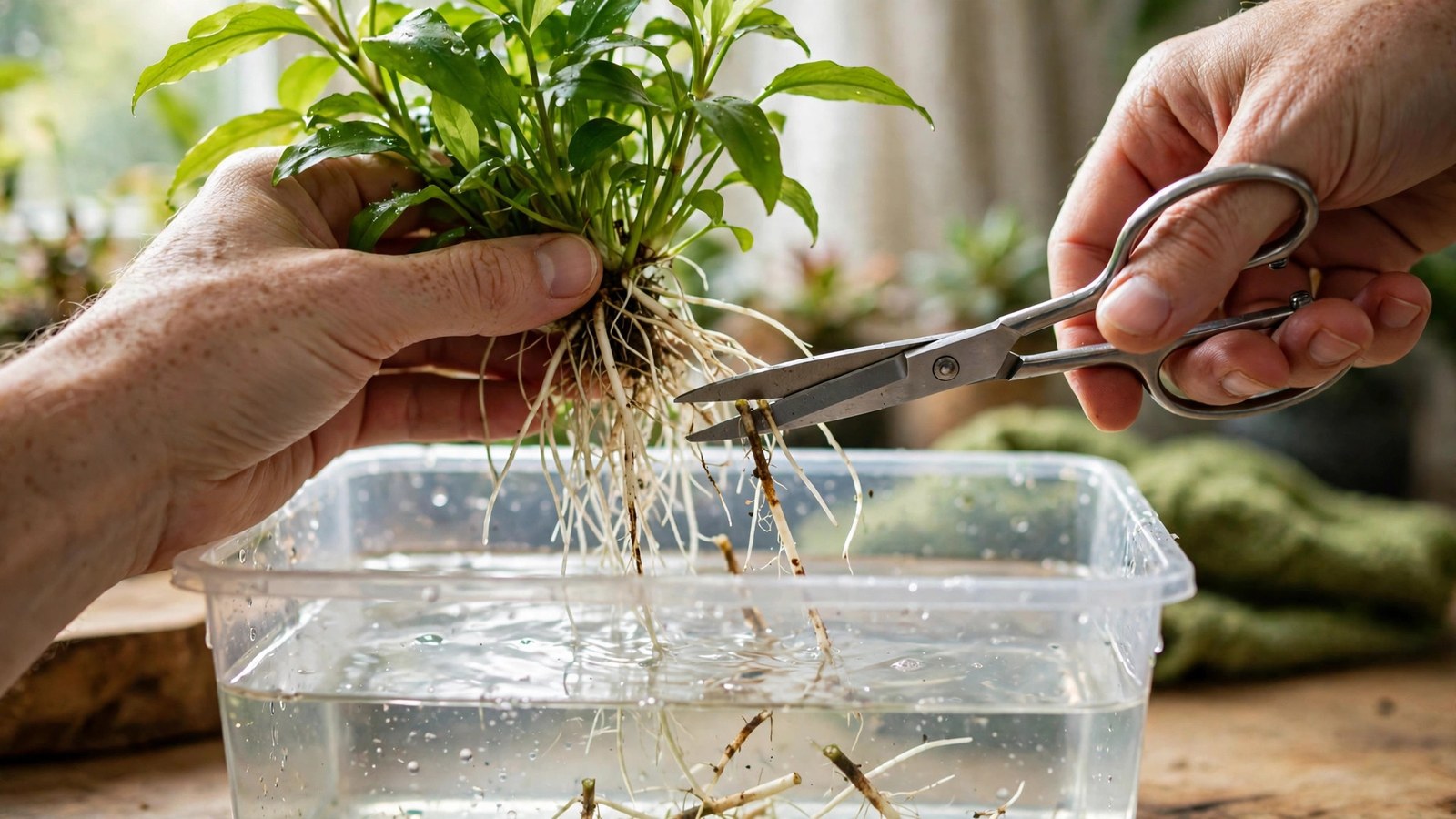
Every planted-tank keeper knows how to trim stems above the waterline, but the underside of the plant gets far less attention. Root pruning aquarium plants — deliberately cutting back the root mass of uprooted stems, crypts, and swords before replanting them — is one of the quietest secrets in serious planted aquariums. Done well, it resets a tired root system, reduces transplant shock, and encourages the explosive white-root regrowth that anchors a fresh scape. Done carelessly, it can melt an entire plant. This guide explains exactly when to trim roots, how much to cut, and how to replant for the fastest recovery.
Root pruning aquarium plants: what it actually is
Root pruning means shortening or thinning a plant's existing roots before putting it back into the substrate. It is not the same thing as trimming stems above the crown, pinching growing tips, or removing old leaves. Shoot work manages what you see; root work manages the half of the plant you never see — and which drives almost everything else.
When a rooted plant is pulled from the substrate, its root ball is usually a tangled mat of brown, mushy, and circling old roots with only a few healthy white ones. Older roots have finished their useful life: their fine root hairs — the actual nutrient-absorbing surfaces — are mostly dead. Cutting the exhausted mass back to the healthy core lets the plant redirect energy into growing fresh roots instead of trying to sustain a dying root system through transplant shock.
When Root Pruning Helps vs. When It Harms
Cases where root pruning helps
- Uprooted stems with long, scraggly root mats — classic on Ludwigia, Rotala, and Hygrophila stems that have been growing for months. Trimming the roots to 1–2 inches before replanting gives a clean, easy replant.
- Moving a crypt or sword to a new spot — mature Cryptocoryne and Echinodorus build dense root balls several inches across. A light thinning of the oldest roots prevents the giant tangled mass from rotting under the new planting position.
- Replanting after a substrate change or rescape — every root was growing into the old substrate. Pruning resets the root system to the new environment.
- Root-bound potted plants from the store — nursery-grown plants in rockwool often have compacted, circling roots. Teasing them out and trimming the circling ones prevents girdling.
- Removing damaged or rotting roots — brown, mushy, foul-smelling roots will rot underground after replanting. Cut them out now rather than planting rot with the plant.
Cases where you should leave roots alone
- Brand-new tissue-culture or in-vitro plants — their young roots are fragile and still establishing. Never prune fresh plantlets; plant them whole per your acclimation routine.
- Plants already mid-melt — a crypt shedding leaves during Cryptocoryne melt is stressed. Root surgery now compounds the damage.
- Weak or algae-stressed plants — any plant already struggling needs every functioning root it has. Prune only the obviously dead roots.
- Immediately after a big tank disturbance — if the tank is cloudy from a rescape and parameters are unstable, wait a day or two before any surgery.
The rule of thumb: prune roots to support a transition, never to punish a weak plant. Healthy roots are reserves; cutting them on a struggling plant removes its last energy store.
How Much Root to Cut: The Species Guide
Different plants carry root mass differently. The table below gives practical starting points — always err on the conservative side the first time you work with a species.
| Plant group | Typical root habit | How much to trim |
|---|---|---|
| Stem plants (Rotala, Ludwigia, Hygrophila, Bacopa) | Fine, dense feeder mats near nodes; long roots on lower stems | Cut to 1–2 inches; replant stem tips and discard mushy lower portions |
| Cryptocoryne spp. | Moderate root ball with a crown | Trim to about 2 inches; thin circling roots, never cut into the crown rhizome |
| Echinodorus (swords) | Thick, fleshy tuber-like roots, extensive | Trim the longest roots by about one-third; remove dead brown ones entirely |
| Vallisneria / runners | Shallow feeder roots plus long stolons | Trim feeders to 1 inch; keep stolons intact where you want runners |
| Anubias / Bucephalandra | Rhizome with attached root threads (not substrate feeders) | Trim only broken or rotten threads — these are not root-pruned like substrate plants |
| Carpeting plants (Eleocharis, HC Cuba) | Delicate fine root webs | Tease apart and trim tangled bottoms only; minimal cutting |
The one-third rule for beginners
If you are unsure, remove no more than roughly one-third of the root mass, prioritizing dead, brown, mushy, or foul-smelling roots first. A conservative first prune that heals perfectly beats an aggressive prune that melts the plant.
Tools and Sterile Technique
What you need
- Sharp, fine scissors — aquascaping scissors or small surgical-style shears. Dull blades crush root tissue instead of cutting it, and crushed tissue rots.
- Curved or straight tweezers — for teasing apart root balls and replanting at depth.
- A clean container of old tank water — work in a bowl of water from the tank itself, never tap water, to avoid chlorine shock and temperature swings.
- Hydrogen peroxide (3%) — a quick 1-minute dip of roots at a 1:20 dilution with tank water can knock back algae spores on the root mass. Rinse in clean tank water afterward.
Step-by-step sterile workflow
- Rinse tools first. Wipe scissors with hydrogen peroxide or boil them before starting. Dirty tools are the main vector for spreading rot from one plant to another.
- Uproot gently. Wiggle the plant loose rather than yanking — the crown and growing points must survive intact. Shake off loose substrate in a bowl of tank water.
- Inspect the root mass. Under good light, separate the roots with tweezers. White or cream roots with firm texture are keepers; brown, translucent, slimy, or smelly roots are dead.
- Cut decisively. One clean snip per cut. Slice dead roots at the point where firm tissue starts. For length reduction, cut the mass to the target length in one pass rather than nibbling, which frays ends.
- Keep roots wet throughout. Never let cut roots sit in air. Work over the bowl and return the plant to water between steps — air-drying for even a minute damages fine root hairs.
- Disinfect between plants. A quick peroxide wipe between different plants prevents transferring pathogens or algae from one root system to the next.
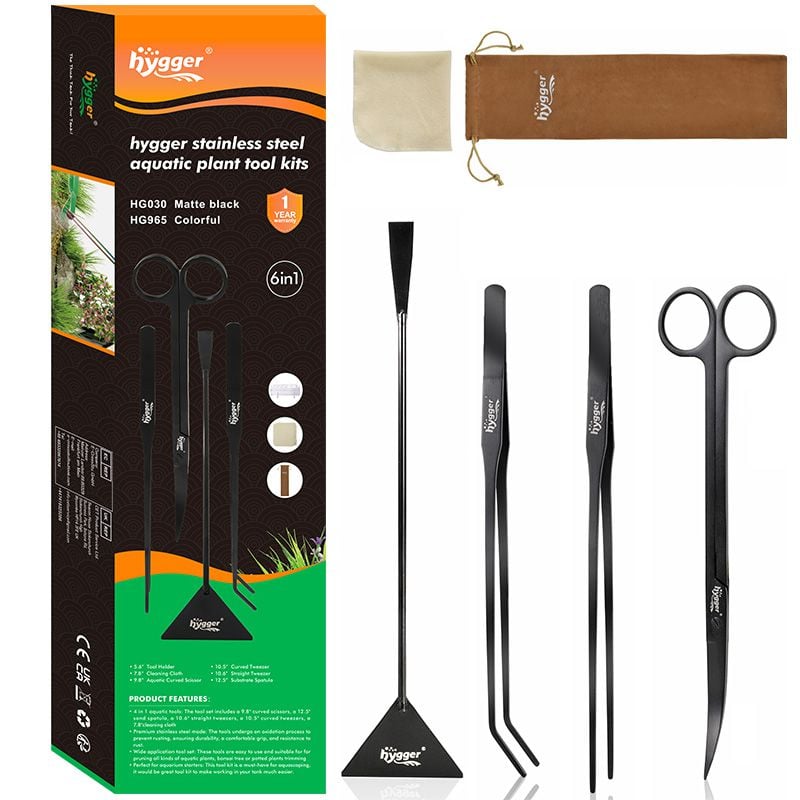
Sharp, clean tools make all the difference; a dedicated aquascaping kit keeps everything in one place: a dedicated aquascaping tool kit like hygger's 6-in-1.
 ★4.6
hygger 6-in-1 Long Aquarium Aquascaping Tools Kit
Check Price on Amazon ★4.6Replanting Depth After Pruning
Freshly pruned roots are shorter than what the plant had before, so planting depth matters more than usual:
- Stems: bury the trimmed root stubs 1–1.5 inches deep, angled slightly, with at least one node underground to form new root anchors. Don't bury deep enough to rot the stem itself — mushy lower stems should be cut off and the fresh tip replanted instead, as covered in propagation techniques.
- Crypts: plant so the crown (where leaves meet roots) sits just above the substrate line. Buried crowns rot; this is the single most common crypt-killer after root pruning.
- Swords: set the crown at substrate level with trimmed roots fanned outward, not folded underneath. Folded roots bend back upward and decay.
- Stabilize the planting. Shortened roots grip poorly for the first week. Use a planting basket, a small ring of pebbles, or plant near a hardscape edge so the current from your filter doesn't pop the plant out while it anchors.
For general replanting technique beyond root work, our planting guide walks through tweezers methods for every substrate type.
Aftercare: Melt Risk and Nutrient Support
Root-pruned plants spend the first 3–14 days rebuilding their absorptive root hairs. During that window they are vulnerable — here is how to shepherd them through.
Expect some melt — and know the difference
A few older outer leaves melting within the first week is normal: the plant is reallocating resources to root regrowth. Alarm signs are different: the crown or growing tip turning mushy, whole stems going translucent within 48 hours, or a sour smell. Those indicate rot at the cut sites, usually from crushing damage or dirty tools. Cut affected tissue back to firm white material immediately, as you would when removing dead leaves.
Water-column support while roots rebuild
Until new roots can pull from the substrate again, feed through the water column:
- Dose a gentle all-in-one liquid fertilizer at half to full strength for the first two weeks. The leaves can absorb nutrients directly while roots recover.
- Keep lighting steady, not intense. Don't crank light up to "force" growth — pruned roots can't meet higher demand, and the excess light feeds algae instead.
- Keep CO₂ stable if you run it. Stable parameters matter more than high CO₂; swings stress recovering plants.
- Add root tabs near heavy feeders (swords, crypts) at replanting time so fresh nutrients await the new root growth — see our root tab placement guide for positioning.
- Minimize disturbance. Don't uproot to "check" progress for at least two weeks. Gentle tugs on a stem are fine; pulling plants out resets the clock.
The regrowth timeline
Most stem plants push visible new white root tips within 3–5 days and anchor firmly in 10–14 days. Crypts and swords are slower: expect 2–4 weeks before they look established again, and don't panic if crypts melt half their leaves first — new submerged leaves usually follow once the roots settle.
Freshly pruned roots need accessible nutrients while they recover: root tabs like Seachem Flourish Tabs.
Common Mistakes That Turn Root Pruning Into Plant Murder
- Pruning with dull scissors — crushed root ends rot from the inside. Sharp, clean cuts heal; pinched ends decay.
- Cutting the crown or rhizome — on crypts and swords the growing crown is sacrosanct. Trim roots only, never the fleshy central tissue.
- Working in the air — roots exposed to air dry out fast. If the root mass starts feeling tacky, it's already damaged.
- Over-pruning slow growers — Anubias, Bucephalandra, and slow crypts recover slowly. The one-third rule is a maximum for them, not a target.
- Replanting too deep — burying the crown or deep stem sections invites rot that mimics "failed" root pruning.
- Fertilizing with ammonia-heavy products — damaged roots are more sensitive to ammonia burn. Stick to balanced, gentle fertilizers during recovery.
How Root Pruning Fits Into Your Maintenance Routine
Root pruning isn't a weekly chore — it's a transition tool. The natural moments for it are rescaping, thinning an overgrown cluster, replanting uprooted stems during a trim session, and dividing root-bound plants. Fold it into your regular plant grooming routine: when you pull a plant up to thin it, take thirty seconds to clean up its roots before it goes back in. That single habit separates tanks that slowly decline from tanks that look freshly planted for years.
Pair root work with above-waterline maintenance. Our complete trimming guide covers shoot-side technique so the top and bottom of the plant are both managed intentionally — and if you're unsure whether a plant is thriving after root work, photographing your plants closely makes problems much easier to identify.
Frequently Asked Questions
Can you root prune a plant without uprooting it?
No — effective root pruning requires access to the root mass, which means lifting the plant. Partial "stabbing" cuts into the substrate with scissors can thin roots in place, but it's blind work that risks the crown and is only useful for controlling aggressive runners. For a real root reset, uproot, prune, and replant properly.
Do root-pruned plants need CO₂ to recover?
CO₂ helps but isn't required. Stability matters far more than concentration — a fluctuating CO₂ system stresses recovering plants worse than a stable low-tech setup does. If you run CO₂, keep it rock steady at your normal level; if you don't, lean on gentle liquid fertilization and patience instead.
Why did my plant melt completely after root pruning?
Complete melt usually comes from one of four errors: crushing damage from dull scissors, cutting into the crown, letting roots air-dry during the work, or pruning a plant that was already weak. Review the sterile workflow section above, be conservative with how much you remove, and always prune only firm, healthy-looking plants.
Can I root prune carpet plants like dwarf hairgrass?
Yes, but lightly. When dividing and replanting Eleocharis mats, trim the tangled underside just enough to separate clumps — don't scalp the root web. Carpet plants rely on their fine root network to knit together, so a conservative trim plus replanting in small tufts gives the fastest spread.
Should I root prune new plants from the store?
Only the obviously dead roots. Store-bought potted plants usually need the rockwool removed, circling roots teased apart, and any rotten brown roots cut away — but the healthy white roots should stay. New arrivals are already stressed from shipping; conserve their reserves, not remove them.
How often can you root prune the same plant?
Once per major transition is plenty. Most healthy aquarium plants only need root attention when they're uprooted for rescapes, thinning, or division — typically a few times a year at most. A plant that "needs" constant root pruning likely has a deeper problem: exhausted substrate, poor water flow, or nutrient deficiency worth diagnosing instead.
Give the Roots the Same Attention as the Leaves
Aquascapers obsess over the canopy and treat the root zone as an afterthought, but half of every plant lives underground. Learning root pruning — recognizing dead roots, cutting cleanly with sharp sterile tools, replanting at the right depth, and supporting recovery with gentle water-column feeding — turns every rescape from a gamble into a controlled reset. The next time you pull a plant out of your substrate, take a minute with your scissors. Your plants' second root systems will be the best ones they've ever grown.
For further reading on root biology in planted tanks, the UKAPS forum's aquatic plant community has extensive grower threads on root-zone techniques, and the International Aquatic Plants Layout Contest site showcases what disciplined root and substrate work can produce at competition level.