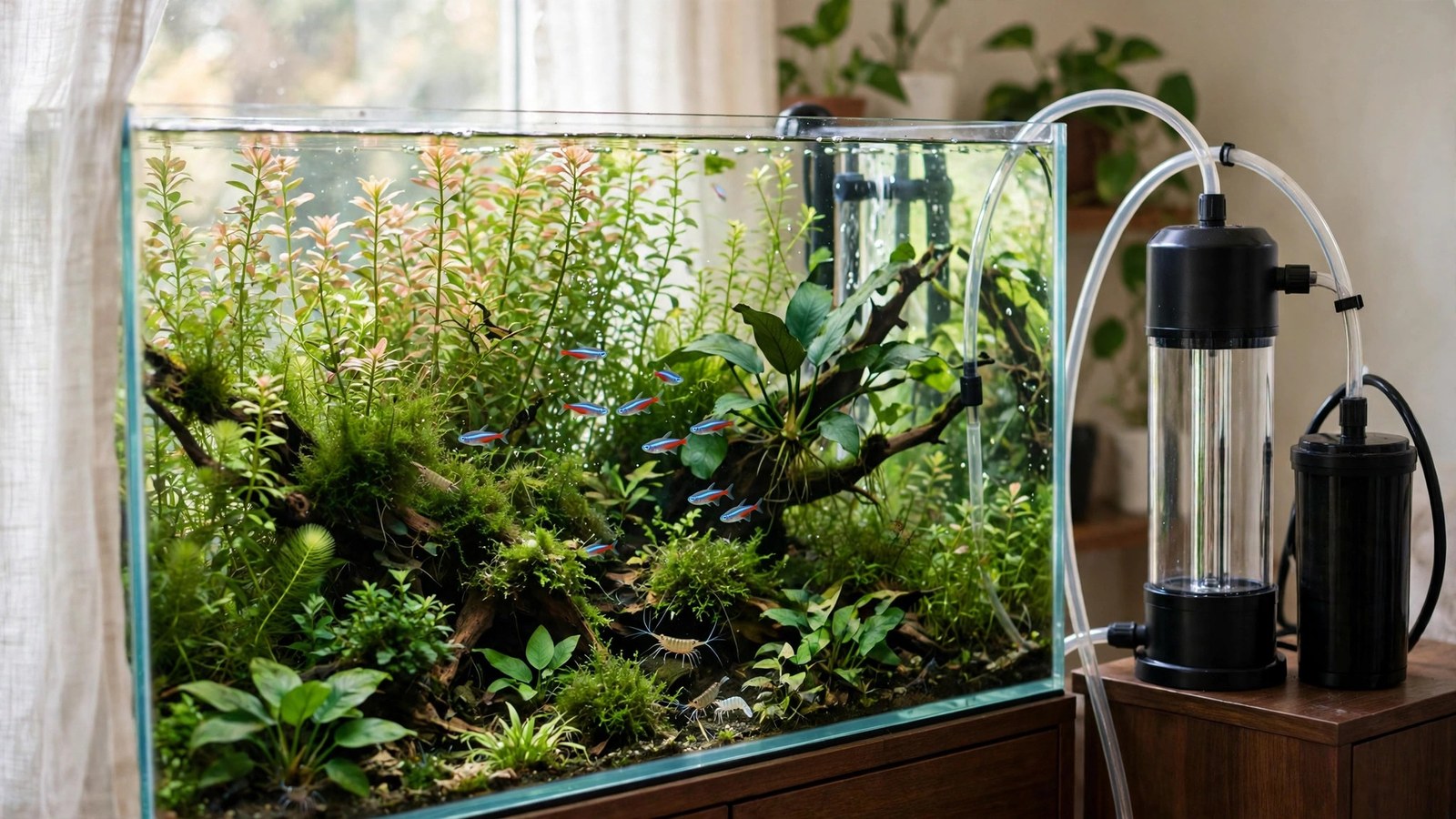
A UV sterilizer for a planted tank is one of the most misunderstood pieces of aquarium equipment. Depending on who you ask, it is either a miracle device that clears green water overnight or an expensive gadget that does nothing a water change couldn't. The truth sits between those two extremes, and understanding exactly where matters — because a UV sterilizer will fix certain problems brilliantly while leaving others completely untouched. If your planted aquarium has pea-soup green water, recurring bacterial blooms, or unexplained disease outbreaks, a properly sized and plumbed UV unit may be the best money you ever spend on the hobby. If your problem is hair algae on the substrate, melting stems, or brown diatoms on the glass, it will help you not at all.
This guide explains how UV sterilizers actually work in a planted-tank context, what they genuinely fix, what they cannot fix no matter how you run them, how to size and install one correctly, and — just as important — when you should not buy one at all.
How a UV Sterilizer Actually Works
A UV sterilizer is a sealed chamber containing an ultraviolet-C lamp. Water flows past the lamp, and the UV-C radiation damages the DNA of whatever free-floating organisms pass through it — algae spores, free-floating bacteria, parasites in their waterborne life stage, and viruses. The damaged organisms either die outright or lose the ability to reproduce. The critical point is that the sterilizer only affects what physically passes through the chamber. Anything attached to a surface — biofilm on the glass, algae rooted to plants, the bacterial colony living in your filter media — never enters the UV chamber and is never touched.
Two variables control how effective the unit is: the wattage of the lamp (which determines the UV dose) and the flow rate through the chamber (which determines how long organisms are exposed). This relationship is called contact time or dwell time, and it is the single most important concept in this entire guide. Slow water past a strong lamp equals a high kill dose; fast water past a weak lamp equals almost nothing.
Clarifier vs. Sterilizer: A Crucial Distinction
Manufacturers use these terms loosely, but they describe genuinely different performance levels:
- UV clarifier: A low-dose unit that clumps single-celled free-floating algae together so your mechanical filter can catch them. It clears green water but does little to pathogens.
- UV sterilizer: A higher-dose unit that actually kills or sterilizes free-floating algae, bacteria, and parasites outright. This is what you want for planted tanks.
Many budget "UV clarifiers" are sold as sterilizers. The difference usually comes down to lamp wattage relative to flow rate. A 9-watt unit pushing 300 gallons per hour is a clarifier at best; the same 9-watt unit throttled to 80 gallons per hour behaves as a true sterilizer for a smaller tank. Always check the manufacturer's flow-rate ratings for "sterilization" rather than "clarification."
What a UV Sterilizer Actually Fixes in a Planted Tank
Green Water (Free-Floating Algae Blooms)
This is the signature problem UV sterilizers were made for. Green water is caused by single-celled algae suspended in the water column, and a properly sized UV unit typically clears it in 3 to 7 days. Nothing about rooted algae, nutrient dosing, or CO₂ levels matters here — the UV chamber simply kills the suspended cells as water cycles through, and the water turns crystal clear. This is also the scenario where UV earns its keep during the first 90 days of a planted tank, when immature biological filtration and unstable nutrient levels make green water especially common.
Bacterial Blooms (Milky Water)
The milky haze that appears in new or disturbed tanks is a bloom of free-floating heterotrophic bacteria. It usually resolves on its own once the filter matures, but a UV sterilizer accelerates the process dramatically — often overnight.
Waterborne Pathogens and Parasite Stages
Many common fish diseases have a free-swimming stage in their life cycle — ich (white spot) theronts, for example, must find a host within a day or two of leaving the cyst. A sterilization-dose UV unit significantly reduces the number of viable parasites in the water column, lowering infection pressure on stressed fish. It does not cure an infected fish — the parasites already on the fish are never exposed — but it reduces transmission to tankmates and can be the difference between a contained outbreak and a full-tank wipeout.
Overall Water Clarity
Even without a visible bloom, UV removes suspended micro-organisms that give water a faint dullness. Many planted-tank keepers notice their tank simply looks sharper with UV running — the water takes on a polished quality that even a good filter cannot quite achieve alone.
What a UV Sterilizer Cannot Fix (No Matter How You Run It)
This is where expectations need honest calibration. A UV sterilizer is not a general algae cure, and treating it as one leads to disappointment and wasted money.
- Algae attached to surfaces is immune. Hair algae, thread algae, black beard algae (BBA), staghorn, green spot algae on glass, diatoms on leaves — none of it passes through the UV chamber, so none of it is affected. If your algae problem is on your plants rather than in your water, your solution is nutrient balance, CO₂, and light management, not a sterilizer. See our guide to cleaning algae off plant leaves for the manual side of that fight.
- It cannot fix root causes. Green water caused by excess light and unstable nutrients will return the moment you turn the UV off, because the underlying imbalance is still there. UV treats the symptom brilliantly; it never treats the disease.
- It does not improve nutrient availability or fix deficiencies. Melting plants, pale new growth, pinholes in leaves — these are fertilization and CO₂ issues. A UV sterilizer changes nothing about your aquarium plant fertilizer schedule.
- It does not cycle your tank or replace biological filtration. The nitrifying bacteria that run your nitrogen cycle live on surfaces in your filter, not floating in the water. UV doesn't harm them — but it doesn't help them either.
Sizing: Matching Wattage and Flow Rate to Your Tank
Sizing a UV sterilizer is where most planted-tank keepers go wrong, usually by buying too small a unit or running too much flow through it. Here is a practical approach:
Step 1: Choose Wattage by Tank Size and Goal
| Tank Size | Algae Clarification | Pathogen Sterilization |
|---|---|---|
| 10–30 gallons | 5–9 W | 9–13 W |
| 30–60 gallons | 9–13 W | 13–25 W |
| 60–120 gallons | 13–25 W | 25–40 W |
| 120+ gallons | 25–40 W | 40 W+ or dual units |
Sterilization always demands more dose than clarification, which is why the right column runs roughly double the wattage. If disease control is your goal, size for sterilization, not clarification.
Step 2: Match Flow Rate to the Dose You Need
Read the manufacturer's specifications for the maximum flow rate that still delivers a sterilizing dose — often quoted in gallons per hour at a given microwatt-seconds-per-square-centimeter dose. The target for true sterilization is roughly 30,000–45,000 µW·s/cm²; clarification works at around 15,000–20,000. If you run your canister filter's full output through the unit and that flow exceeds the sterilization rating, you have built a clarifier, not a sterilizer.
The practical fix is simple: do not plumb the UV inline with your main filter if the flow is too high. Instead, run it on a separate low-flow loop with a small dedicated pump, or use a bypass valve so only part of the flow goes through the UV chamber. This is the most common installation mistake, and it is completely avoidable.
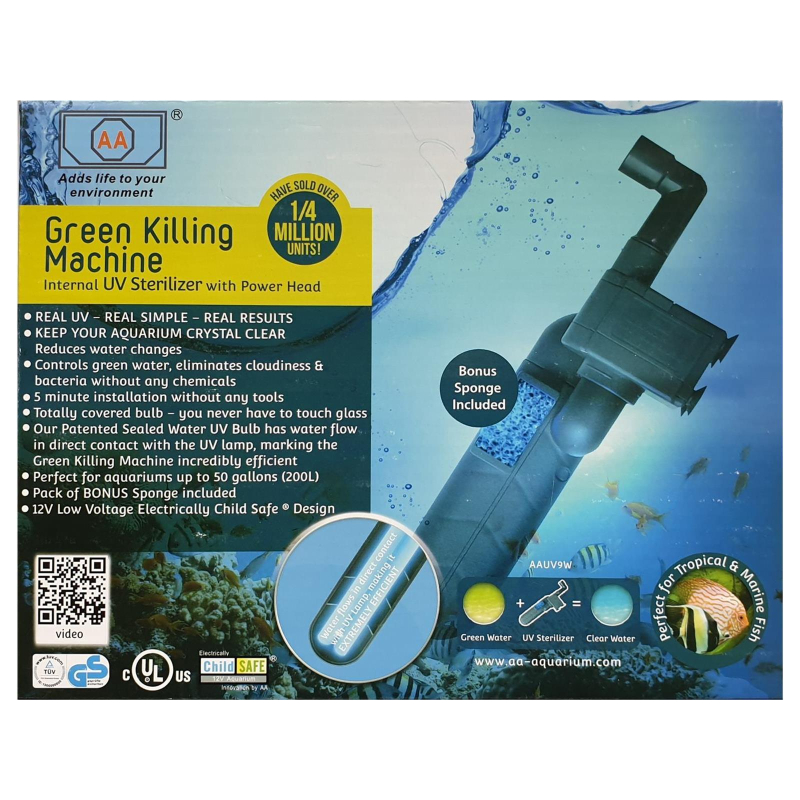
A self-contained 9W unit suits the tank sizes discussed here: AA Aquarium Green Killing Machine UV sterilizer.
 ★4.4
AA Aquarium Green Killing Machine 9W UV Sterilizer
Check Price on Amazon ★4.4Placement and Installation in a Planted Tank
Where you install the unit matters as much as which unit you buy:
- Separate low-flow loop (best): A small pump (100–200 GPH depending on unit rating) draws water from the tank, pushes it through the UV, and returns it. This gives you full control over contact time and is the recommended setup for planted tanks.
- Inline with canister filter (acceptable with care): Works only if the filter's flow rate is within the unit's sterilization rating. Place it on the return side (after the filter media) so debris doesn't shade the lamp.
- Drop-in HOB-style units: Convenient for smaller tanks and nano setups. Effective for clarification; check wattage carefully if you want sterilization.
- Never on the intake side before the filter: Organic debris coating the quartz sleeve blocks UV light and drastically cuts effectiveness. Water entering the chamber should already be mechanically clean.
One more placement note specific to planted tanks: position the return flow away from your CO₂ diffuser output. Strong surface agitation from the UV return can drive off dissolved CO₂. Aim returns low and gentle, the same way you manage filter outflow in a high-tech tank.
UV and Your Plants, Bacteria, and Fertilizers
A persistent myth says UV sterilizers kill beneficial bacteria. The reality: beneficial nitrifying bacteria colonize surfaces — filter media, substrate, plant leaves, hardscape — not the water column, so they never pass through the chamber. The one exception is during initial cycling, when bacteria are still establishing: running UV during the first week or two can slightly slow colonization, so leave the unit off until the cycle completes.
The fertilizer question is more nuanced. UV-C can break down certain chelated iron compounds — specifically Fe-EDTA, common in liquid fertilizers — reducing their bioavailability. In practice, this matters most for high-tech tanks dosing heavy micros: if you notice pale new growth after installing UV, try dosing iron at night with the UV off, or switch to a more UV-stable chelate like Fe-DTPA or Fe-EDDHA. It is a minor, manageable effect. Your overall water change routine for planted tanks and dosing discipline remain far more important than any UV-related nutrient loss.
There is also a small amount of heat: UV lamps add a degree or two of warmth to the water passing through, and the unit itself runs warm. In most tanks this is negligible, but in warm climates or summer months it is worth watching — sudden temperature swings stress aquarium plants, and every heat source in the system counts.
Maintenance: Keeping the Unit Effective
A neglected UV sterilizer is decoration — the lamp's UV output decays long before the visible light dies. Follow this schedule:
- Replace the bulb every 6–9 months of continuous use, even if it still lights up. Mark the install date on the housing with a label maker or tape.
- Clean the quartz sleeve monthly. Mineral deposits and biofilm coat the inner sleeve and block UV transmission. Power off, remove the sleeve carefully (they're fragile), wipe with a soft cloth and white vinegar, rinse, and reassemble.
- Check O-rings and seals whenever you open the unit. A slow leak at the UV housing is one of the more common causes of mysterious water loss.
- Verify flow rate periodically. Pump impellers wear and pre-filters clog; a loop that started at 120 GPH may be pushing 60 six months later, which changes your dose (in this direction it actually increases dose, but it reduces turnover).
Fold these checks into your weekly plant routine — a quick glance at the indicator light and return flow takes seconds and keeps the unit honest.
When NOT to Buy a UV Sterilizer
Honest guidance requires saying when the purchase is a waste. Skip the UV sterilizer if:
- Your algae problem is attached to surfaces (hair, BBA, spot algae) — fix light, nutrients, and CO₂ instead.
- Your tank is already crystal clear and stable — a UV unit adds nothing but an electricity bill and a maintenance chore.
- You have a new, uncycled tank — wait until the biological filter is established.
- Your plants are struggling with deficiencies or melting — the problem is fertilization or quarantine and plant health fundamentals, not water clarity.
- You're treating an active fish disease — medications and quarantine treat the fish; UV only reduces water-column transmission.
Conversely, buy one with confidence if you fight recurring green water, keep expensive or disease-prone fish in a densely stocked planted tank, or simply want that last 5% of water polish that filters can't deliver.
Frequently Asked Questions
Will a UV sterilizer kill my beneficial filter bacteria?
No. Beneficial nitrifying bacteria live attached to filter media, substrate, and plant surfaces — they are not free-floating, so they never pass through the UV chamber. The only caveat is during initial tank cycling, when colonization is incomplete; leave the unit off for the first couple of weeks while the biological filter establishes.
How long does it take a UV sterilizer to clear green water?
Typically 3 to 7 days for a correctly sized unit on an appropriately throttled flow rate. If nothing changes after a week, the unit is undersized, the flow is too fast for a sterilizing dose, the bulb is old, or the quartz sleeve is coated with mineral deposits. Address the root cause of the bloom (excess light, nutrient instability) in parallel so the green water doesn't return.
Can I run a UV sterilizer 24/7 on a planted tank?
Yes, continuous operation is standard and safe. The main trade-off is minor degradation of certain chelated iron fertilizers (Fe-EDTA) under UV exposure. If you run a high-tech tank with heavy micro dosing, consider dosing iron in the evening or switching to a UV-stable chelate like Fe-DTPA. Bulb life is measured in months of continuous use, so plan replacements every 6–9 months.
Does UV sterilization affect my CO₂ injection?
The UV unit itself doesn't consume or destroy CO₂, but strong return flow can agitate the surface and drive off dissolved CO₂. Aim the return low and keep surface disturbance gentle. If anything, crystal-clear water improves light penetration, which complements CO₂ rather than conflicting with it.
What's the difference between a UV clarifier and a UV sterilizer?
Dose. A clarifier uses a low UV dose to clump free-floating algae so filters can trap it; a sterilizer delivers a high enough dose to kill or sterilize algae, bacteria, and parasite stages outright. The difference comes down to lamp wattage relative to flow rate. Many cheap "sterilizers" are effectively clarifiers at their rated flow — check the manufacturer's sterilization-dose flow rating, not just the marketing name.
The Bottom Line
A UV sterilizer for a planted tank is a precision tool, not a cure-all. Point it at free-floating problems — green water, bacterial blooms, waterborne disease stages — and it performs brilliantly, often clearing in days what water changes alone take weeks to fix. Point it at attached algae, nutrient deficiencies, or an unstable cycle, and it will do exactly nothing, because none of those problems pass through its chamber. Size it generously, throttle the flow to a true sterilizing dose, maintain the bulb and quartz sleeve on schedule, and respect its limits. Do that, and it earns its place as one of the most satisfying upgrades a planted-tank keeper can make.